Para sa anumang distribusyon na may Flatpak — nakalista ang setup sa bawat app.
.deb (Debian, Ubuntu)
Para sa Debian, Ubuntu at mga hango rito — mismo sa bawat app sa ibaba.
jsNetMonitor
v1.0.4 · SDL2
Ipinapakita nang live ang ginagawa ng iyong network — bawat device, bawat koneksyon, bawat programa, at kung gaano karami ang naiipon sa loob ng mga araw, buwan at isang taon.
Download at upload ng bawat device bilang makinis na kurba at level meterAling programa ang gumagamit ng network – at gaano karamiBawat koneksyon na may remote host, bansa, serbisyo, bilis at latencySaan napupunta ang iyong trapiko: mga destinasyon at bansa sa isang sulyapAng kabuuan ng iyong trapiko sa loob ng mga minuto, oras, isang linggo, isang buwan o isang buong taonTrapiko bawat araw at buwan, nananatili kahit mag-restartAng network chip, ang driver nito, firmware at mga detalye ng linkCable, Wi-Fi, mobile, VPN at iba paAyusin ang mga device ayon sa gusto mo – naaalala ang pagkakasunod-sunodMaliit na window na laging nasa ibabawMaliwanag at madilimSDL2 · Cairo83 mga wika
Magbigay ng access sa mga koneksyon at programa (Snap)
sudo sh -c 'for i in network-observe system-observe hardware-observe; do snap connect jsnetmonitor:$i; done'
Sa simula, hindi nakikita ng isang snap kung anong mga koneksyon ang umiiral at aling mga programa ang nasa likod ng mga ito. I-paste ang command sa terminal nang isang beses, pindutin ang Enter at i-restart ang jsNetMonitor – lalabas na ang mga koneksyon, programa at detalye ng network chip. Read access lang ang ibinibigay ng command.
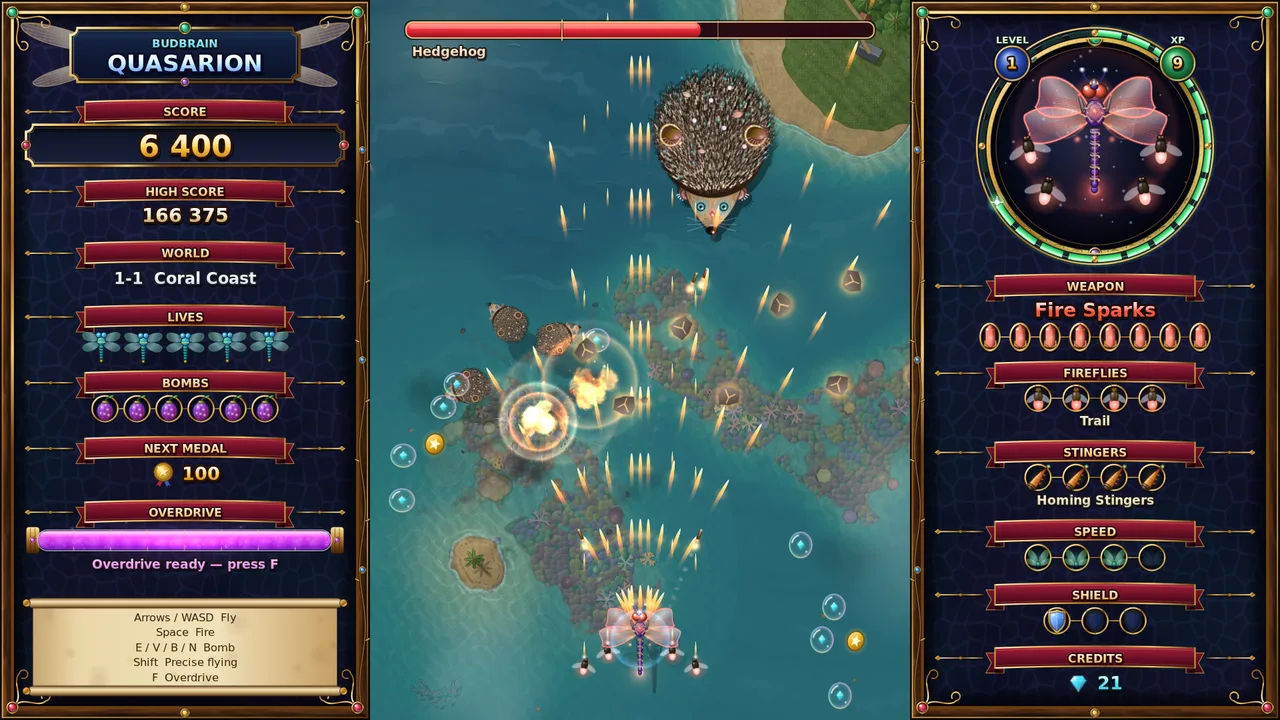
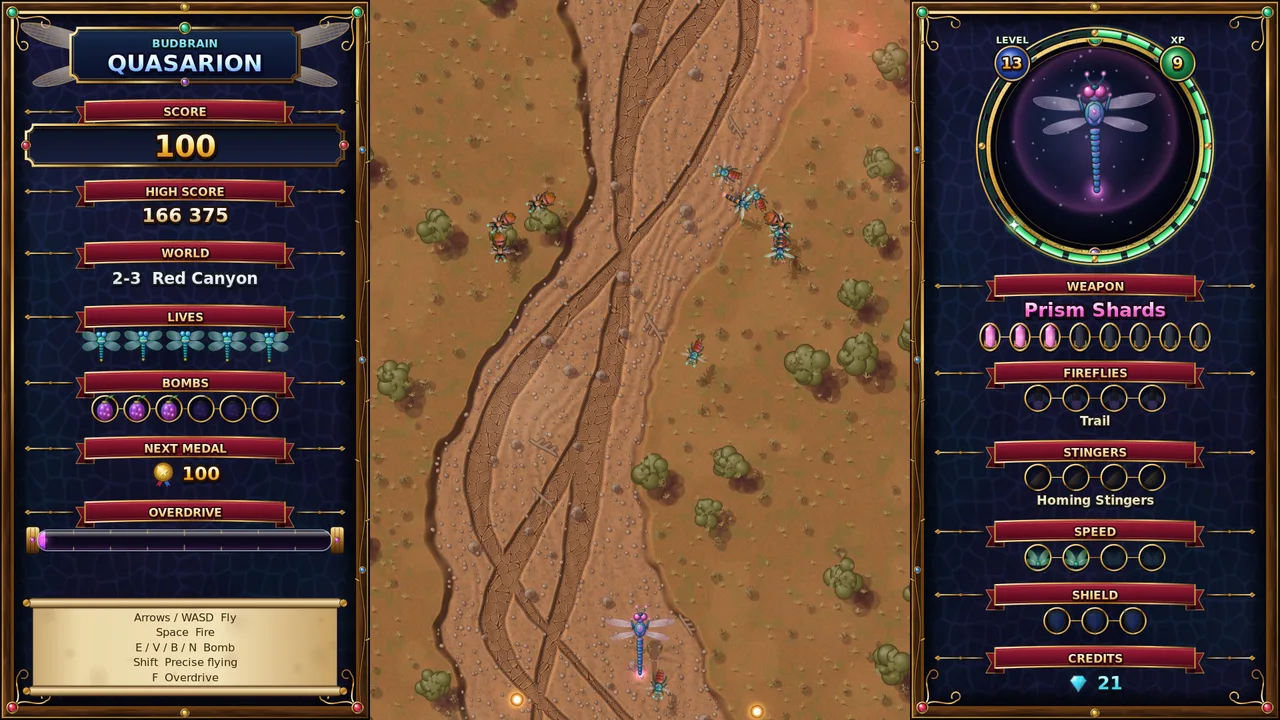
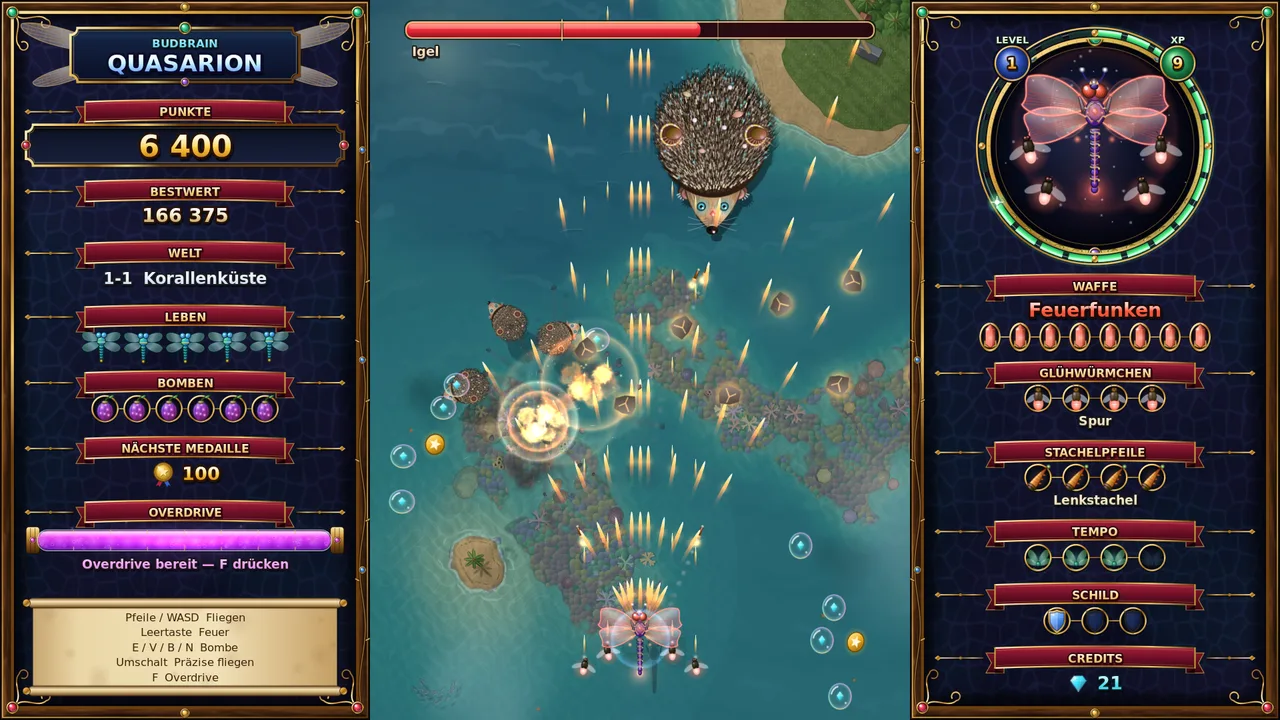
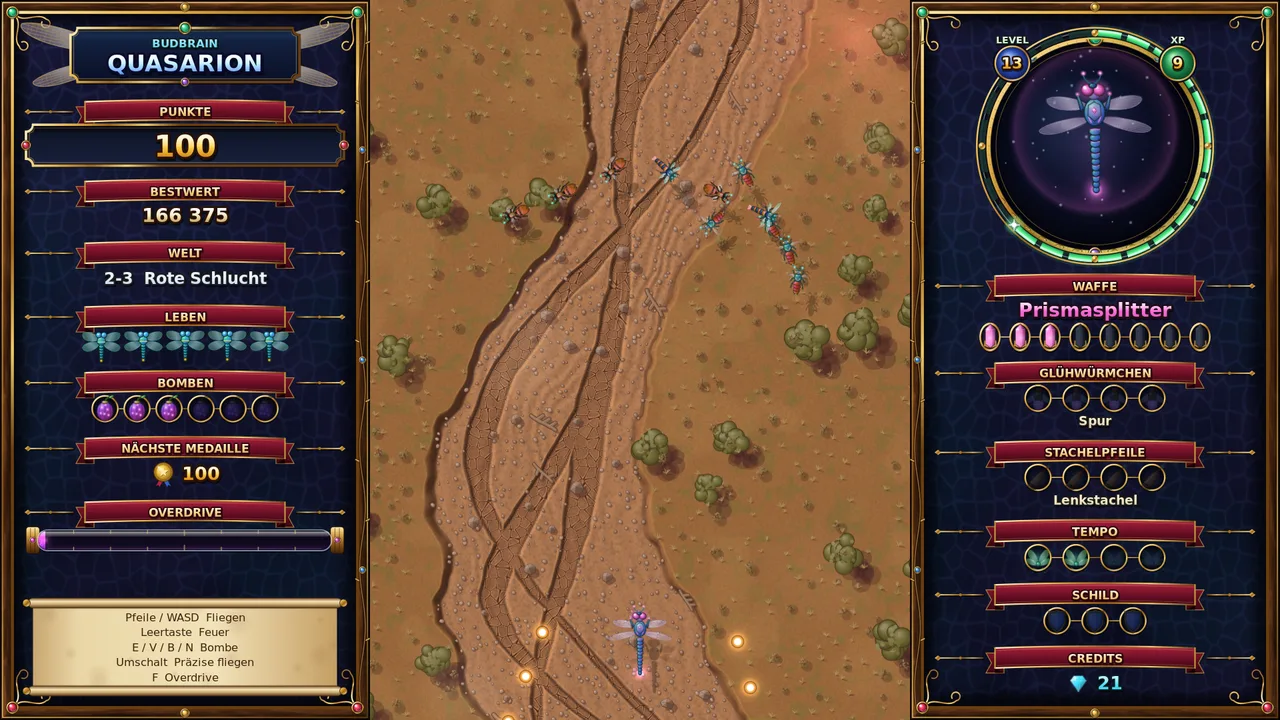
Lumipad bilang tutubi sa mga kumikinang na fantasy world at harapin ang mga higanteng hayop.
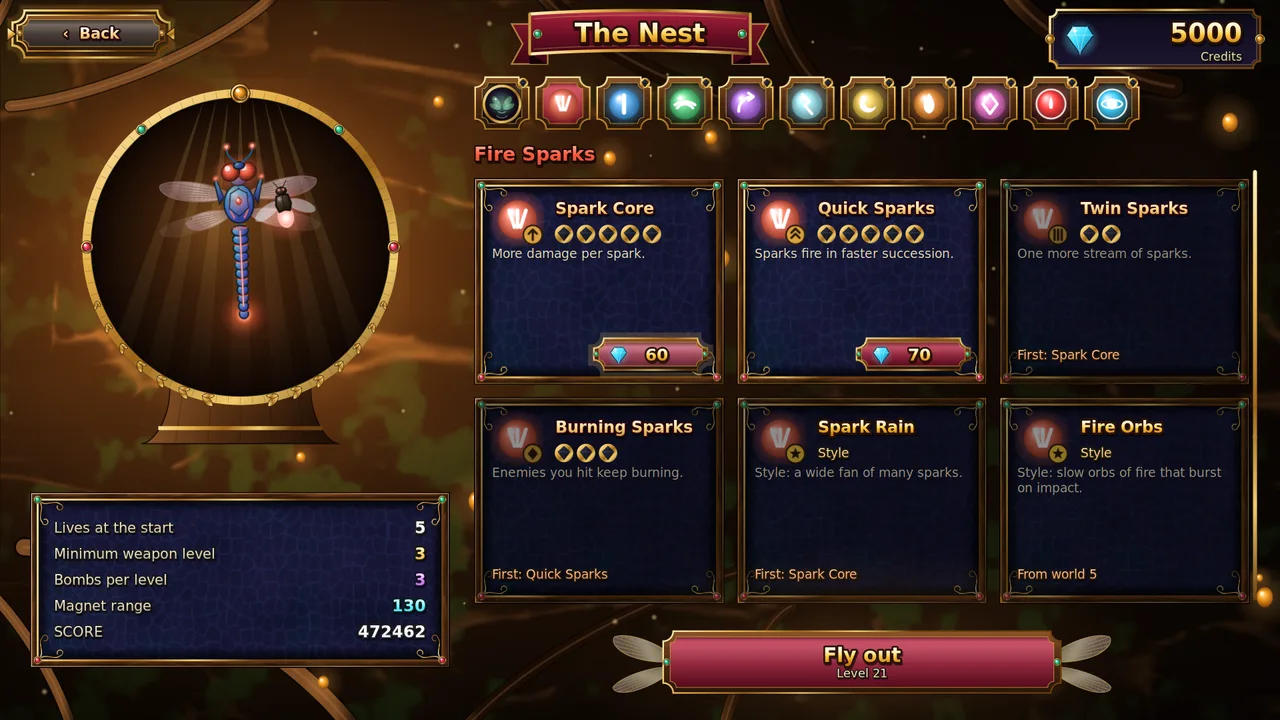
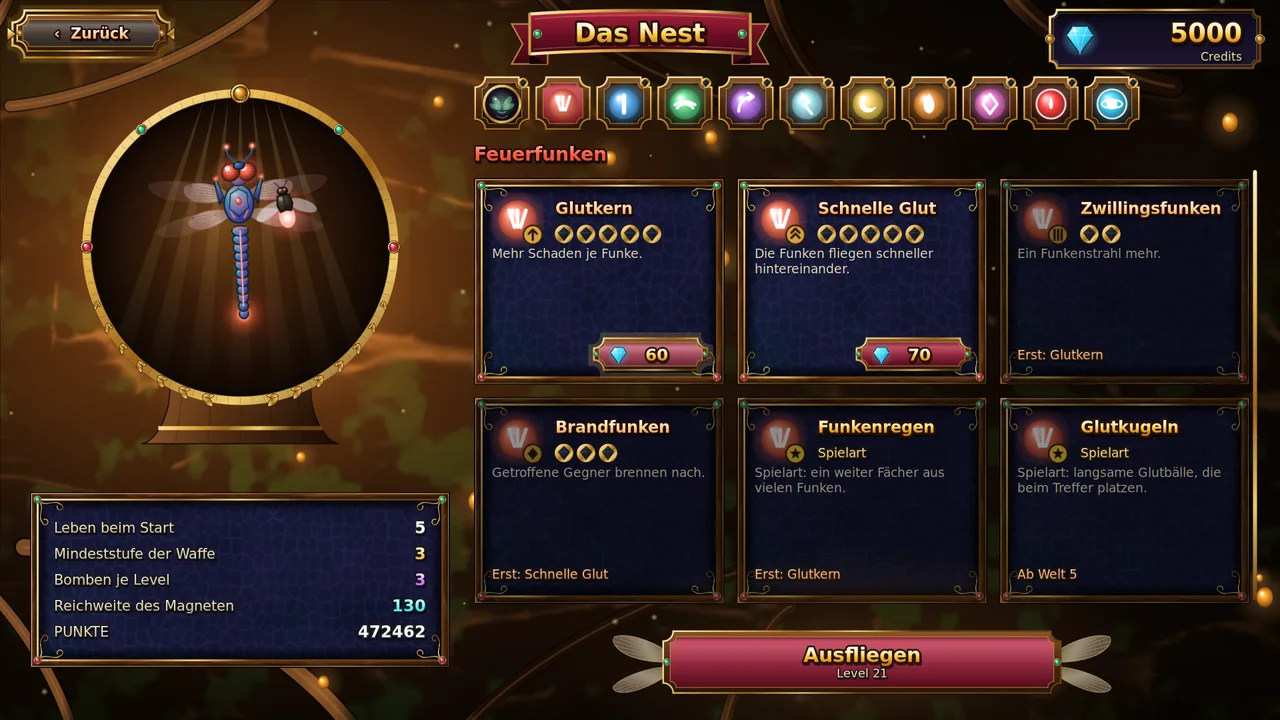
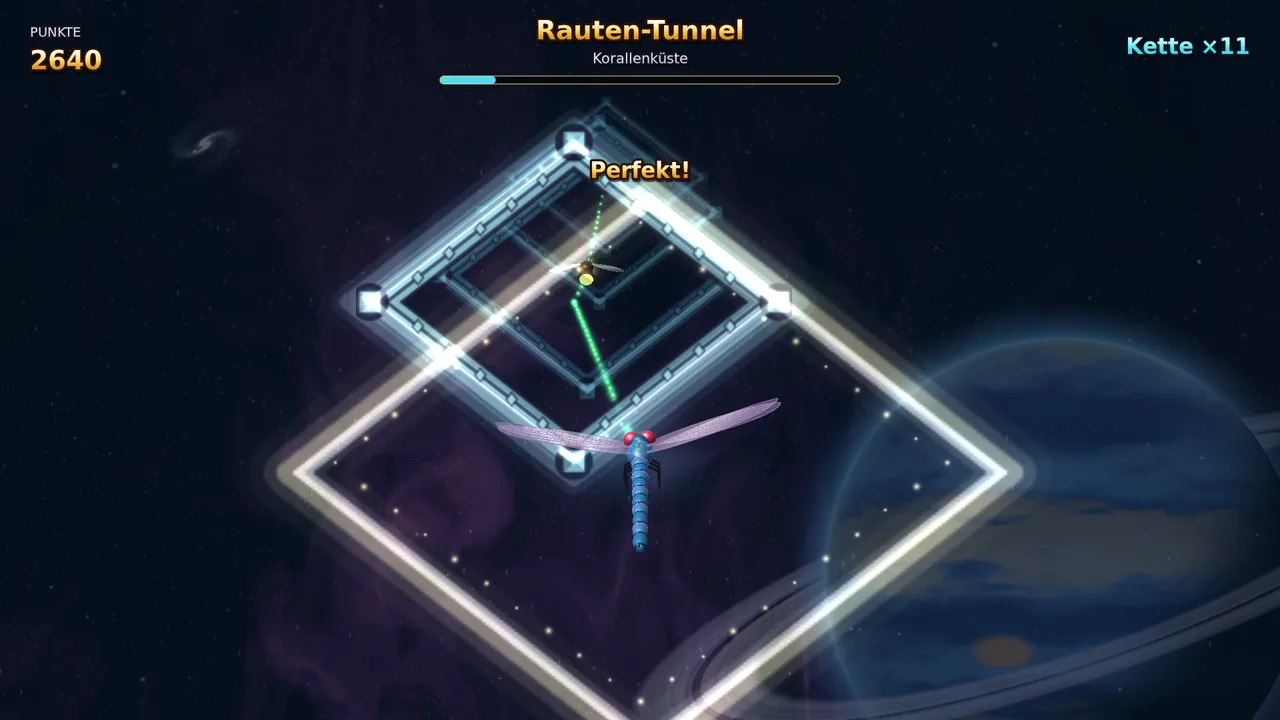
Ibang higanteng hayop sa dulo ng bawat antasWalong uri ng liwanag para sa iyong tutubi, bawat isa sa walong yugtoMga alitaptap na sumusunod sa daan ng iyong paglipadMga upgrade sa pugad at malaking skill tree na lumalaki kasabay moIsang diamond tunnel na kasabay ng indayog ng musika pagkatapos ng bawat mundoAnim na antas ng hirap, mula Madali hanggang BaliwKeyboard, gamepad o touchSDL2 · Cairo83 mga wika
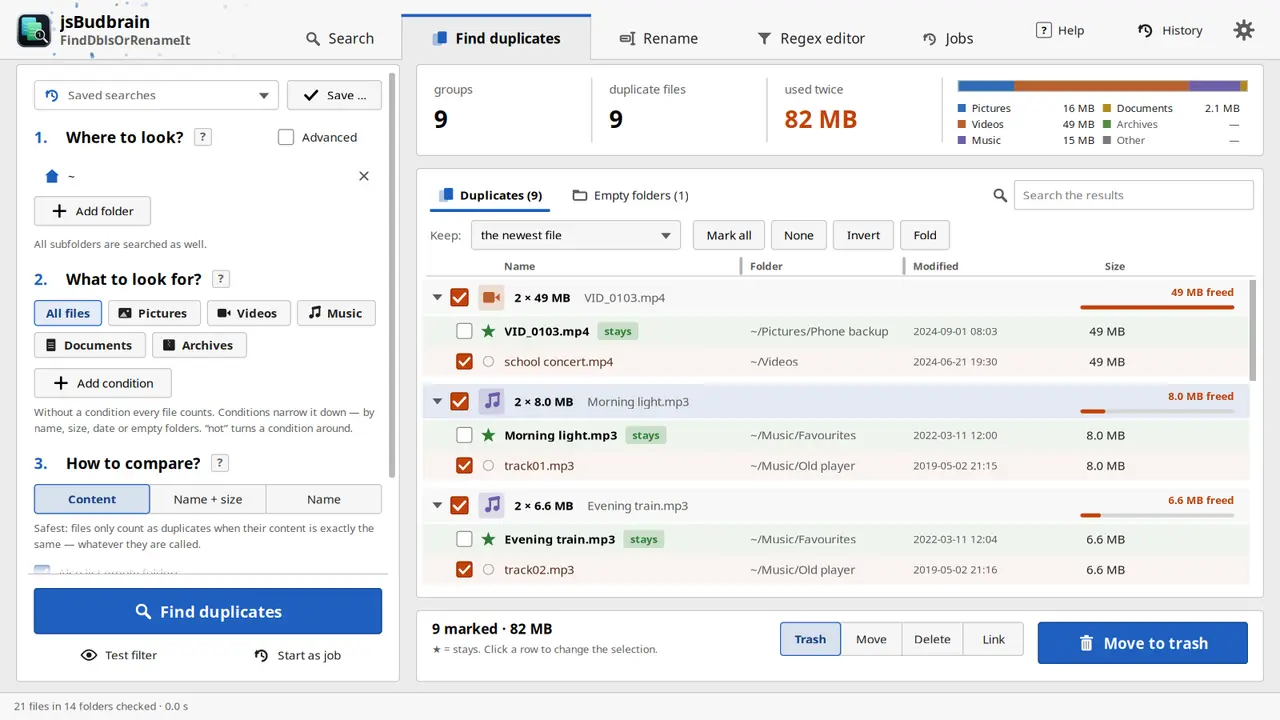
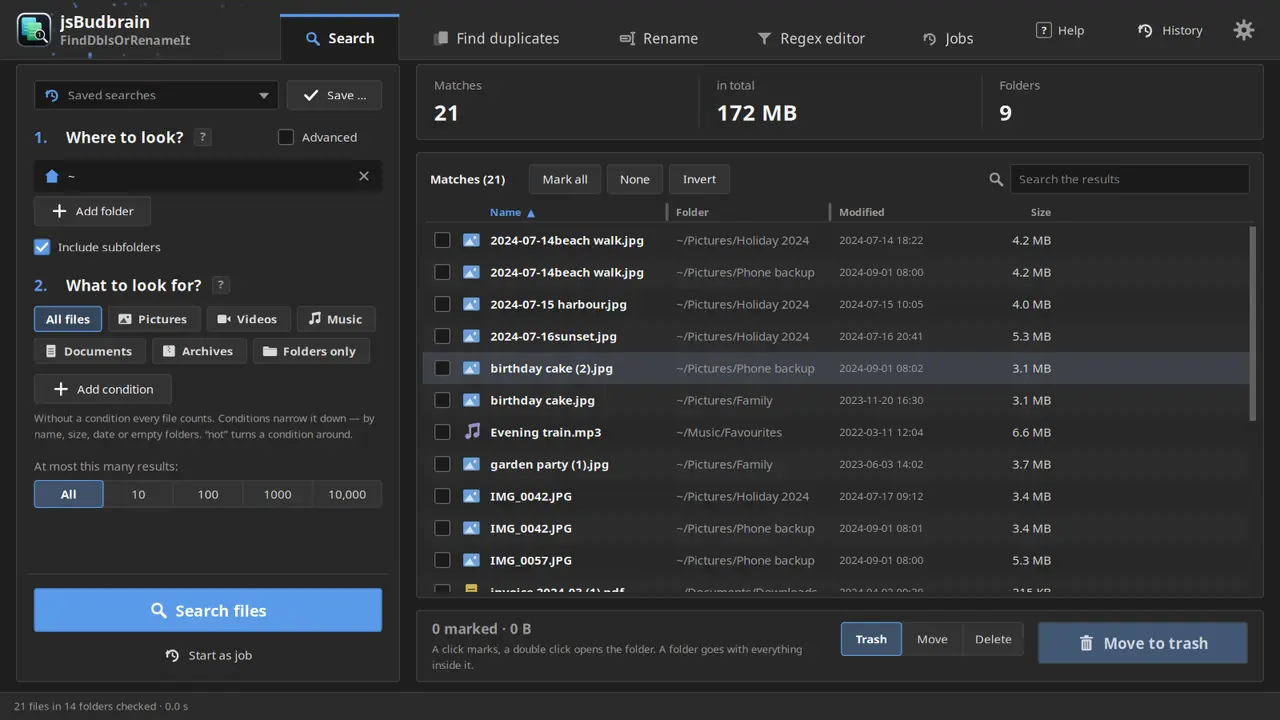
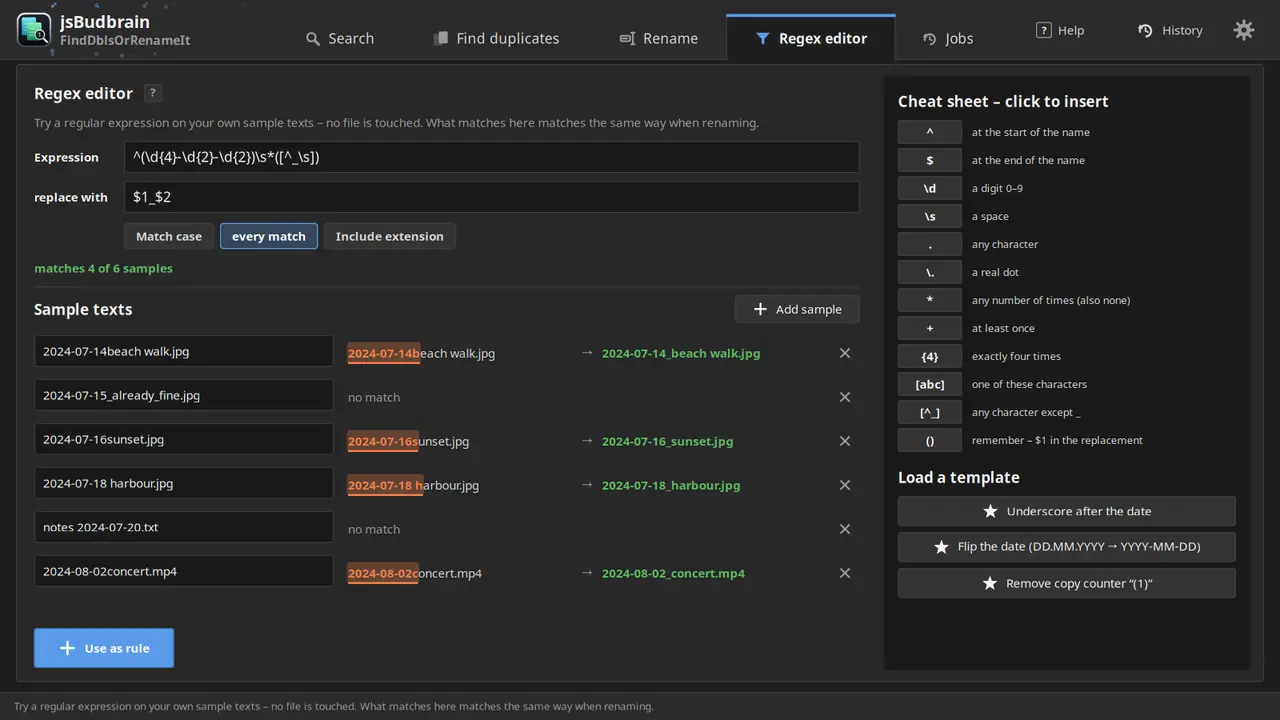
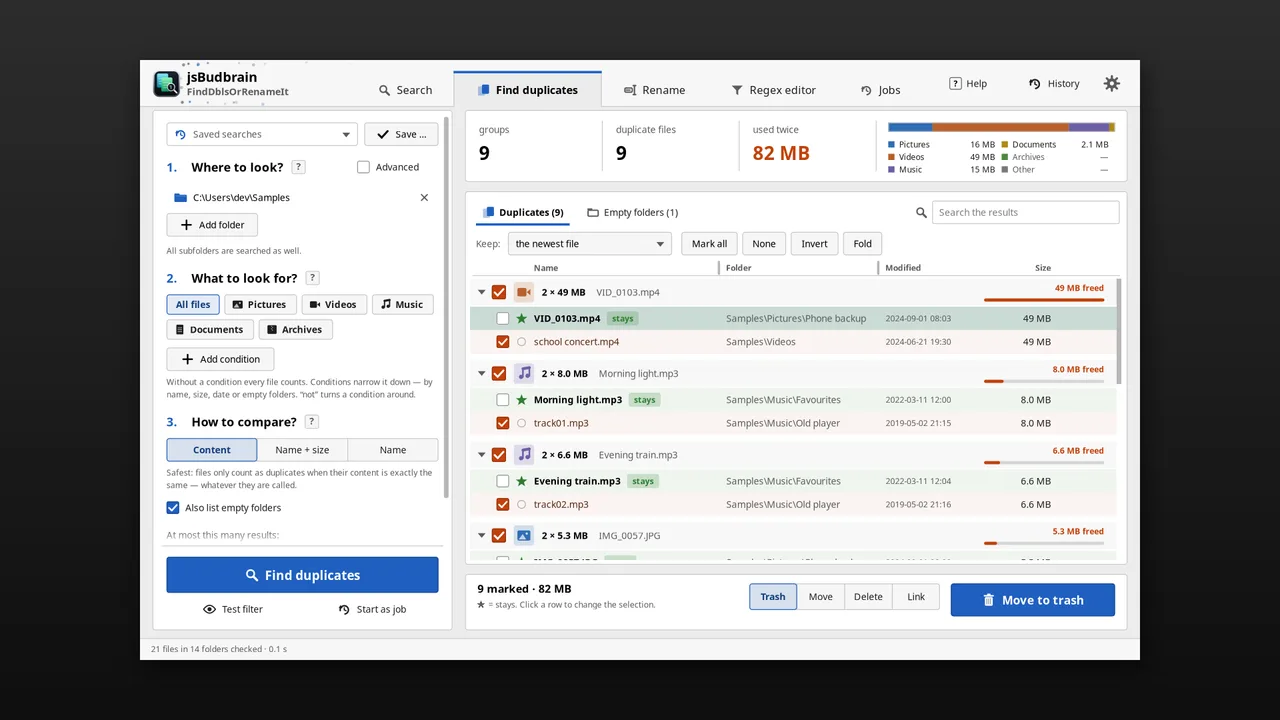
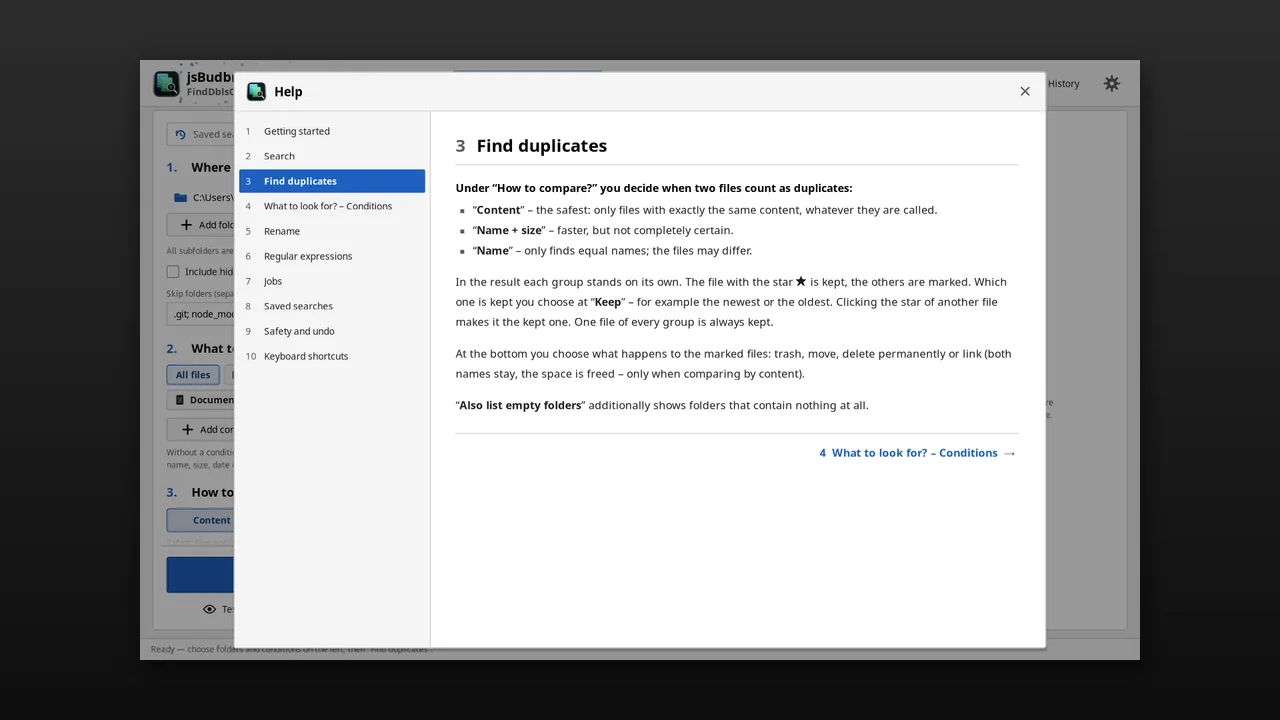
Naghahanap ng mga duplicate na file at inaayos ang mga ito – at pinapalitan ang pangalan ng maraming file nang sabay ayon sa sarili mong mga panuntunan, na may preview at undo.
Nakakahanap ng tunay na duplicate ayon sa nilalaman, anuman ang pangalanNananatili ang pinakabagong file – ikaw ang magpapasyaTrash, ilipat, burahin o i-linkPalitan ang pangalan ayon sa panuntunan na may live previewMaghanap ng file ayon sa pangalan, uri, laki o petsaI-save ang mga paghahanap, magpatakbo ng ilang gawain nang sabayI-undo ang paglilipat at pagpapalit ng pangalanMaliwanag at madilimSDL2 · Cairo47 mga wika
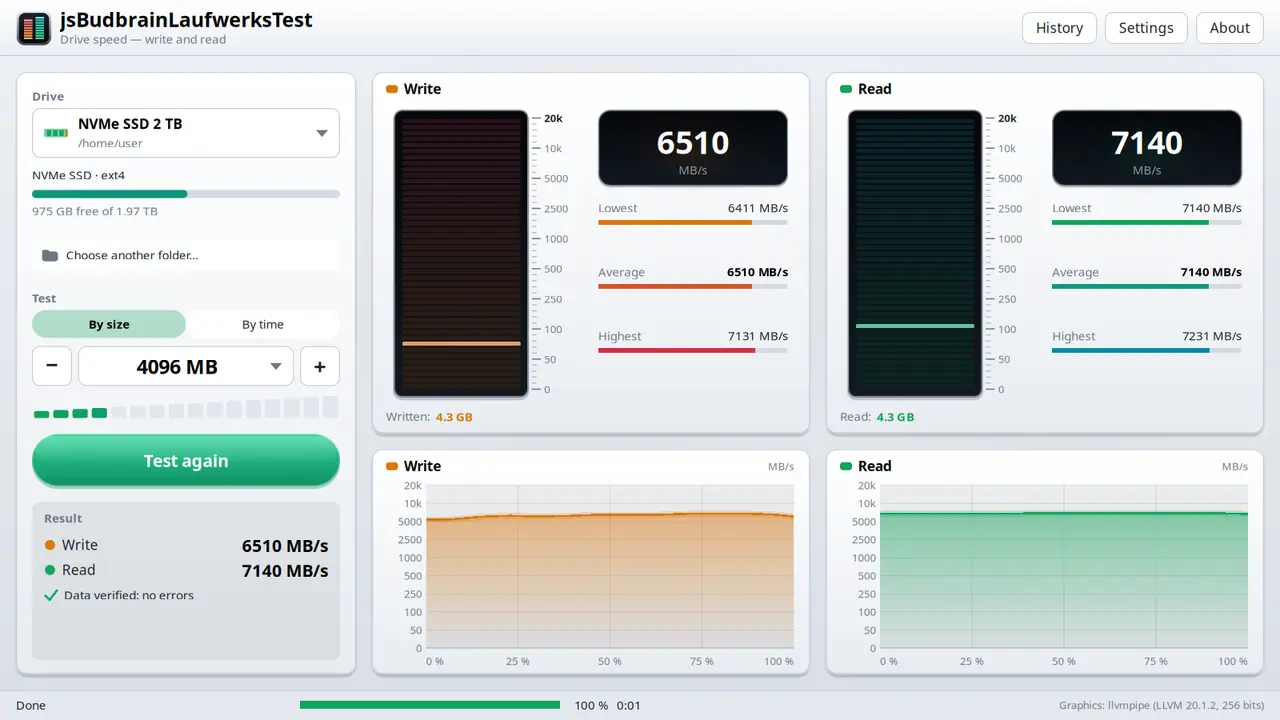
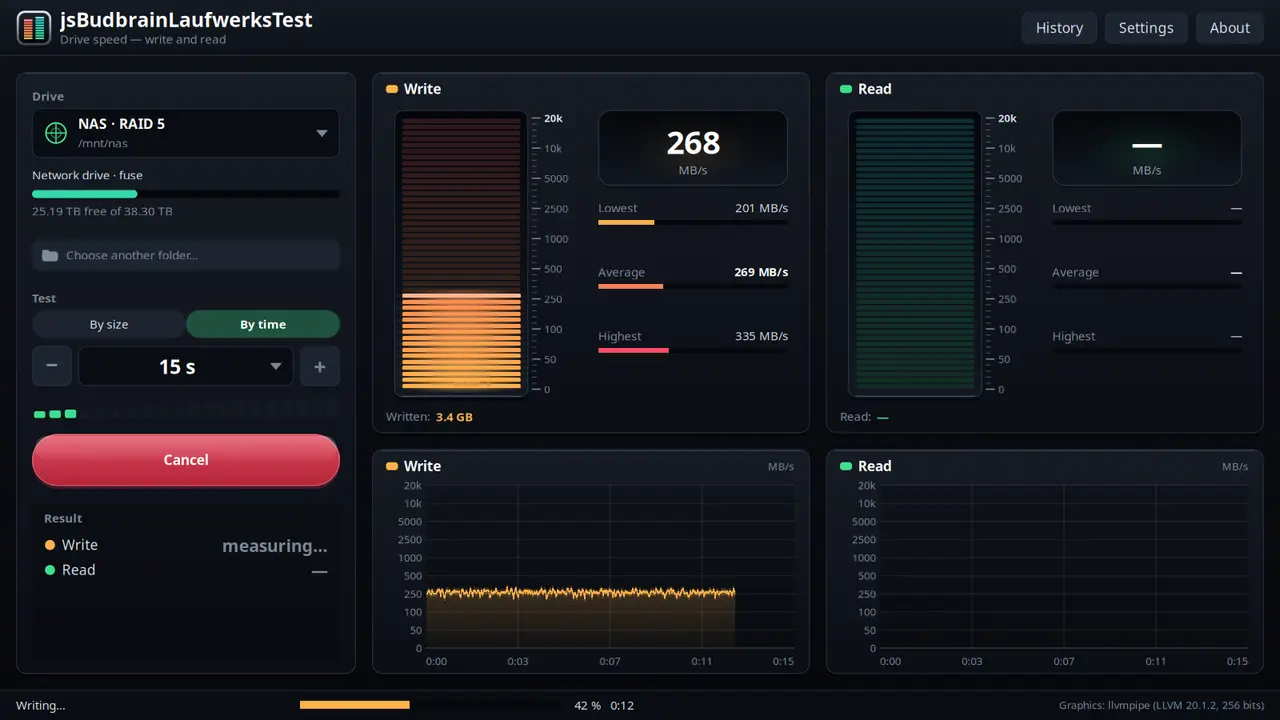
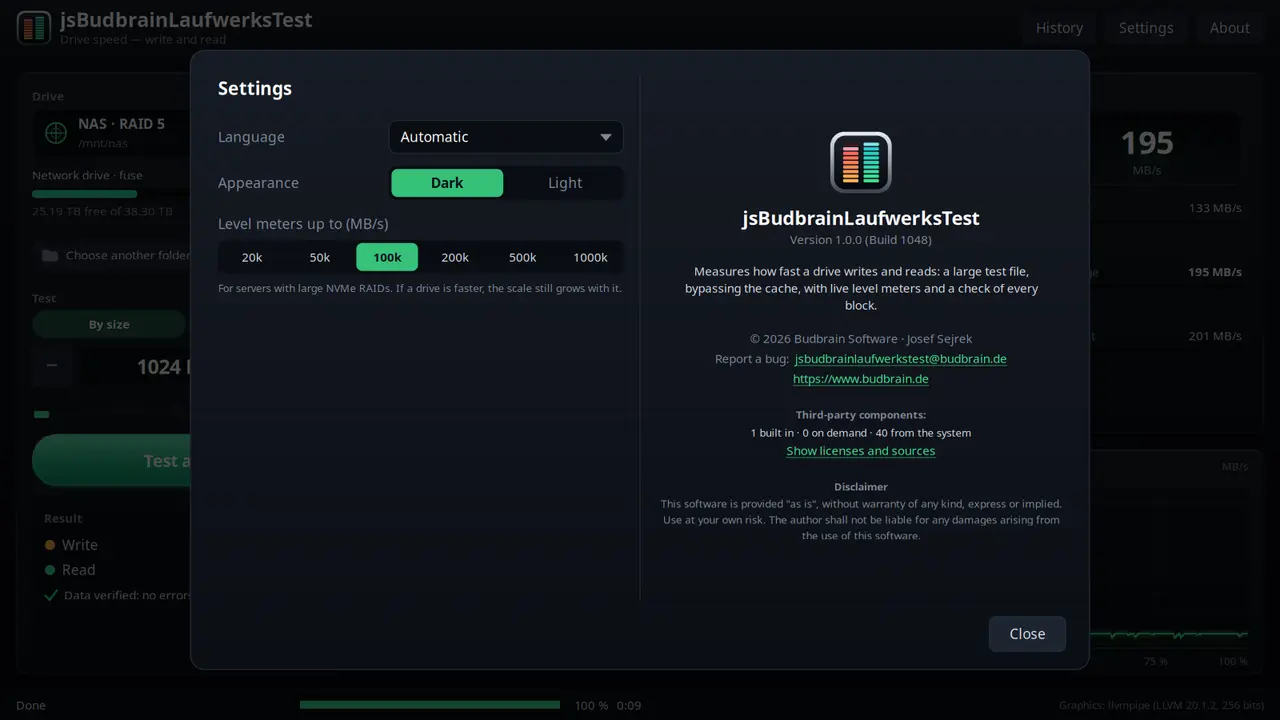
Sinusukat kung gaano kabilis sumulat at bumasa ang isang drive — na may dalawang live level meter, chart at pagsusuri sa bawat block.
Live na bilis ng pagsulat at pagbasaAyon sa laki (1–16 GB) o oras (5 s – 16 min)Sinusuri ang bawat blockIpinapakita kung kailan nauubusan ng hininga ang mabilis na driveMga USB stick, memory card, network driveKasaysayan ng lahat ng test, i-save bilang textMag-scale hanggang 1,000,000 MB/s para sa mga server RAIDMaliwanag at madilimSDL2 · Cairo47 mga wika
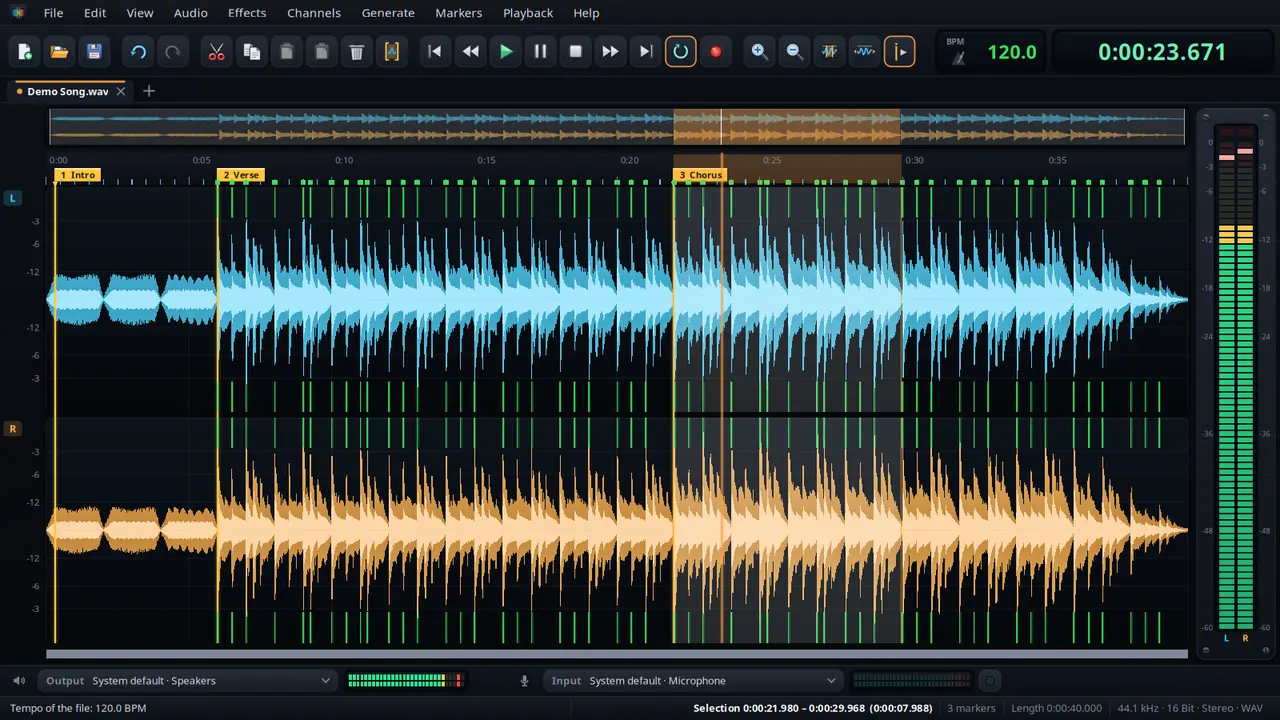
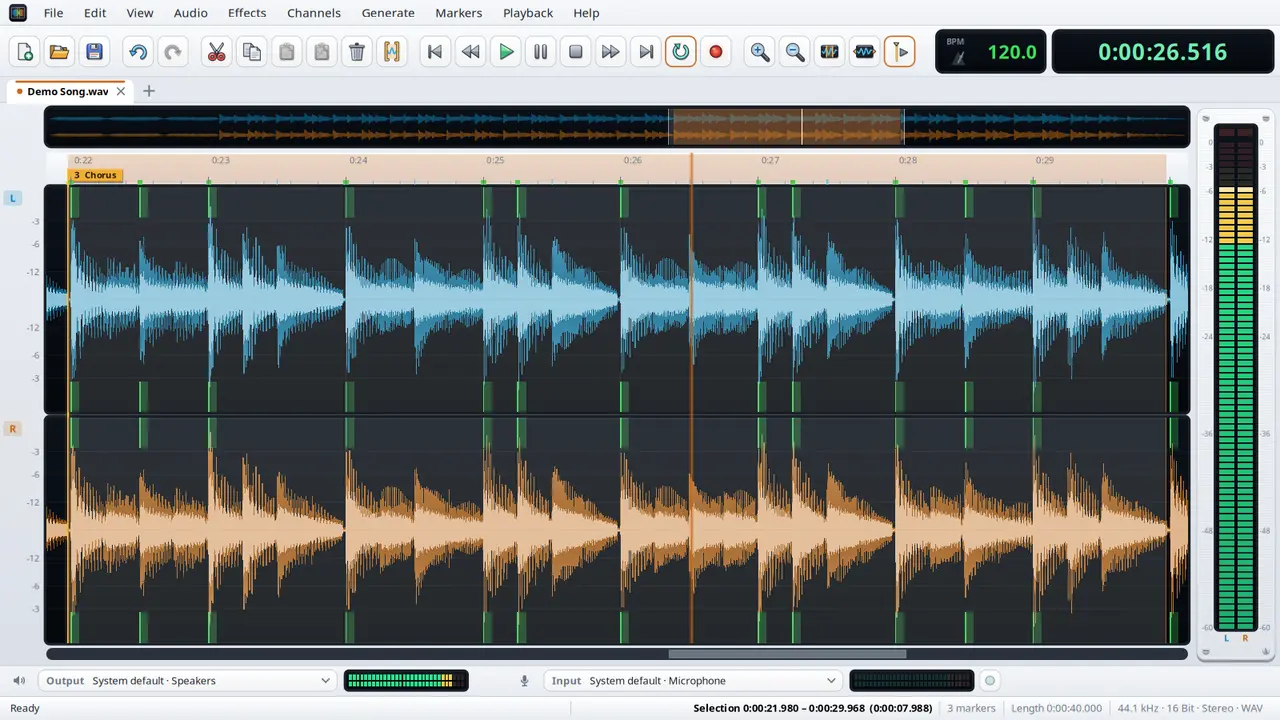
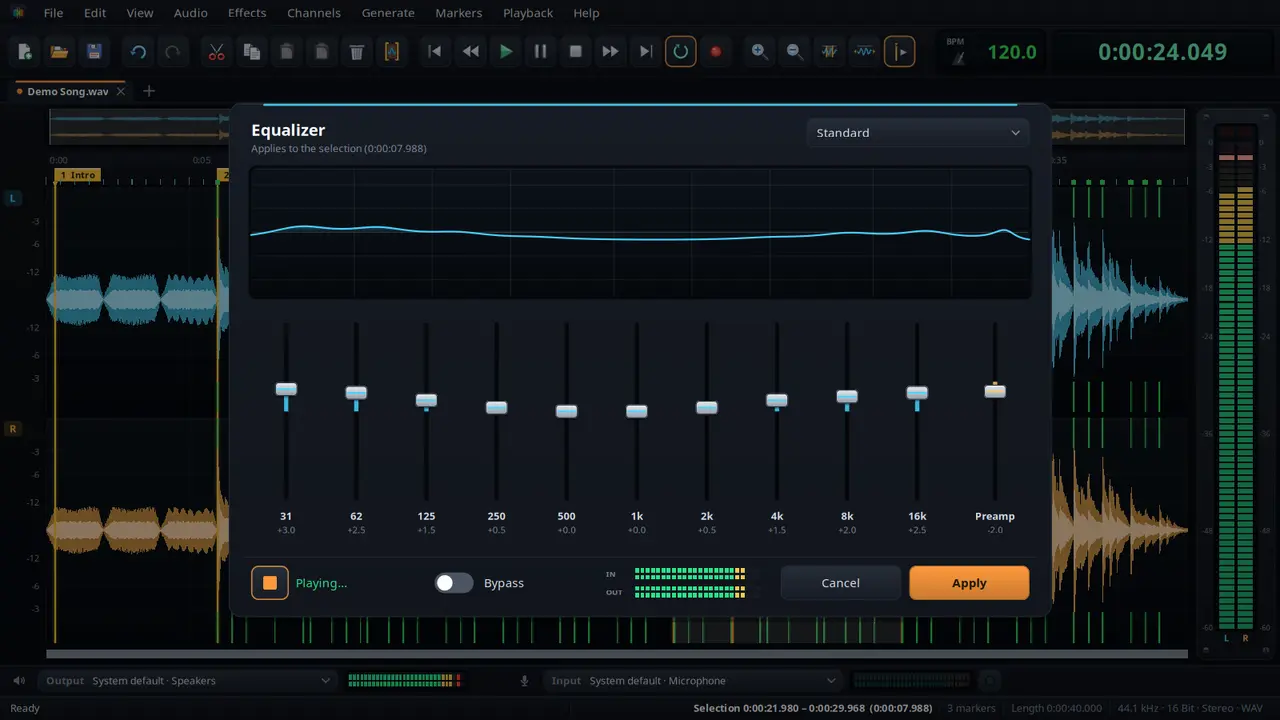
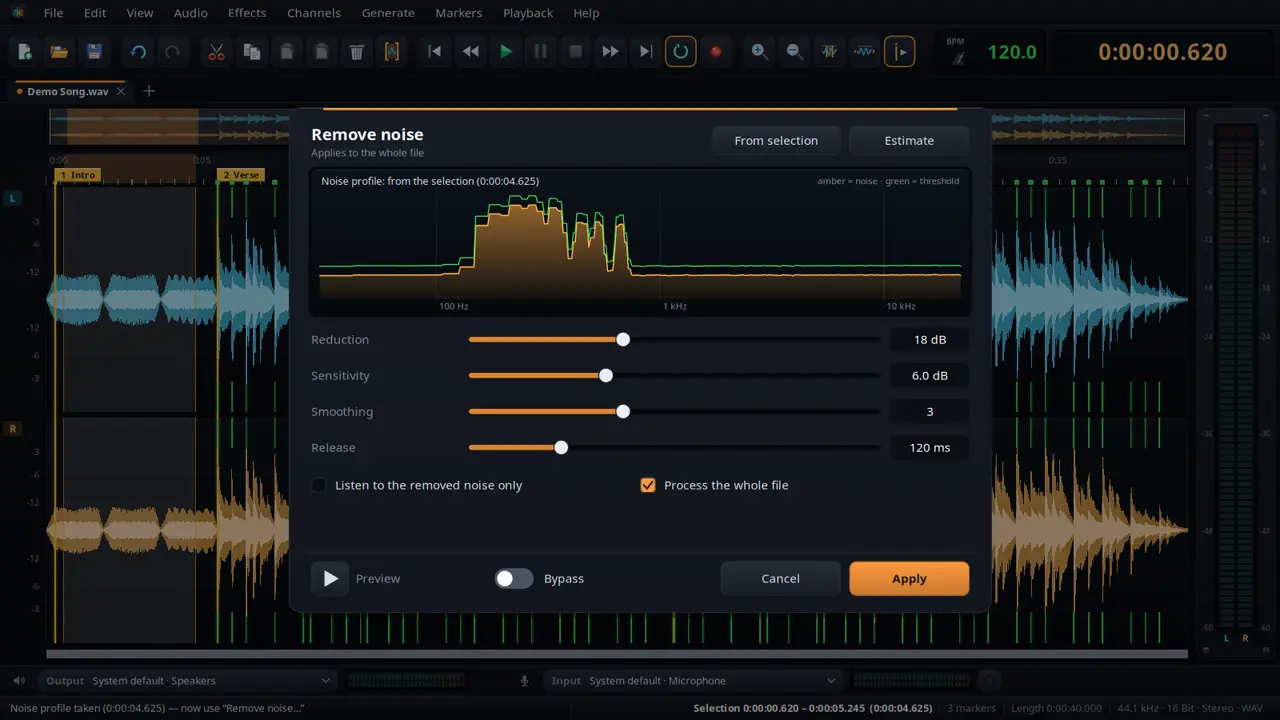
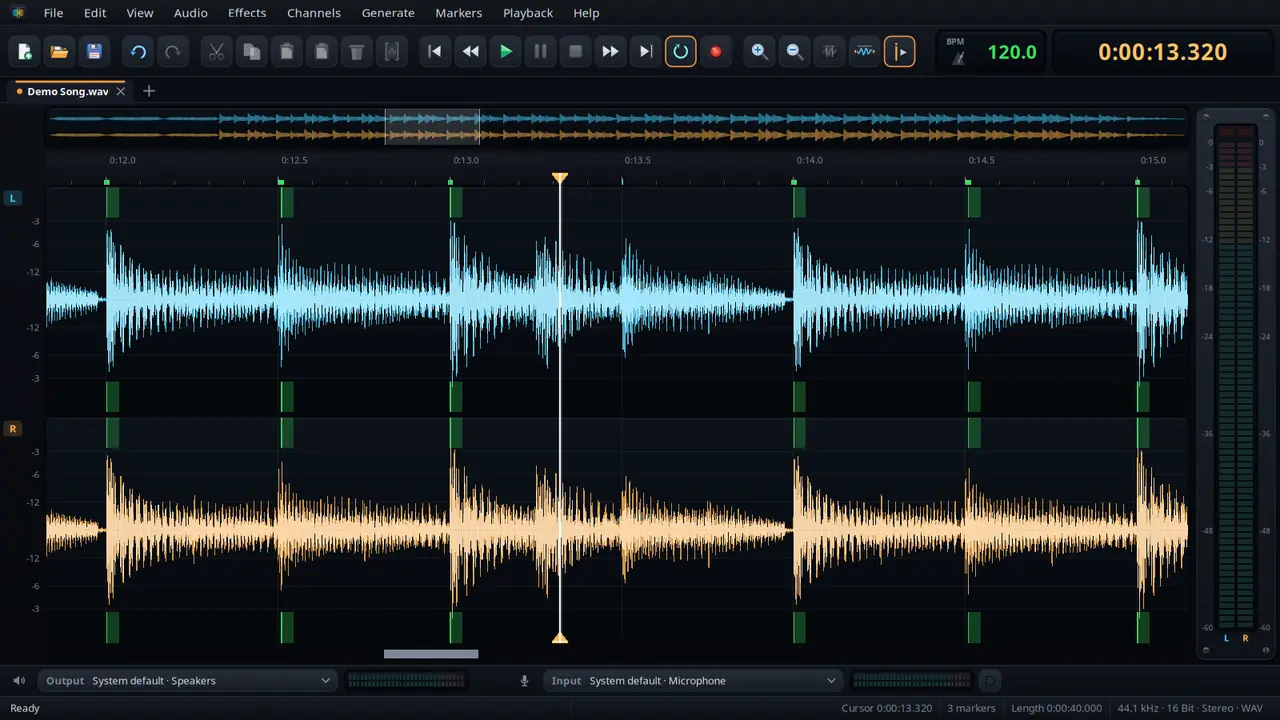
Isang audio editor para mag-cut, maglinis at mag-polish — na may mga marker, pag-alis ng ingay, tempo at ang mga effect ng mga sound app ng Budbrain.
Mag-cut, kopyahin, i-paste at ihaloMag-zoom gamit ang mouse wheel hanggang sa isang sampleMagtakda at magpangalan ng mga marker, mag-play sa pagitan ng mga itoUndo na walang takdang limitasyonPag-alis ng ingay gamit ang noise profileHanapin at baguhin ang tempo, na may bass drum at beat gridEqualizer, tube & compressor, limiter at FX studio na may live previewMag-record hangga't gusto moMaliwanag at madilimWAV · FLAC · Ogg · Opus · MP3SDL2 · CairoPipeWire · PulseAudio47 mga wika
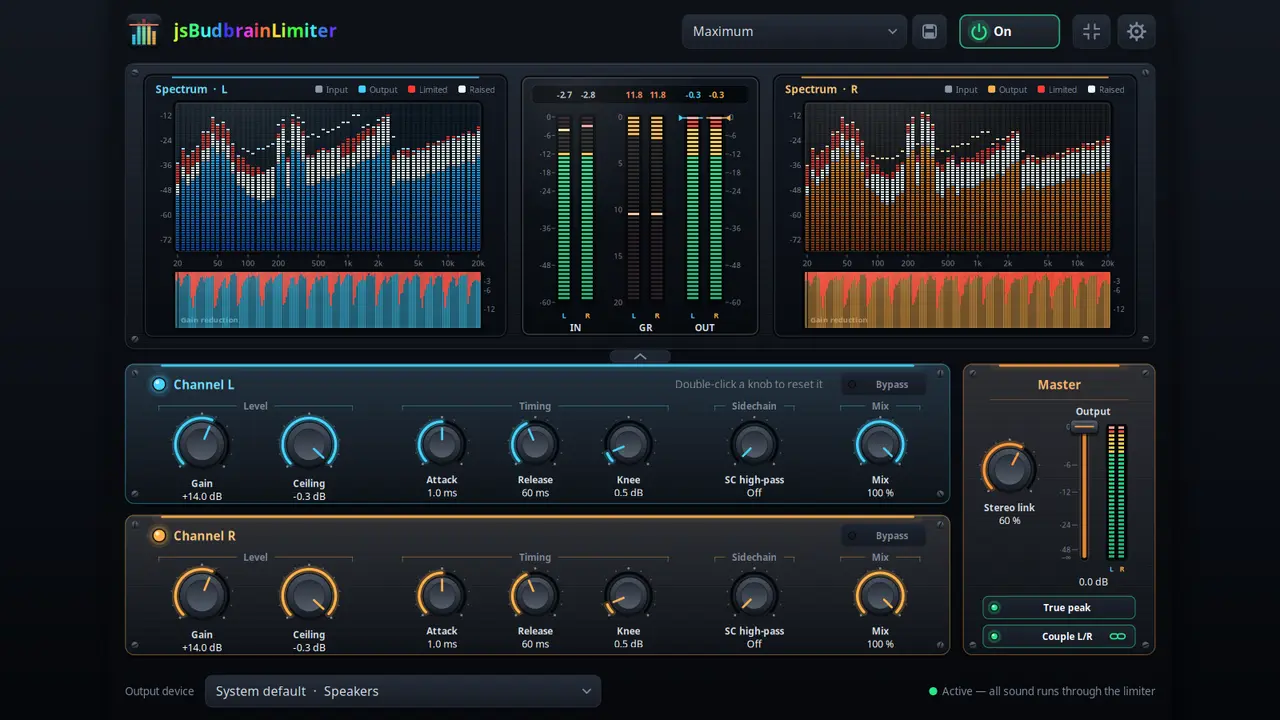
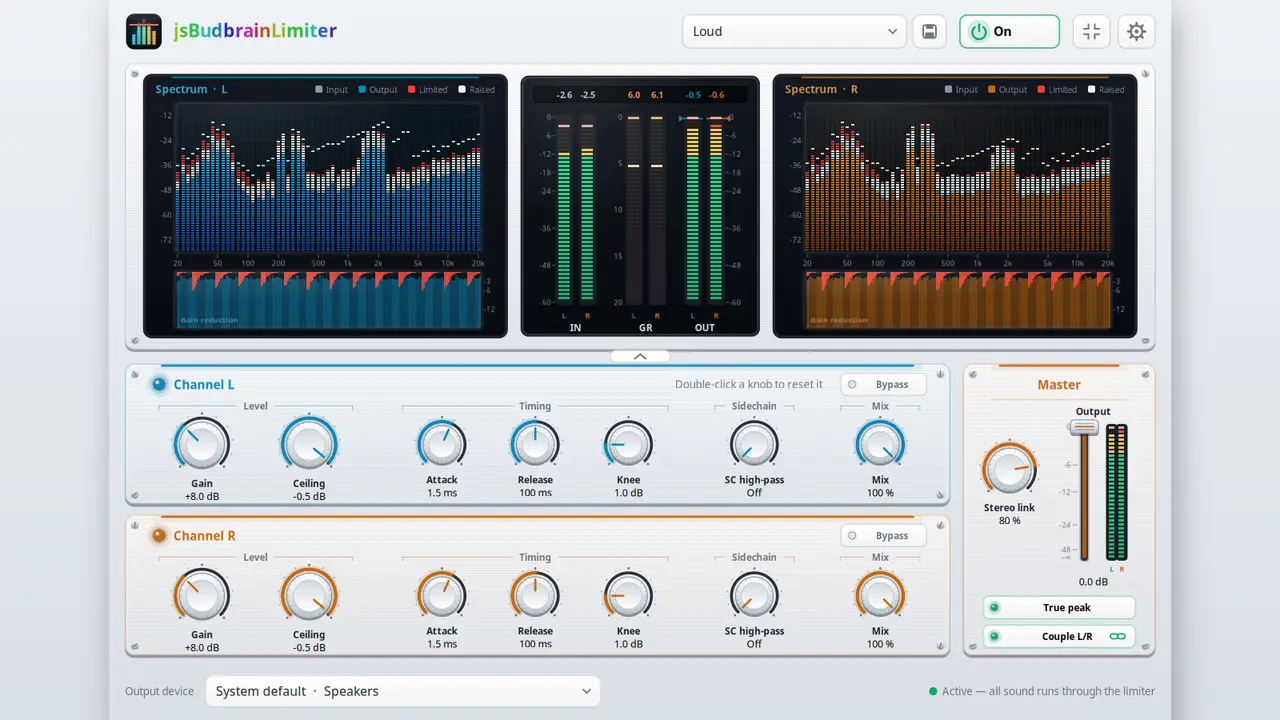
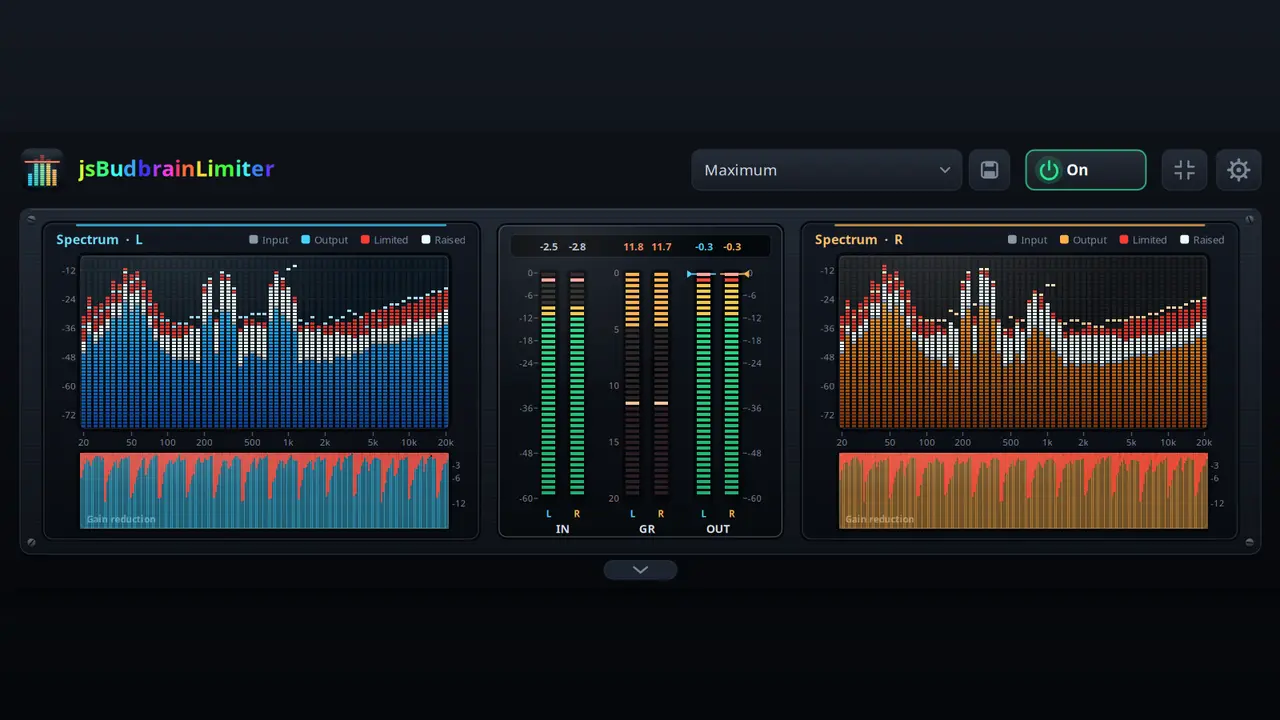
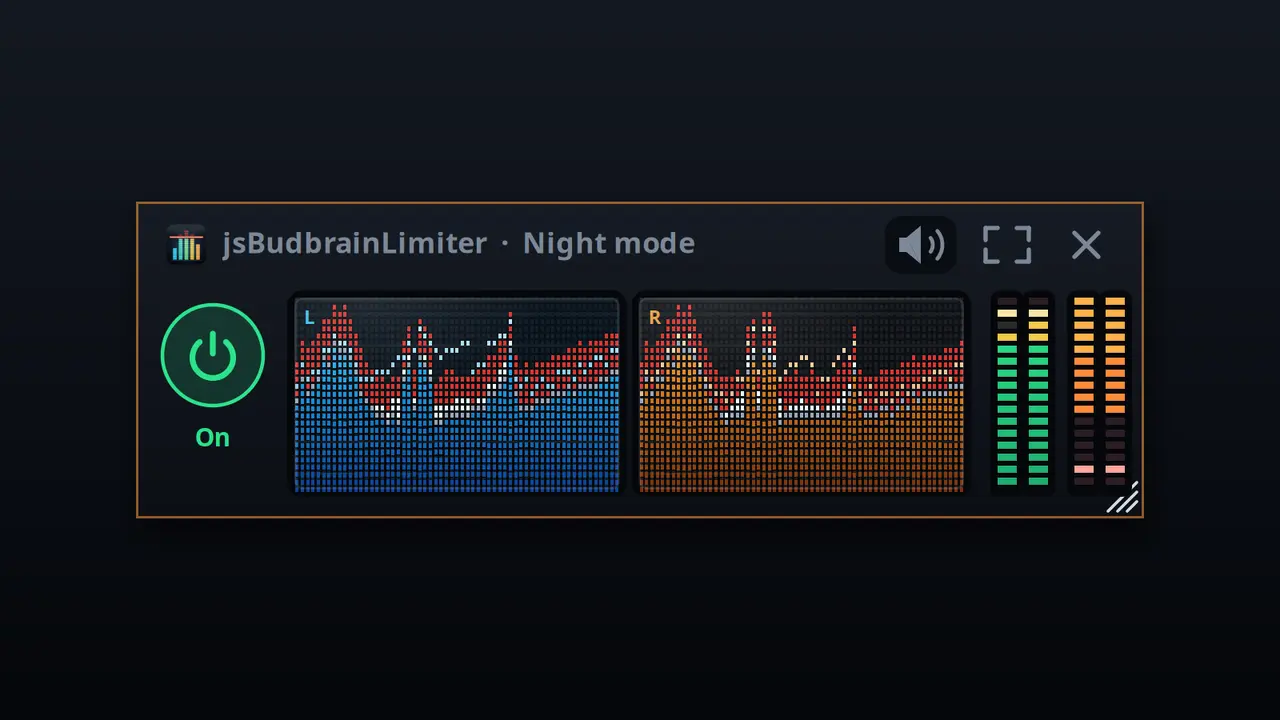
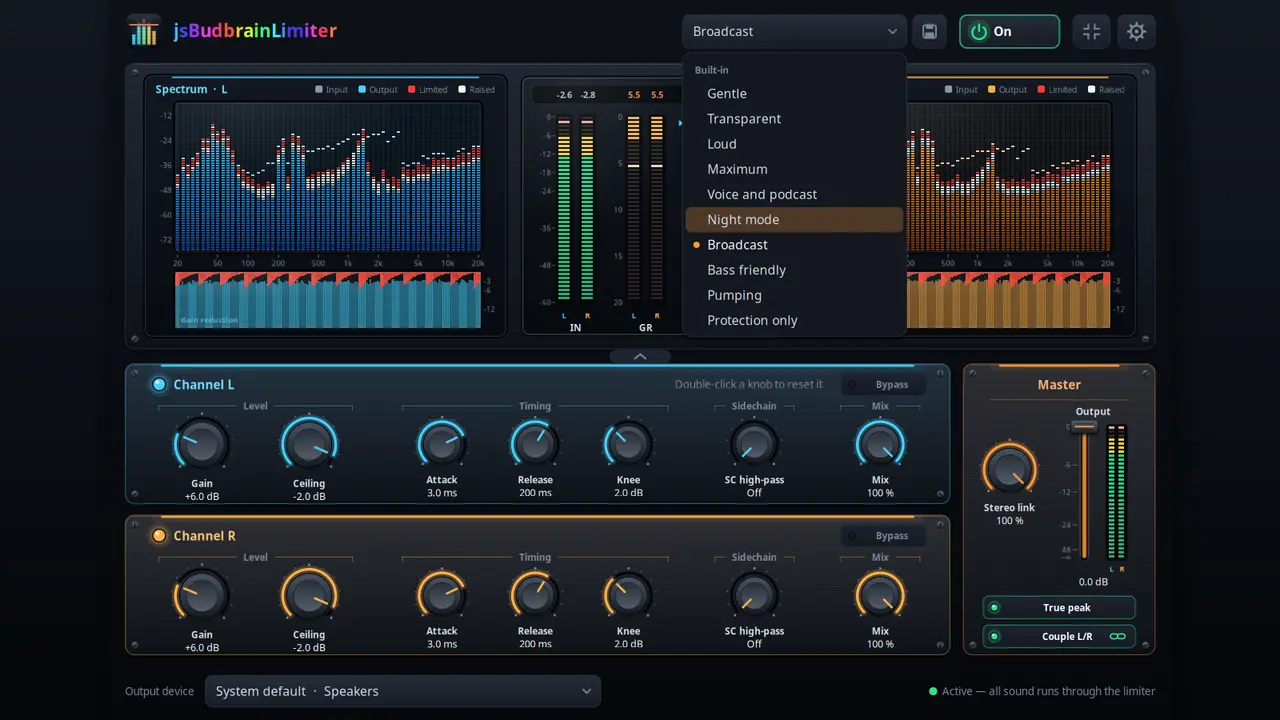
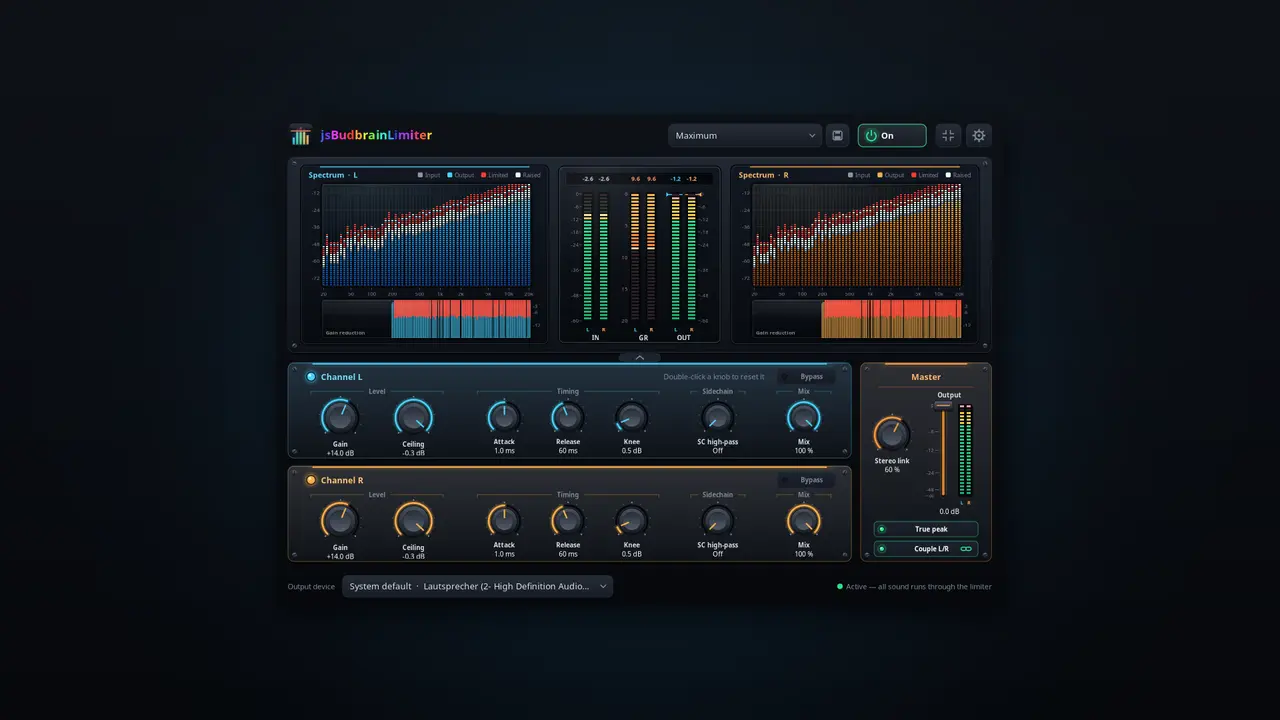
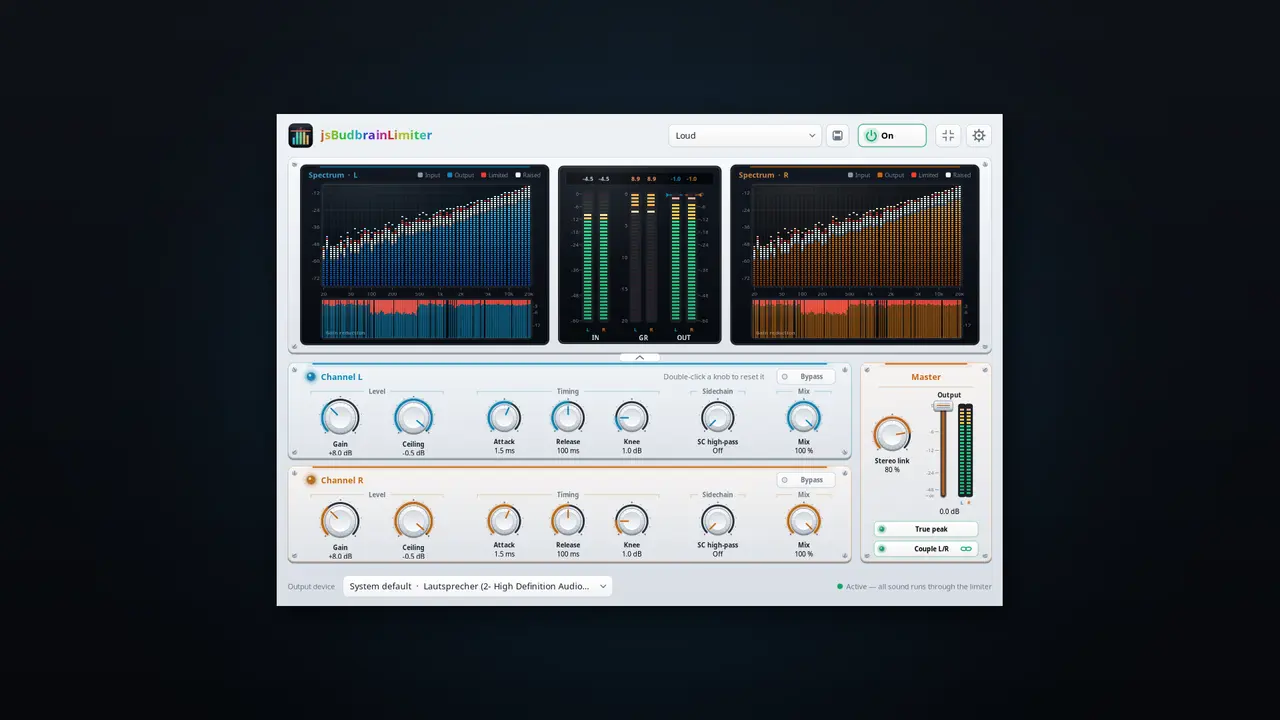
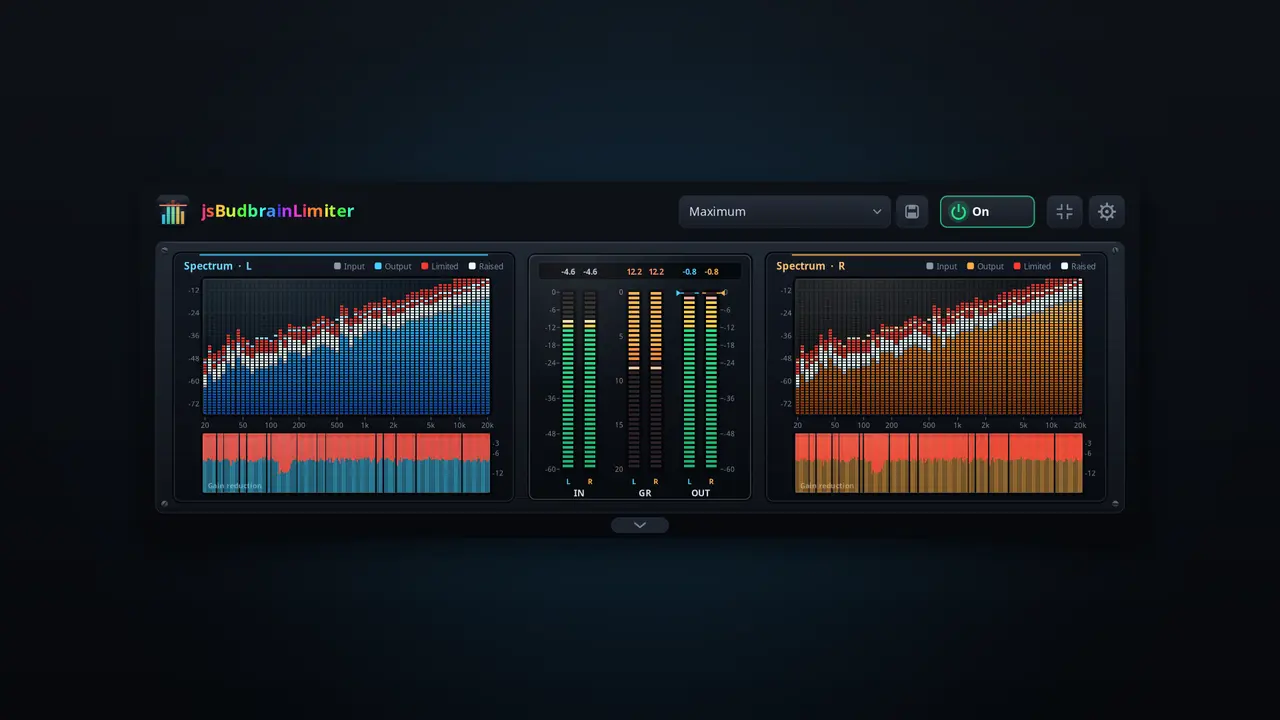
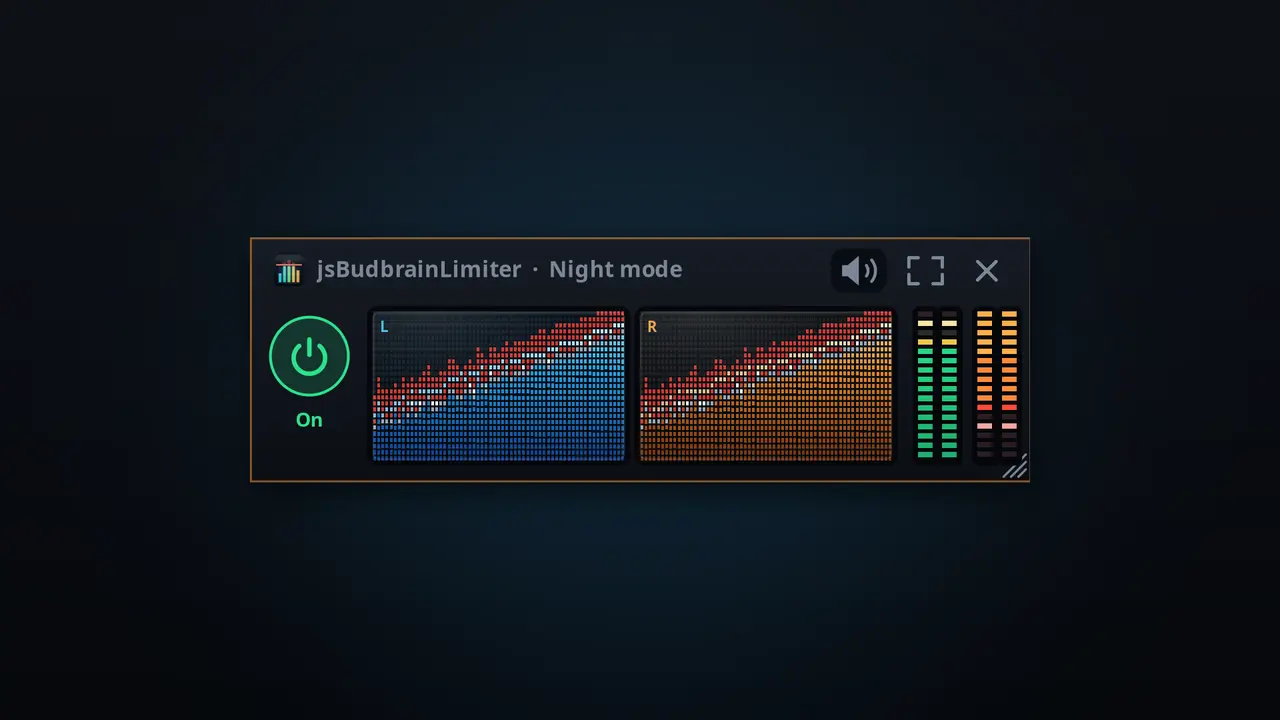
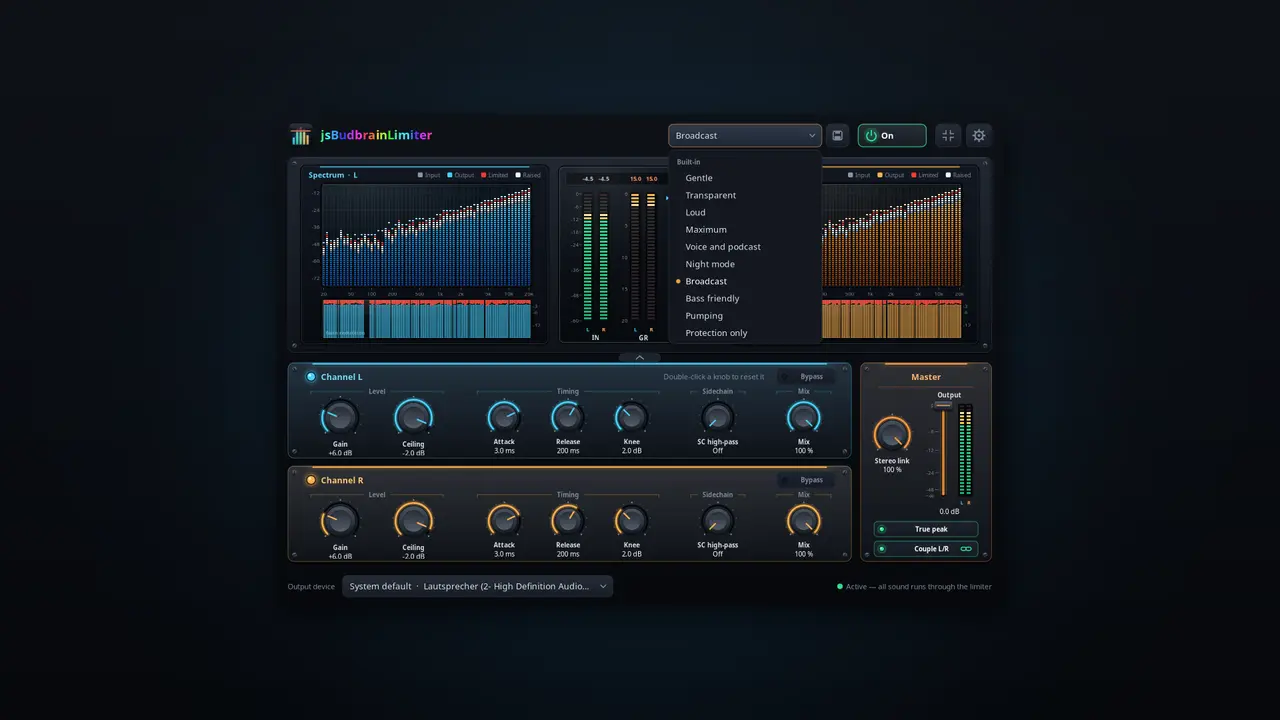
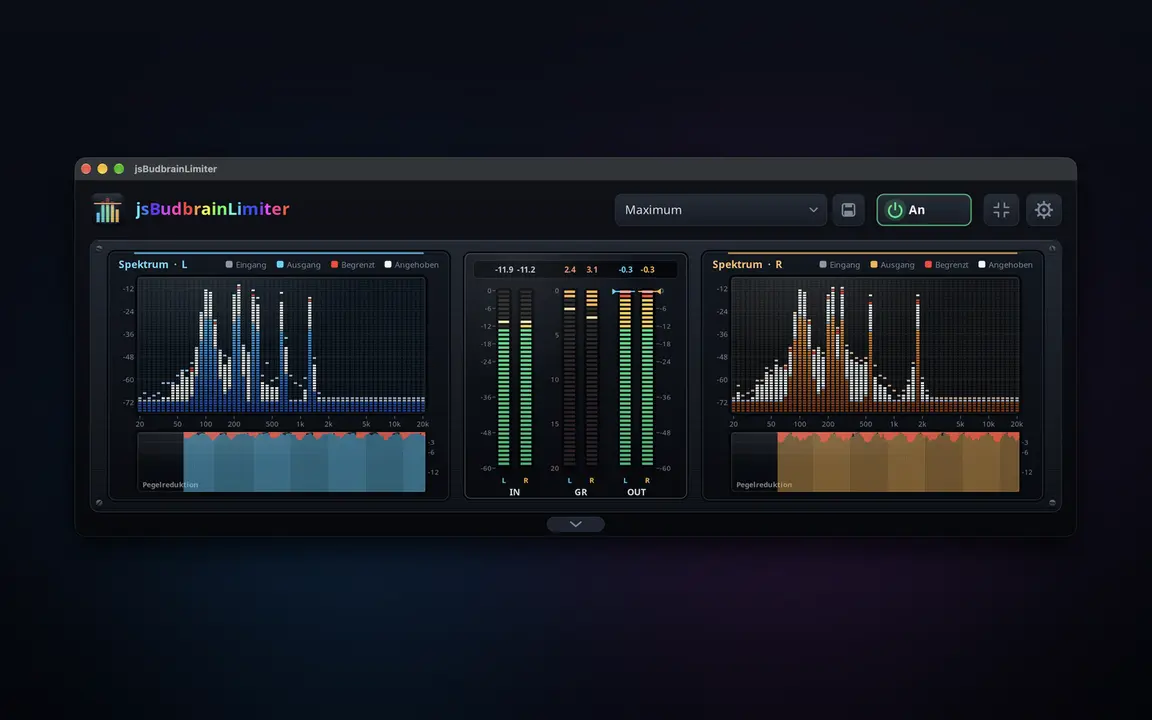
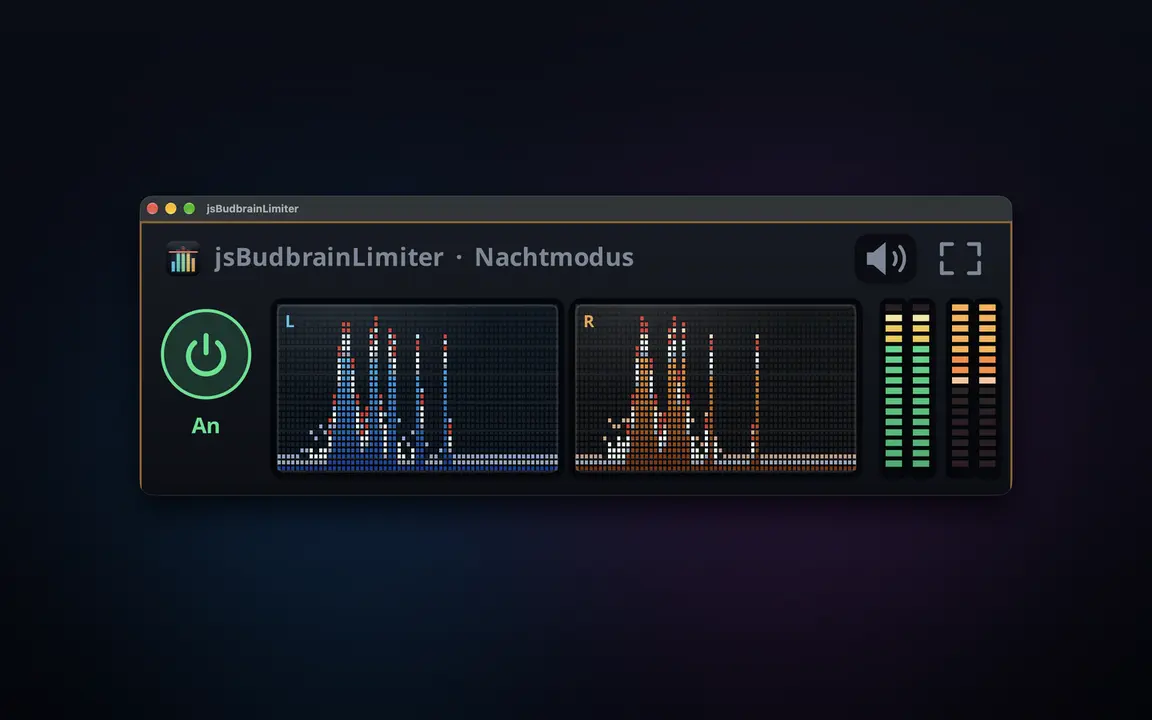
Isang limiter para sa lahat ng pinapatugtog ng iyong computer — mas malakas, nang hindi kailanman lumalampas, na may dalawang spectrum display na nagpapakita ng ginagawa nito.
Magkahiwalay na kontrol para sa kaliwa at kanang channelGain, ceiling, attack, release, knee, sidechain high-pass at mixNahuhuli ng true peak kahit ang pinakamaikling peakOutput fader na may level meter para sa dalawang channelDalawang spectrum display ang nagpapakita kung ano ang itinataas at ano ang nilimitahanKasaysayan ng gain reduction at mga pagbasa ng peakMga handa nang setting, at sarili moGumagana kasama ang jsBudbrainCompressor, jsBudbrainEqualizer at jsBudbrainsFxStudioMute button para kapag tumutunog ang teleponoPiliin ang iyong mga speaker o headphoneMaliit na window na laging nasa ibabawMaliwanag at madilimSDL2 · CairoPipeWire · PulseAudio83 mga wika
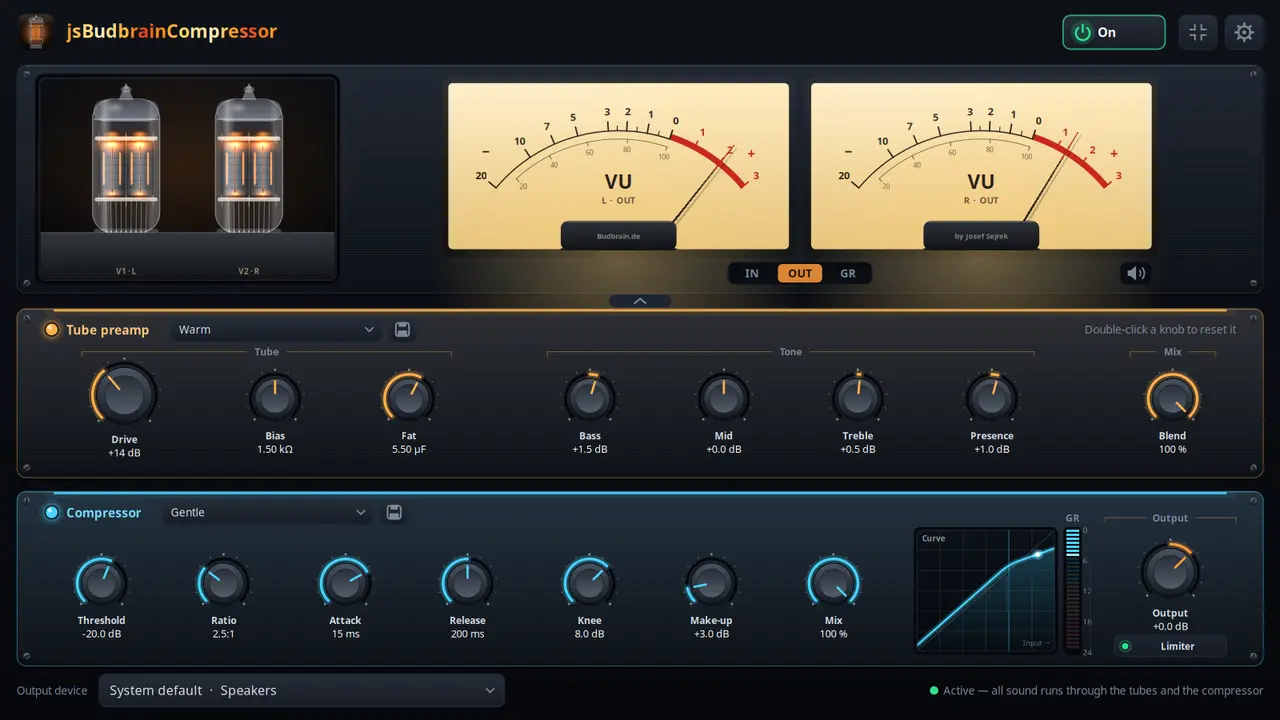
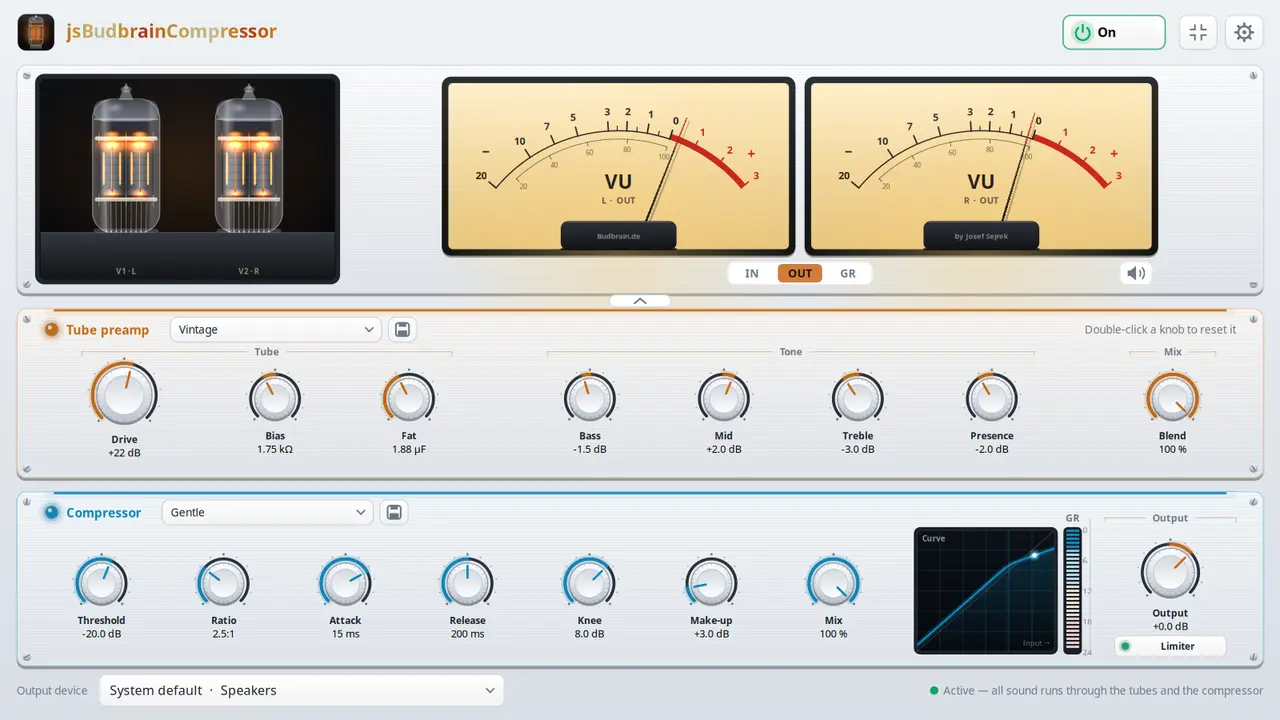
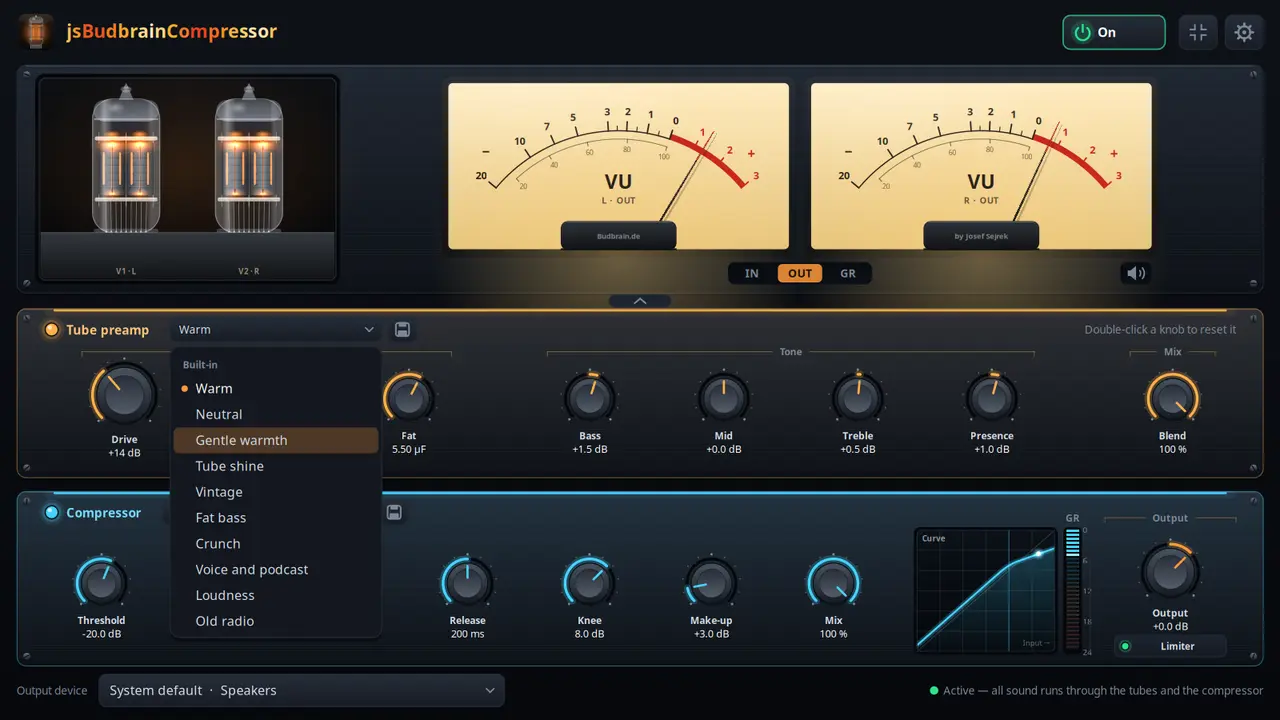
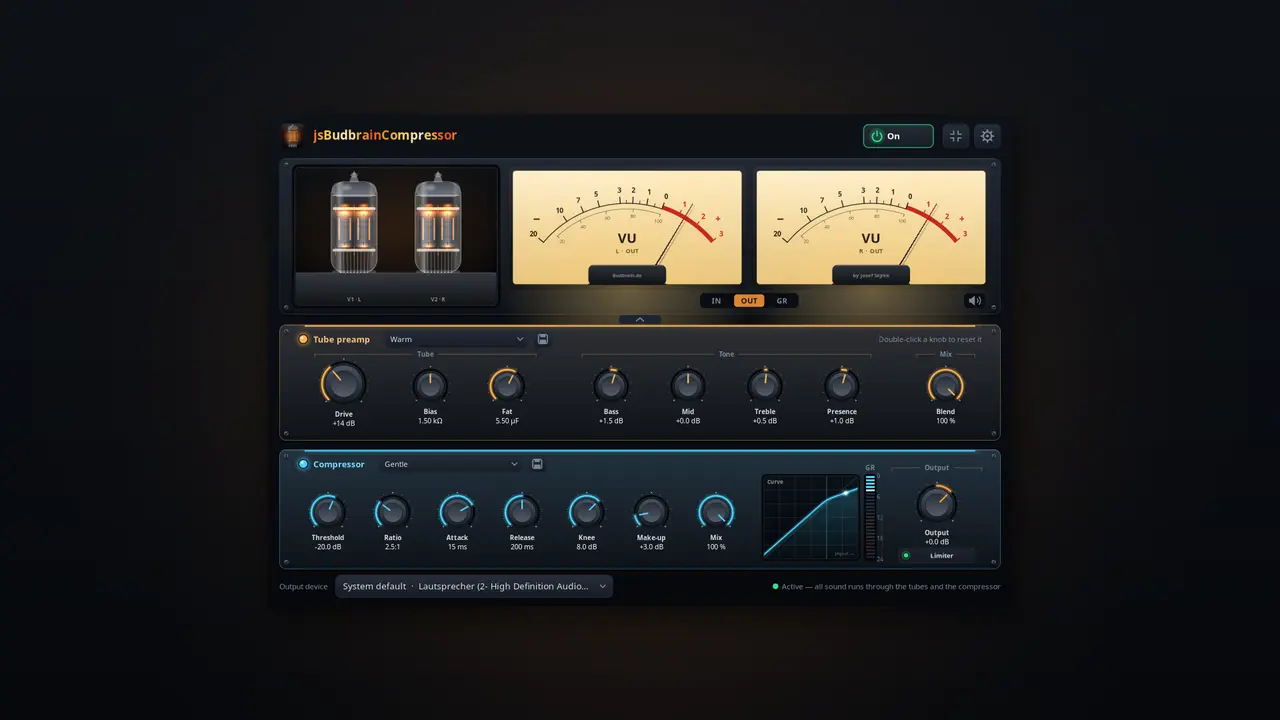
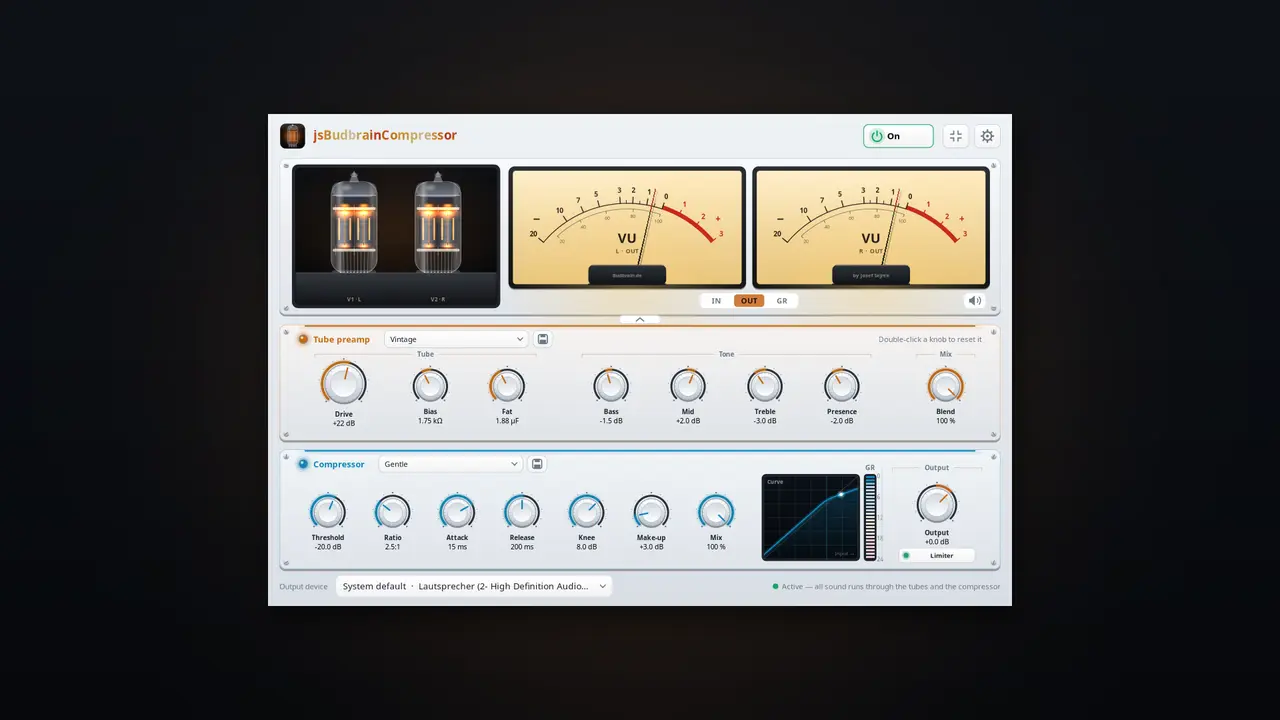
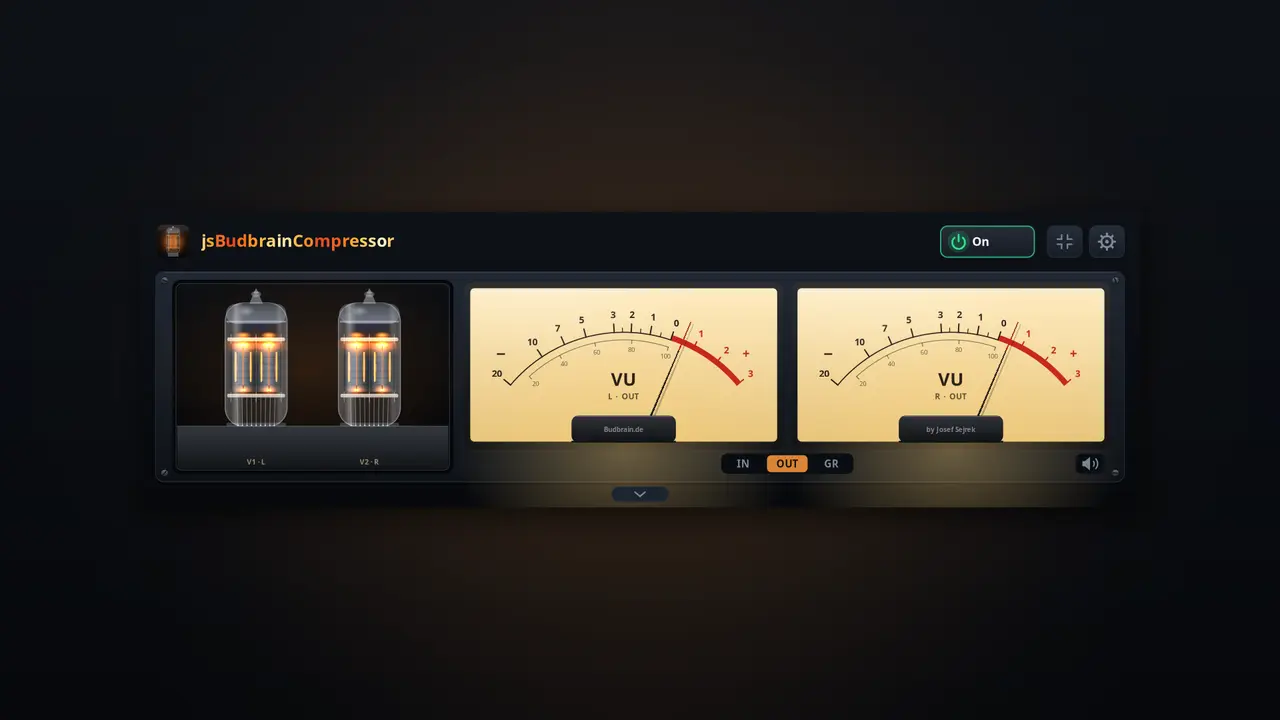
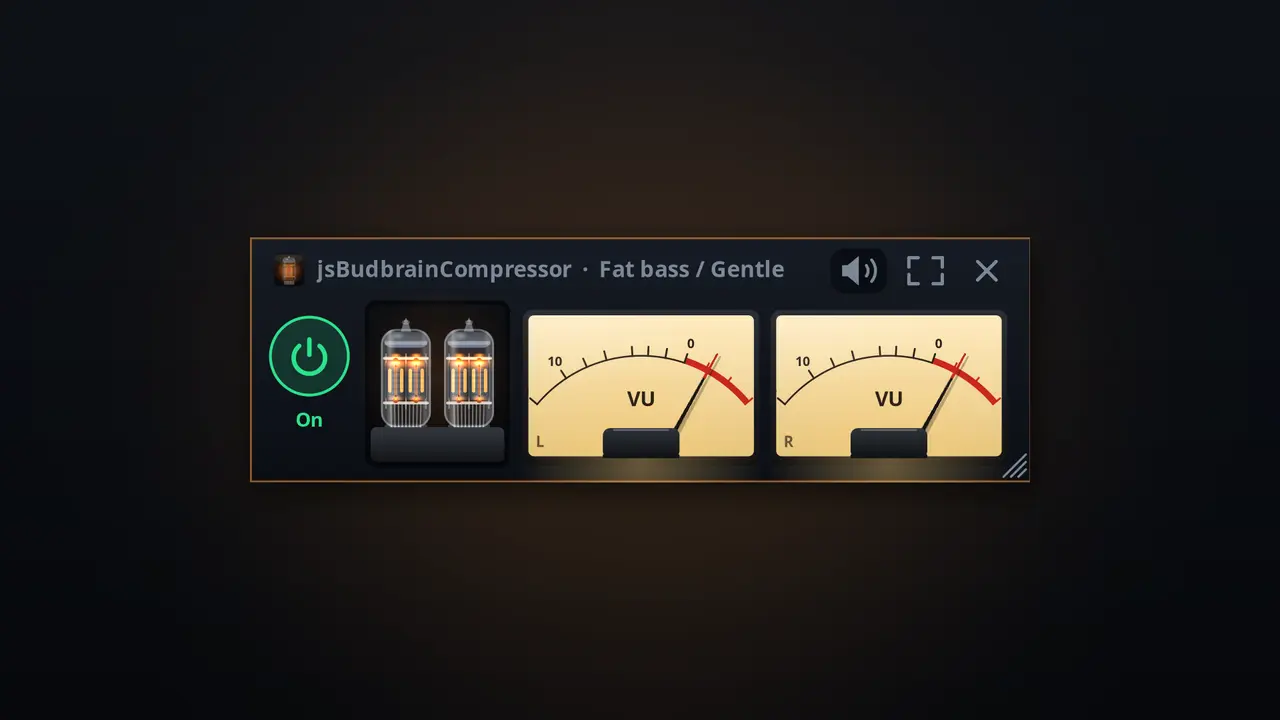
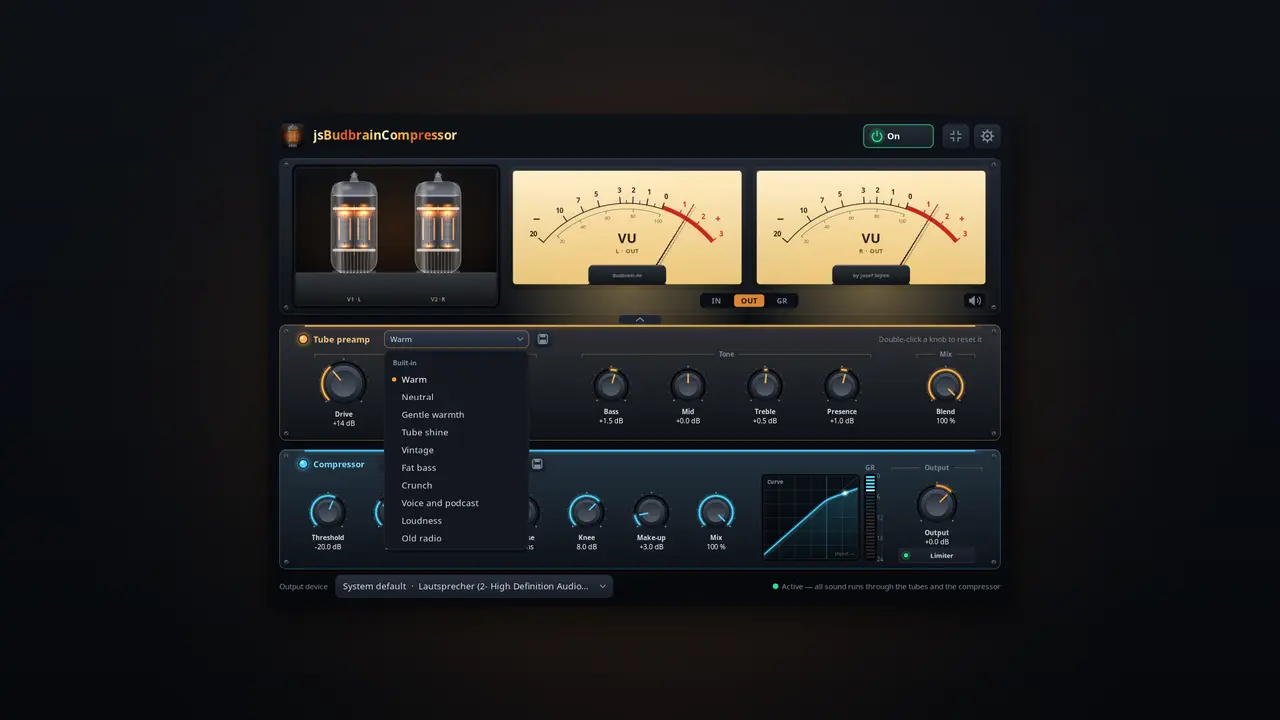
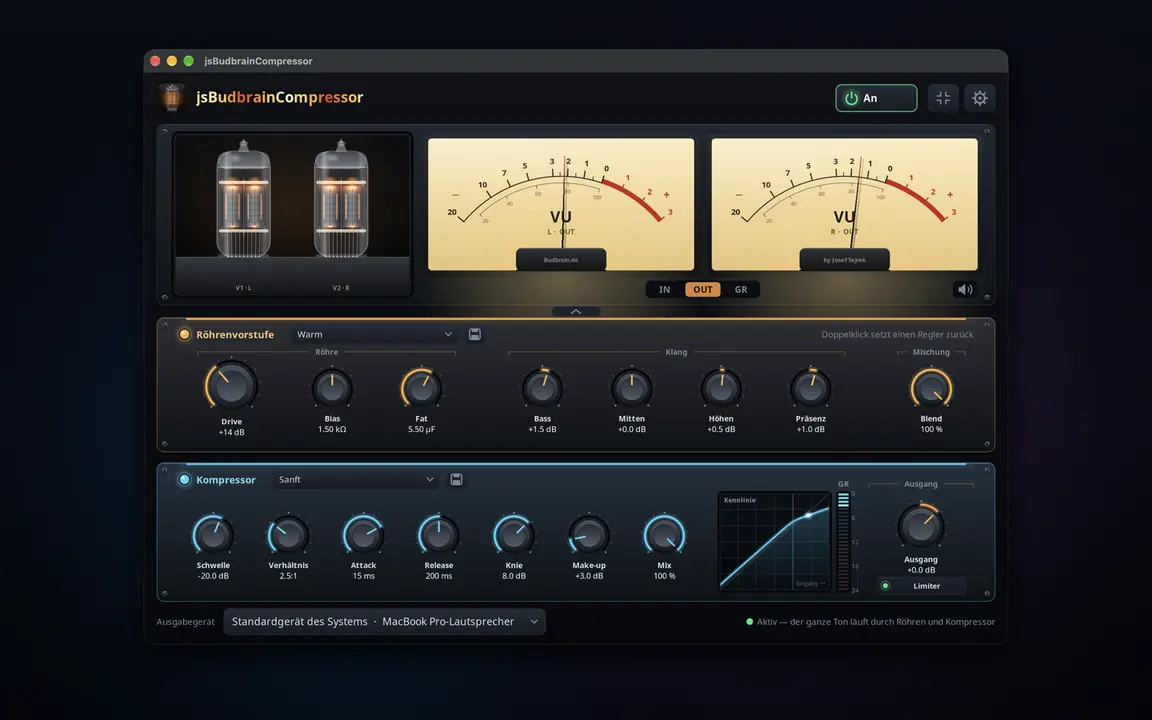
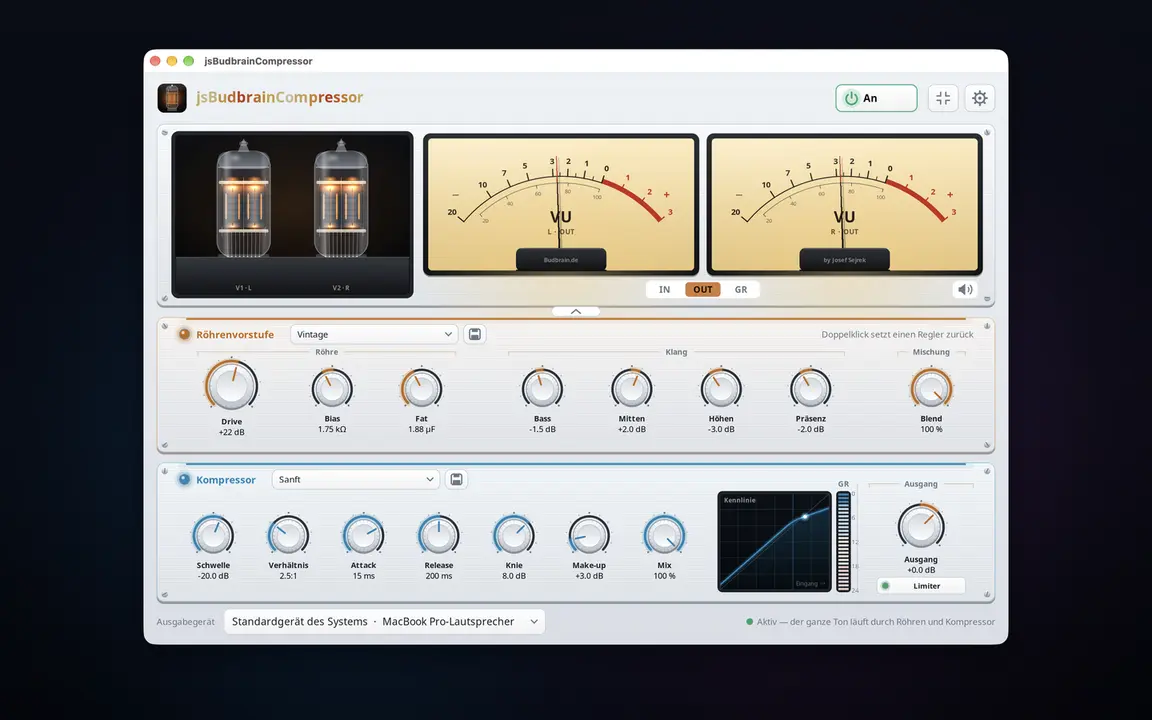
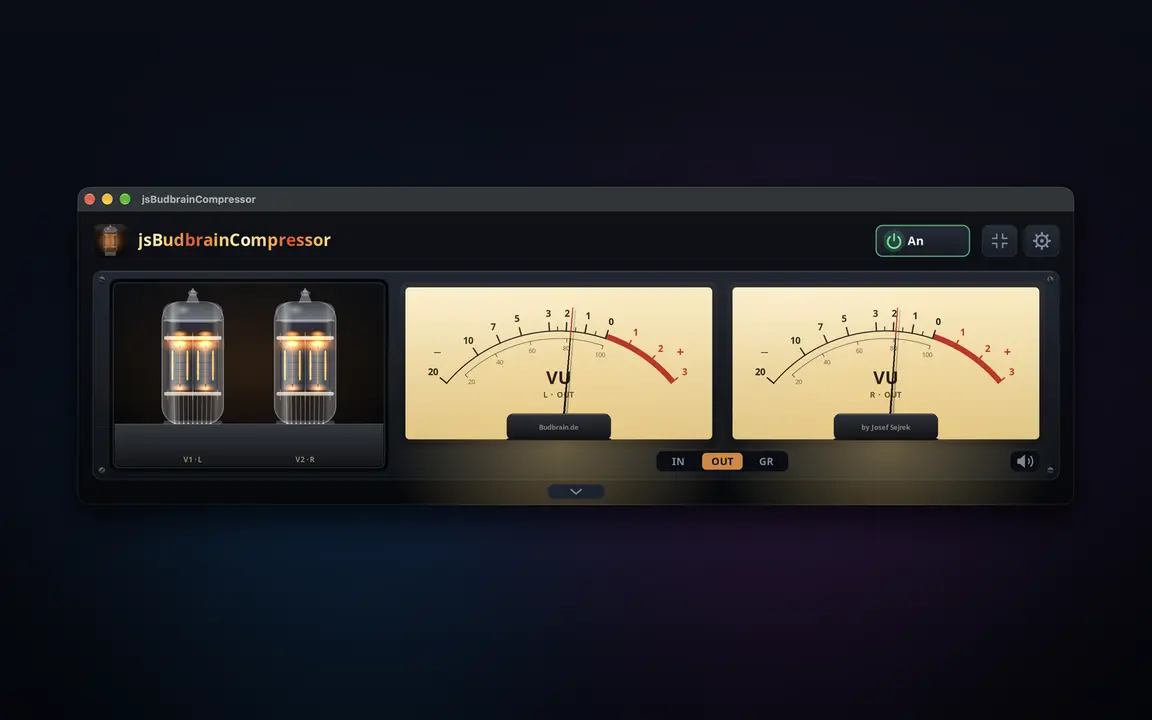
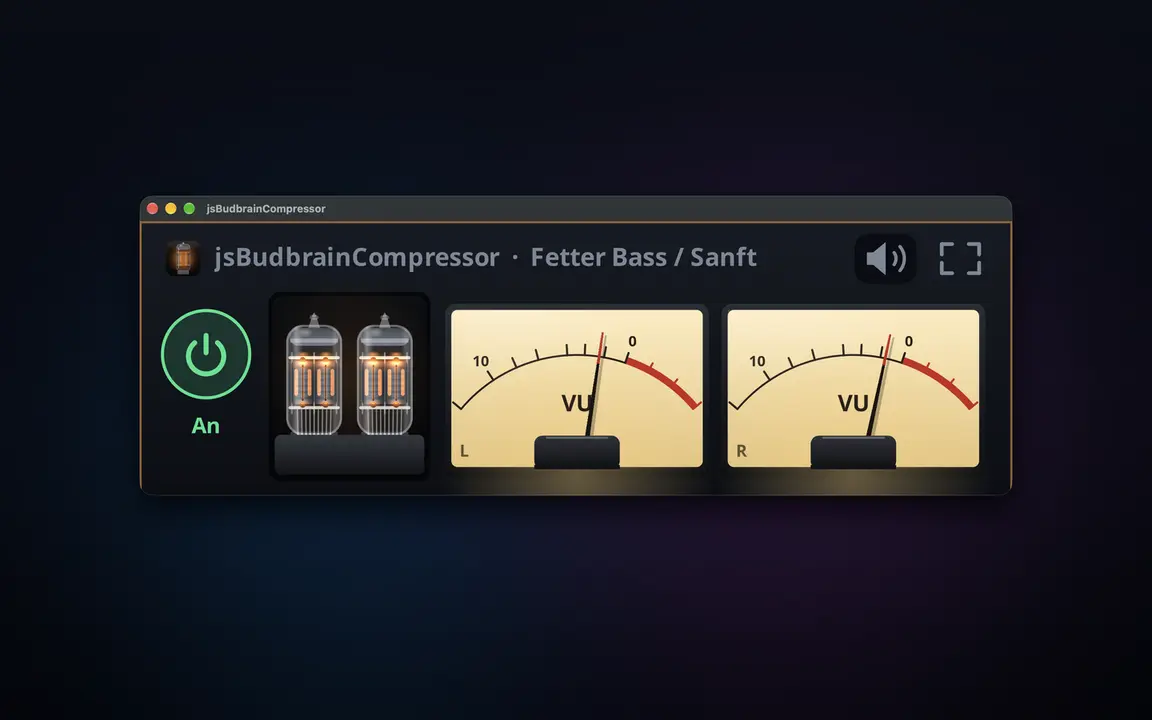
Init ng tube at isang studio compressor para sa lahat ng pinapatugtog ng iyong computer — na may kumikinang na tube at VU meter.
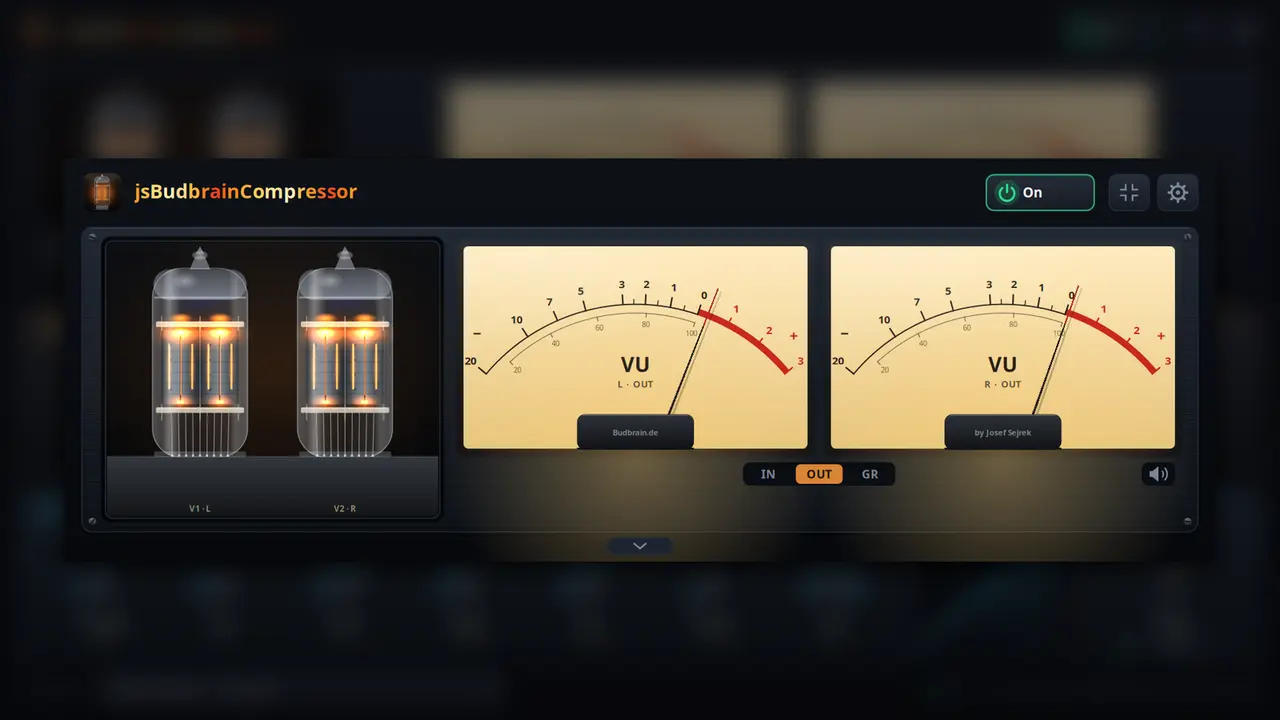
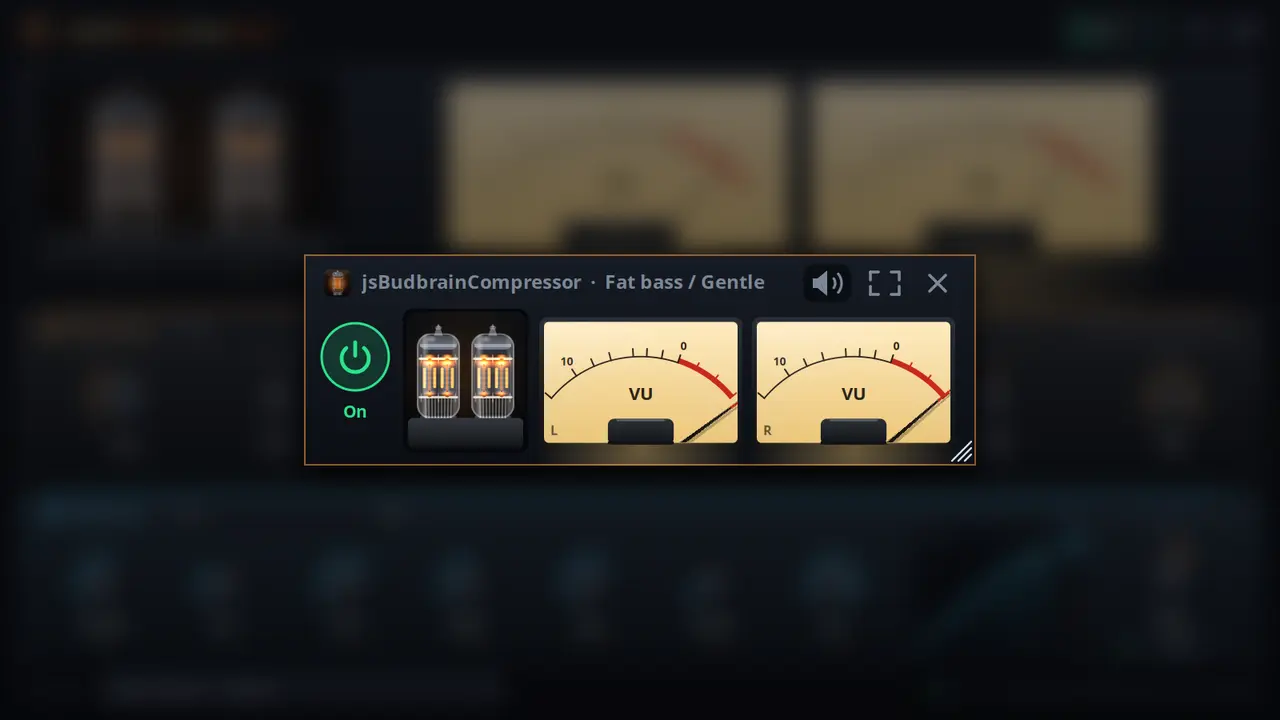
Simulated na tube preamp na may drive, bias at fatBass, mid, treble at presenceCompressor na may threshold, ratio, attack, release, knee, make-up at mixDalawang VU meter na may totoong galaw ng karayomMas maliwanag ang kinang ng mga tube habang mas nagtatrabaho silaMga handa nang setting para sa mga tube at compressor, at sarili moPinoprotektahan ng limiter ang tainga at mga speakerGumagana kasama ang jsBudbrainEqualizer at jsBudbrainsFxStudioMute button para kapag tumutunog ang teleponoPiliin ang iyong mga speaker o headphoneMaliit na window na laging nasa ibabawMaliwanag at madilimSDL2 · CairoPipeWire · PulseAudio83 mga wika
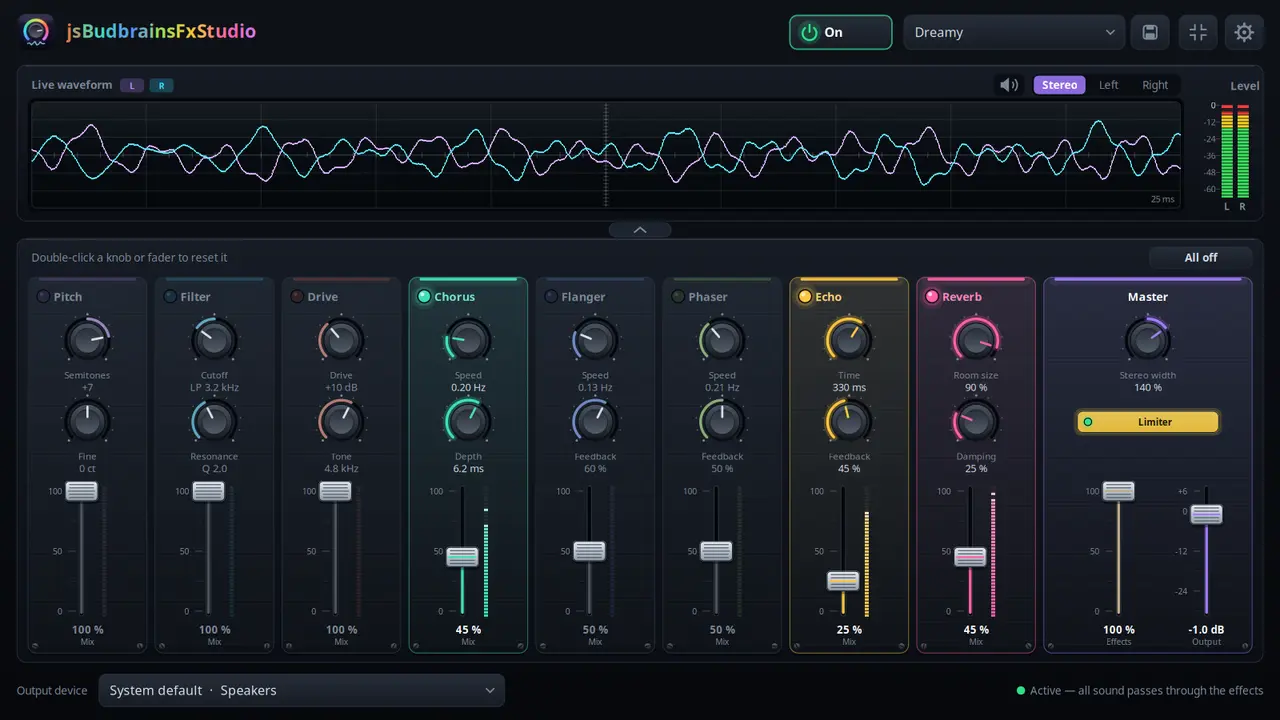
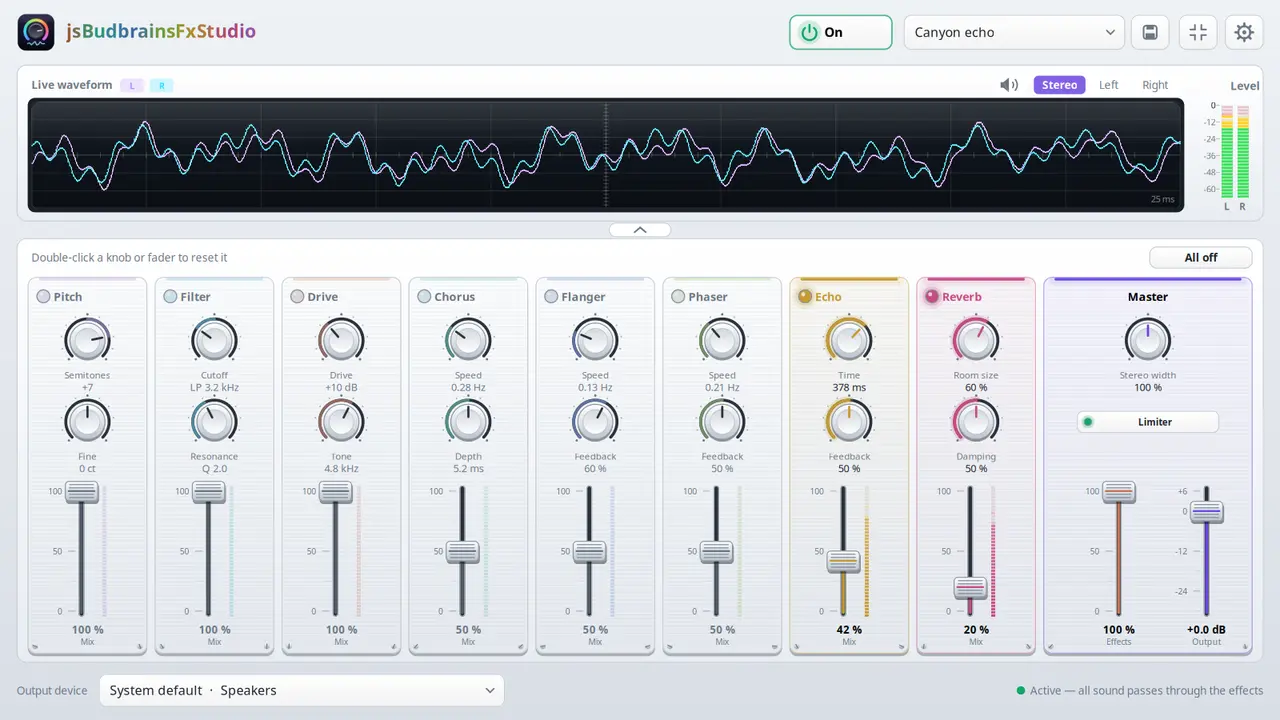
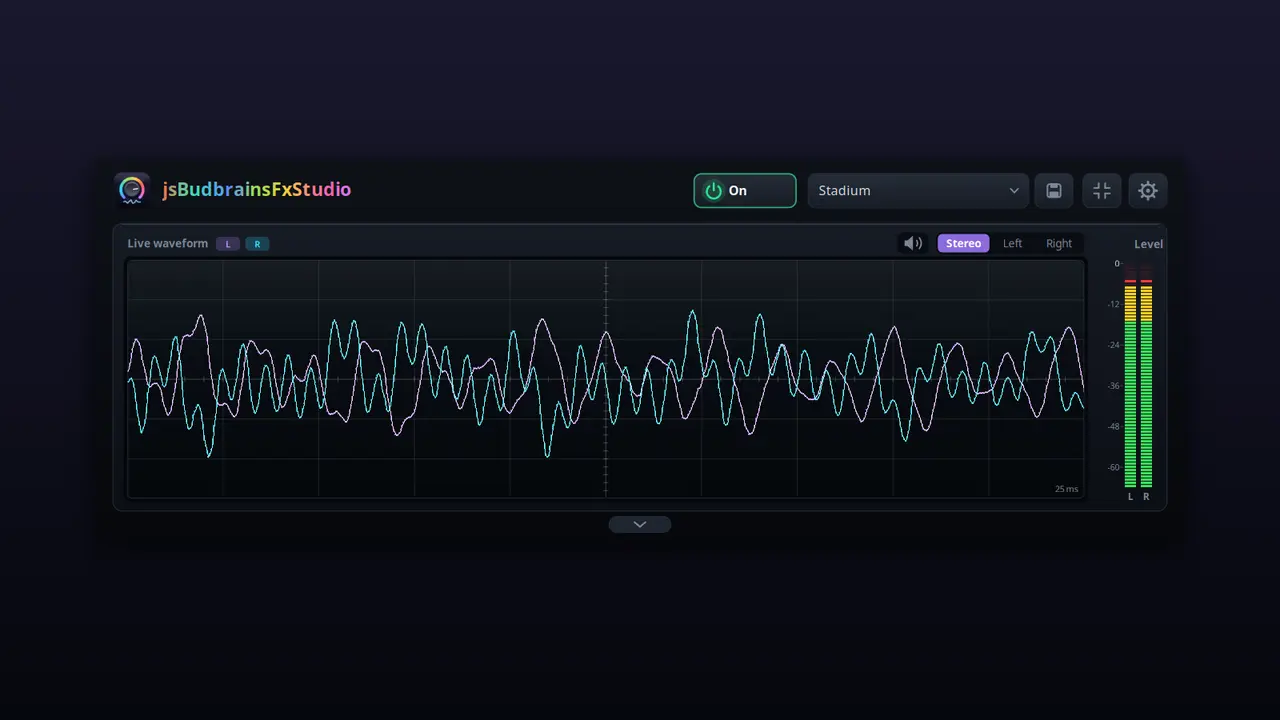
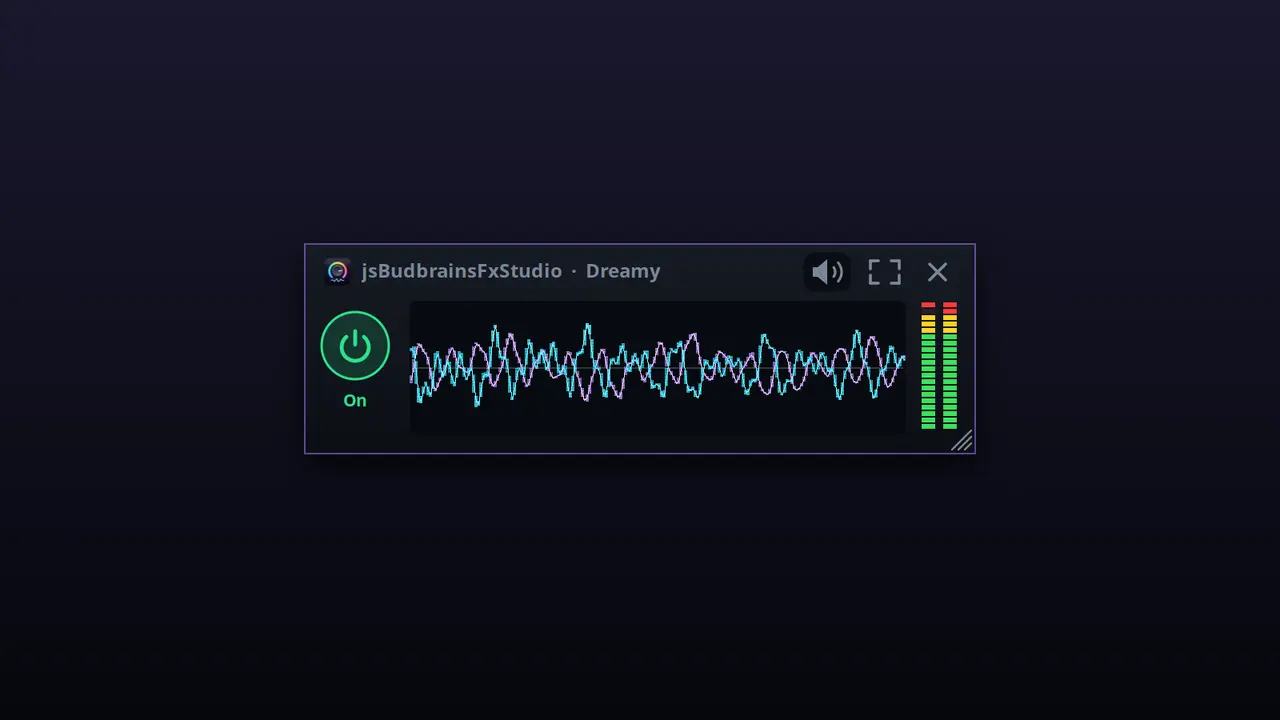
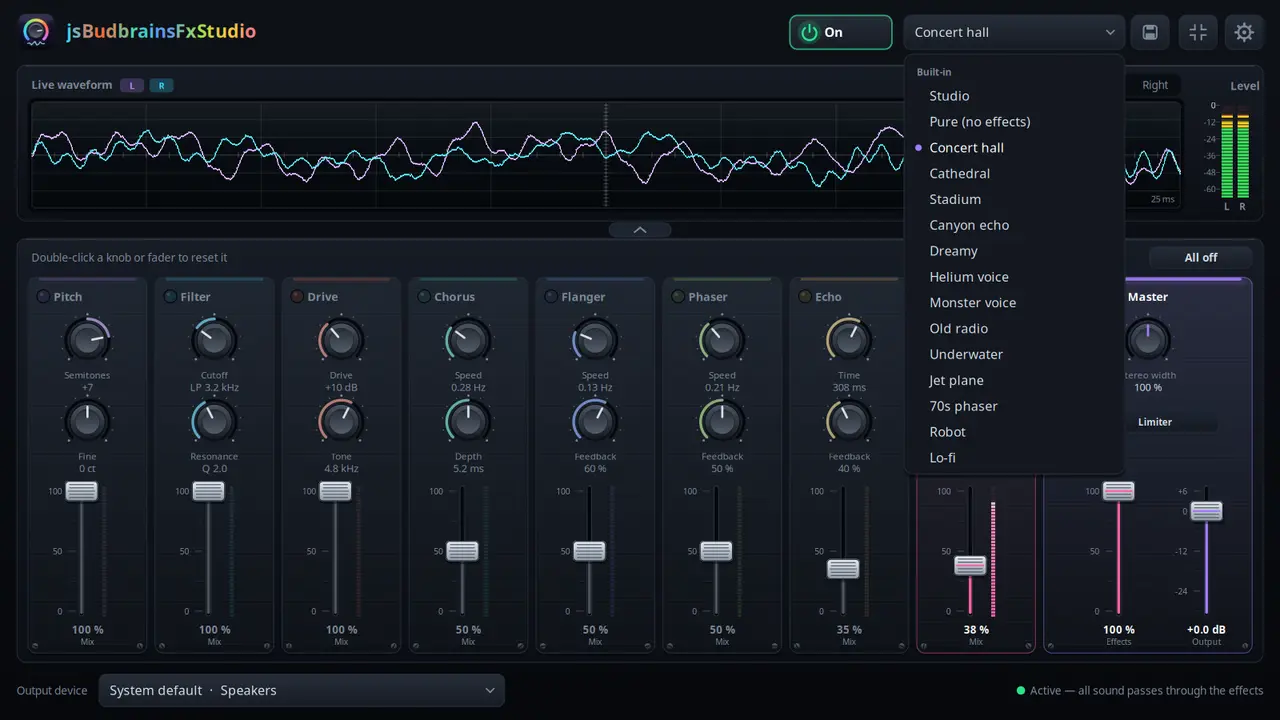
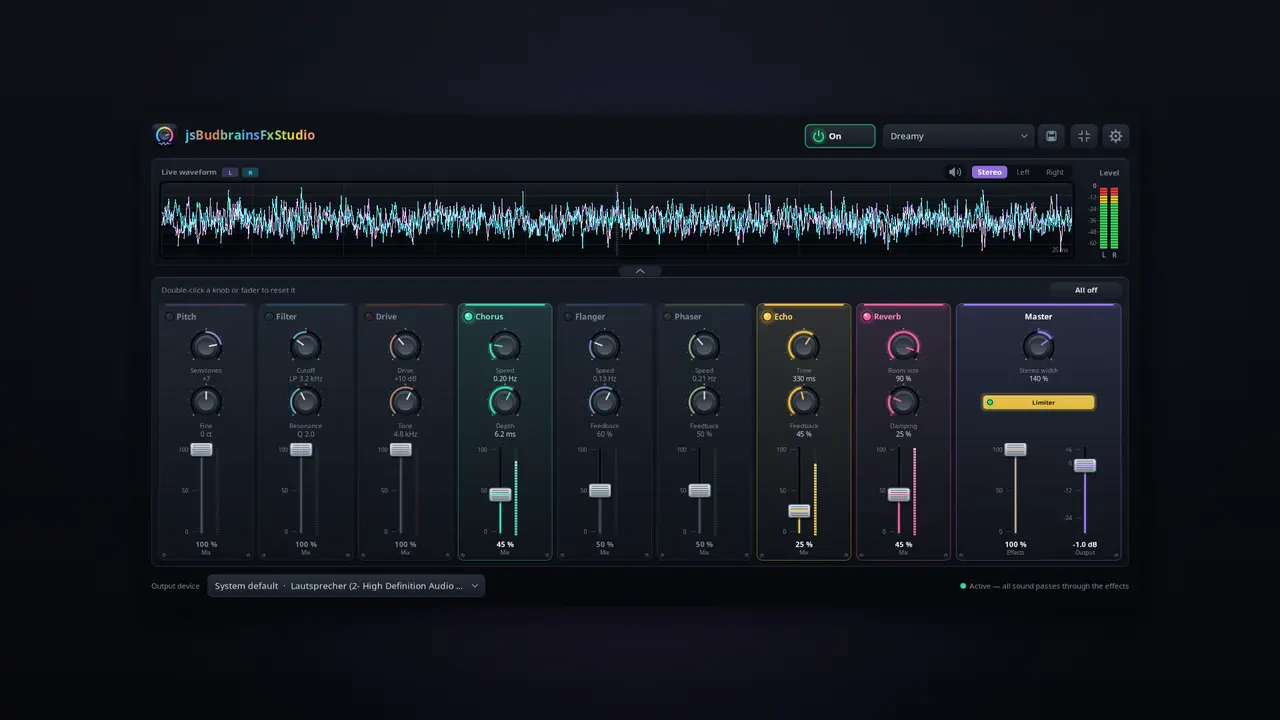
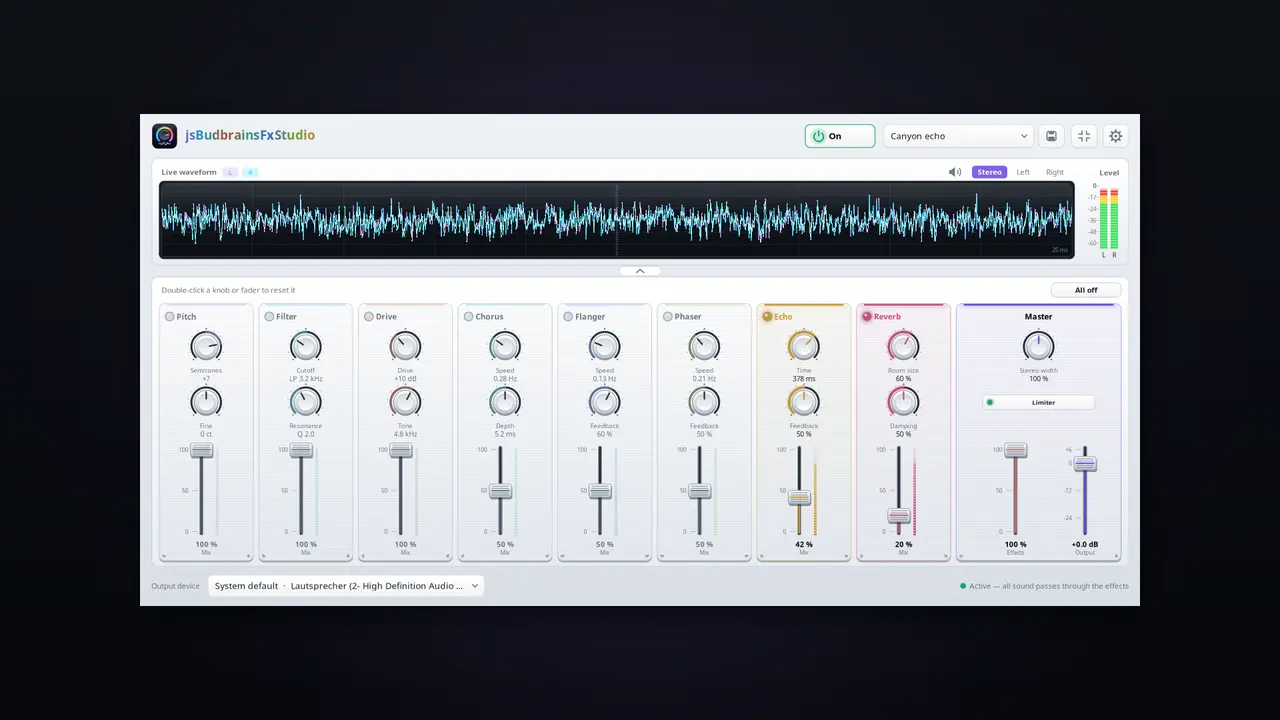
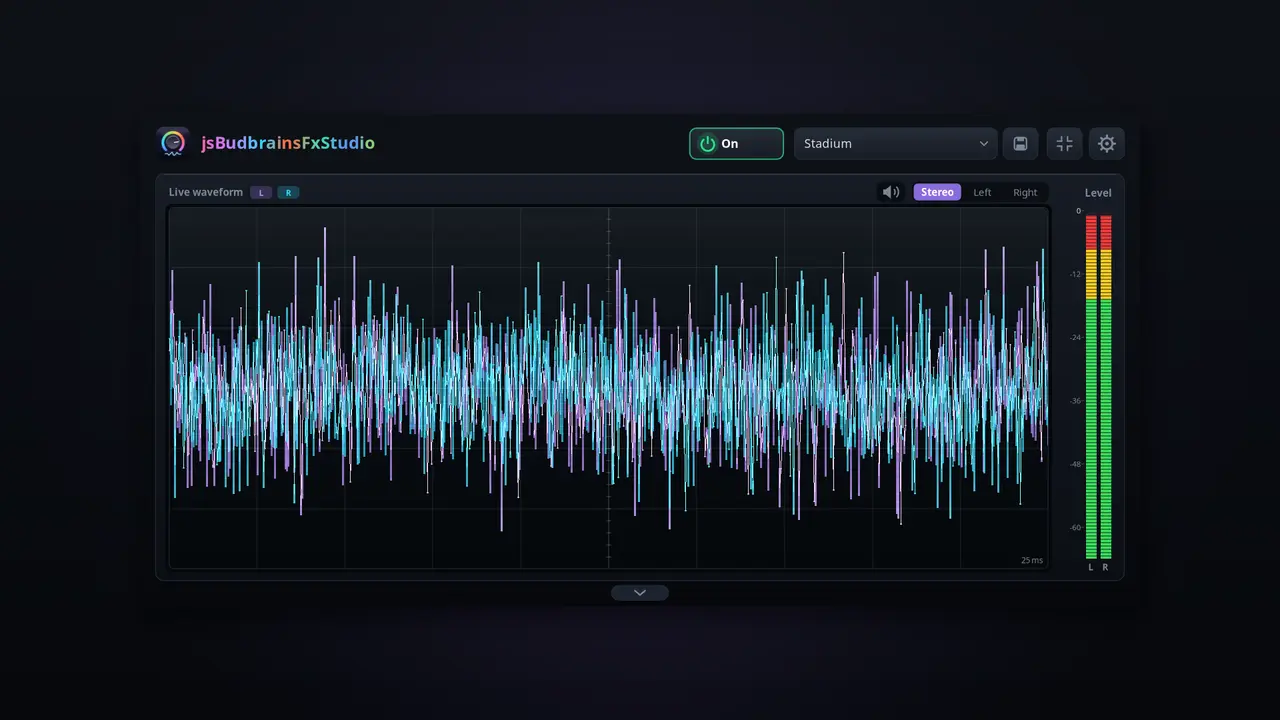
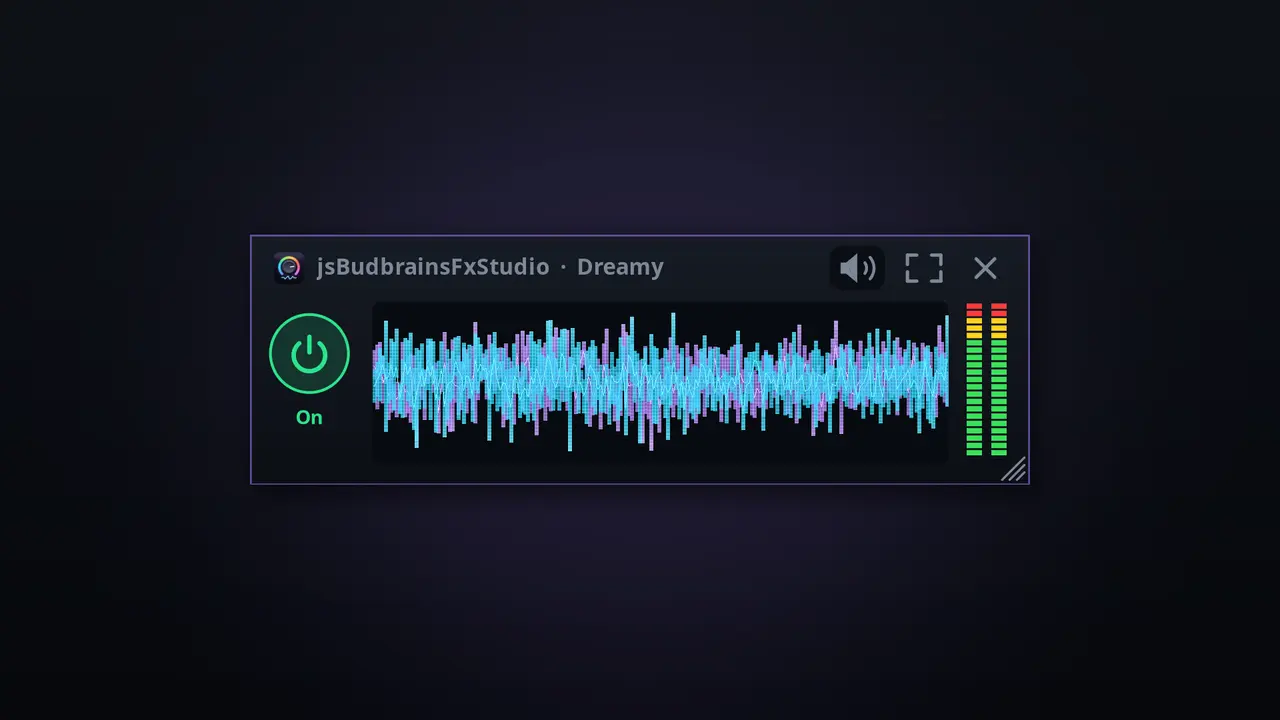
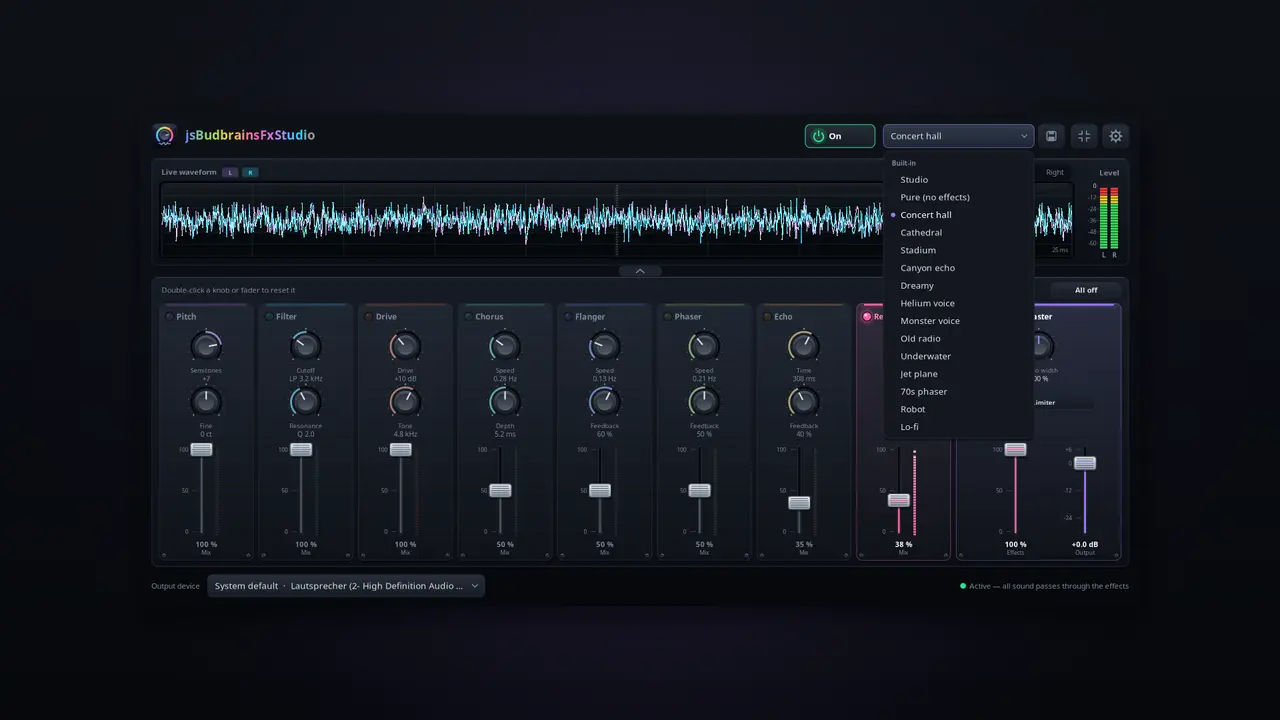
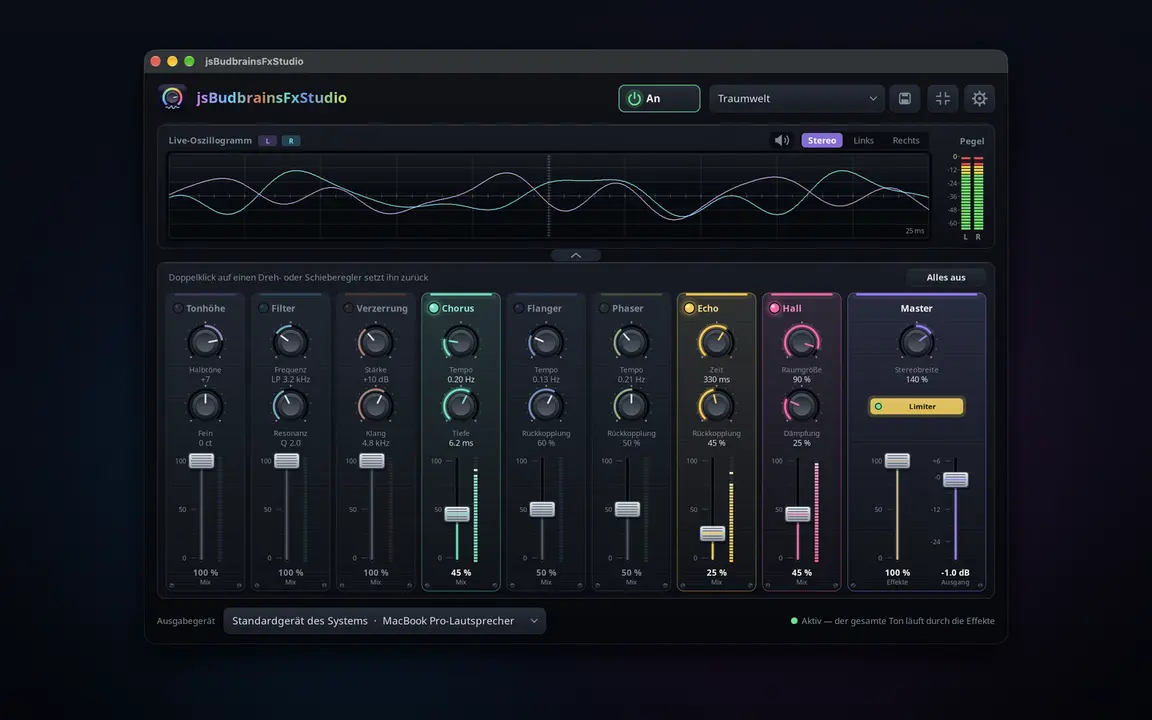
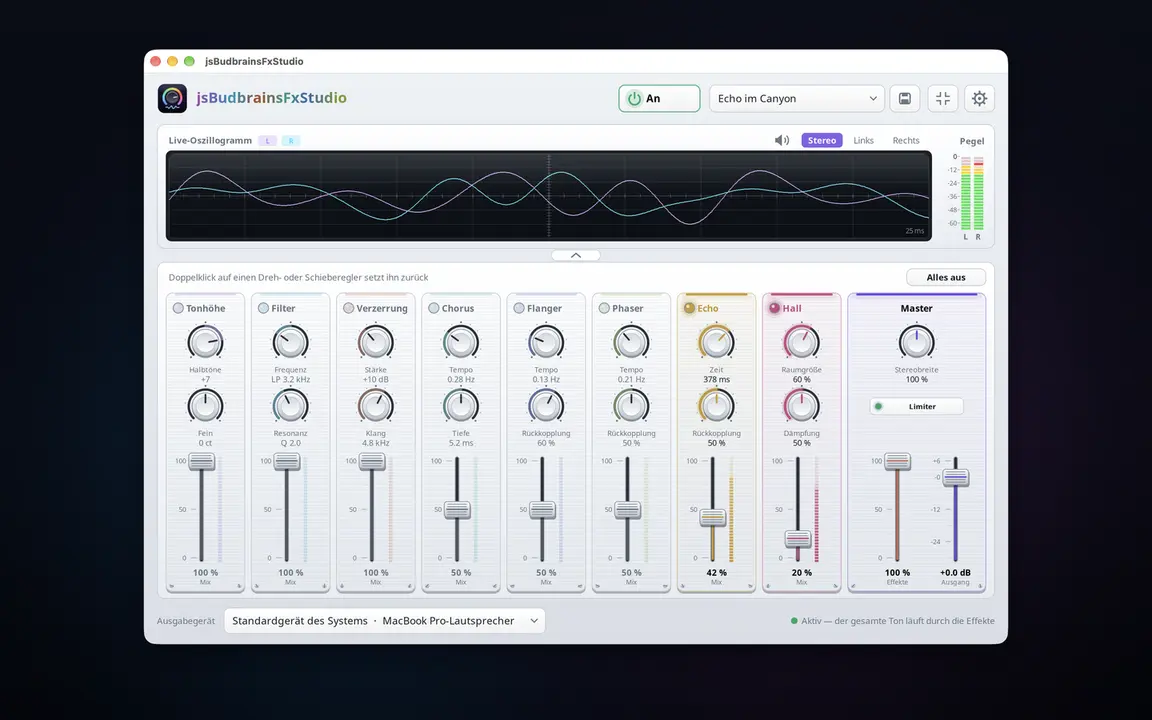
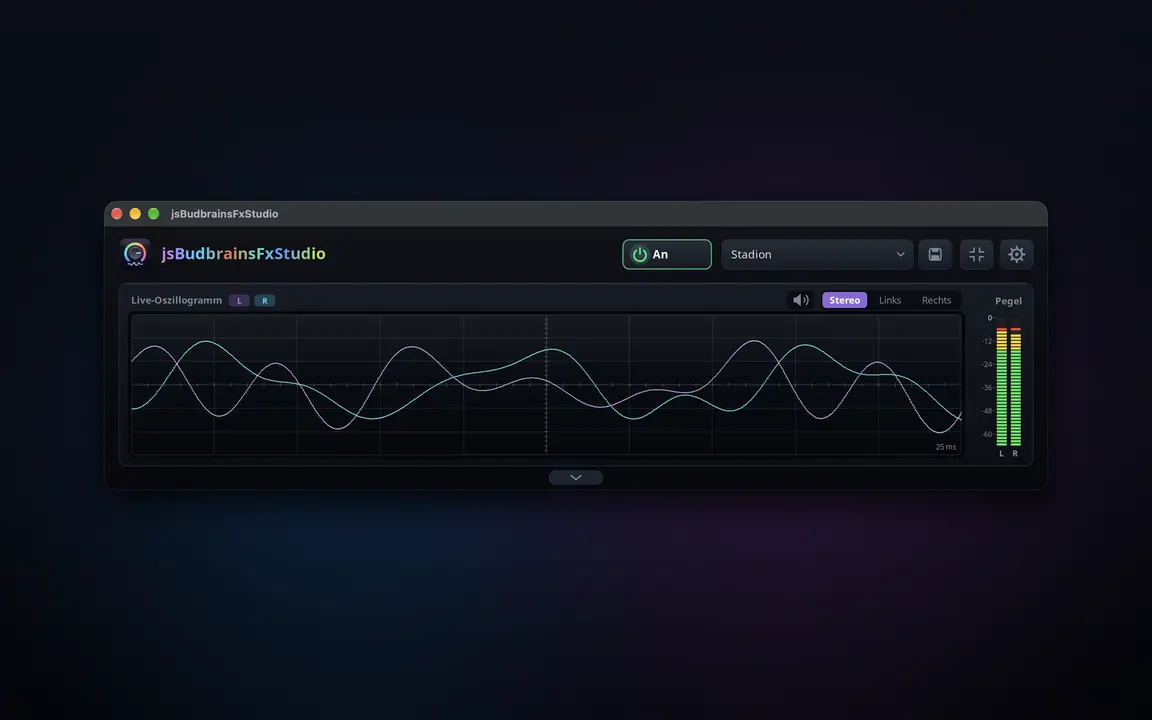
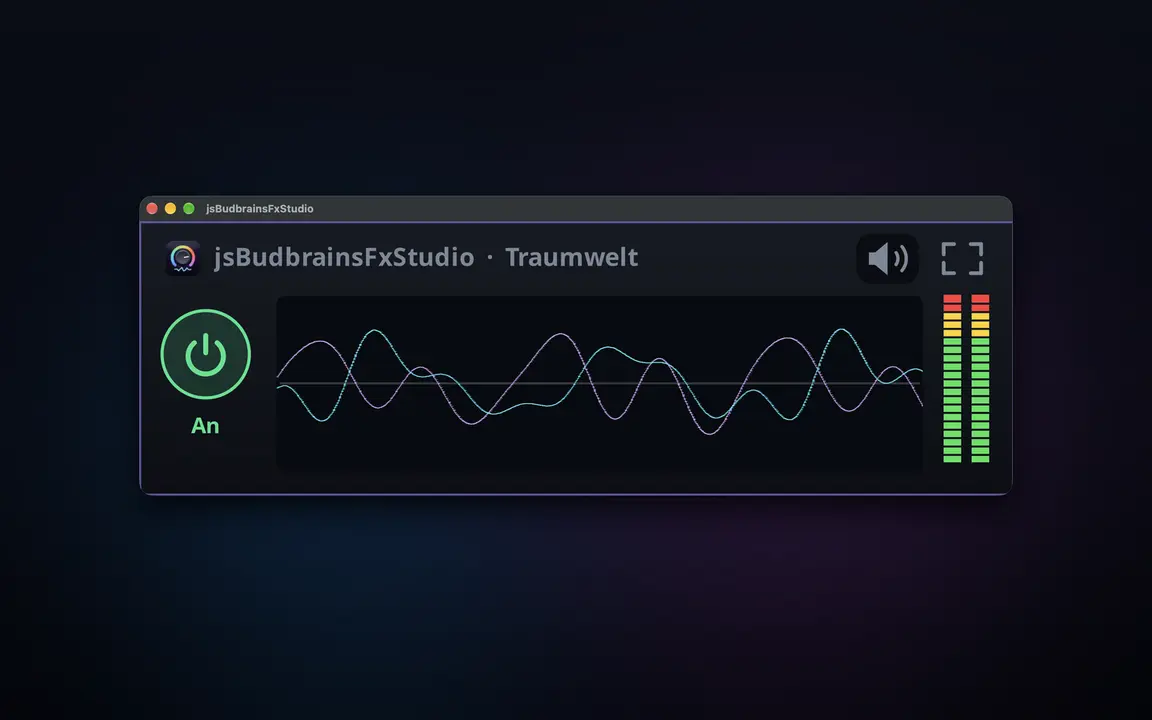
Mga live effect para sa lahat ng pinapatugtog ng iyong computer — reverb, echo, pitch at iba pa, hinahalo sa tunog gamit ang fader.
Walong effect: pitch, filter, drive, chorus, flanger, phaser, echo, reverbBawat effect ay may sariling knob at mix faderIsang fader ang naghahalo ng lahat ng effect sa pangunahing mixLive na waveform at level meterMga handa nang setting gaya ng concert hall o canyon echo, at sarili mo“All off” sa isang click — at ibalik sa susunodPinoprotektahan ng limiter ang tainga at mga speakerGumagana kasama ang jsBudbrainEqualizerMute button para kapag tumutunog ang teleponoPiliin ang iyong mga speaker o headphoneMaliit na window na laging nasa ibabawMaliwanag at madilimSDL2 · CairoPipeWire · PulseAudio83 mga wika
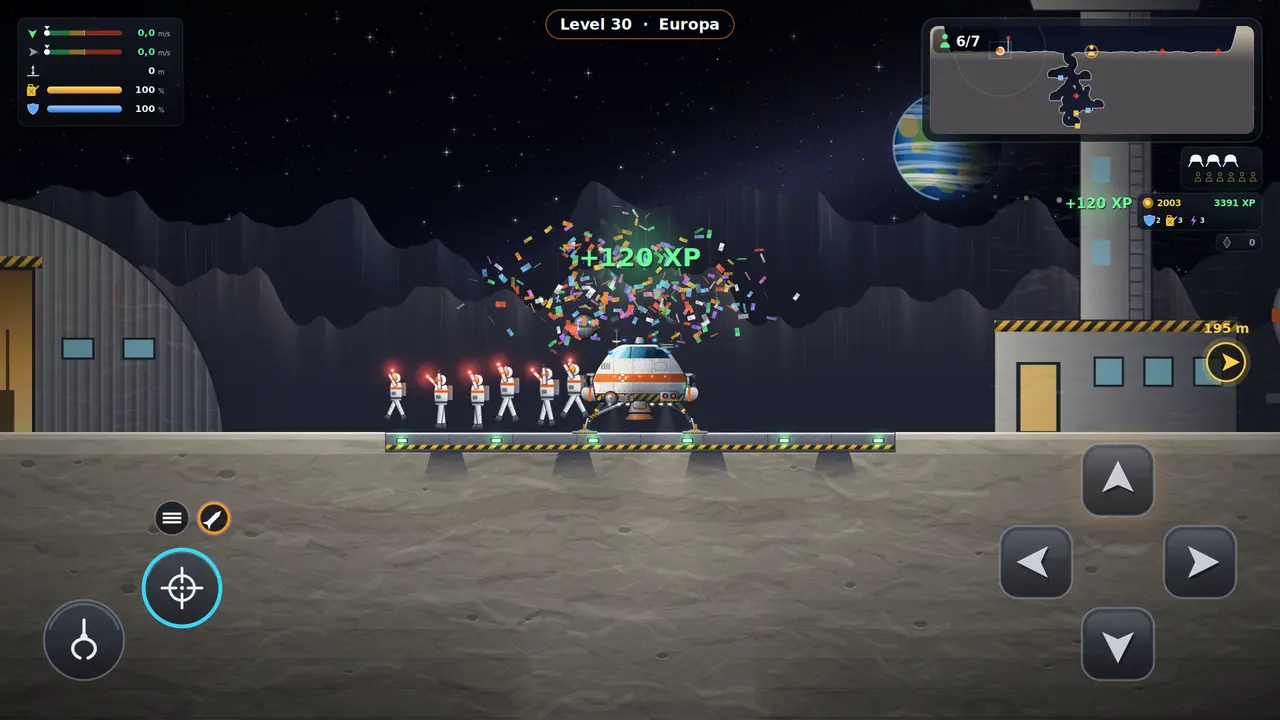
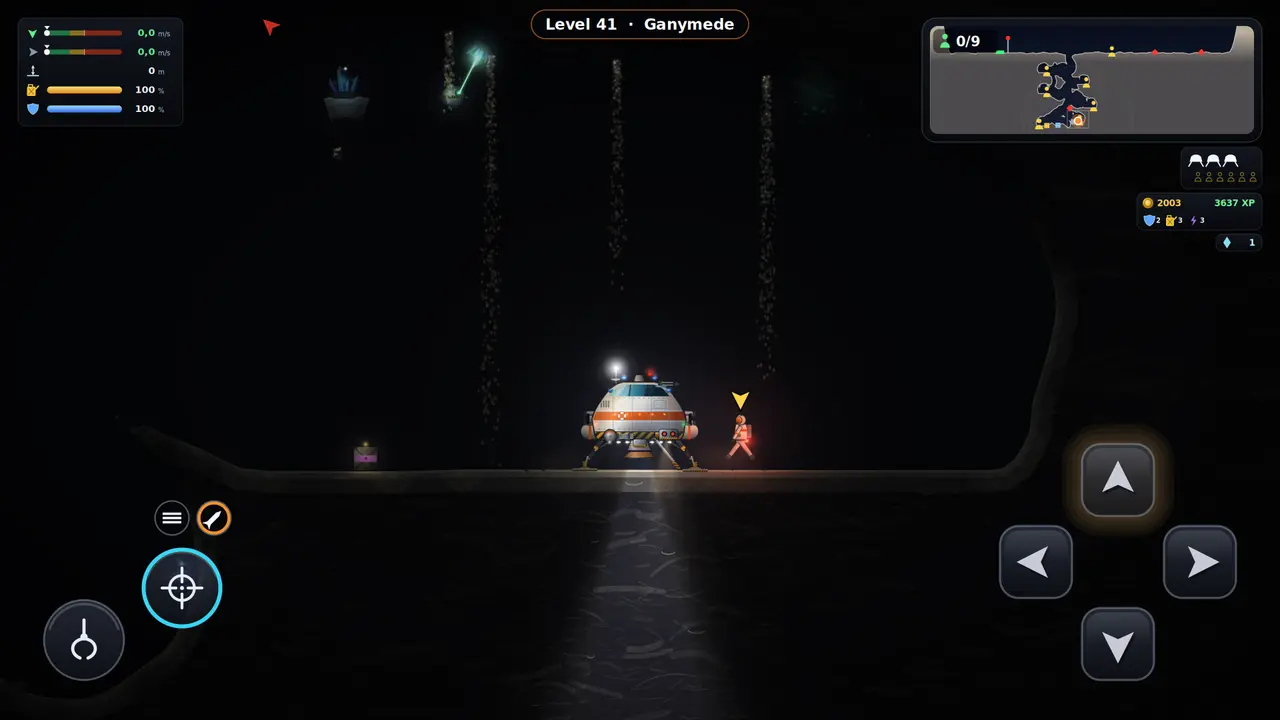
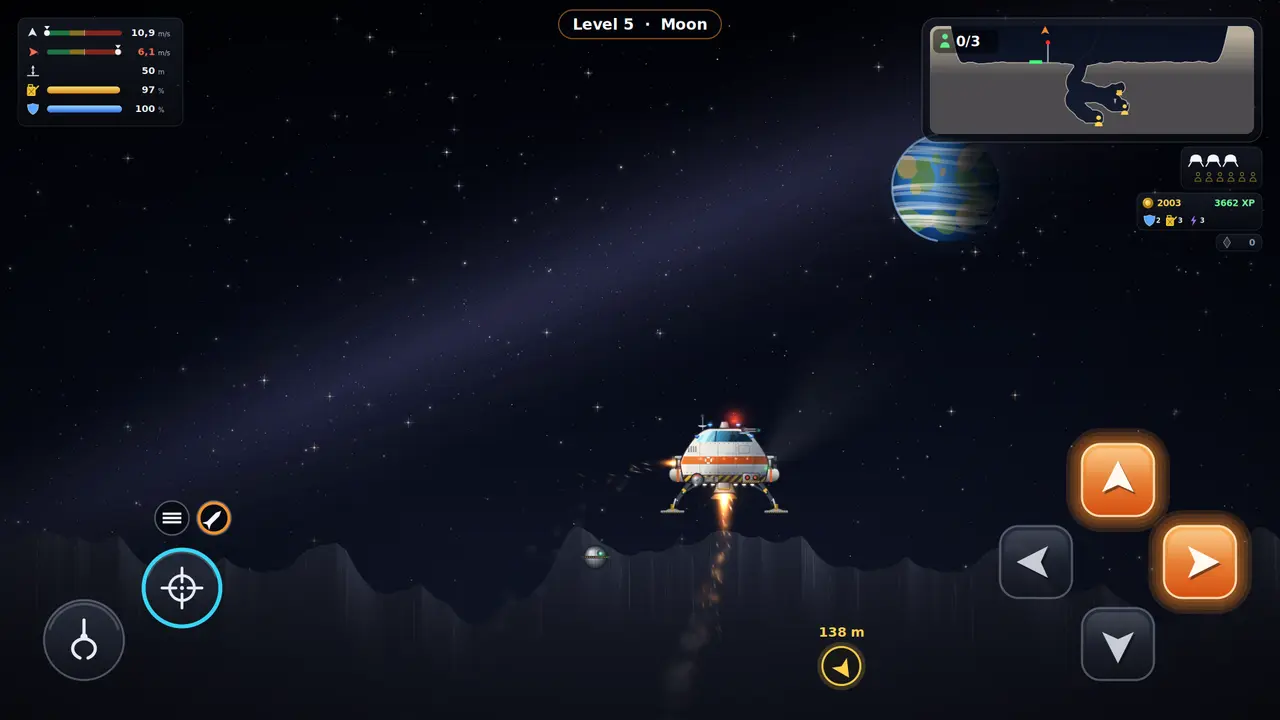
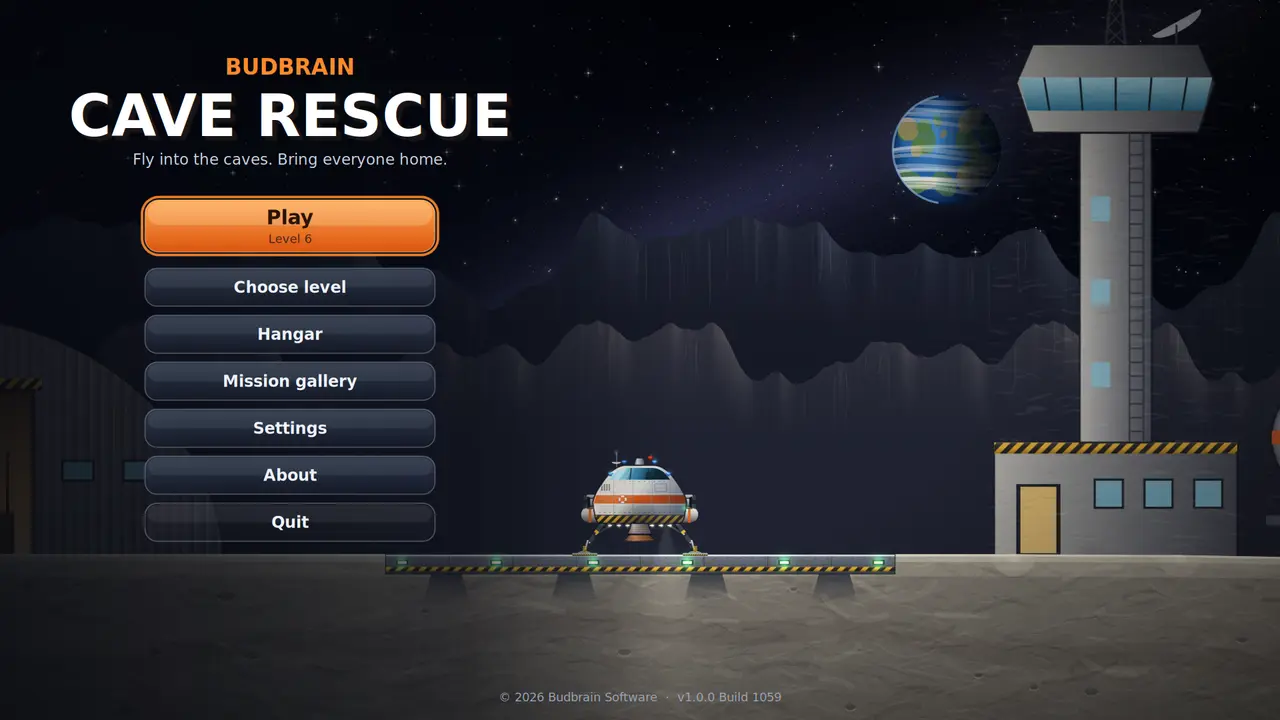
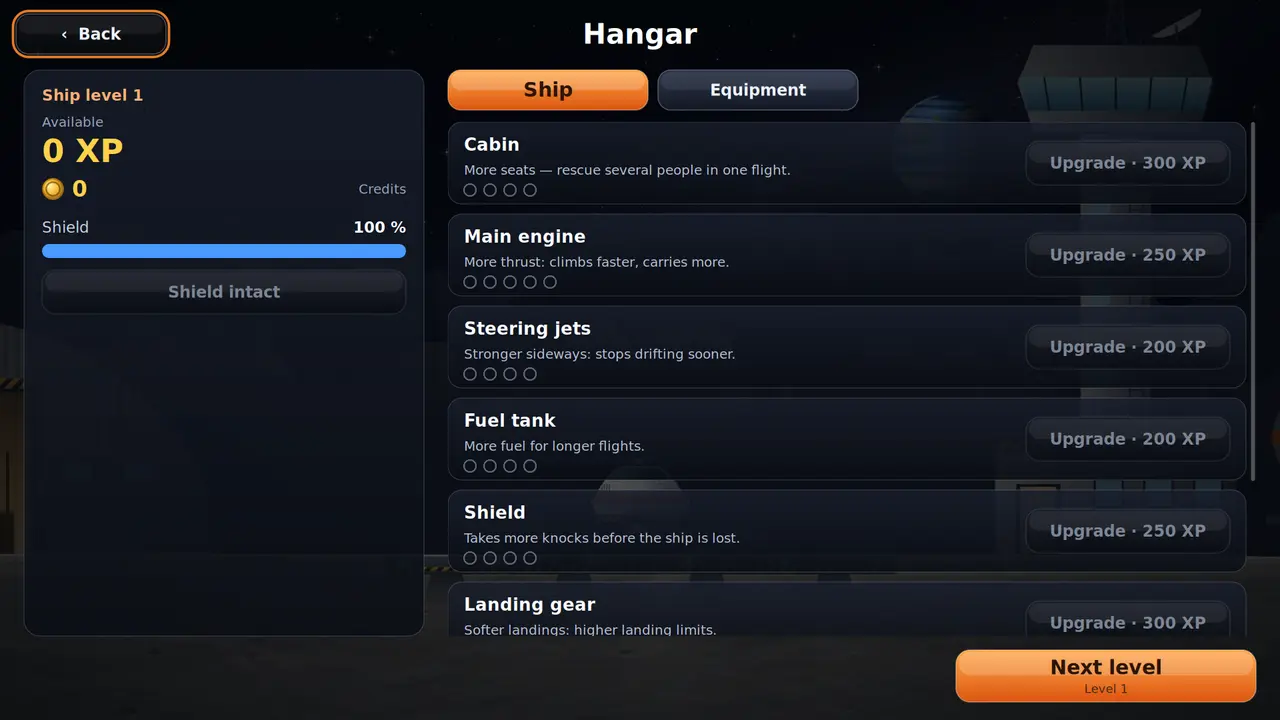
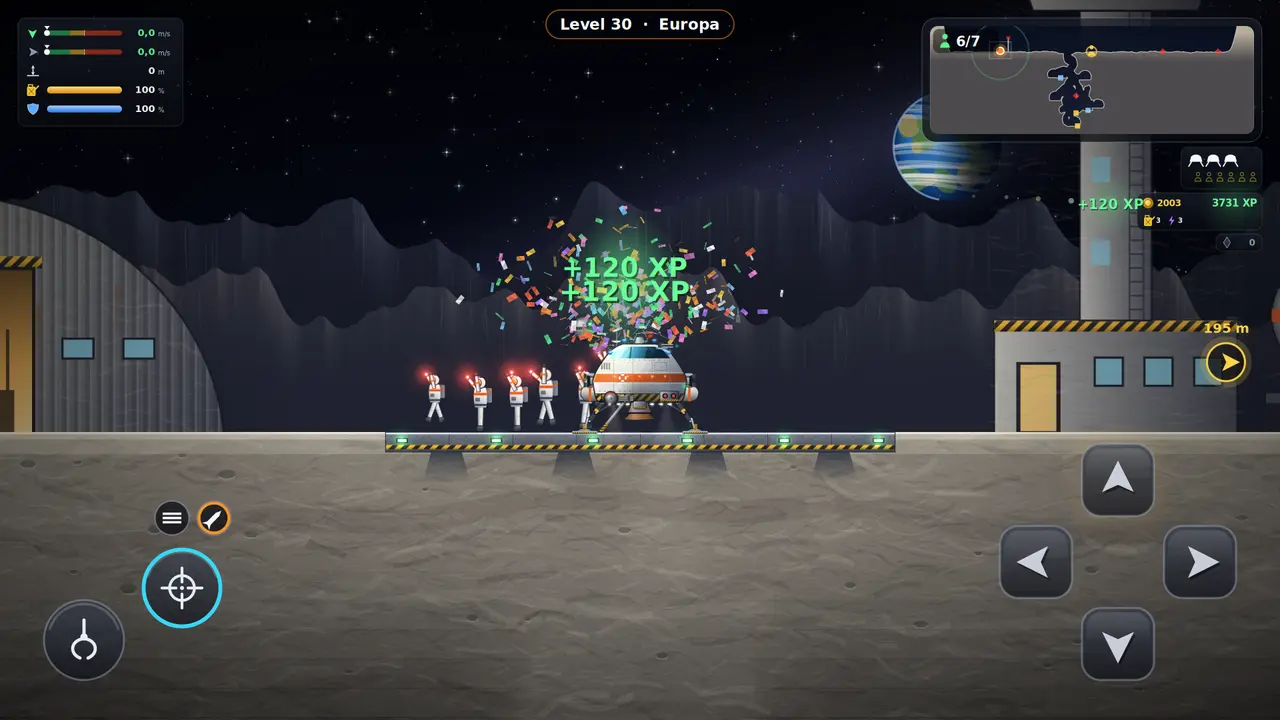
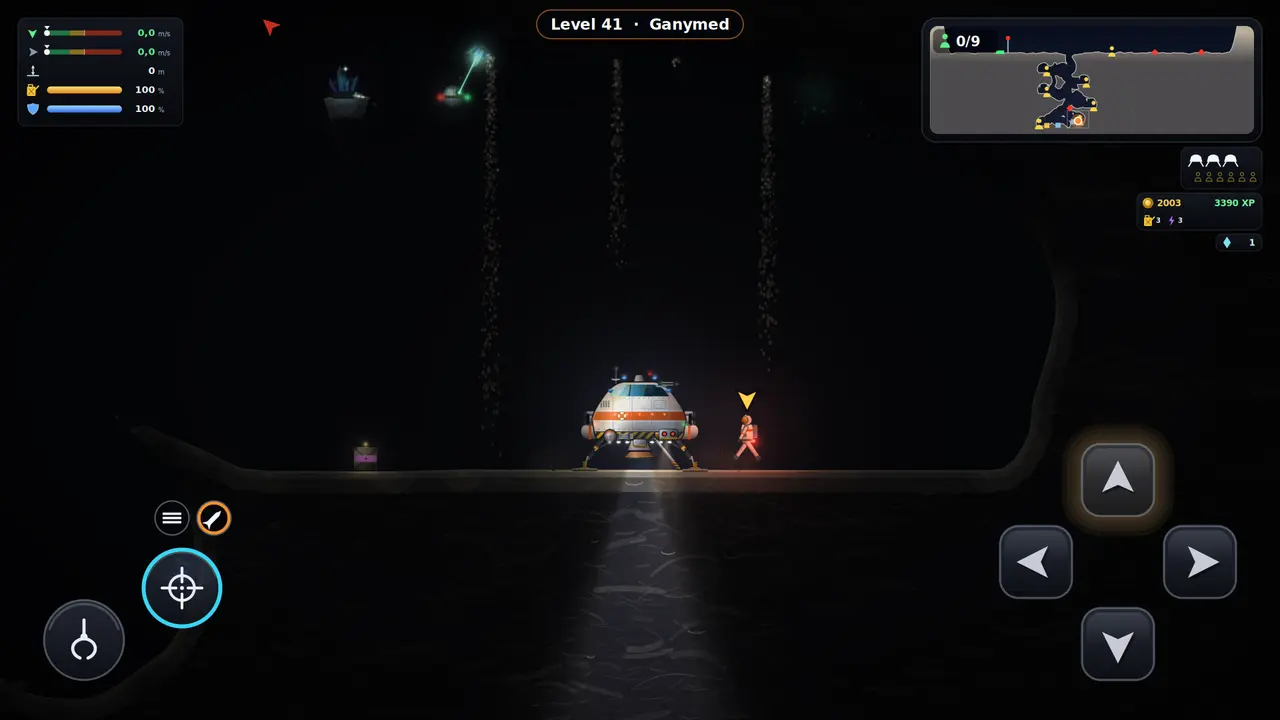
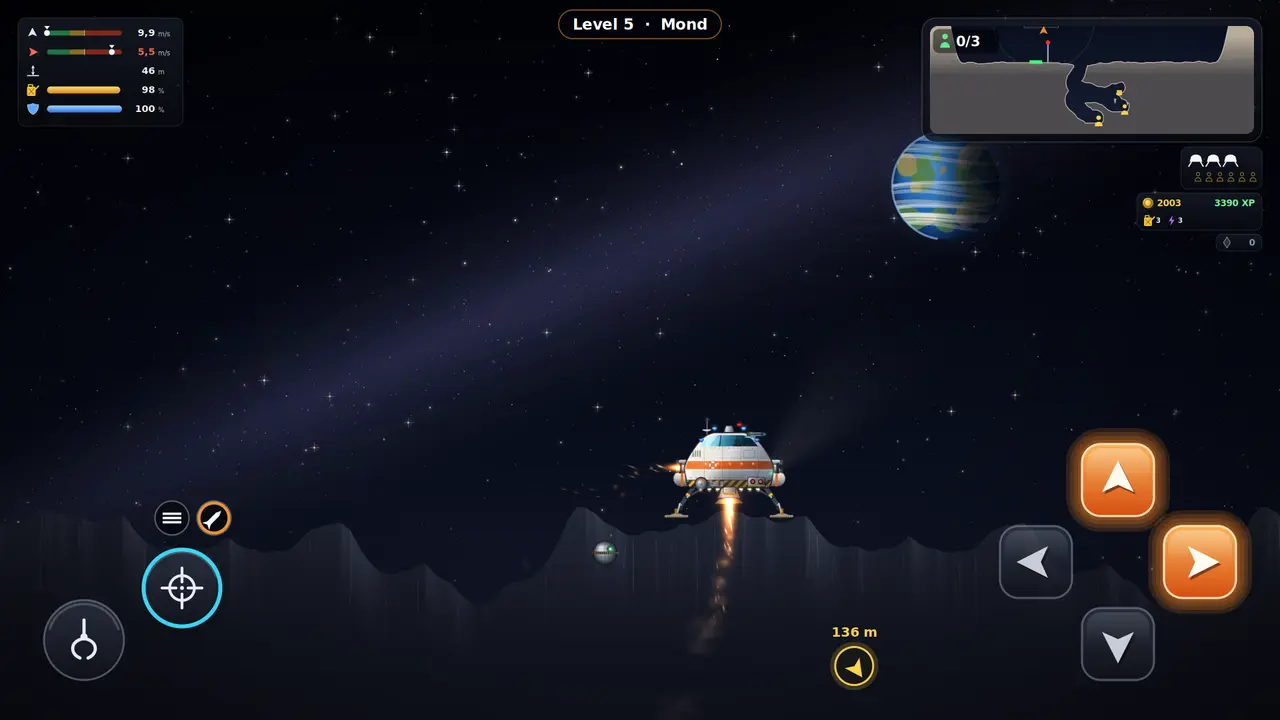
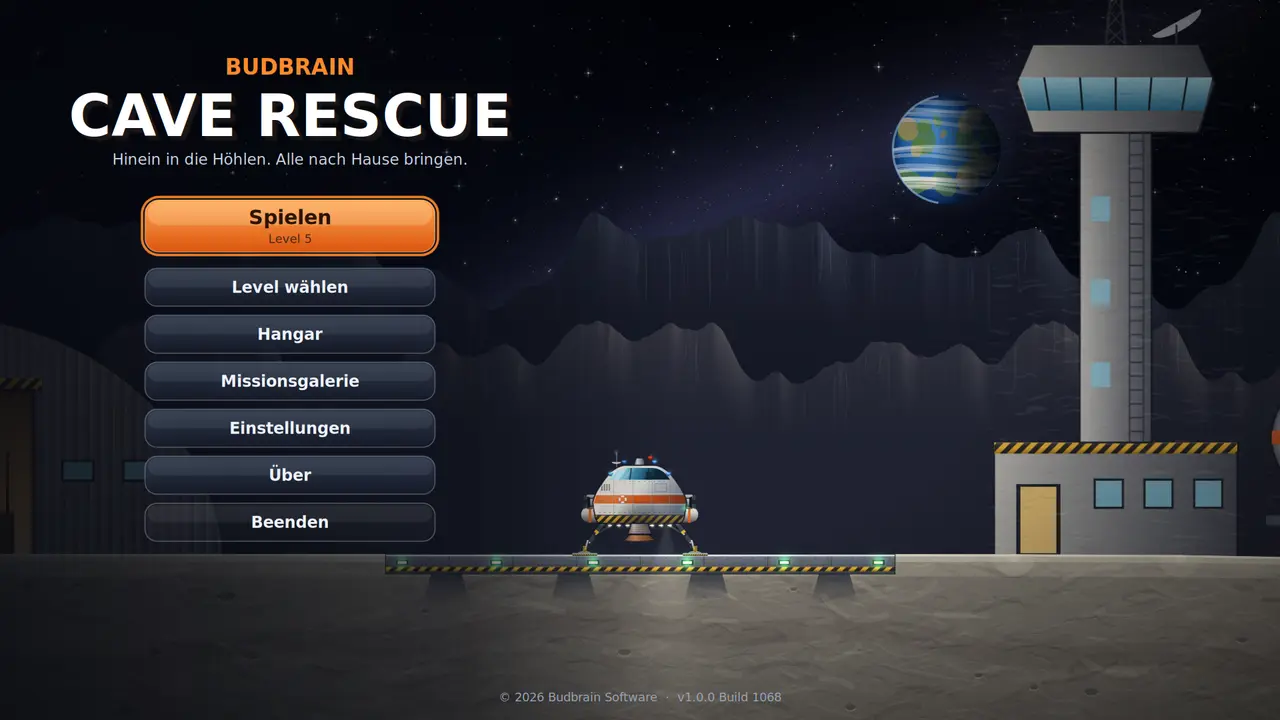
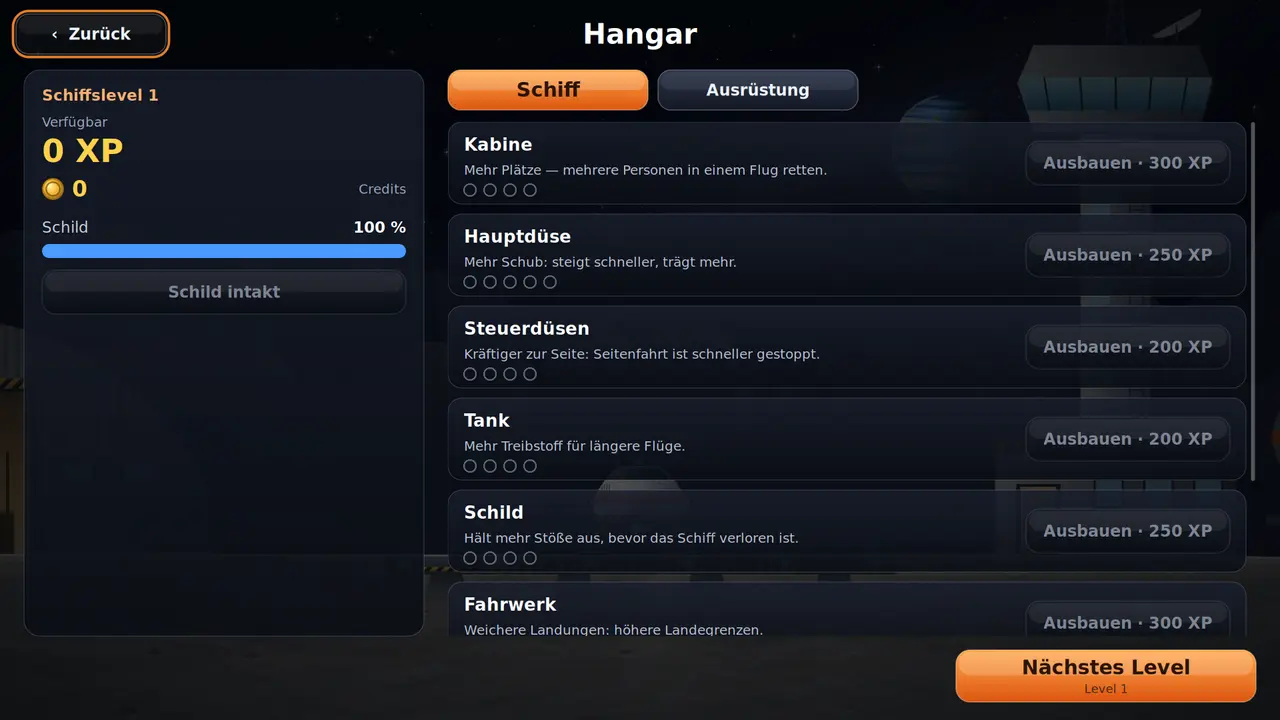
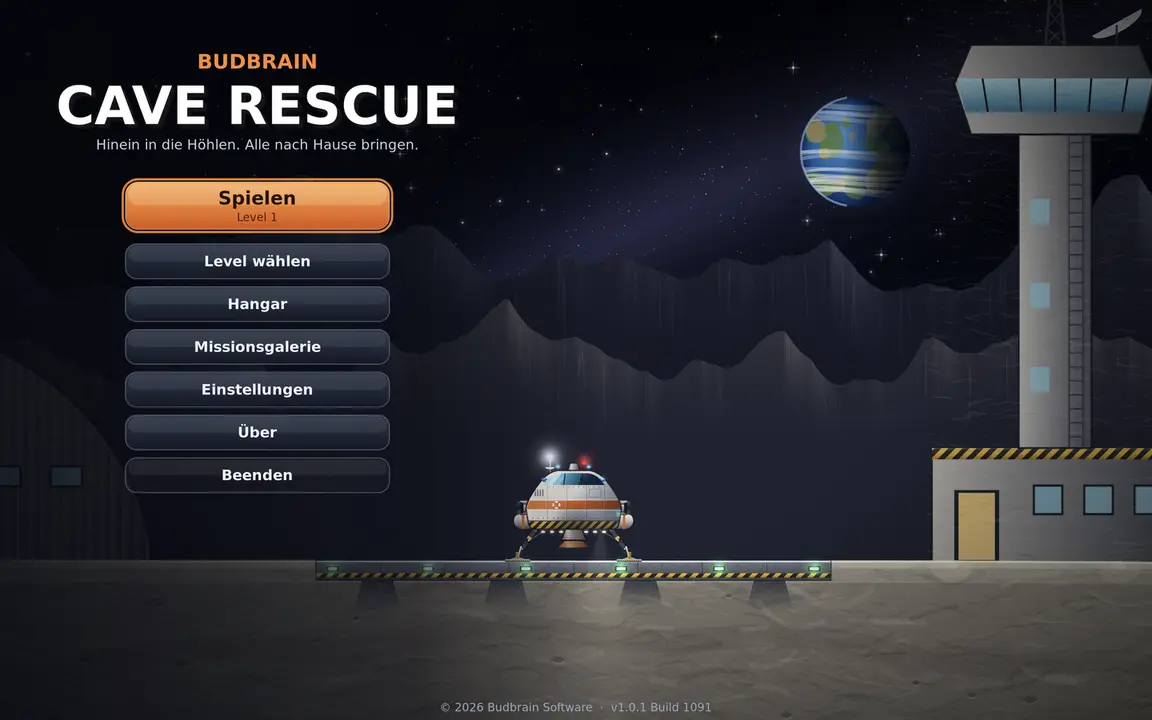
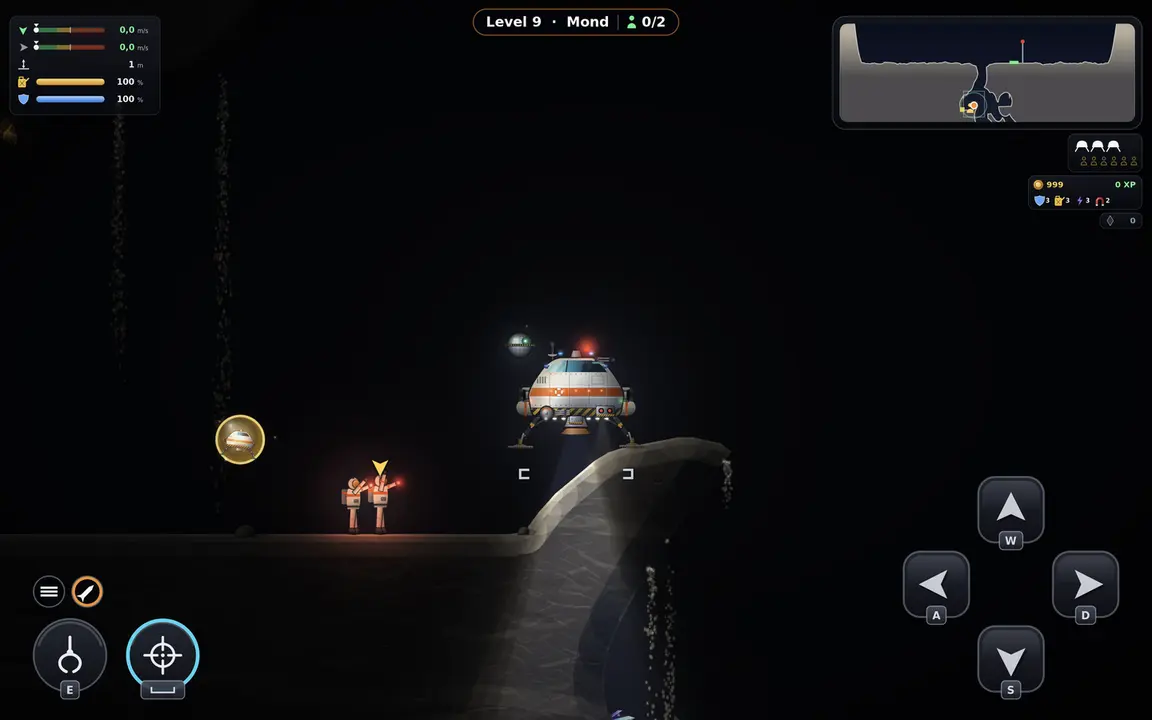
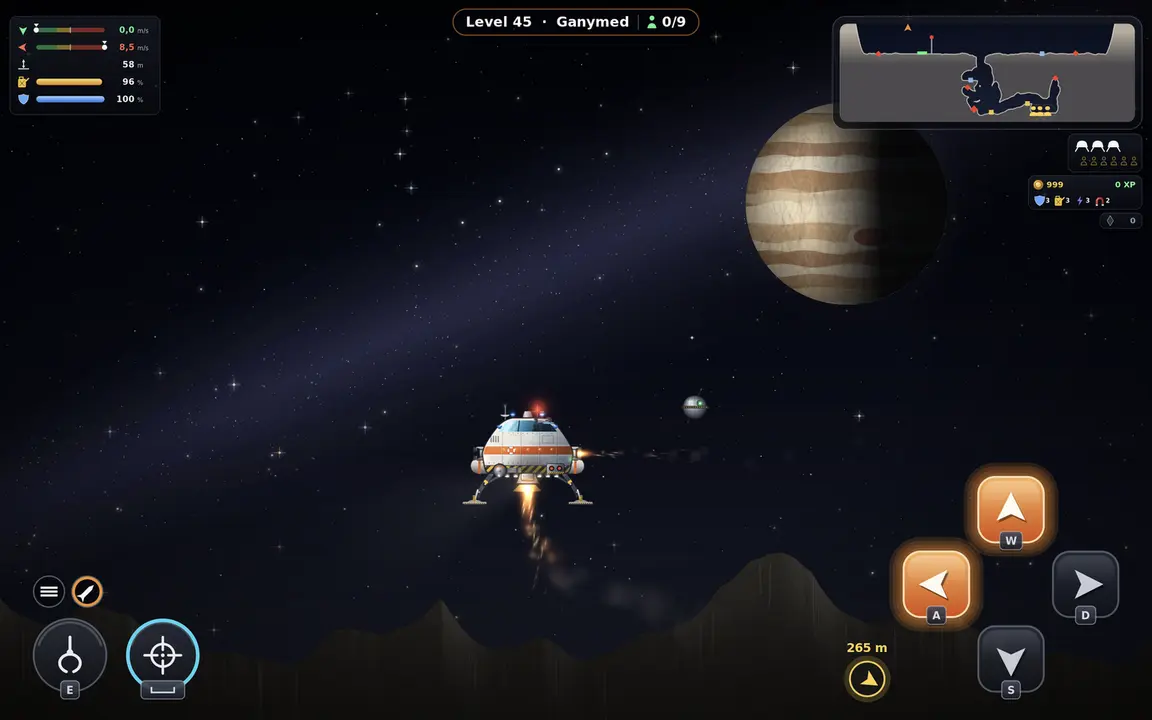
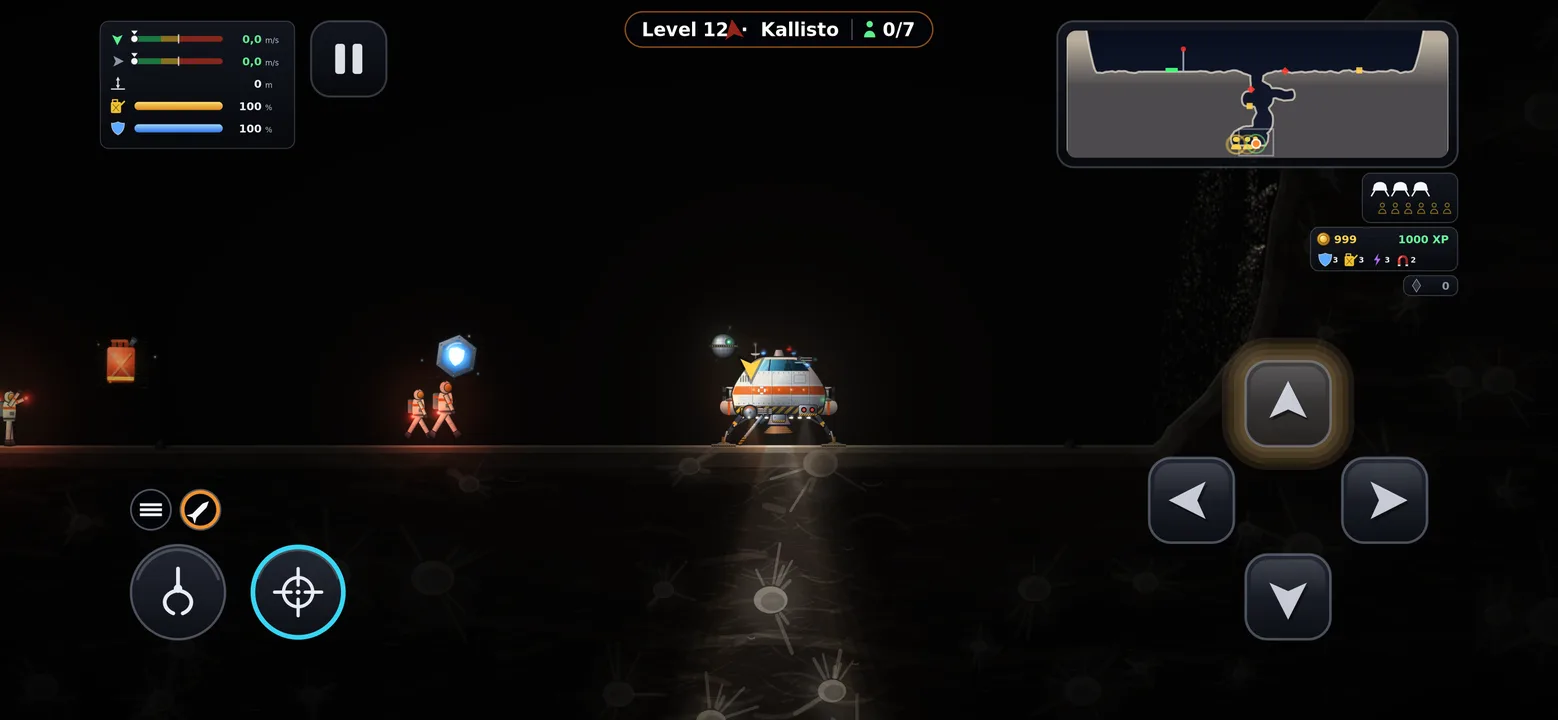
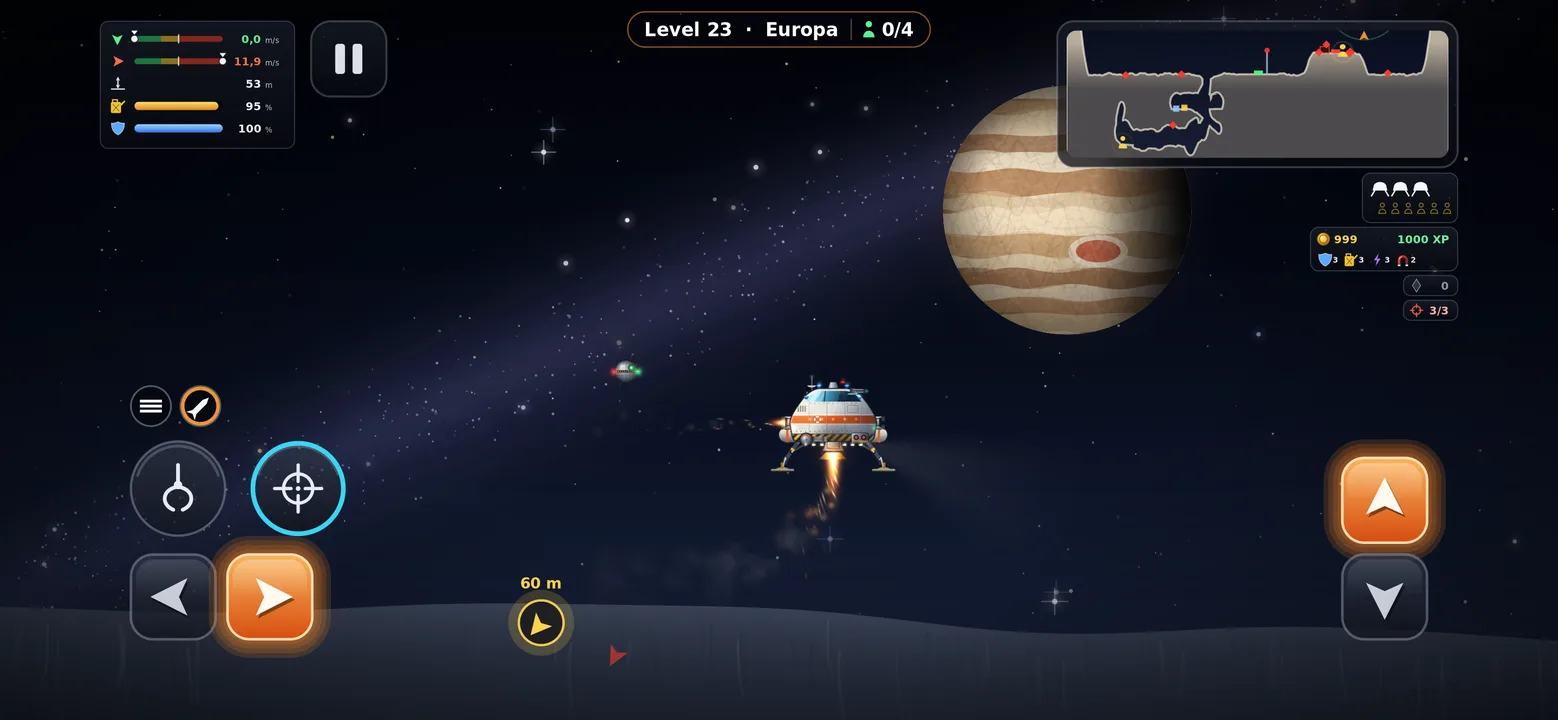
Lumipad sa malalalim na kweba ng buwan at ibalik nang ligtas sa tahanan ang mga naipit na astronaut.
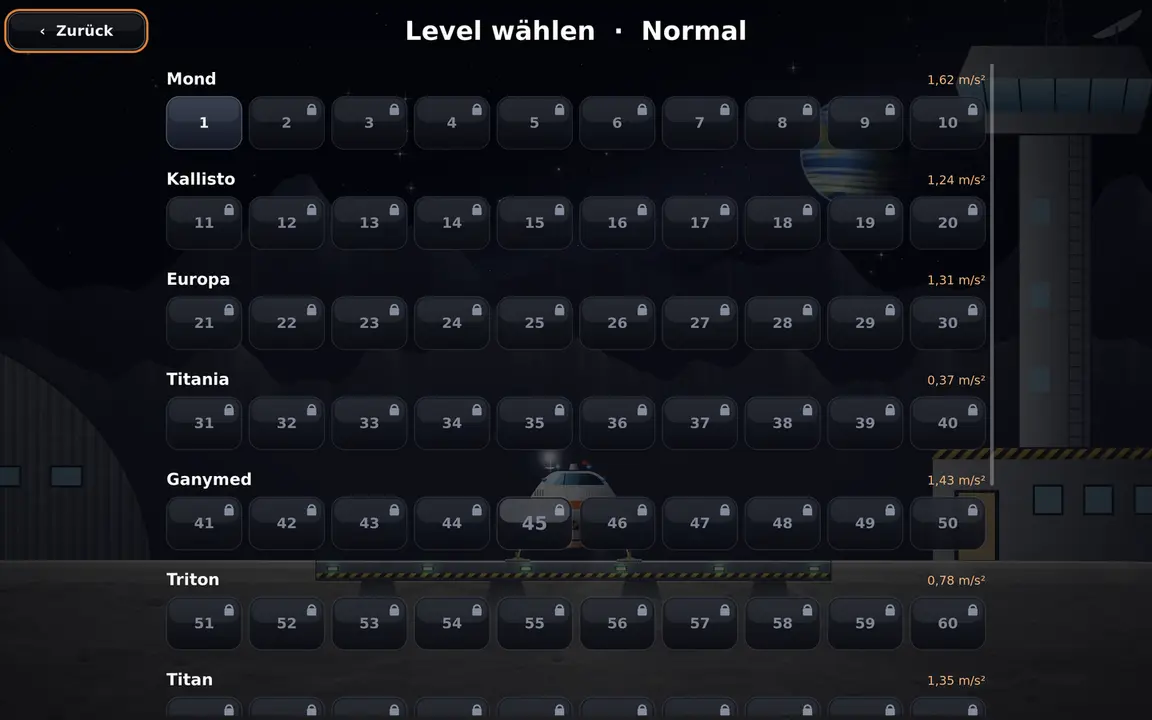
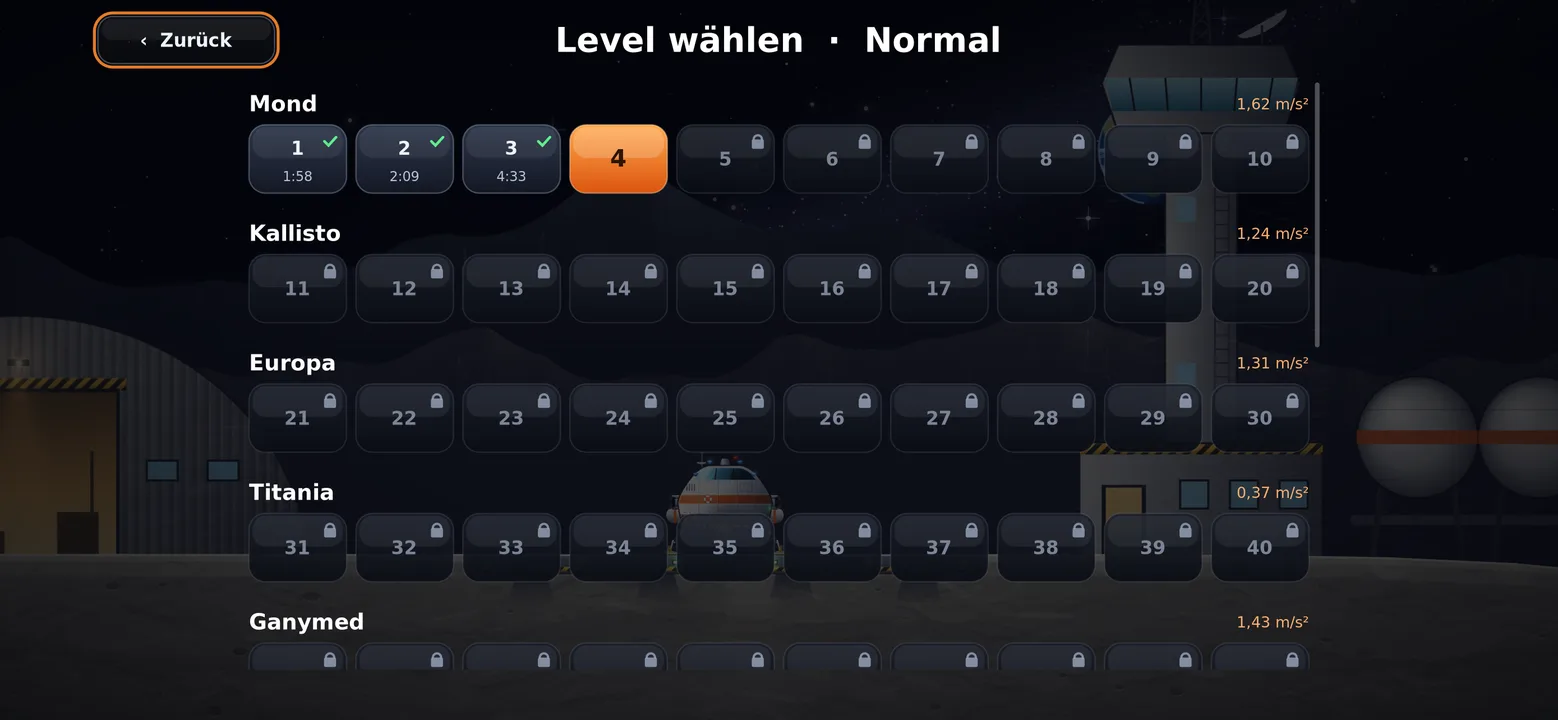
100 antas sa sampung mundoTotoong gravityApat na button, wala nang ibaI-upgrade ang iyong barko gamit ang karanasanApat na antas ng hirapGallery ng mga misyon na may mapa ng paglipadKeyboard, mouse o gamepadSDL2 · Cairo44 mga wika
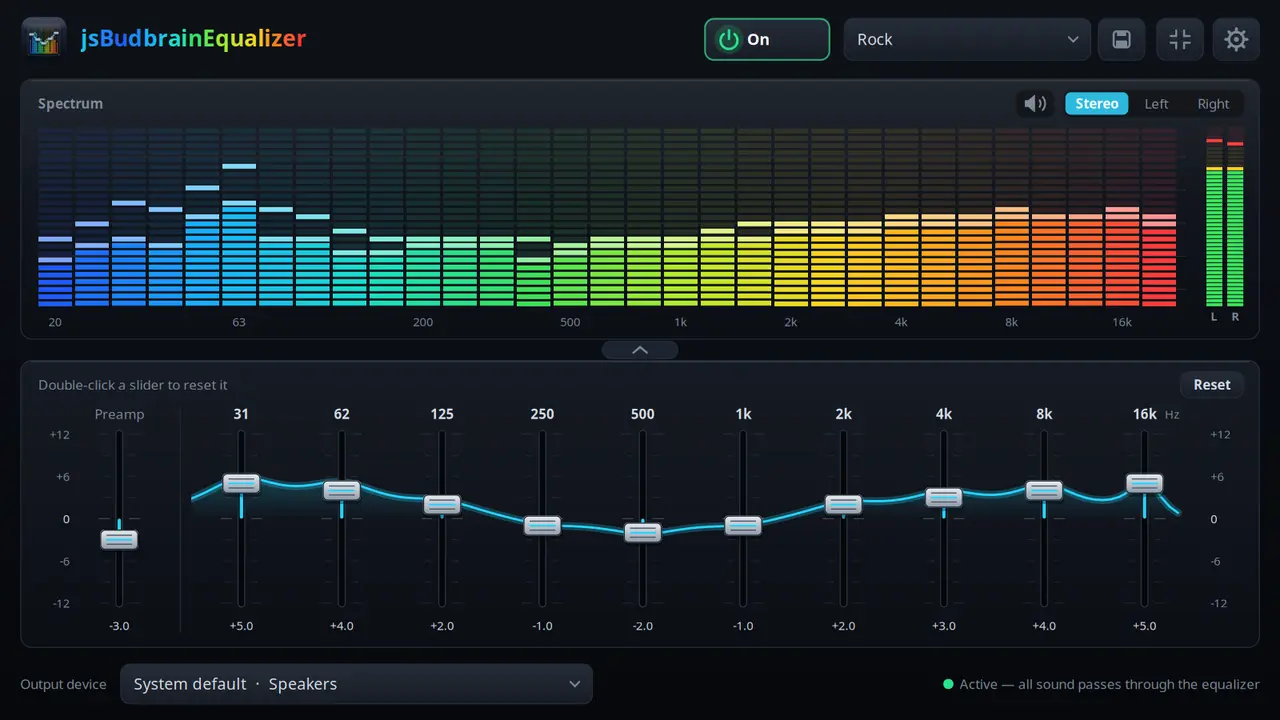
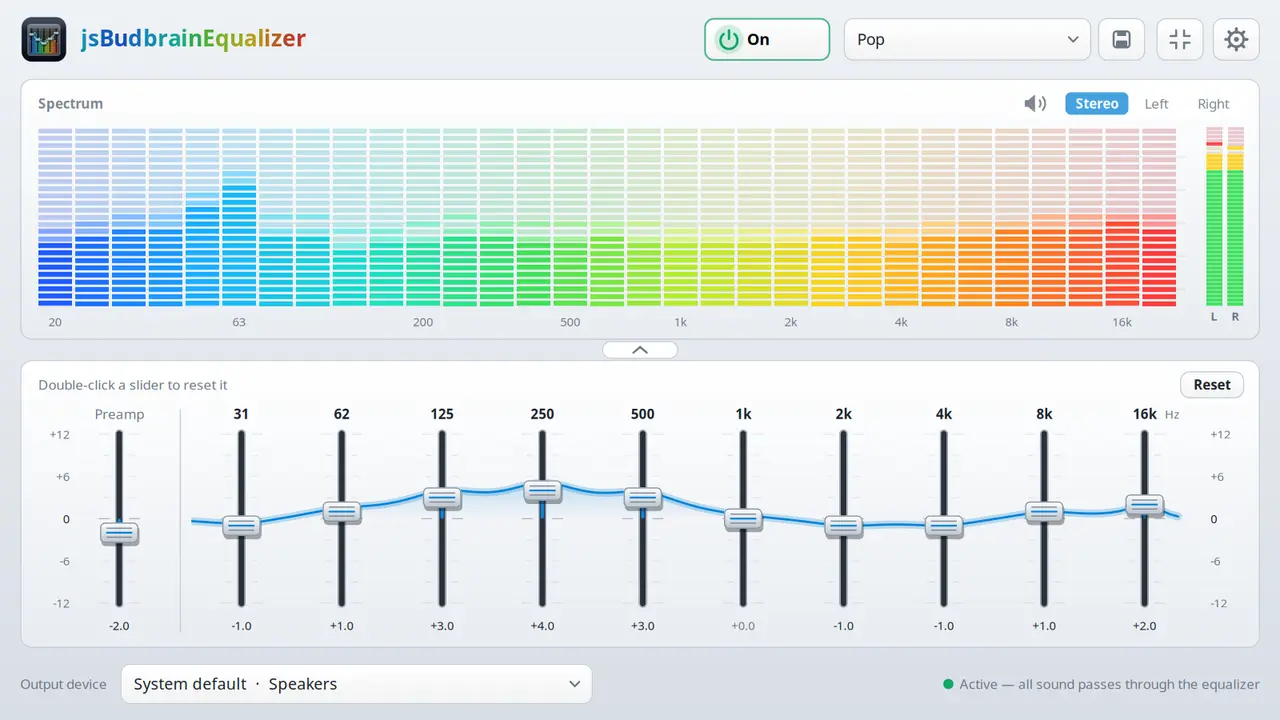
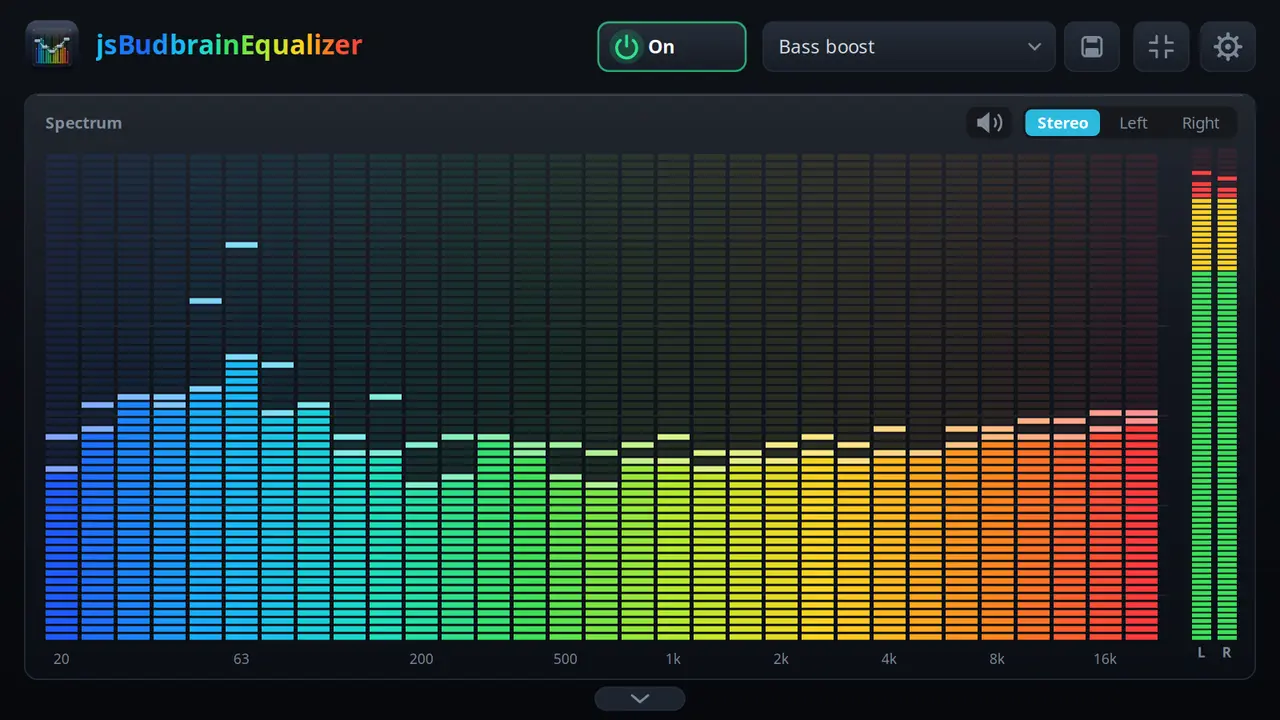
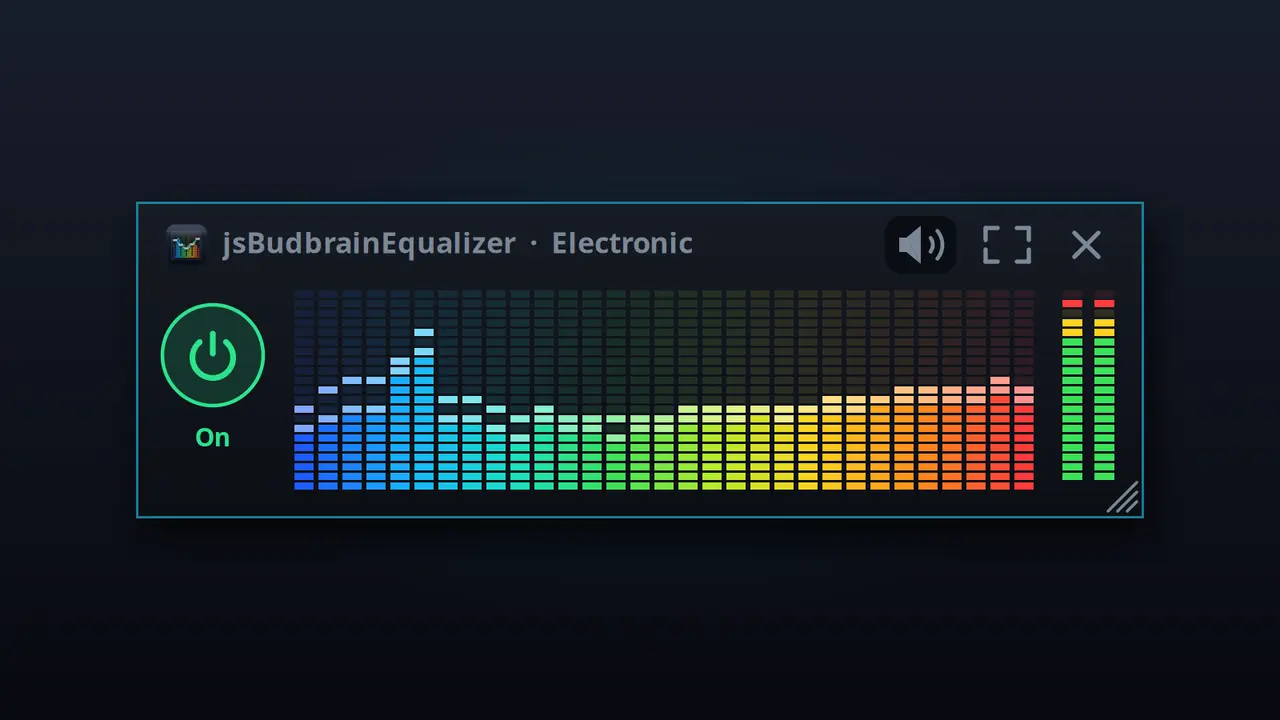
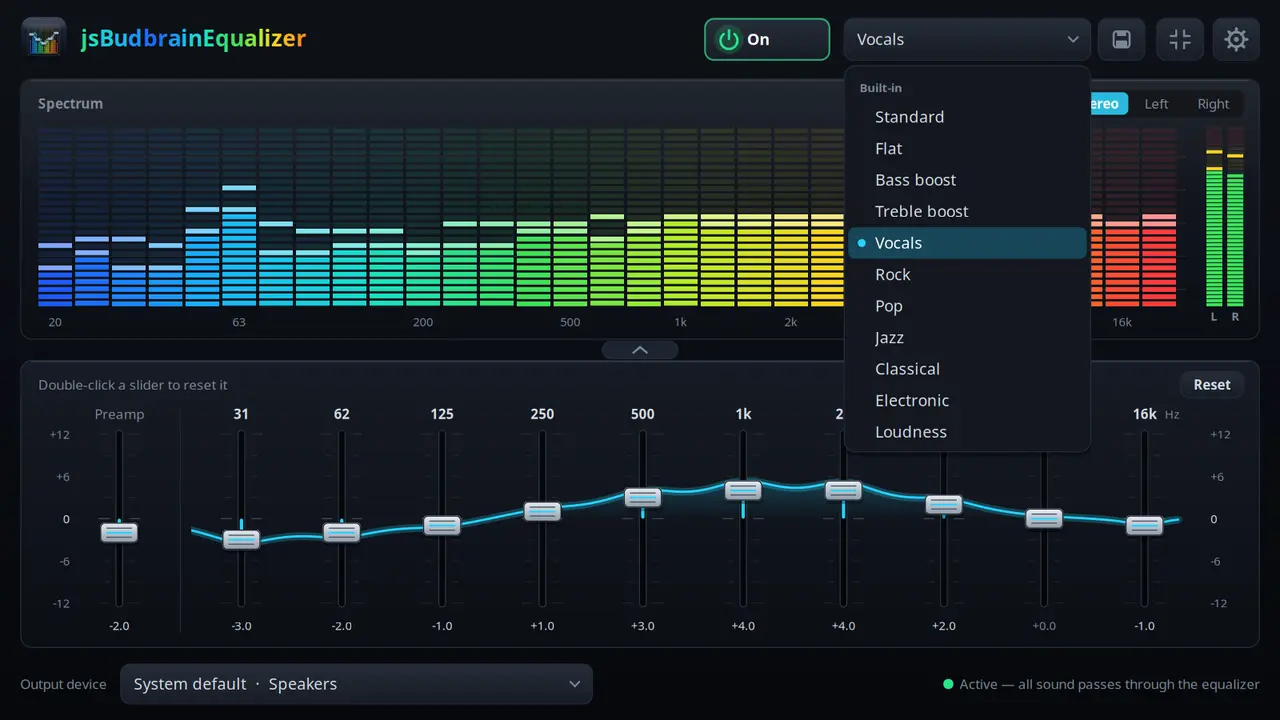
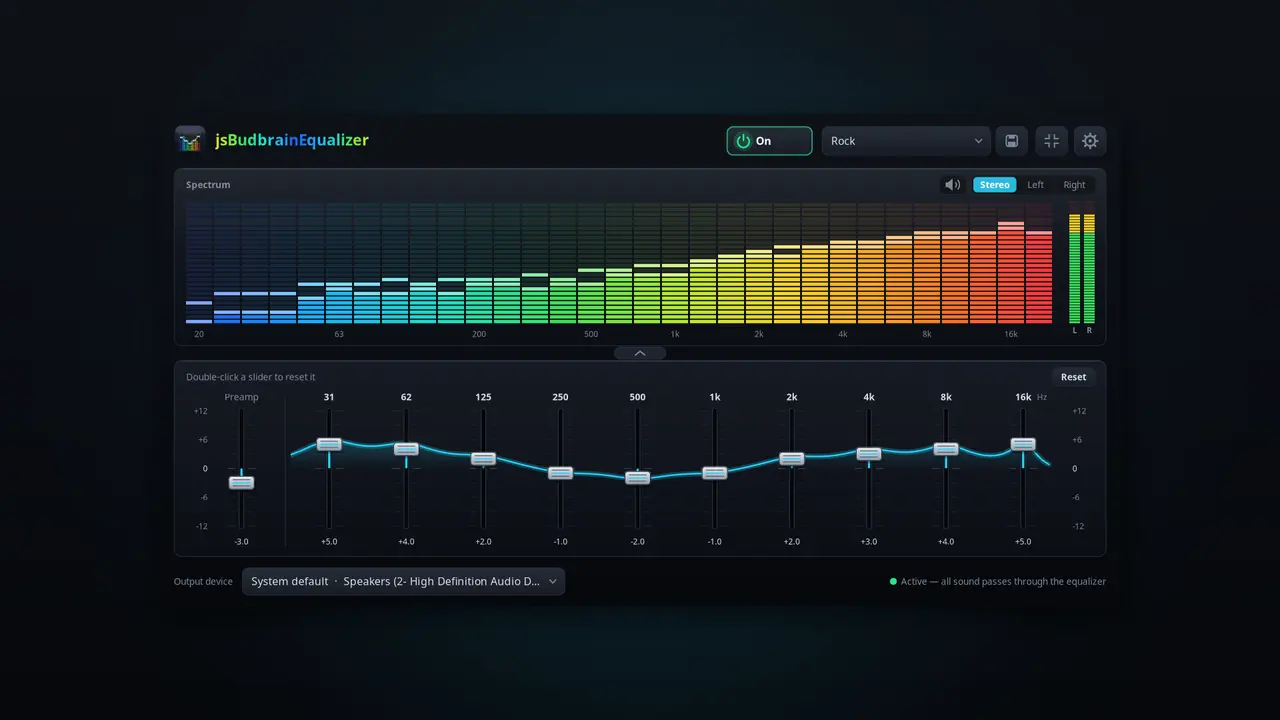
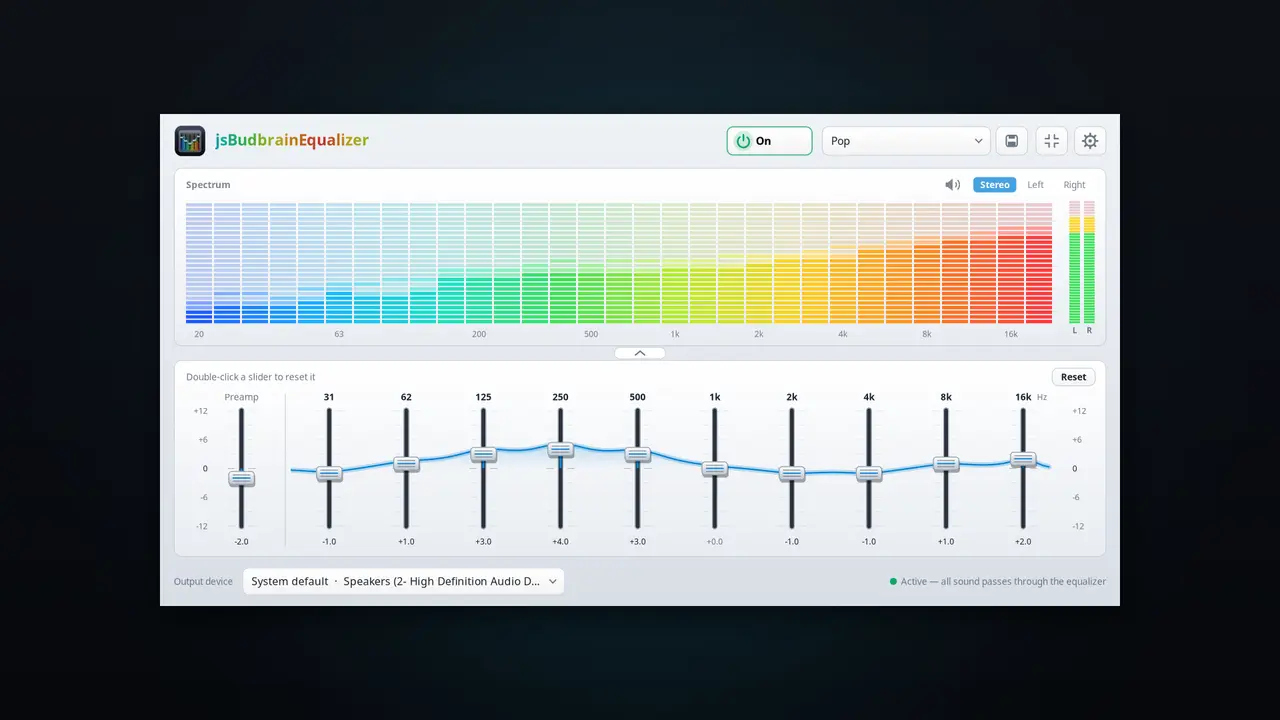
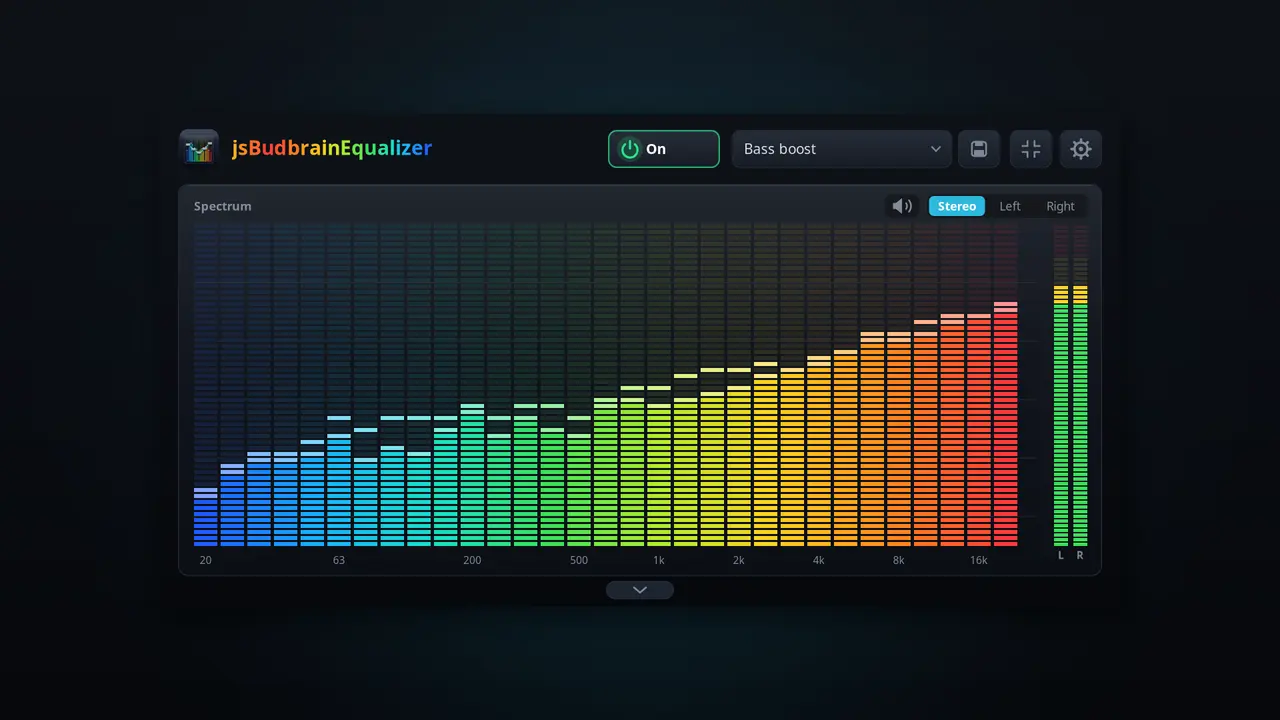
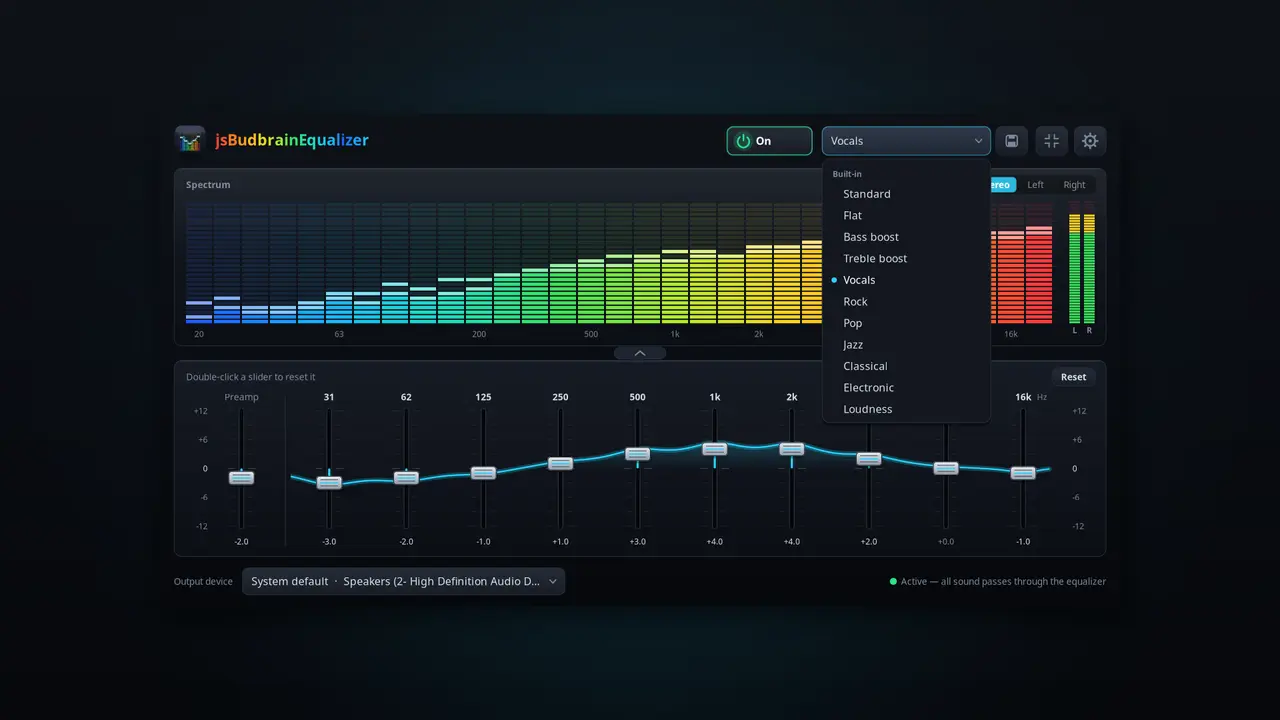
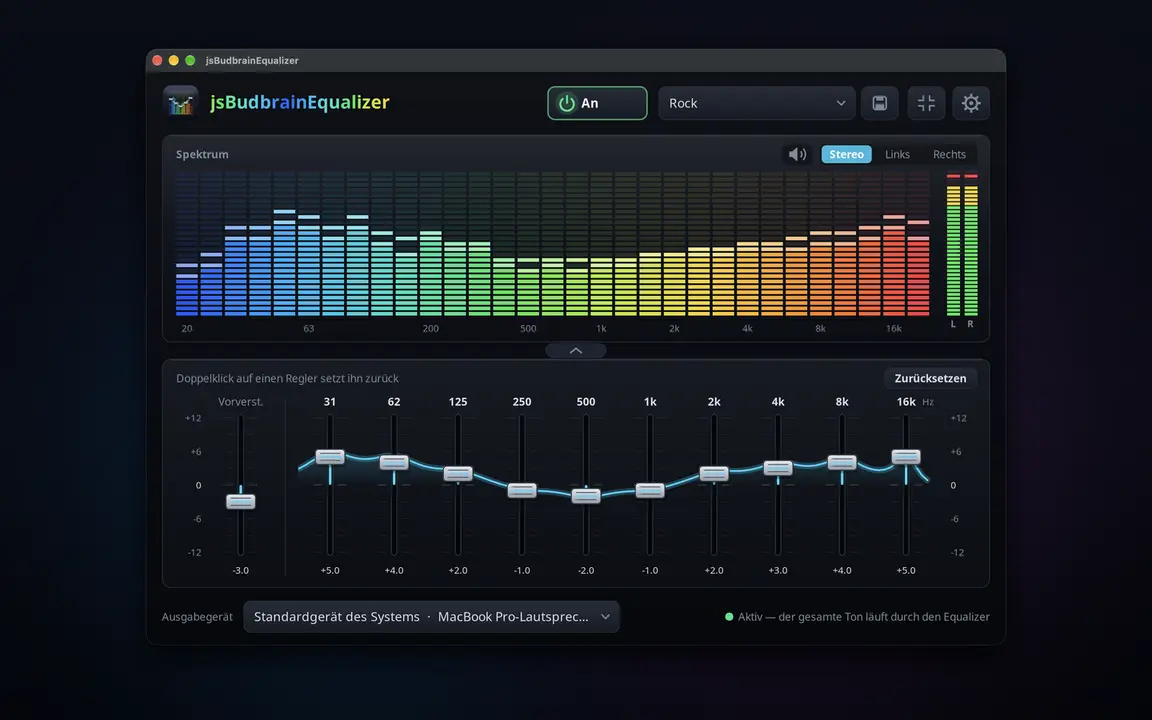
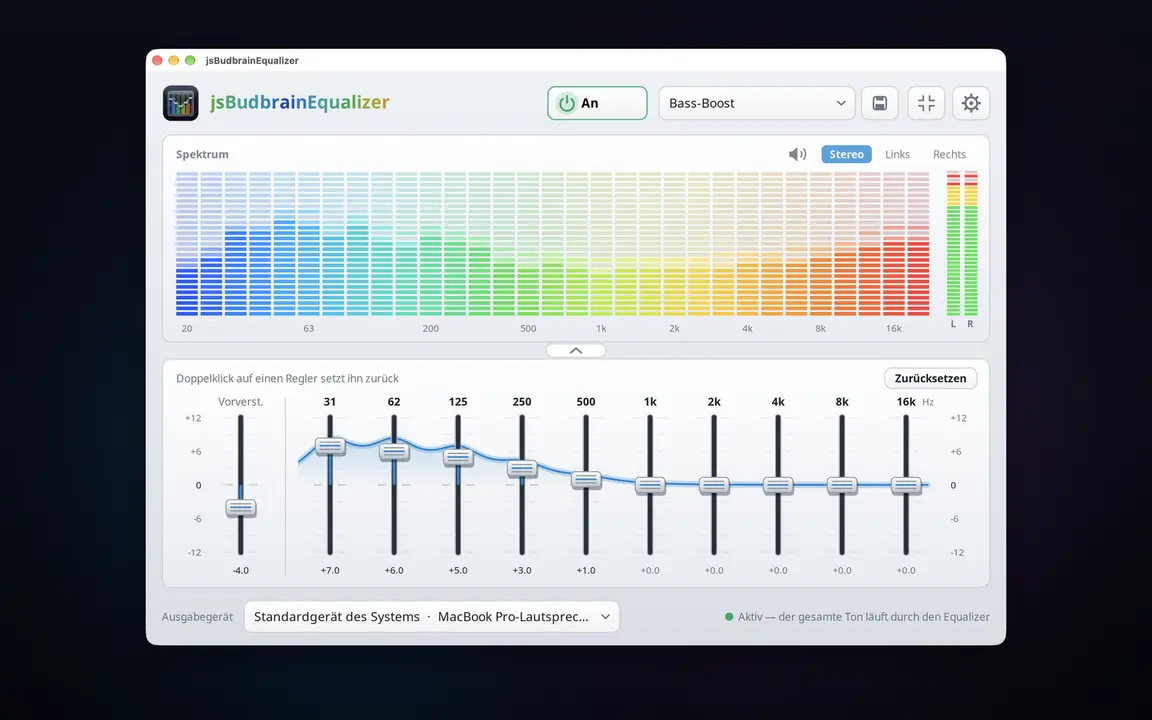
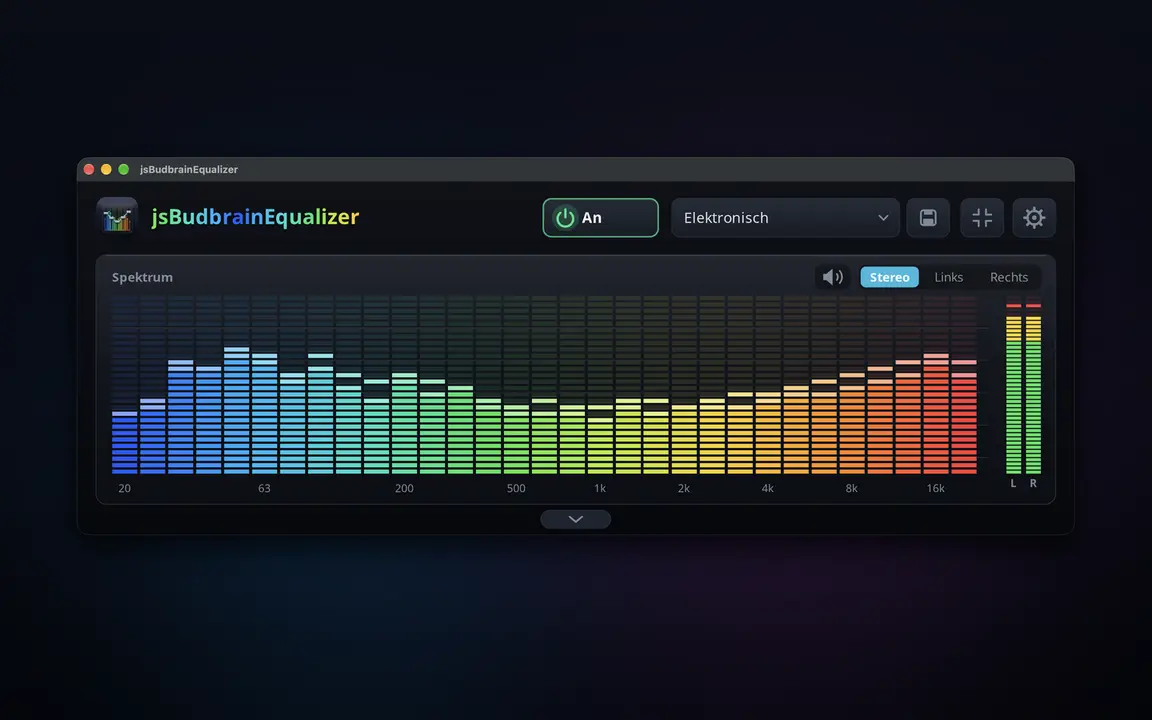
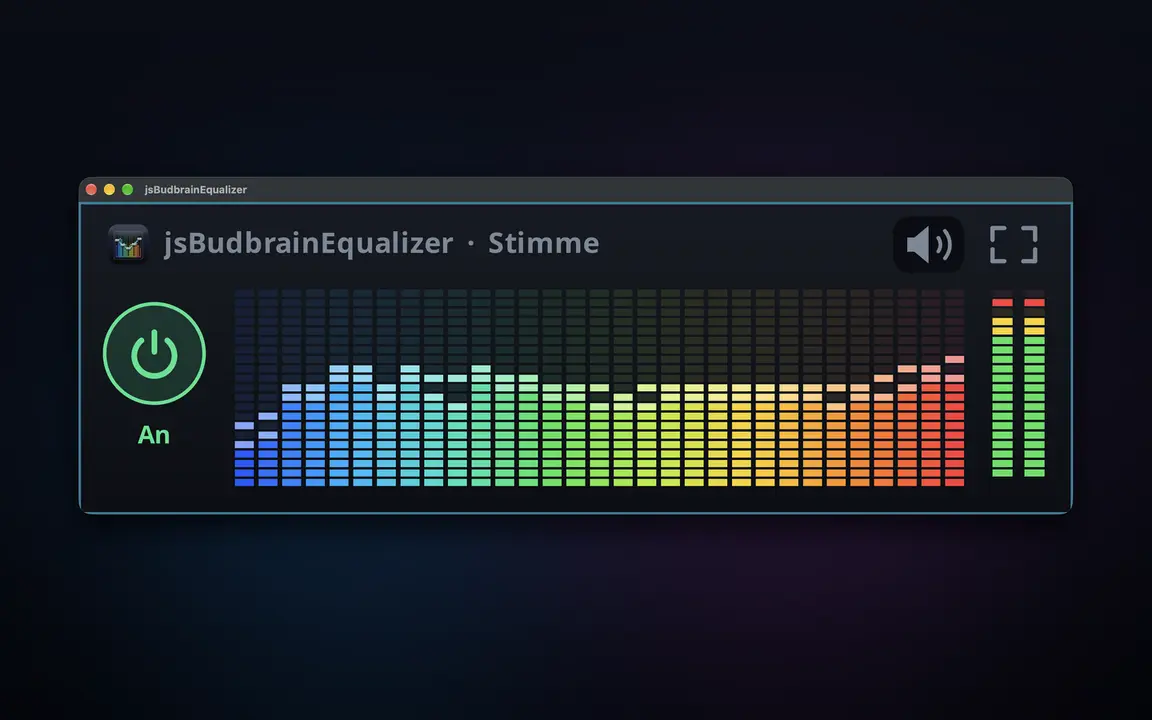
Isang equalizer para sa lahat ng pinapatugtog ng iyong computer — na may live na spectrum.
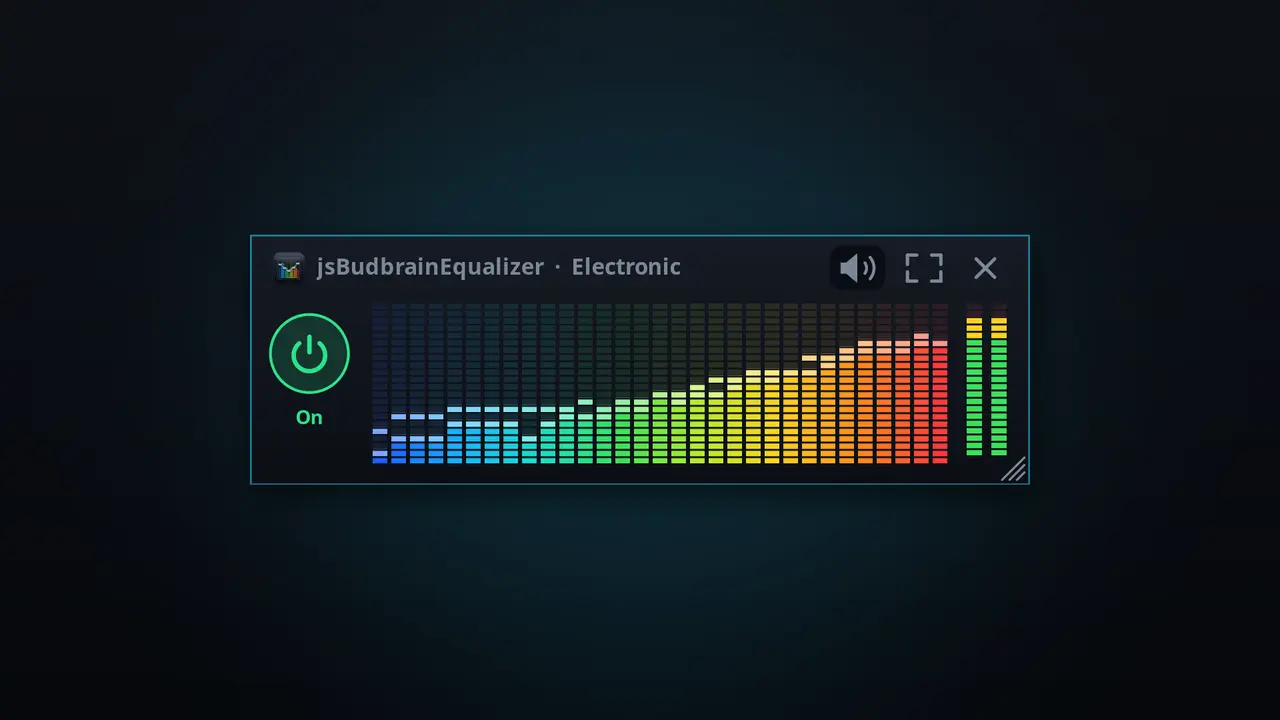
Sampung slider, mula malalim na bass hanggang maliwanag na trebleLive na display ng pinapatugtog — kaliwa, kanan o parehoMga handa nang sound setting at sarili mo, nakasave sa isang pangalanMute button para kapag tumutunog ang teleponoPiliin ang iyong mga speaker o headphoneItiklop ang mga slider, ang display lang ang matiraMaliit na window na laging nasa ibabawNagsisimula pag-log in mo, kung gusto moMaliwanag at madilimSDL2 · CairoPipeWire · PulseAudio83 mga wika
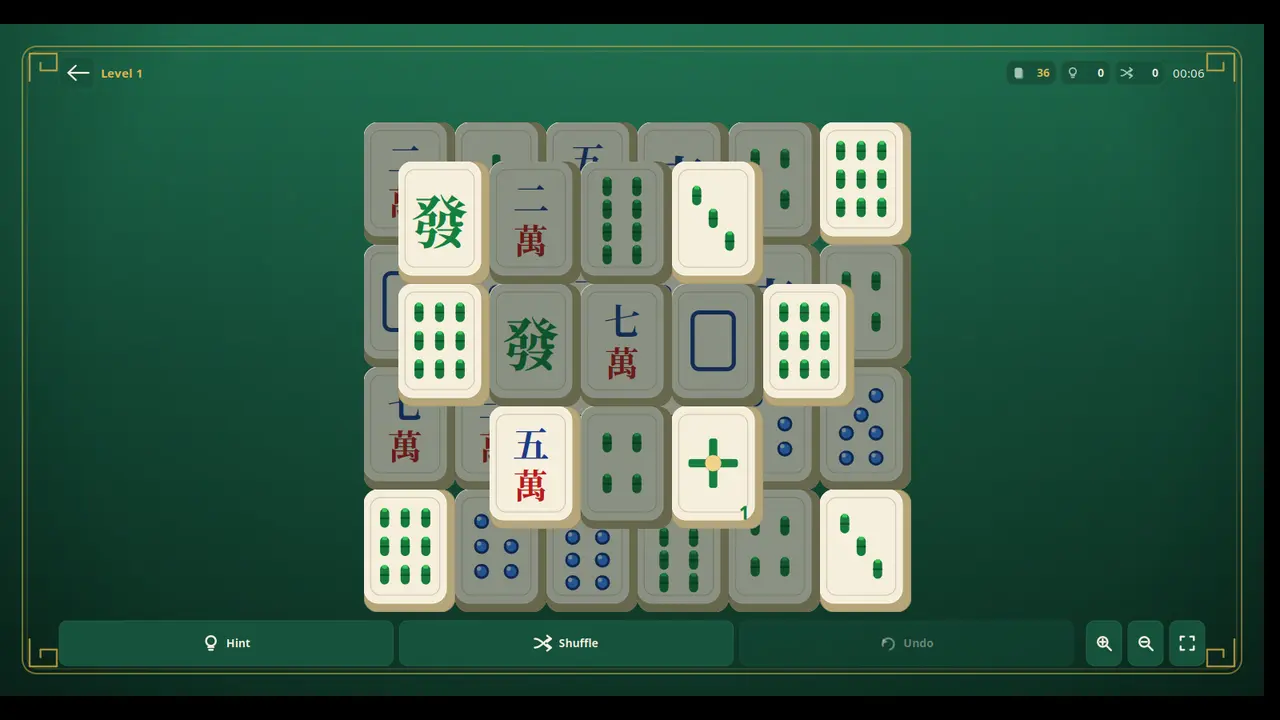
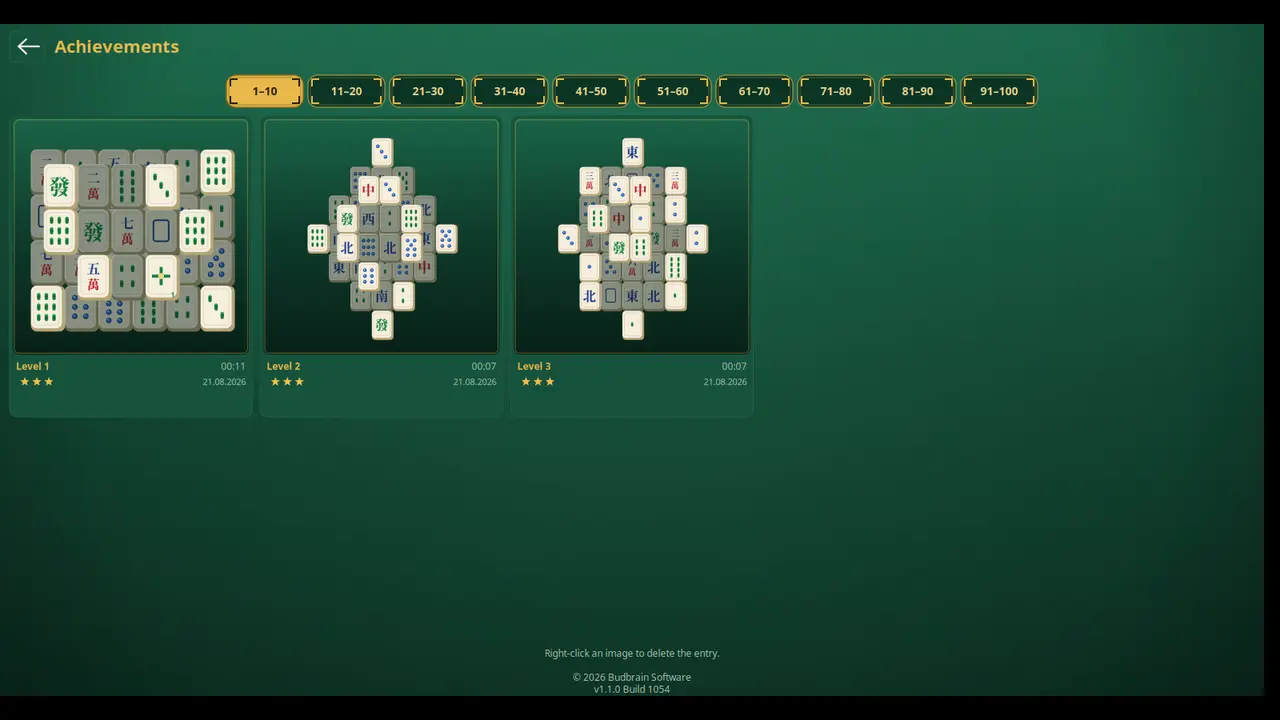
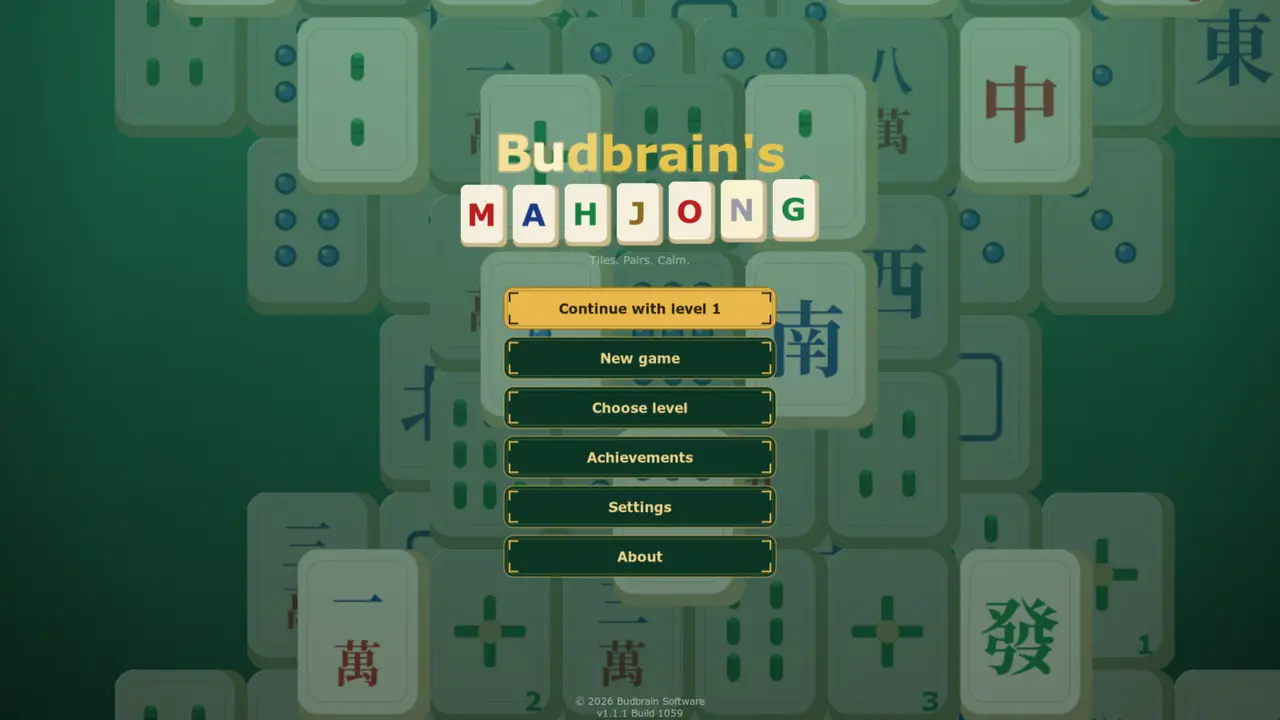
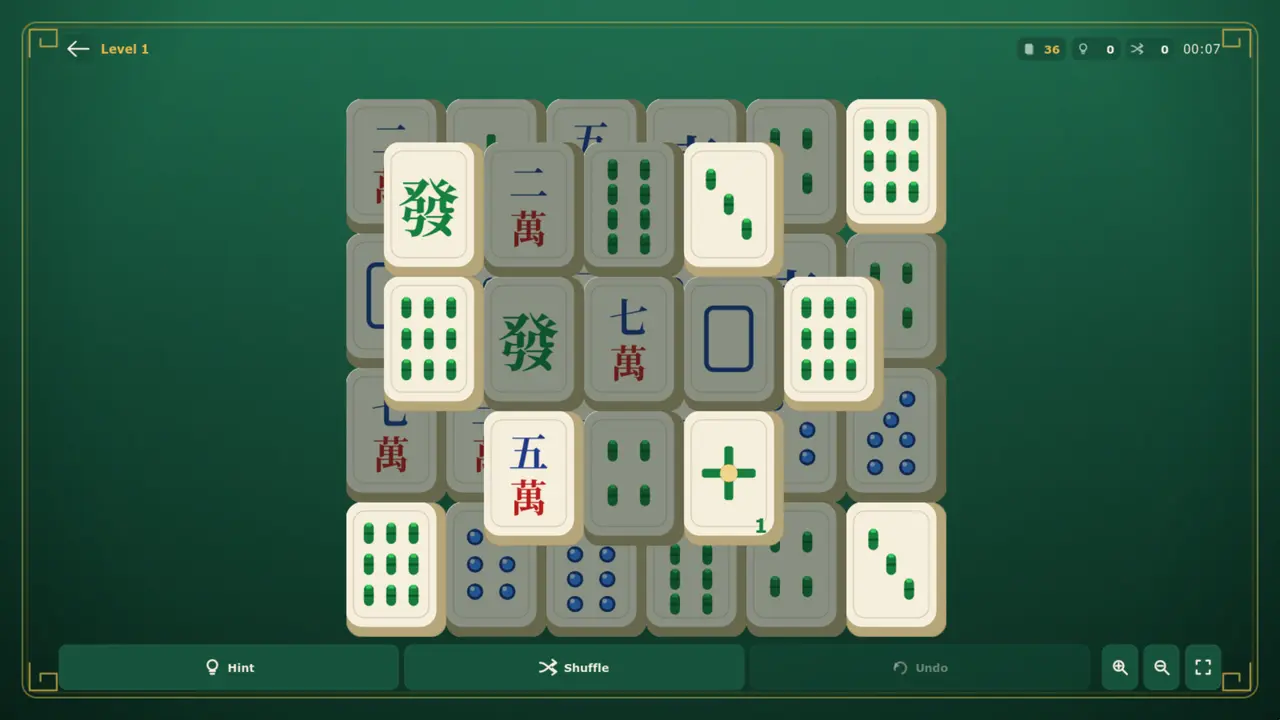
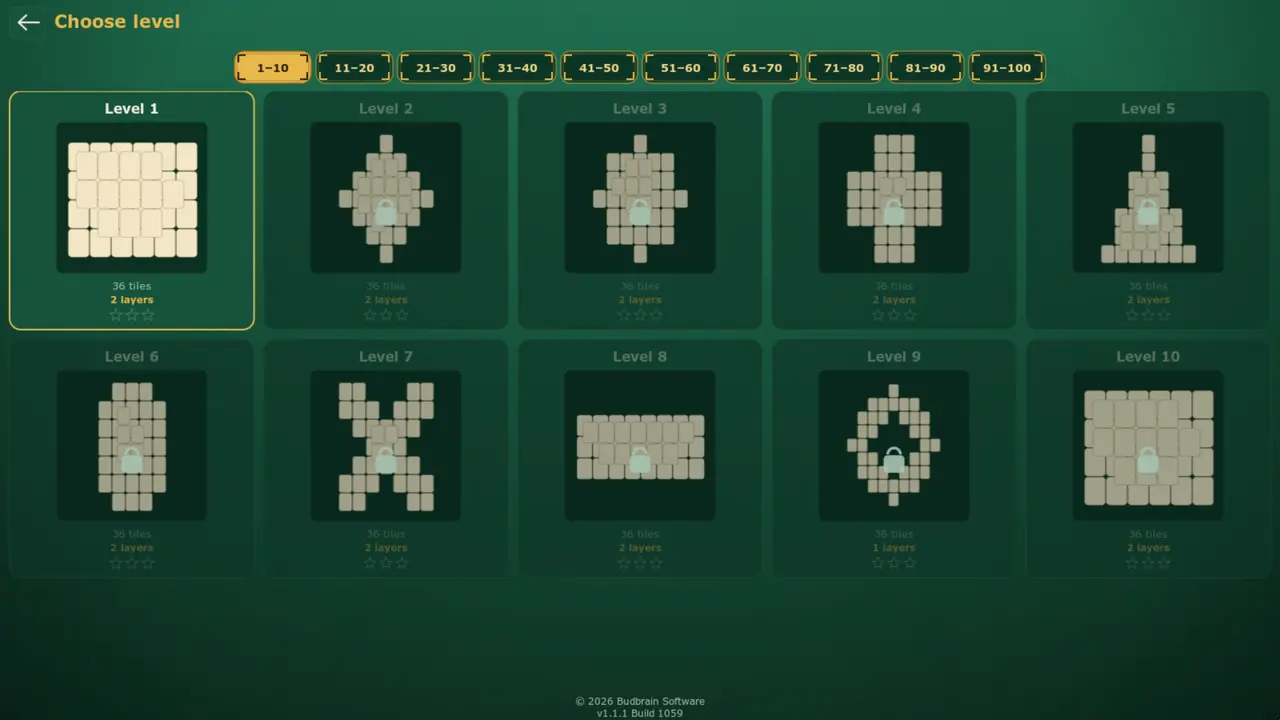
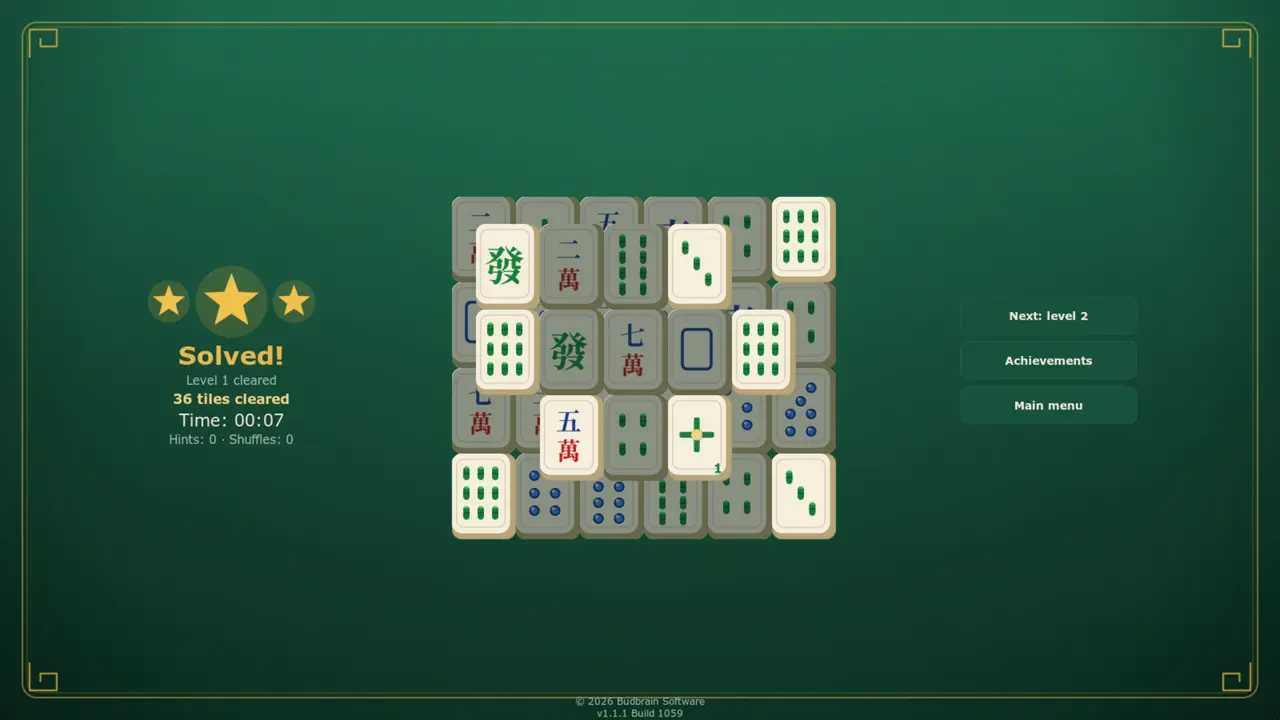
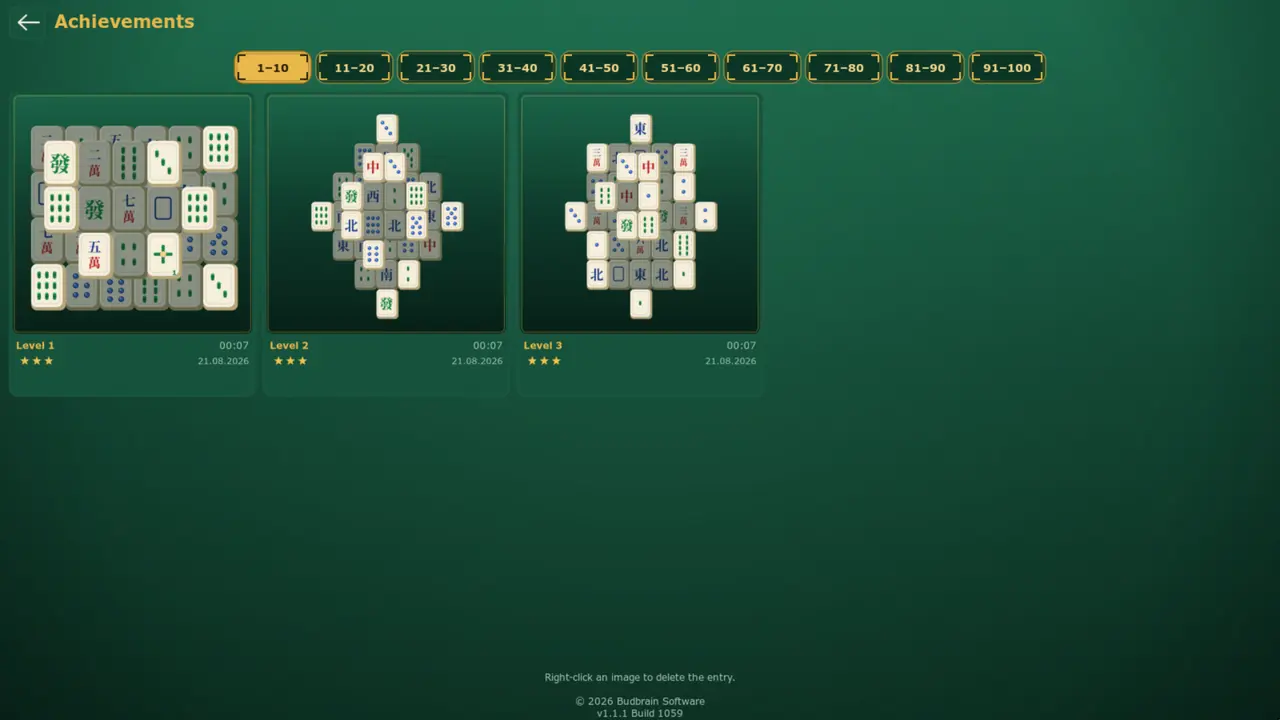
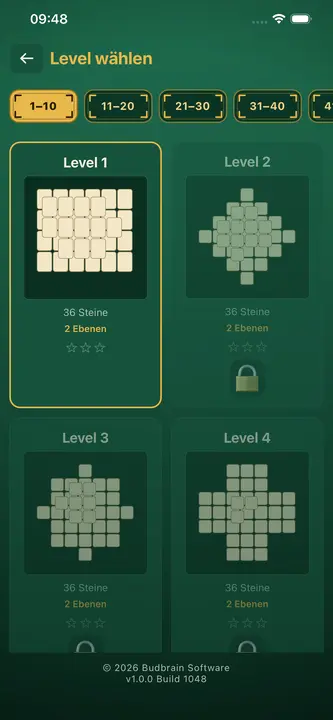
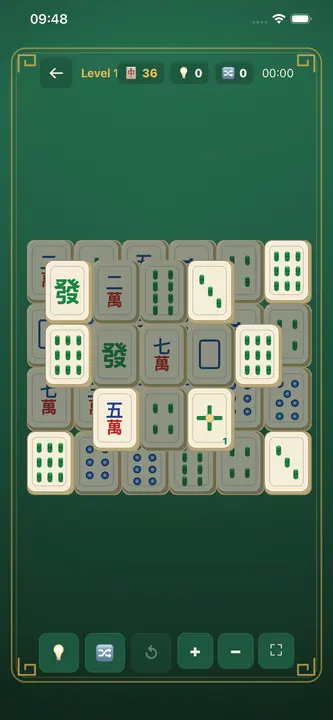
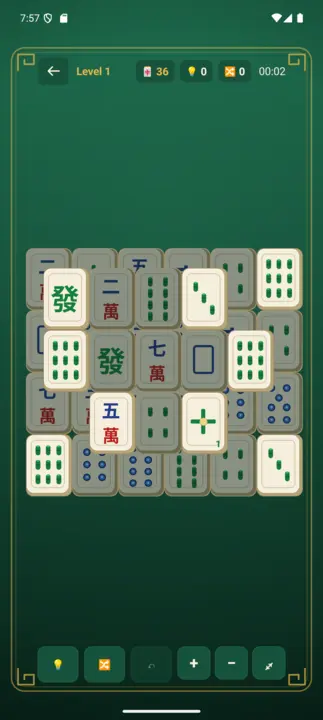
Mahjong solitaire na may isang daang antas: nawawala ang dalawang magkaparehong libreng tile, sampung hand-drawn na mesa, at bawat board na nalinis mo ay nakatago bilang larawan.
100 antasSampung mesaTip · Shuffle · UndoPader ng mga tagumpayOpenGLSDL2 · CairoGNOME / KDE / XFCE22 mga wika
Nagpe-play ng mga recording mula sa isang folder — random o nang pagkakasunod-sunod, sa mga oras na pipiliin mo.
Nagpe-play ng mga recording mula sa isang folder, kasama ang network driveRandom o nang pagkakasunod-sunodSa pagitan lang ng dalawang oras ng arawSa mga araw lang ng linggo na titickan moPinapantay ang mga recording na magkaiba ang lakas ng tunogNagsisimula pag-log in mo at kusang nagpapatuloyMP3GTK3 · CairoPipeWire · PulseAudio44 mga wika
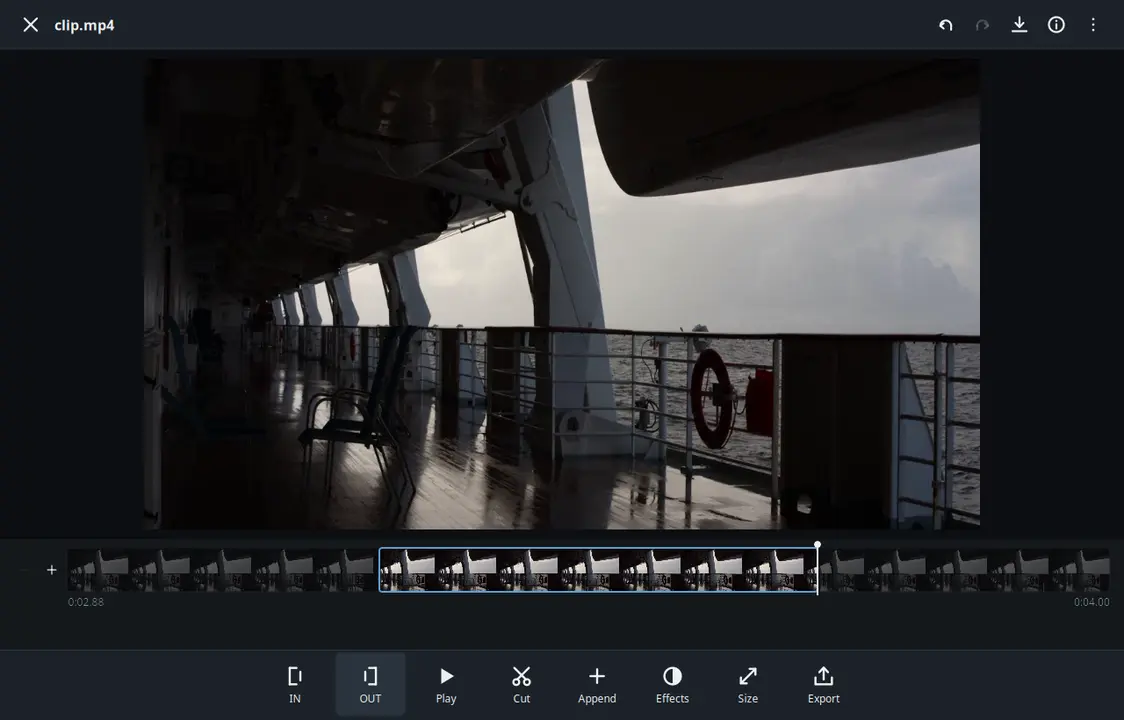
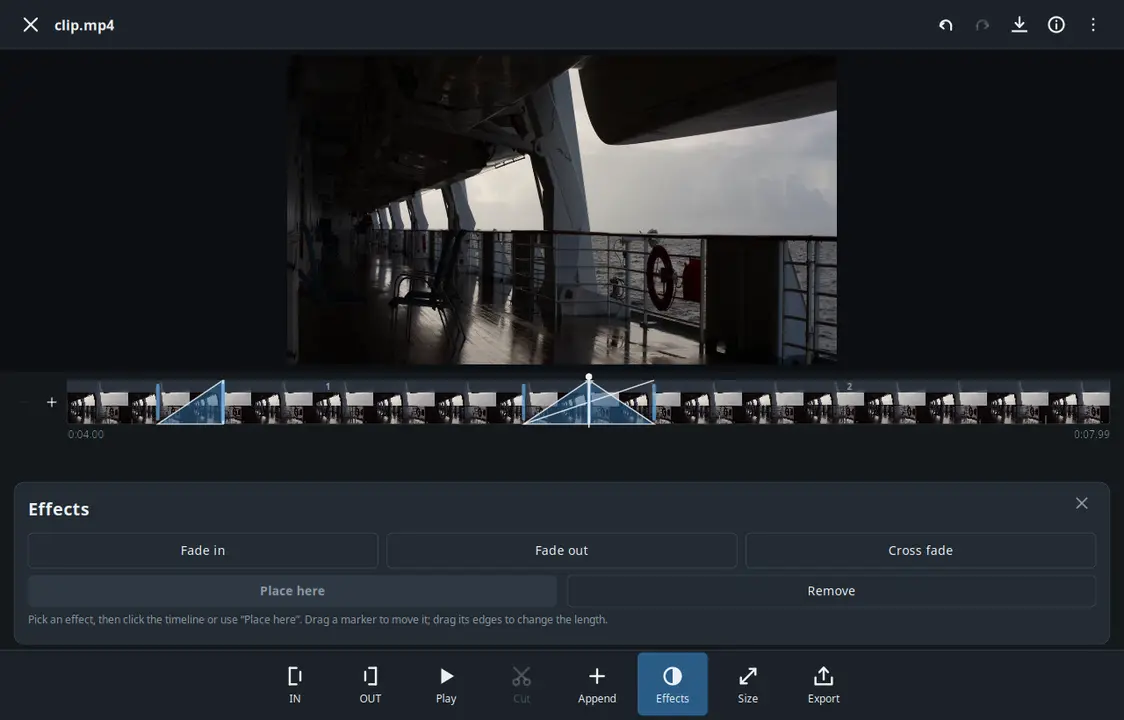
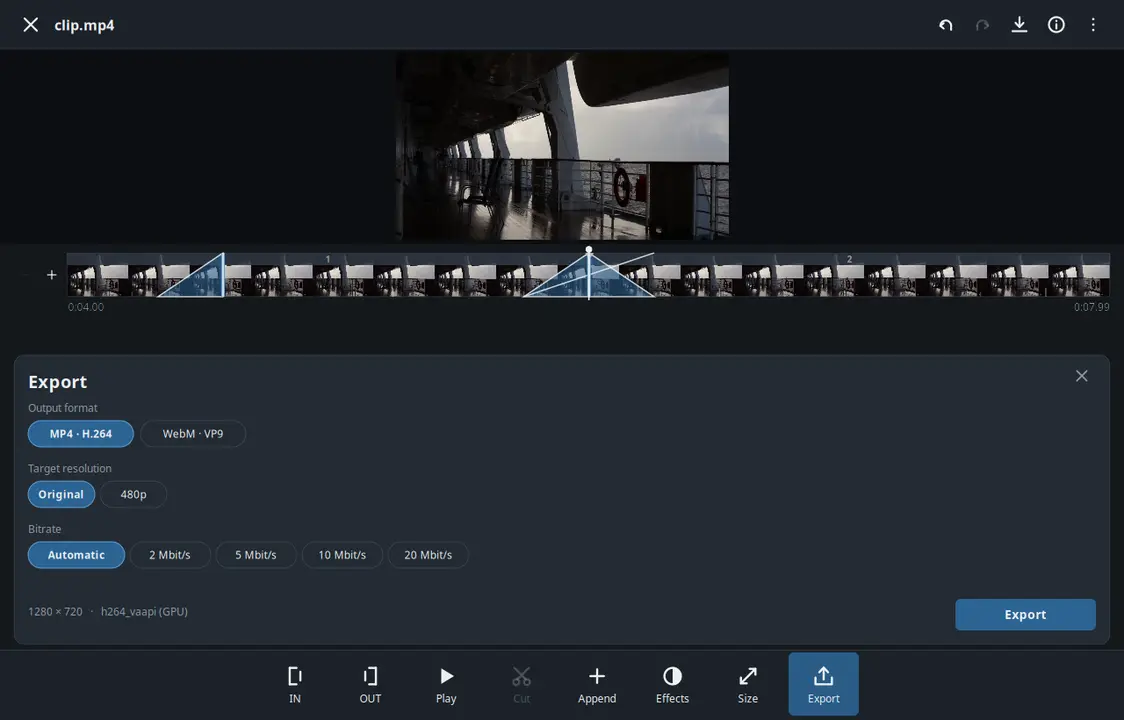
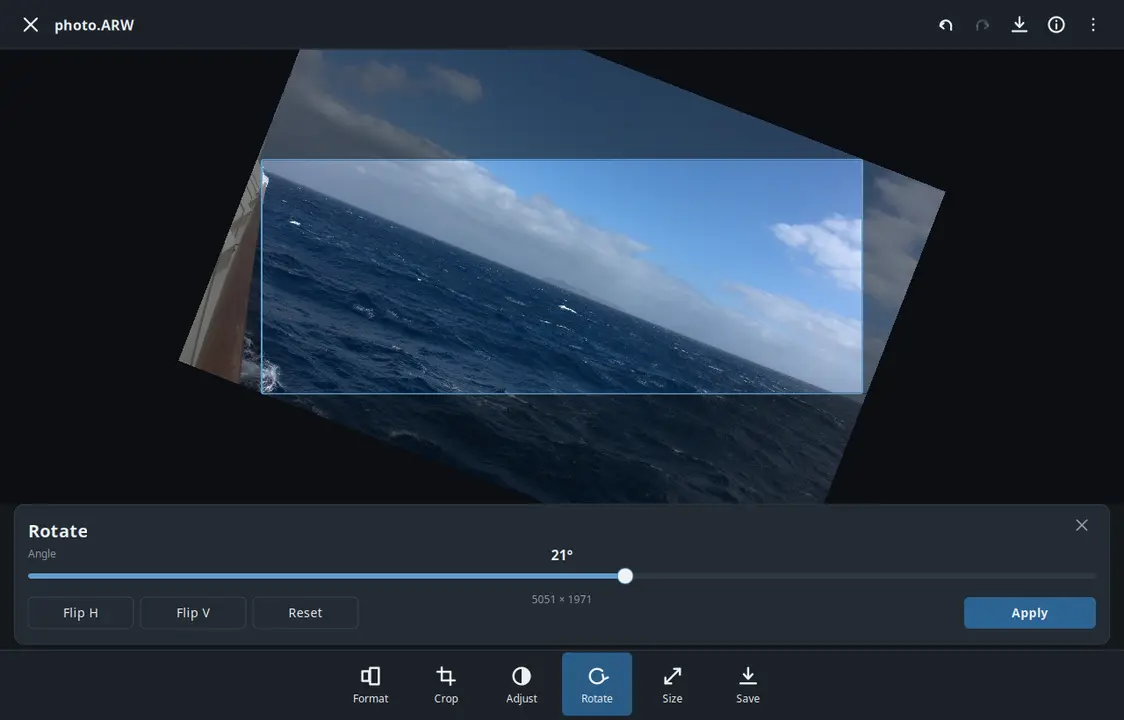
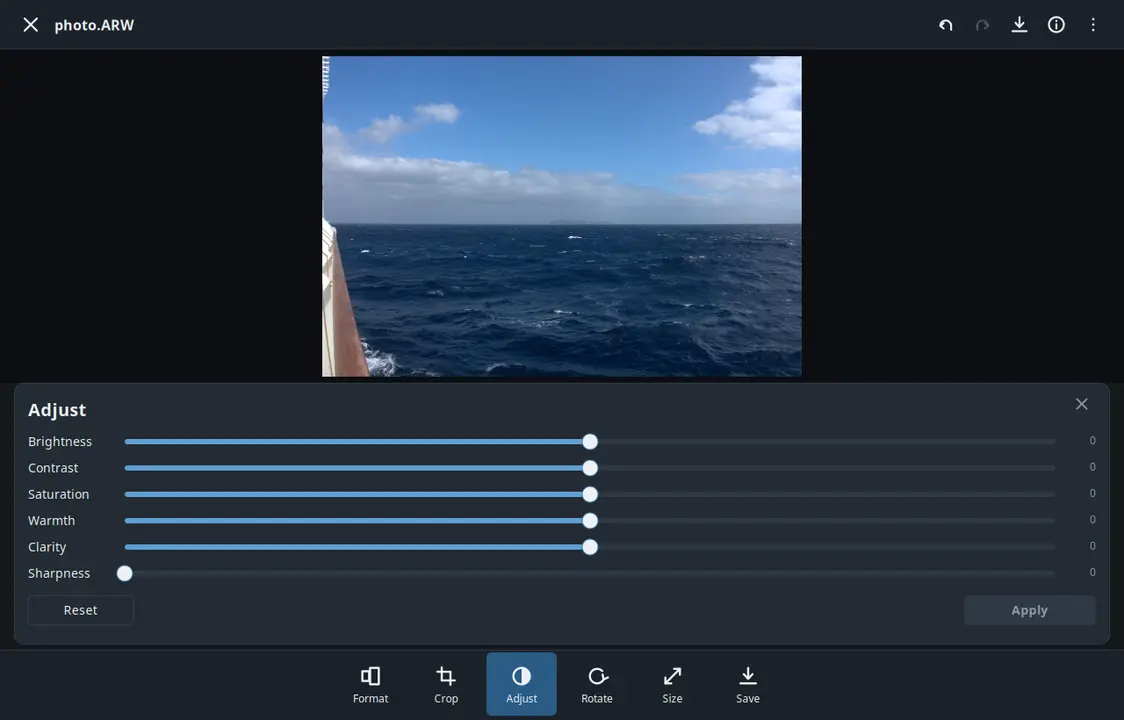
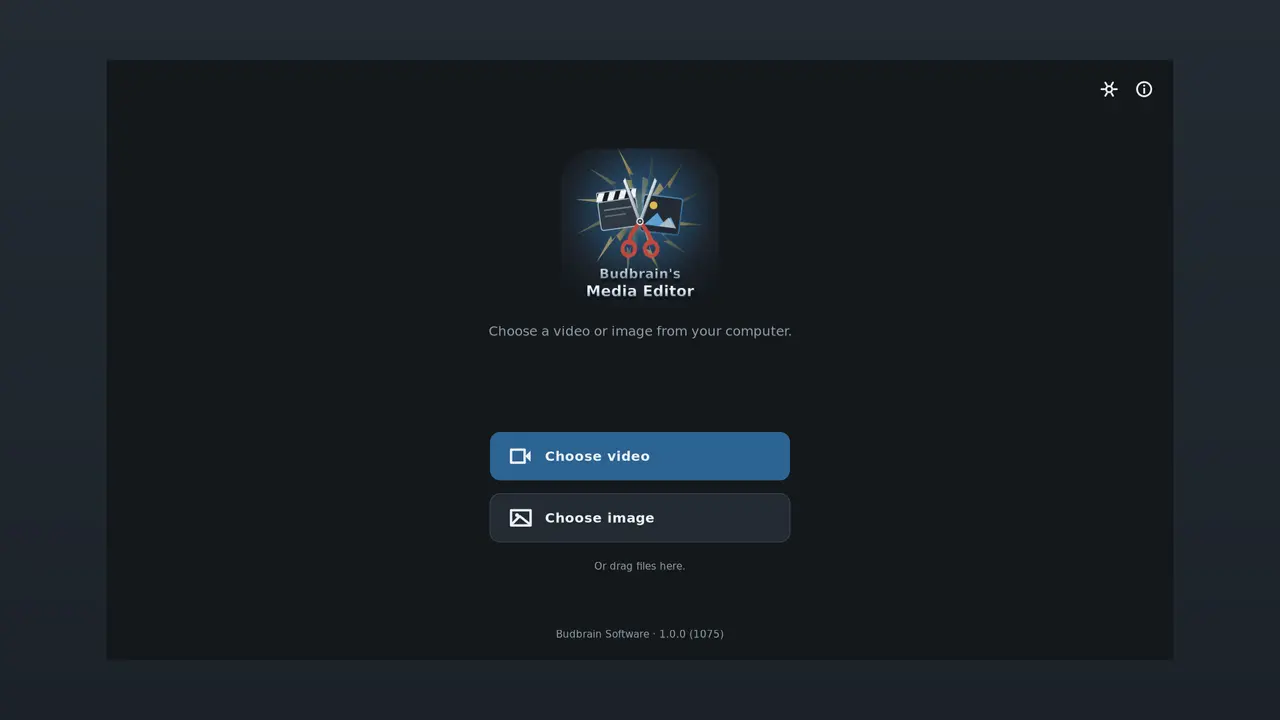
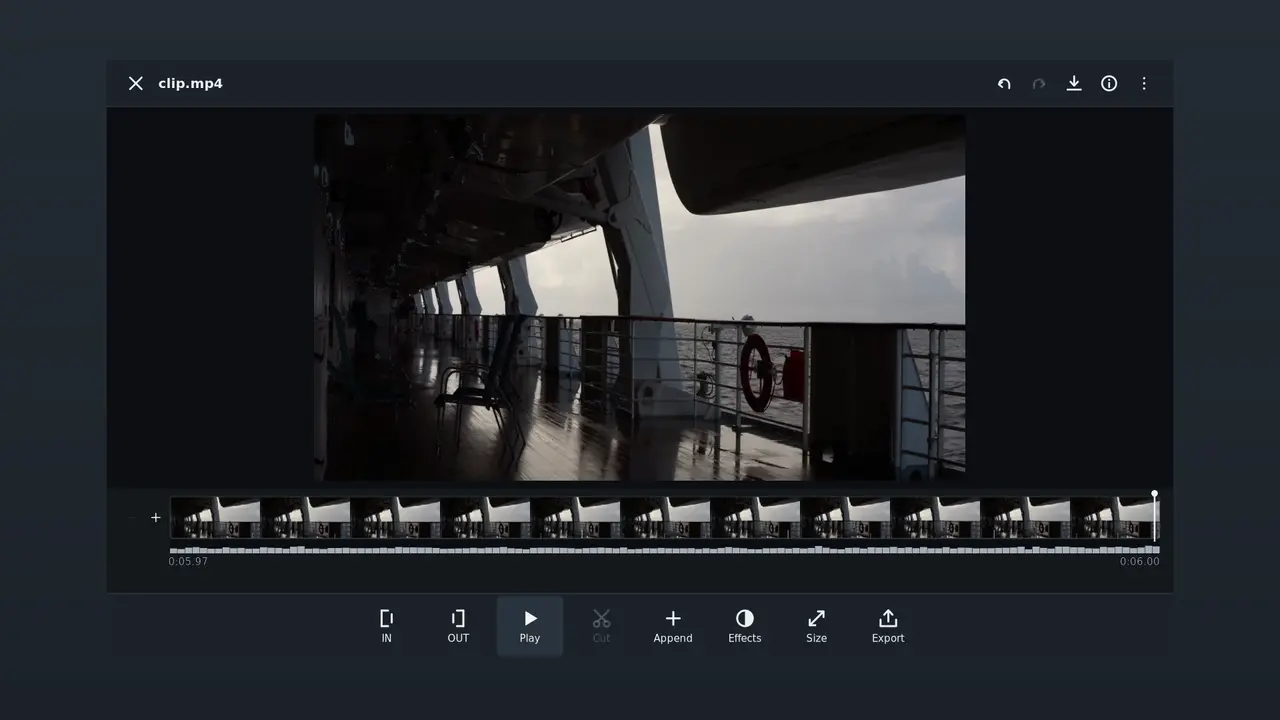
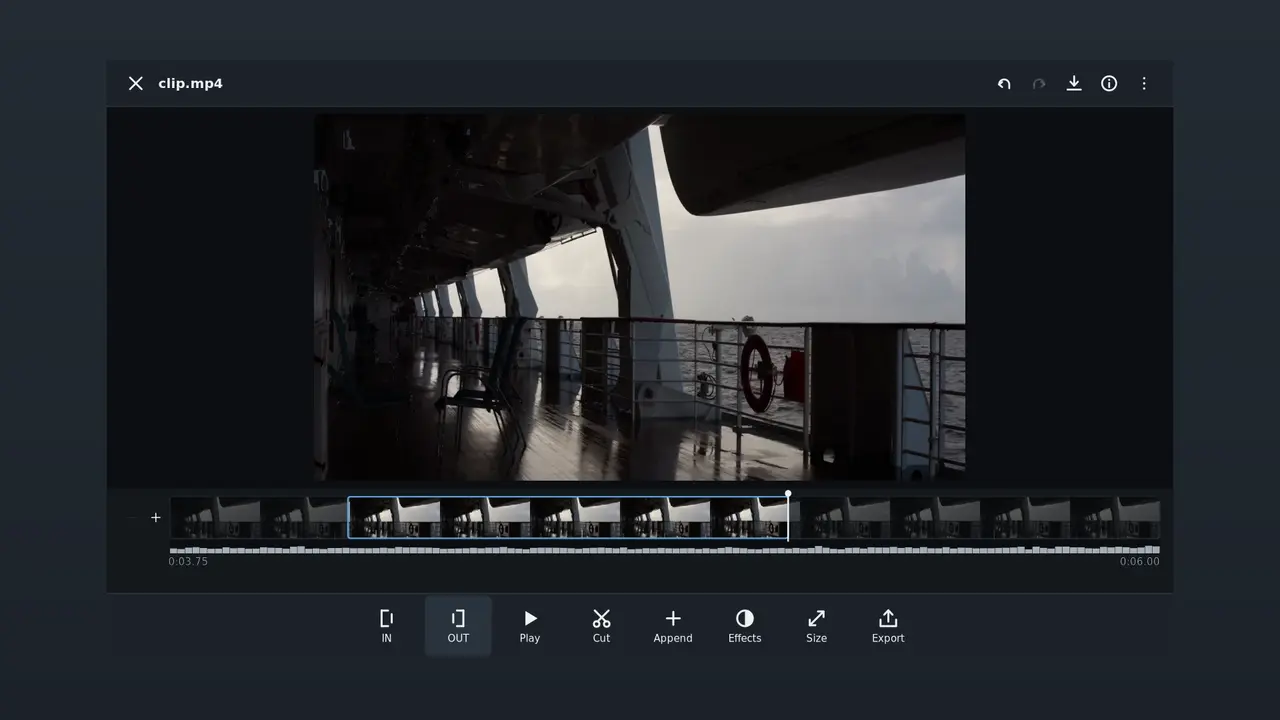
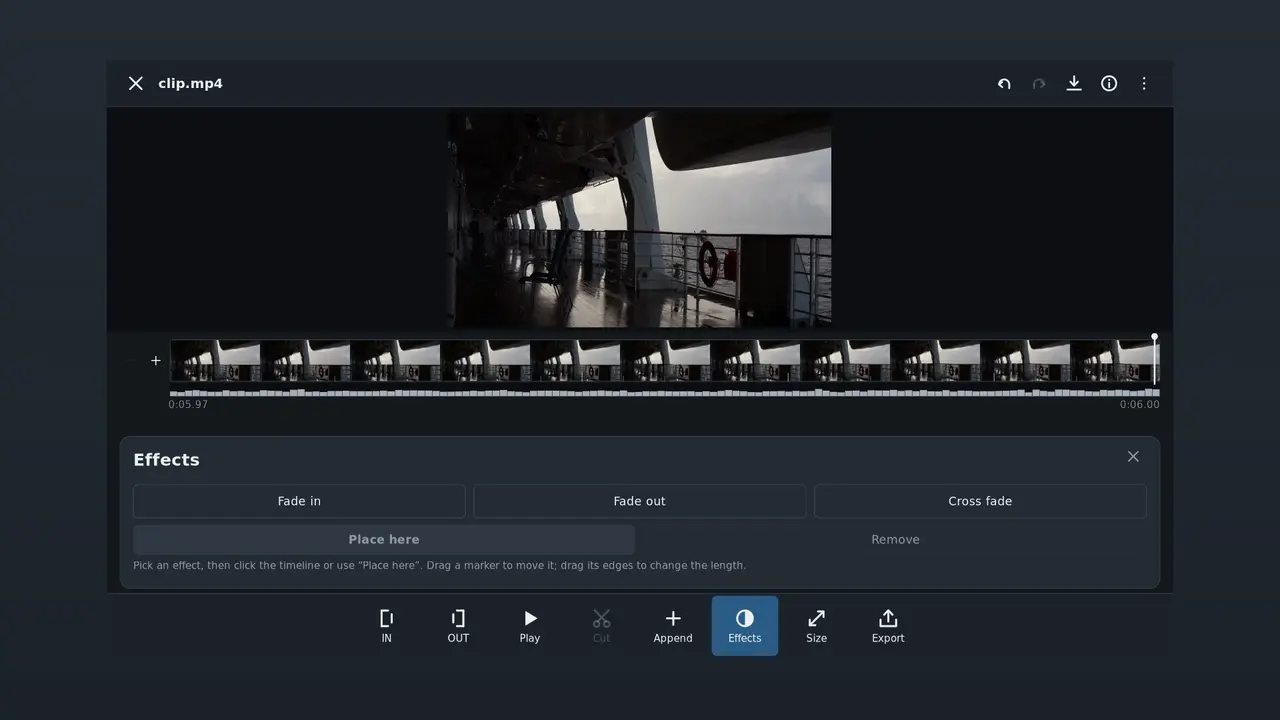
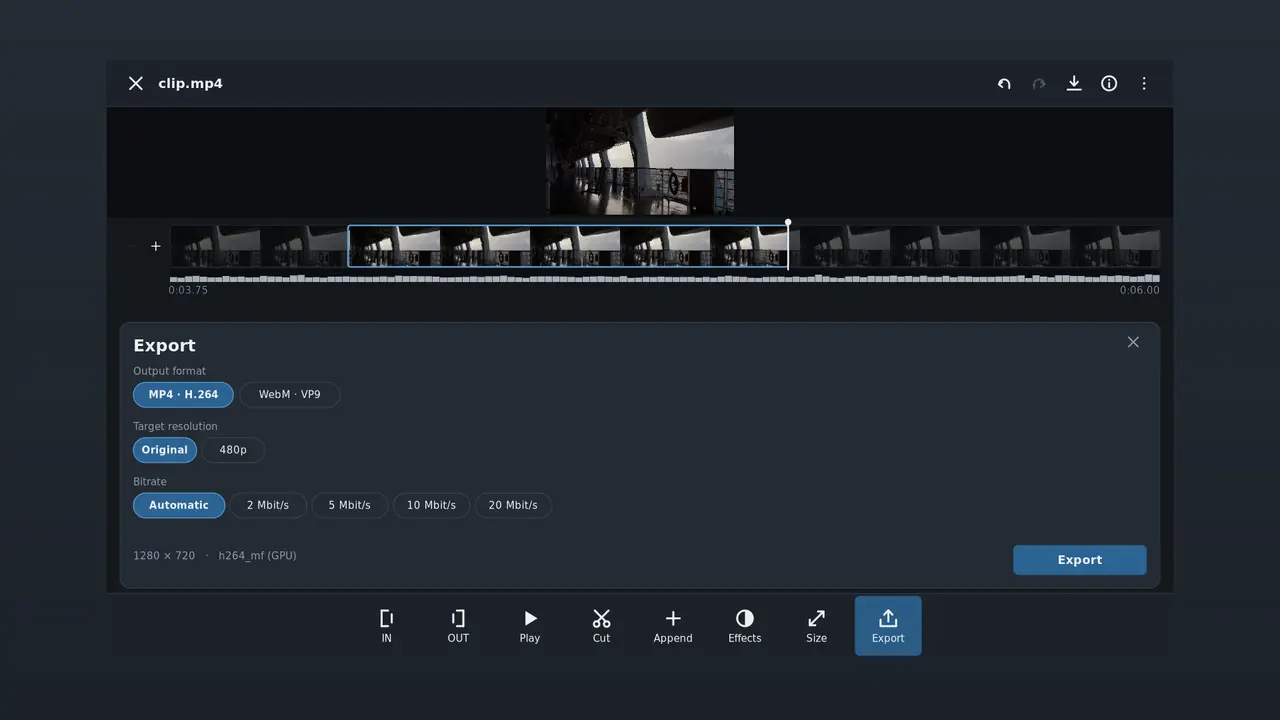
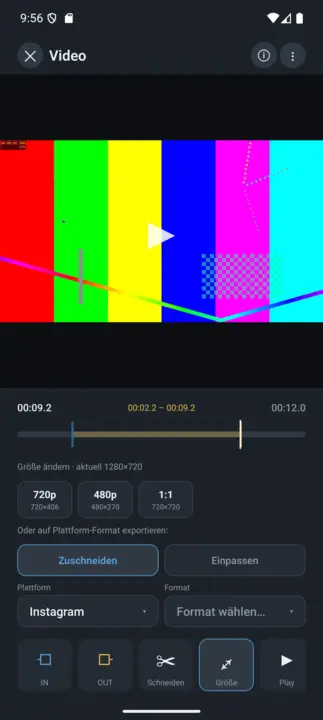
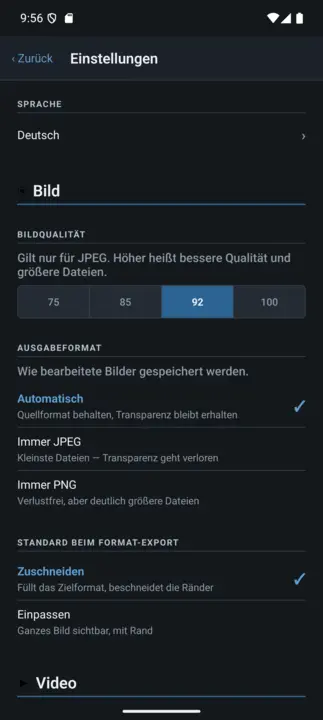
Mag-edit ng video o larawan at i-save ito. Paikliin ang pelikula o magdagdag ng mga clip, lagyan ng fade sa pagitan ng mga ito, at i-save ang video sa partikular na laki o format. Ituwid, i-crop at ayusin ang mga larawan, saka i-save bilang JPEG, PNG o WebP.
Putulin at pagdugtunginMga fade at cross-fadeI-crop at ayusin ang mga larawanMga export preset para sa karaniwang platformMga camera raw fileFFmpeg (LGPL)VAAPI · NVENCSDL2 · CairoGNOME / KDE / XFCE44 mga wika
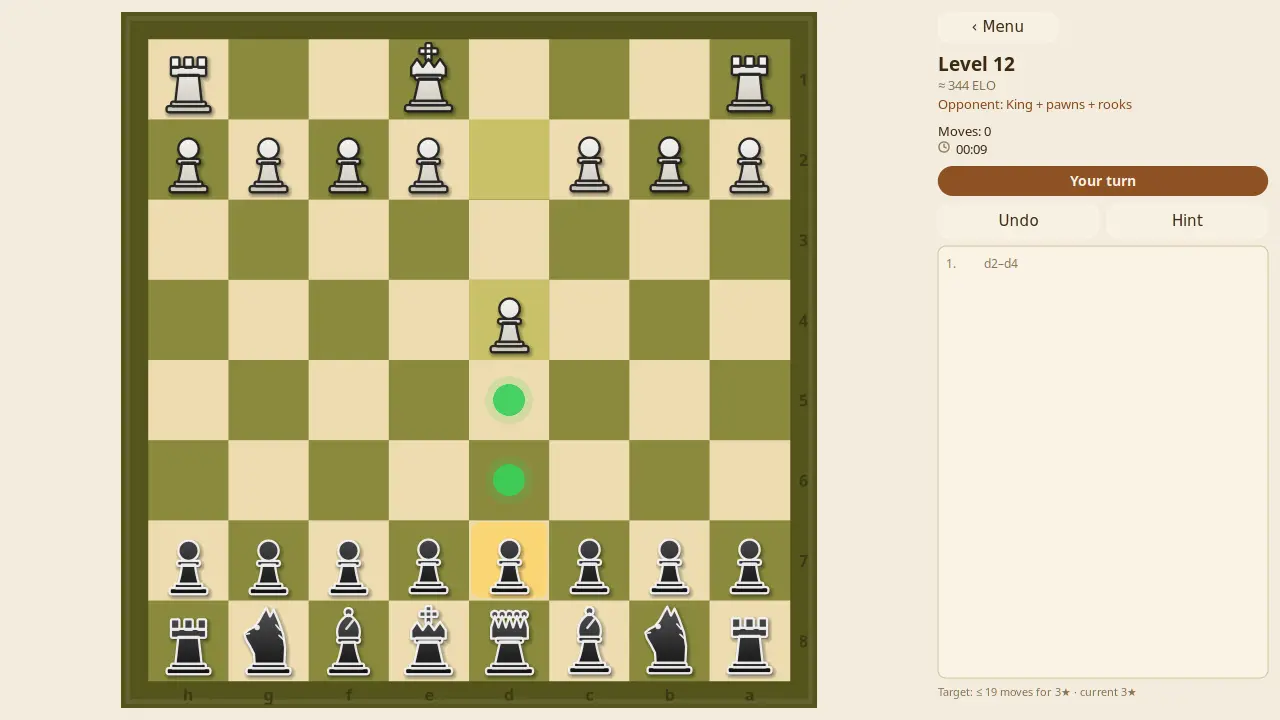
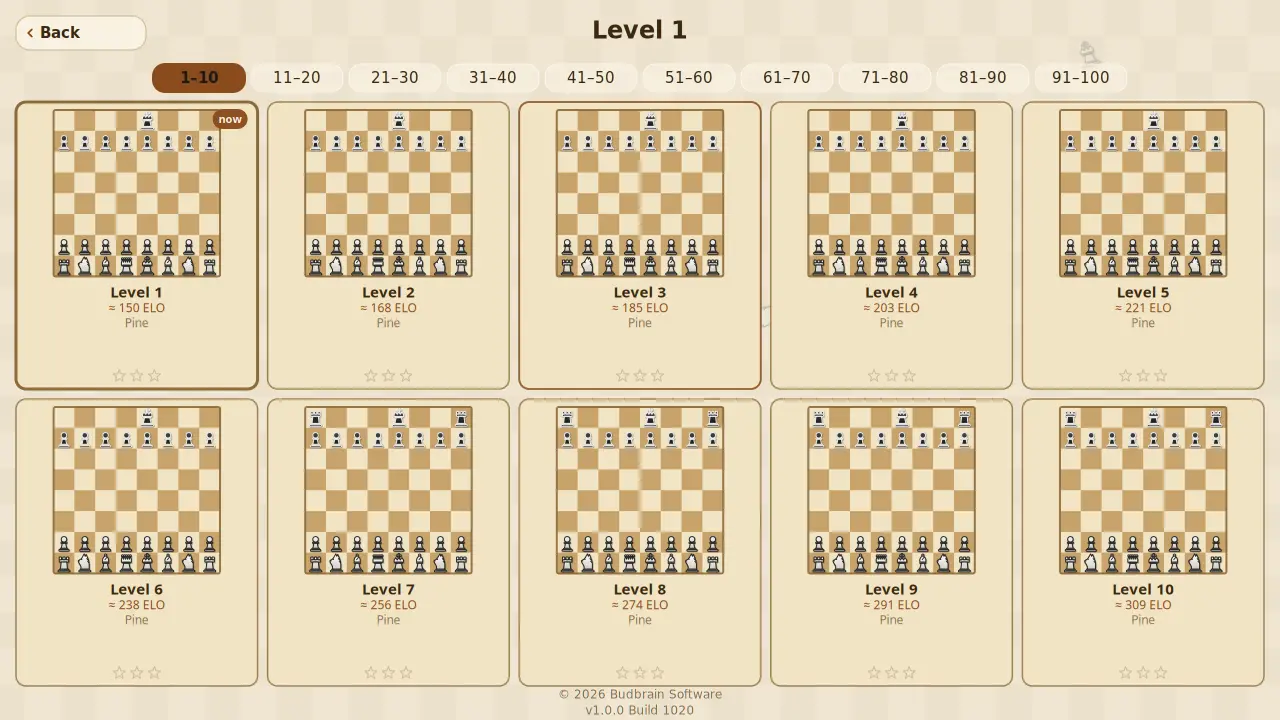
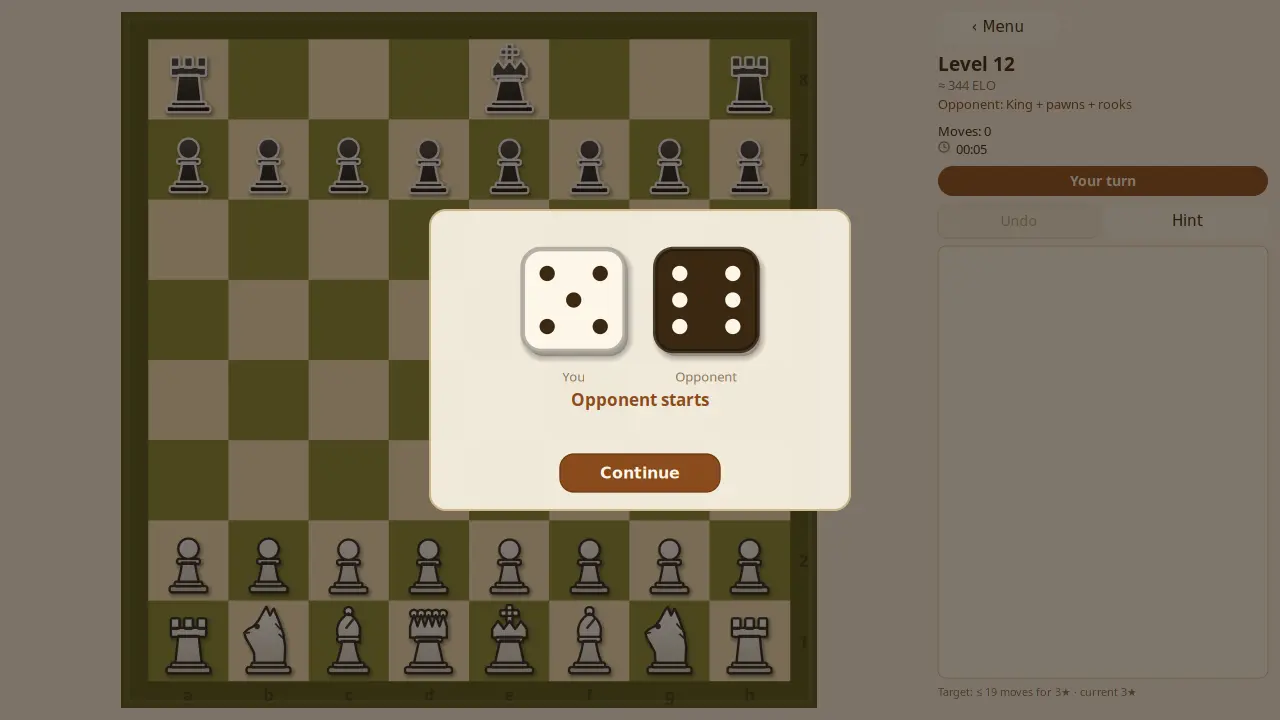
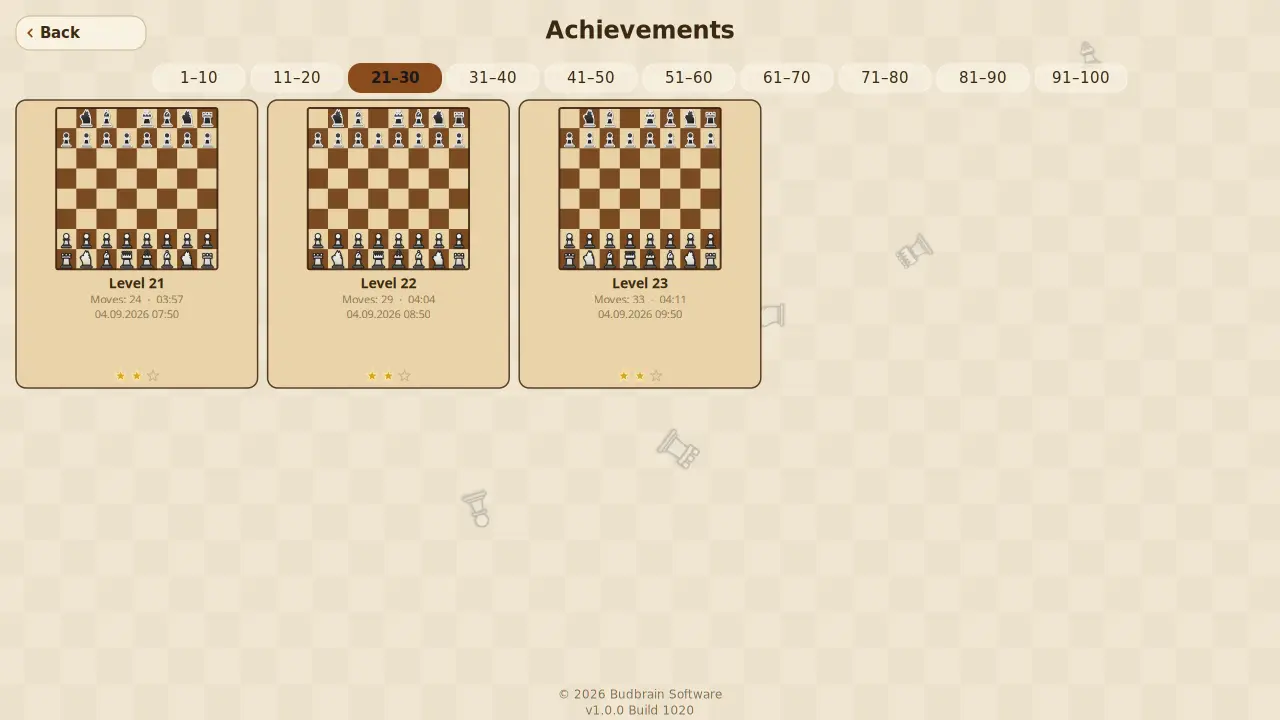
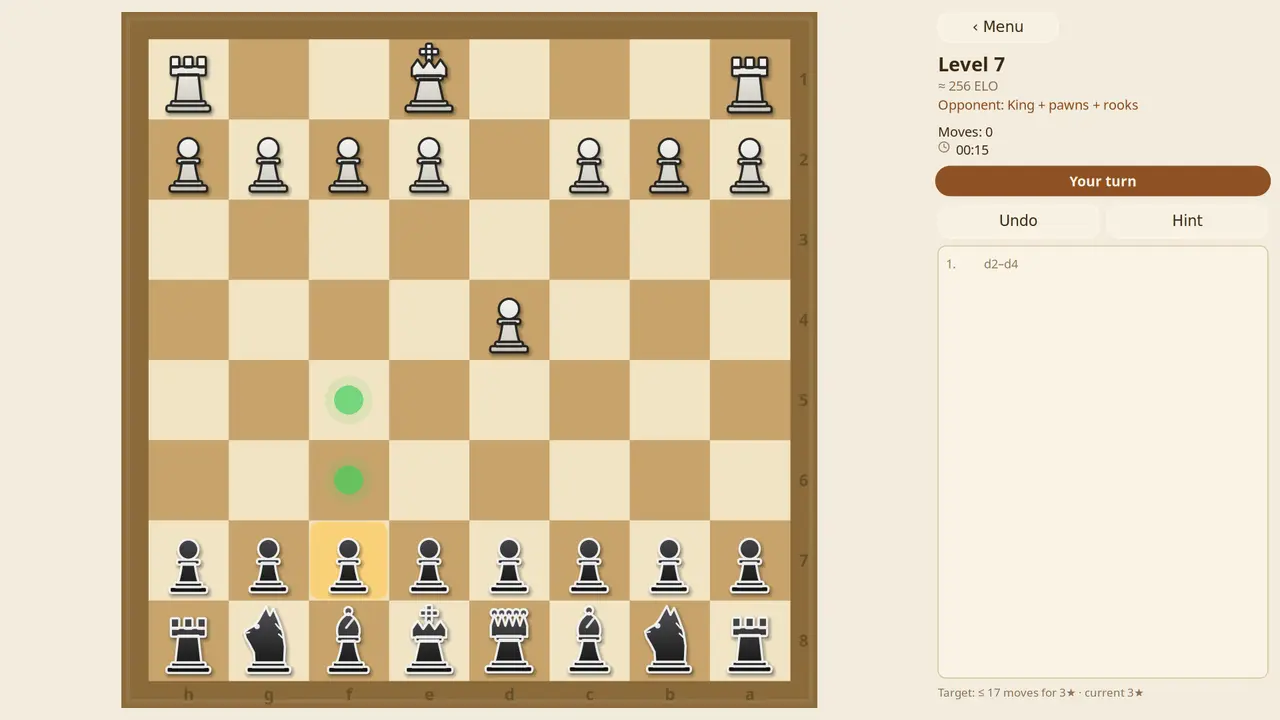
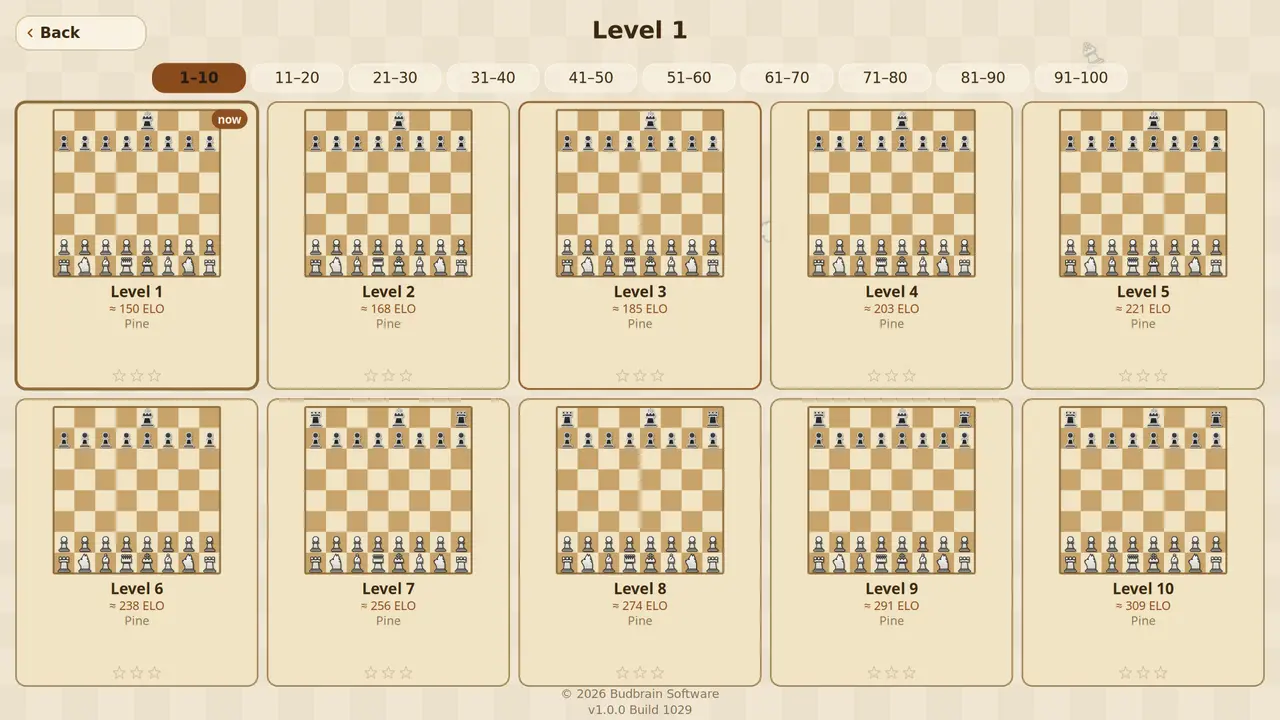
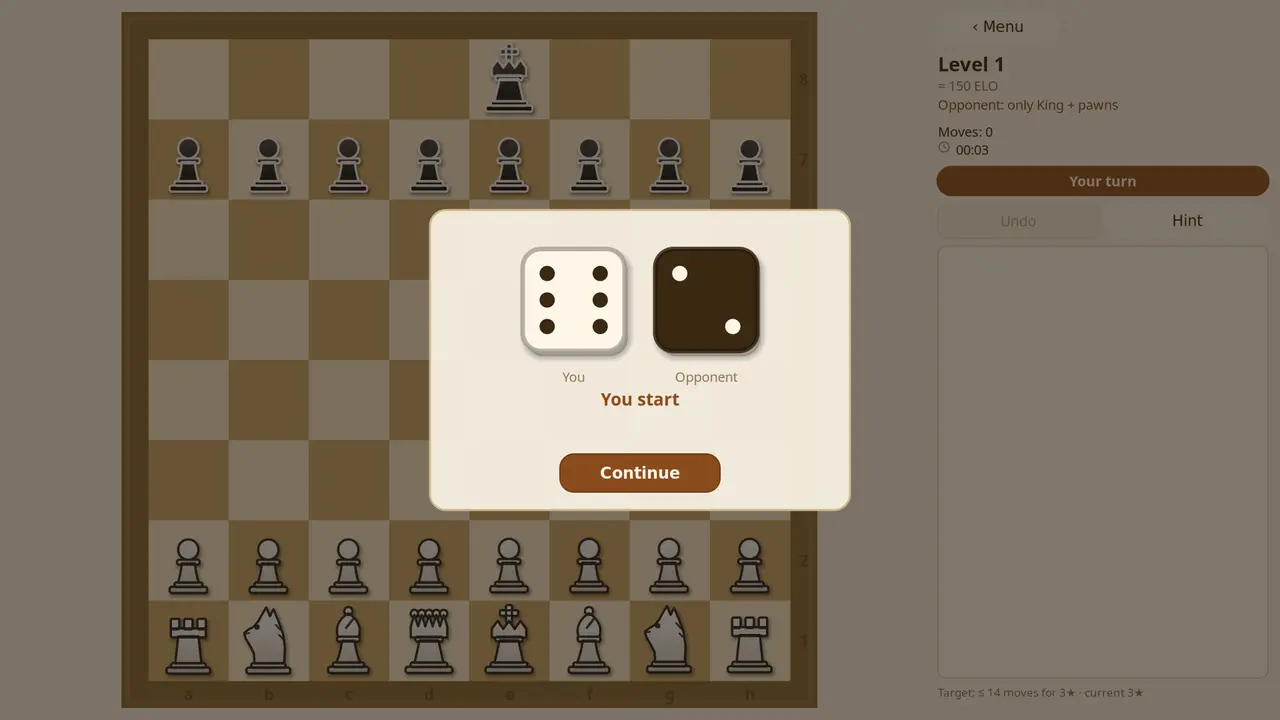
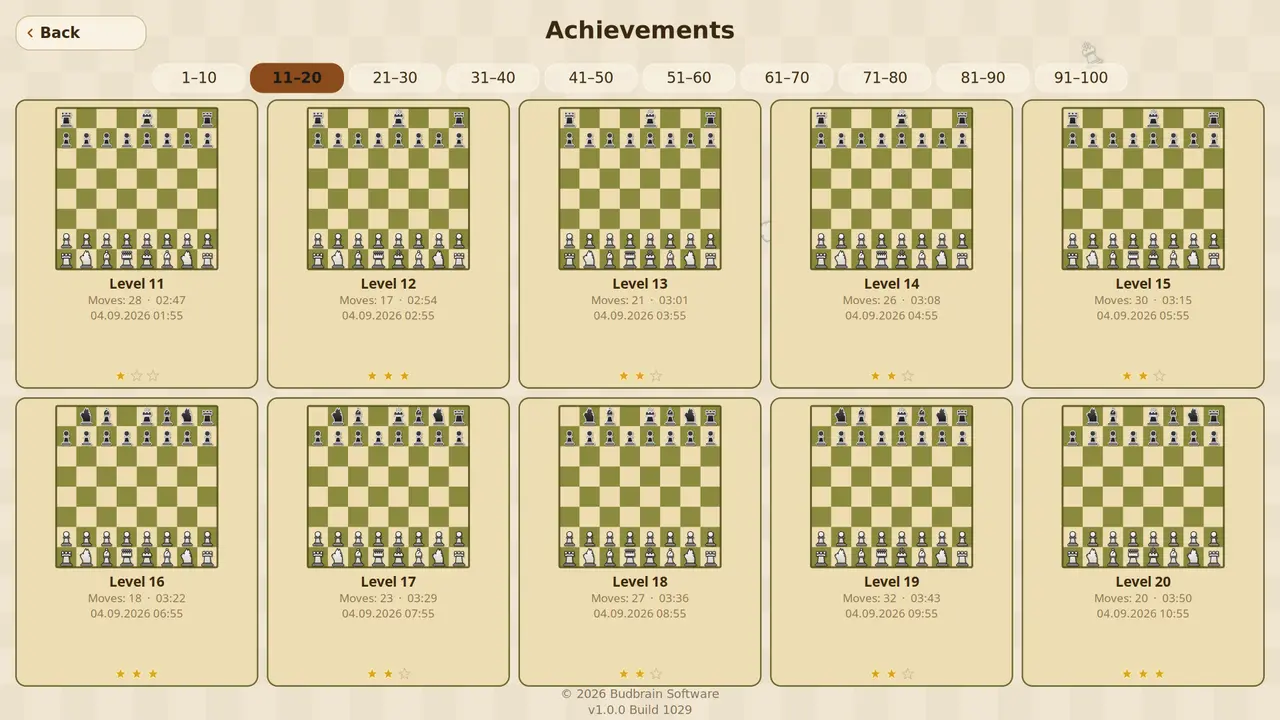
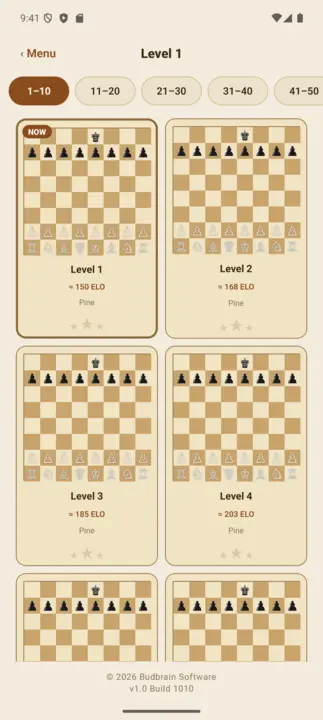
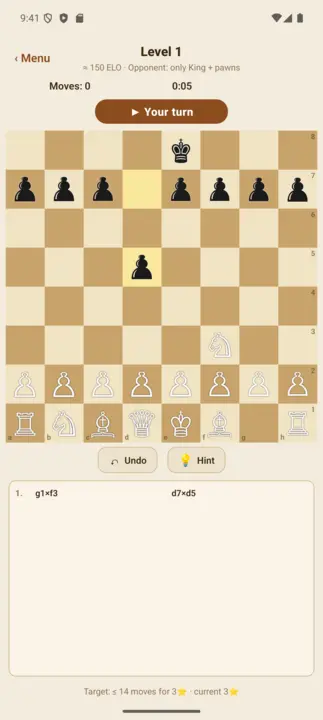
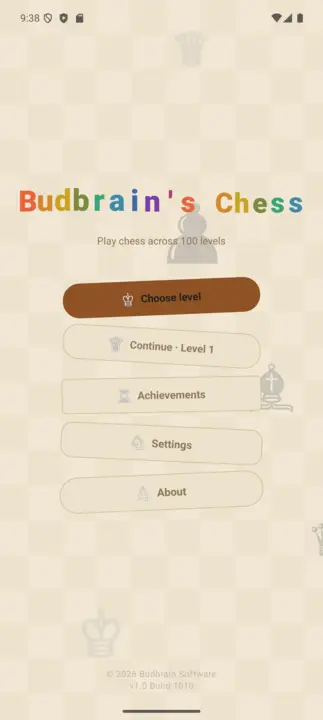
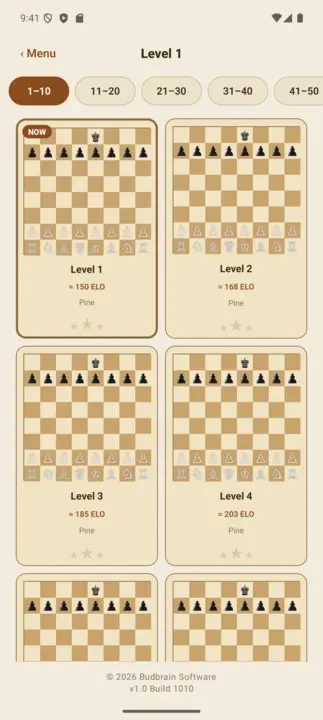
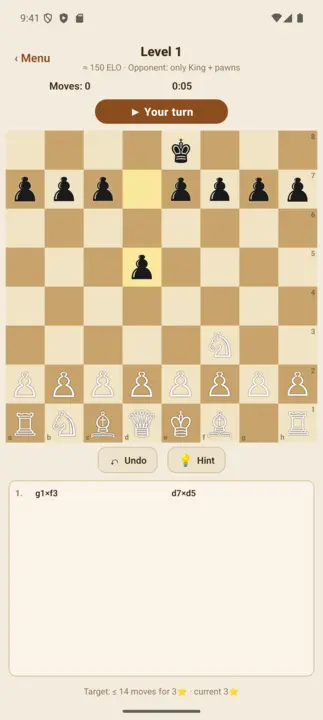
Isang daang antas ng chess laban sa computer, mula 150 hanggang 1900 ELO. Sa mga unang antas ay may handicap ang kalaban, saka lumalakas antas bawat antas. May hint na tumutulong, kumukurap ang mga piyesang nanganganib, maaaring bawiin ang bawat galaw — at bawat larong napanalunan mo ay nananatili sa gallery.
100 antas150 hanggang 1900 ELOKalaban na may handicapHint at undoGallery ng mga napanalunang laroOpenGLSDL2 · CairoGNOME / KDE / XFCE22 mga wika
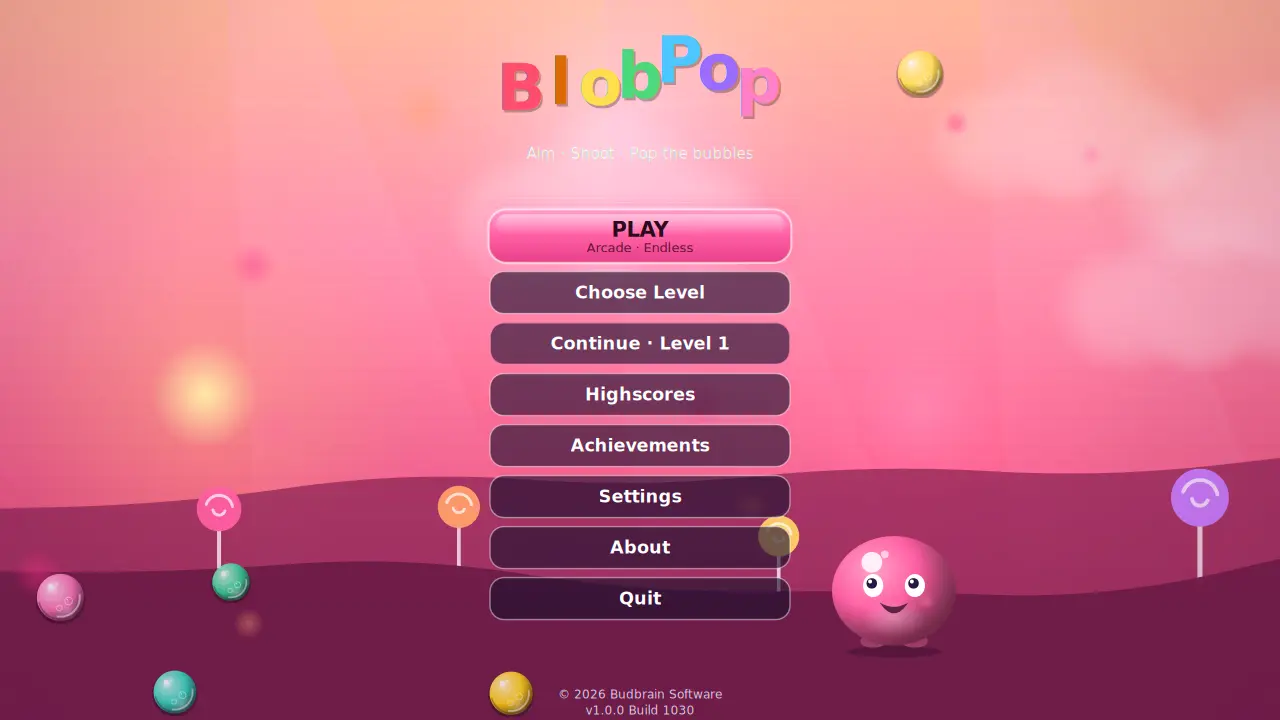
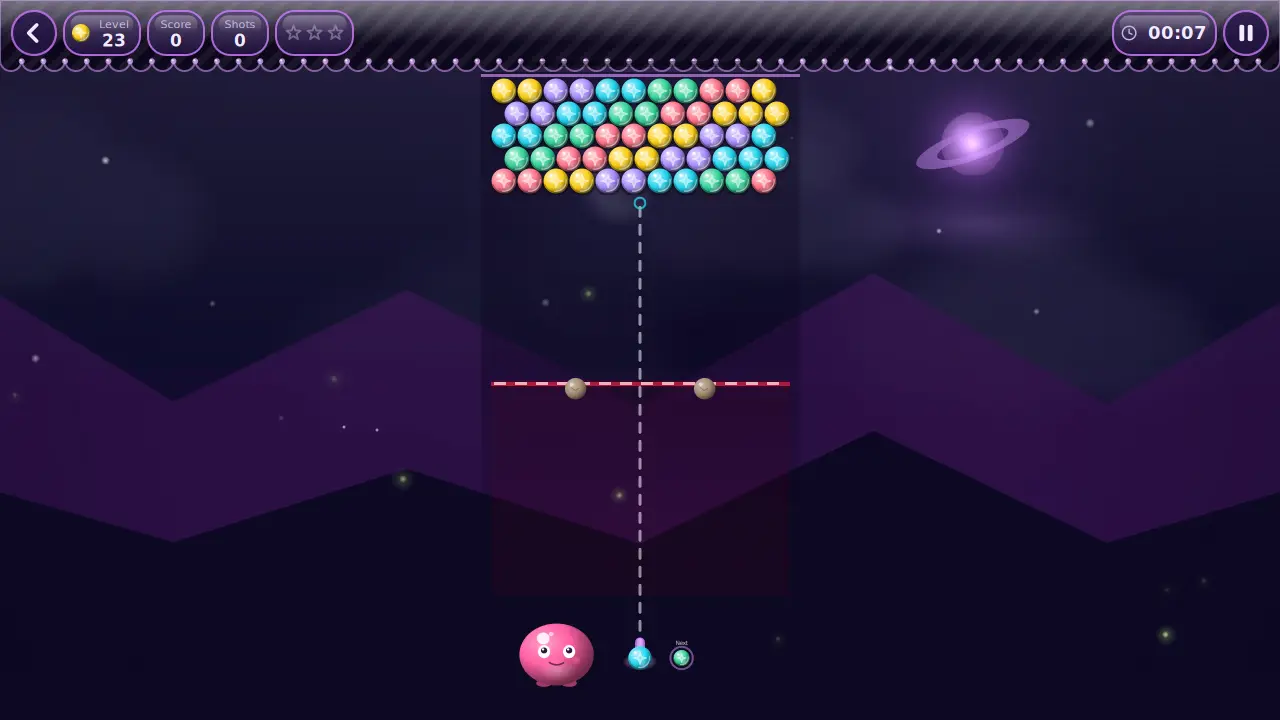
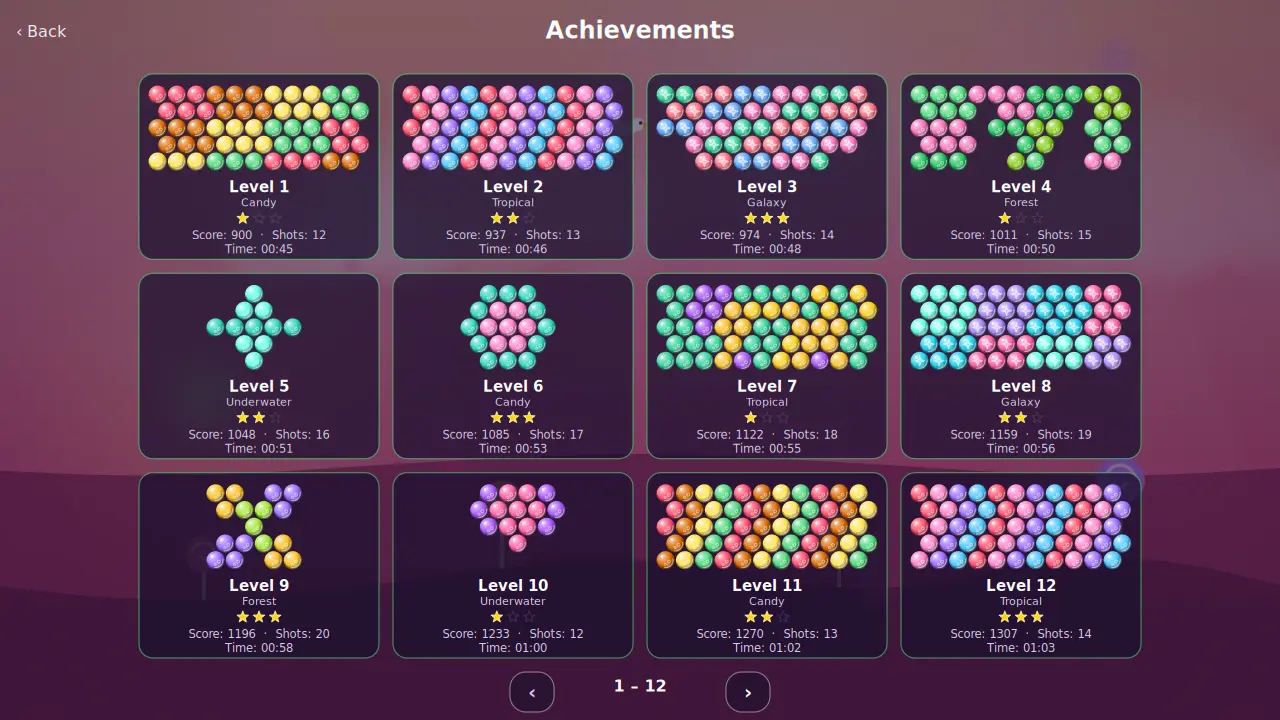
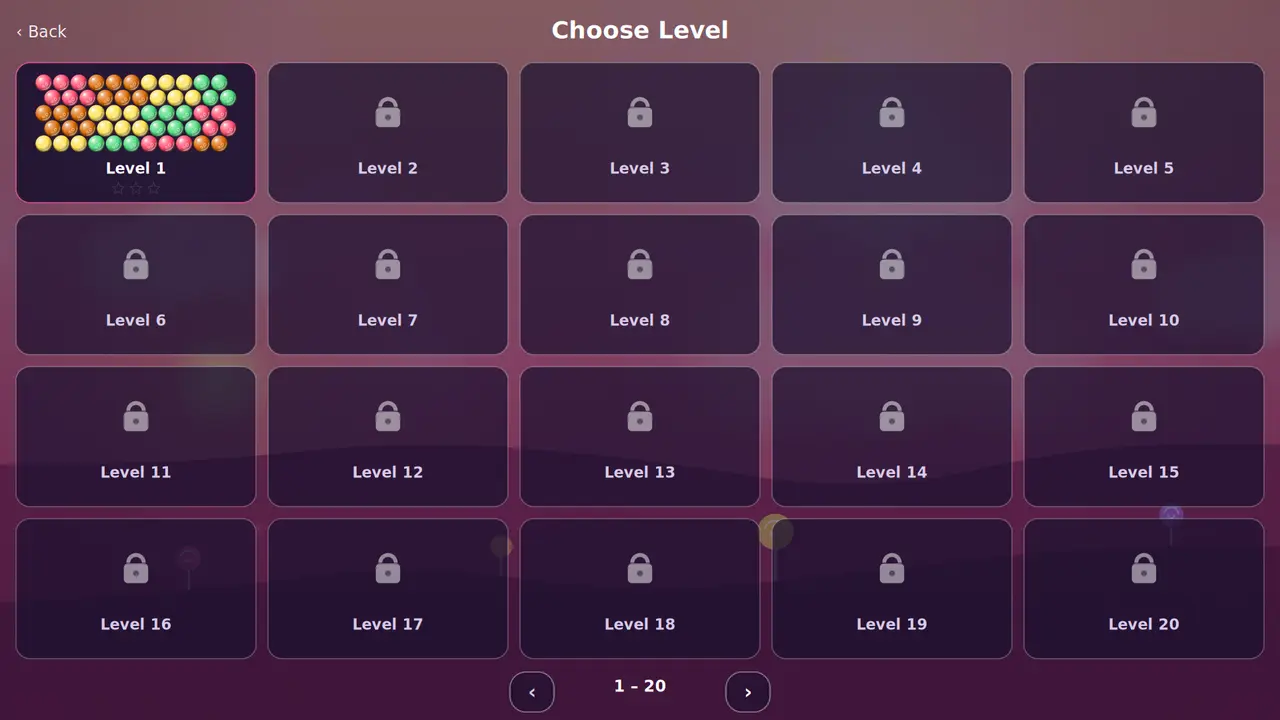
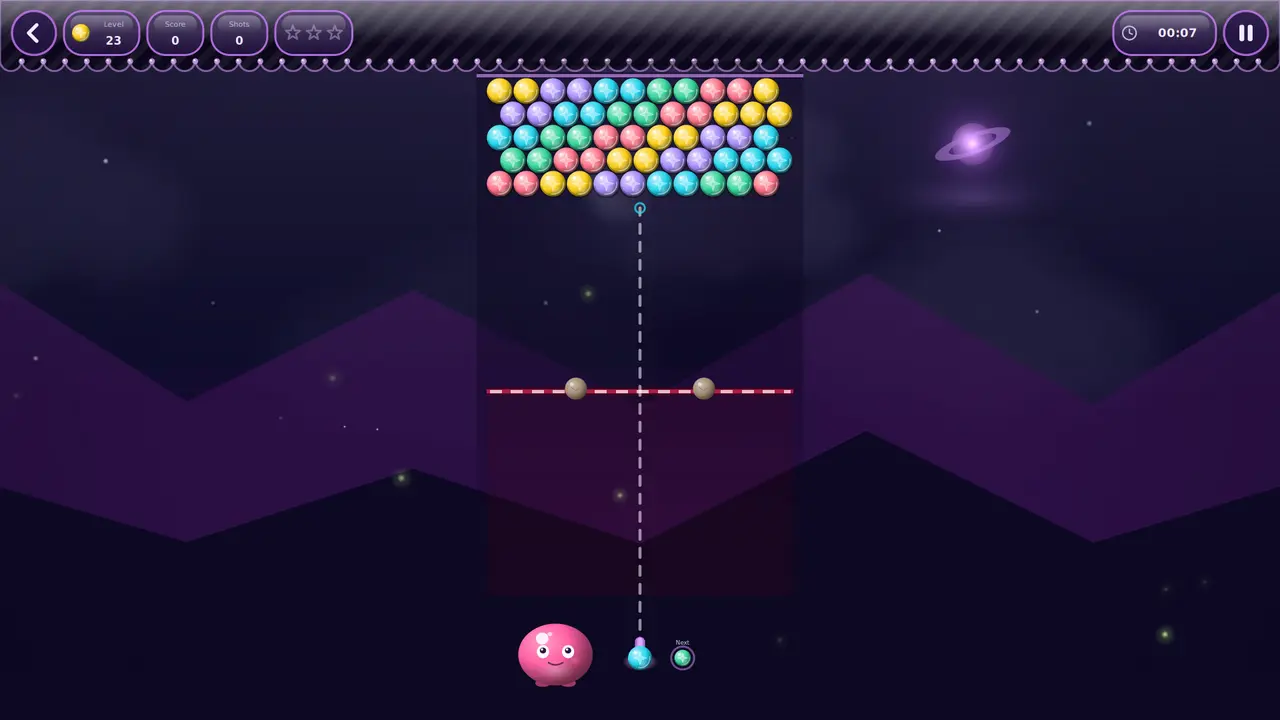
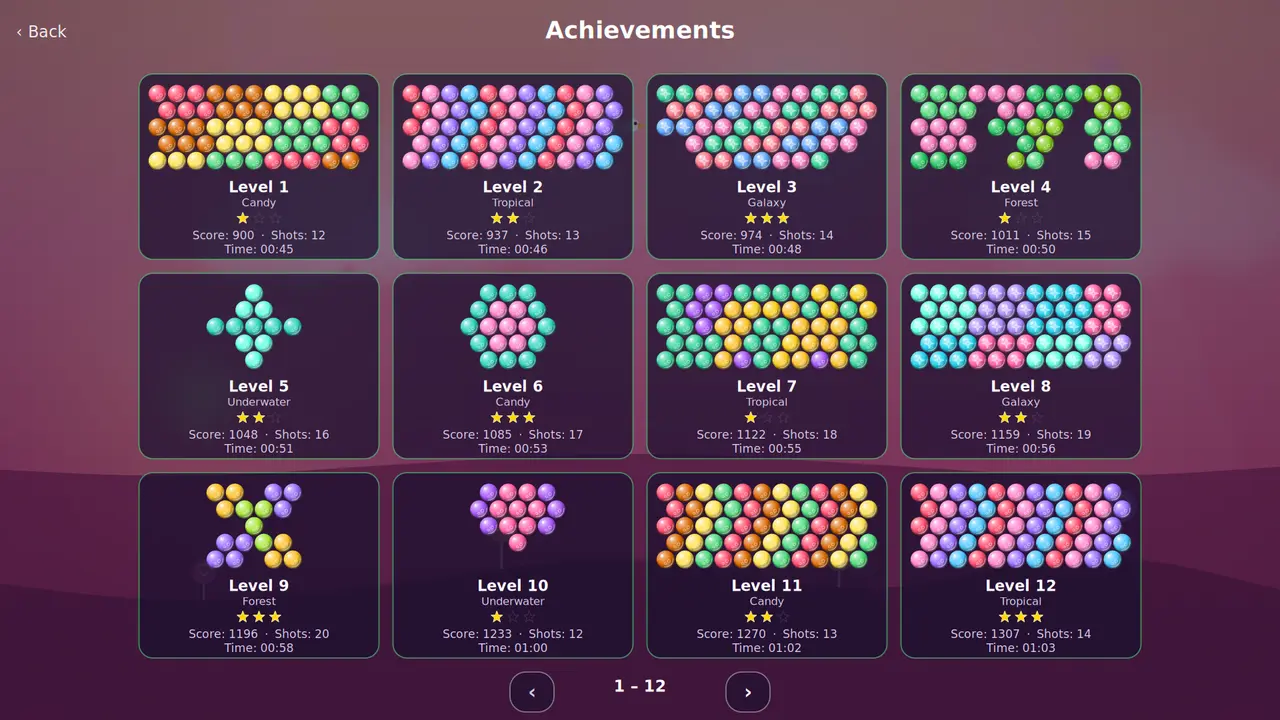
Isang daang antas sa limang mundo: tumutok, mag-click, pagsamahin ang tatlo ng isang kulay. Bawat ilang tira ay bumababa ng isang hanay ang board — linisin ito bago umabot sa ilalim at makakakuha ka ng tatlong bituin. Kasama ang endless mode na may talaan ng high score.
100 antasLimang mundoEndless modeAraw at gabiTalaan ng high scoreOpenGLSDL2 · CairoGNOME / KDE / XFCE22 mga wika
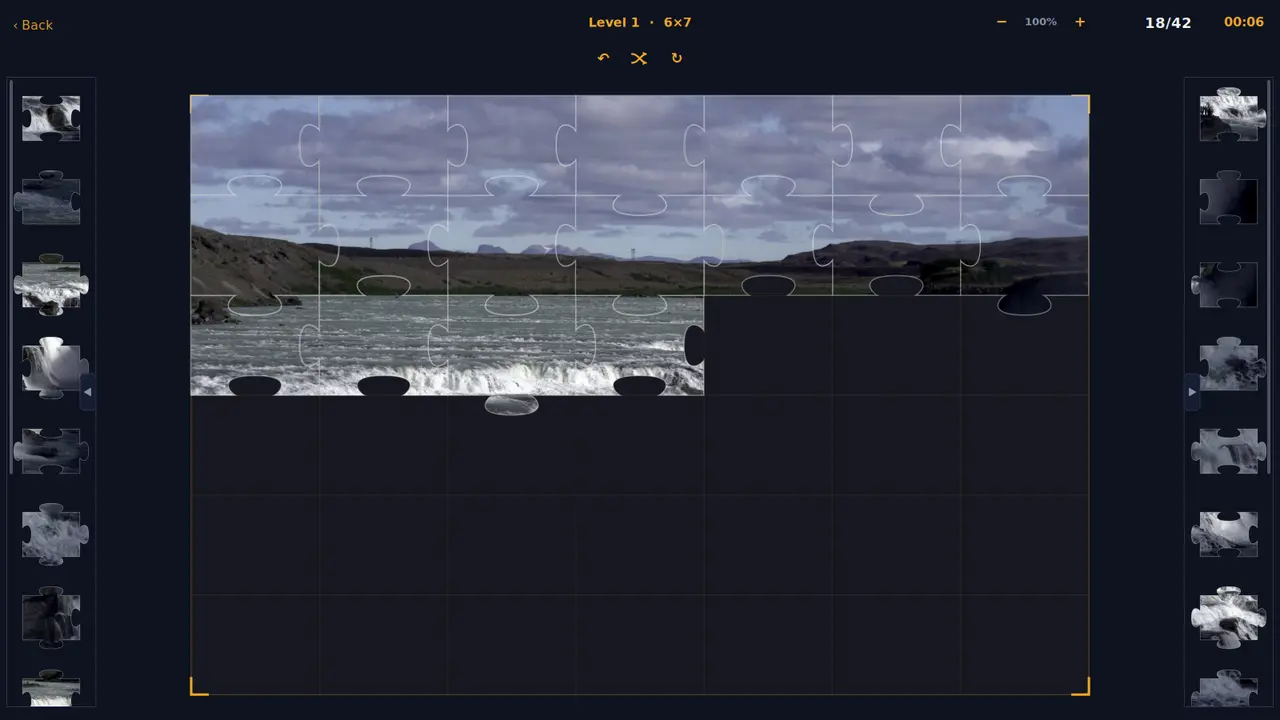
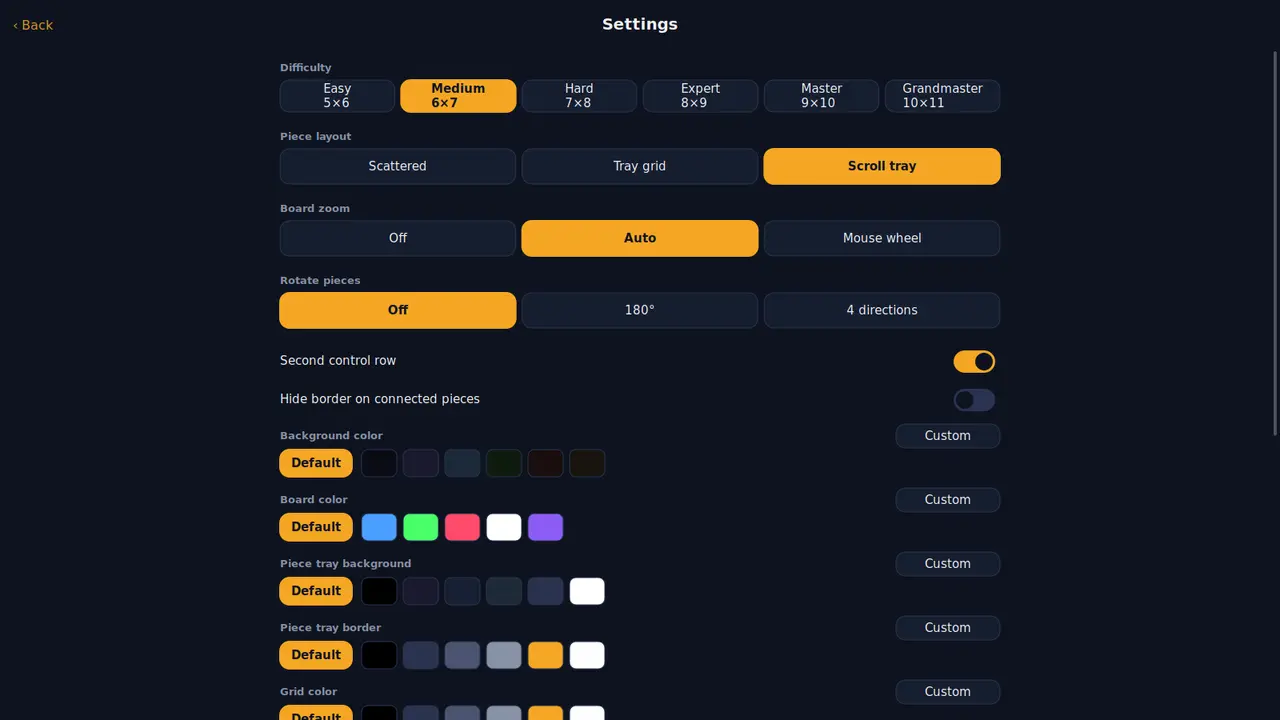
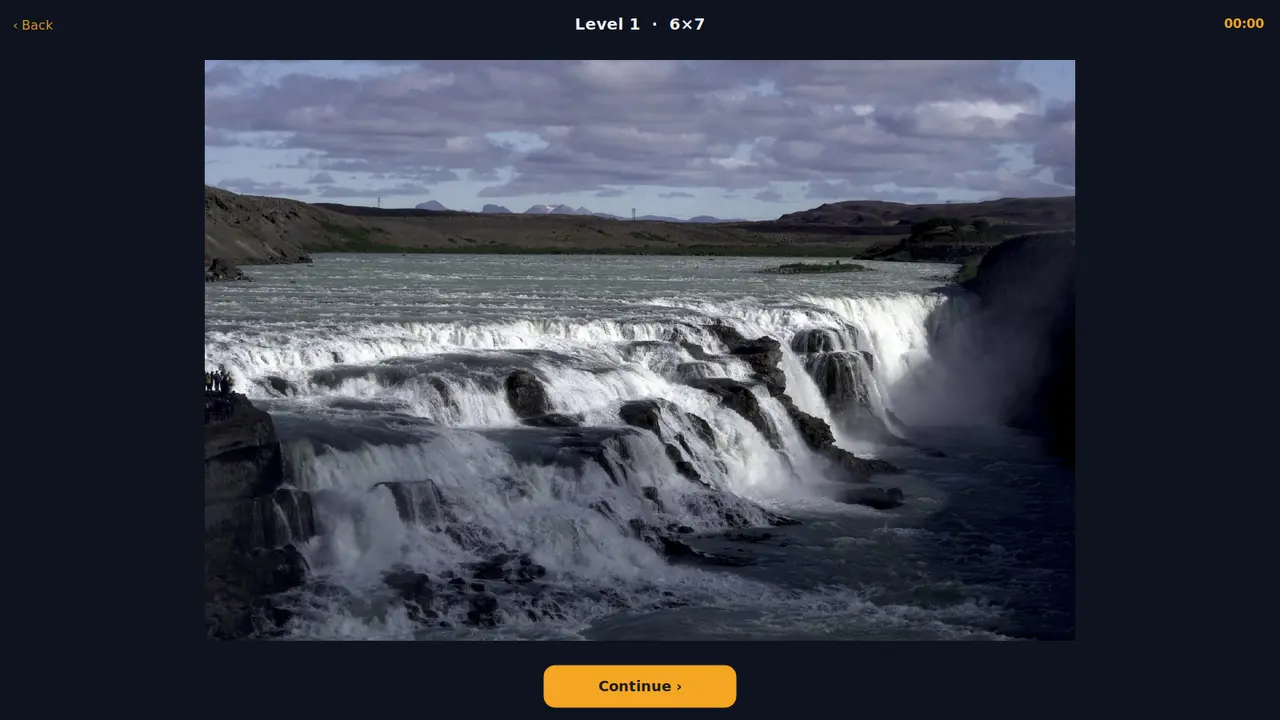
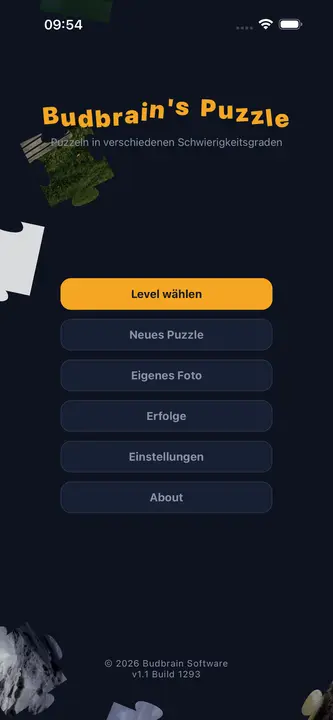
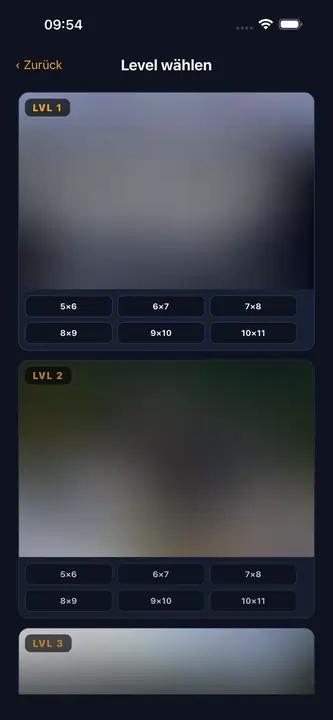
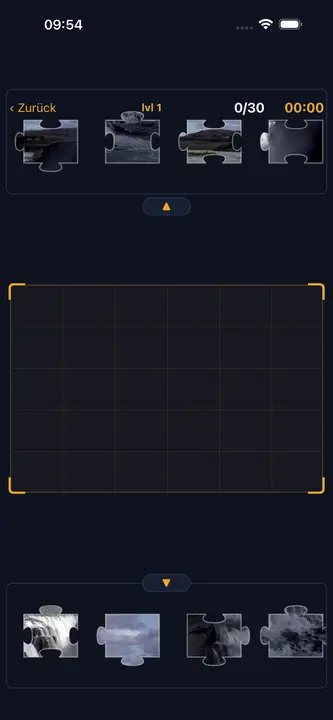
Apatnapung larawan bilang jigsaw puzzle, bawat isa sa anim na laki mula tatlumpu hanggang isang daan at sampung piraso. Ang pirasong malapit sa lugar nito ay kusang kumakabit — buksan ang rotation kung gusto mong mas mahirap.
Apatnapung larawanAnim na laki30 hanggang 110 pirasoUmiikot na mga pirasoMga tagumpayAng iyong mga sariling kulayOpenGLSDL2 · CairoGNOME / KDE / XFCE22 mga wika
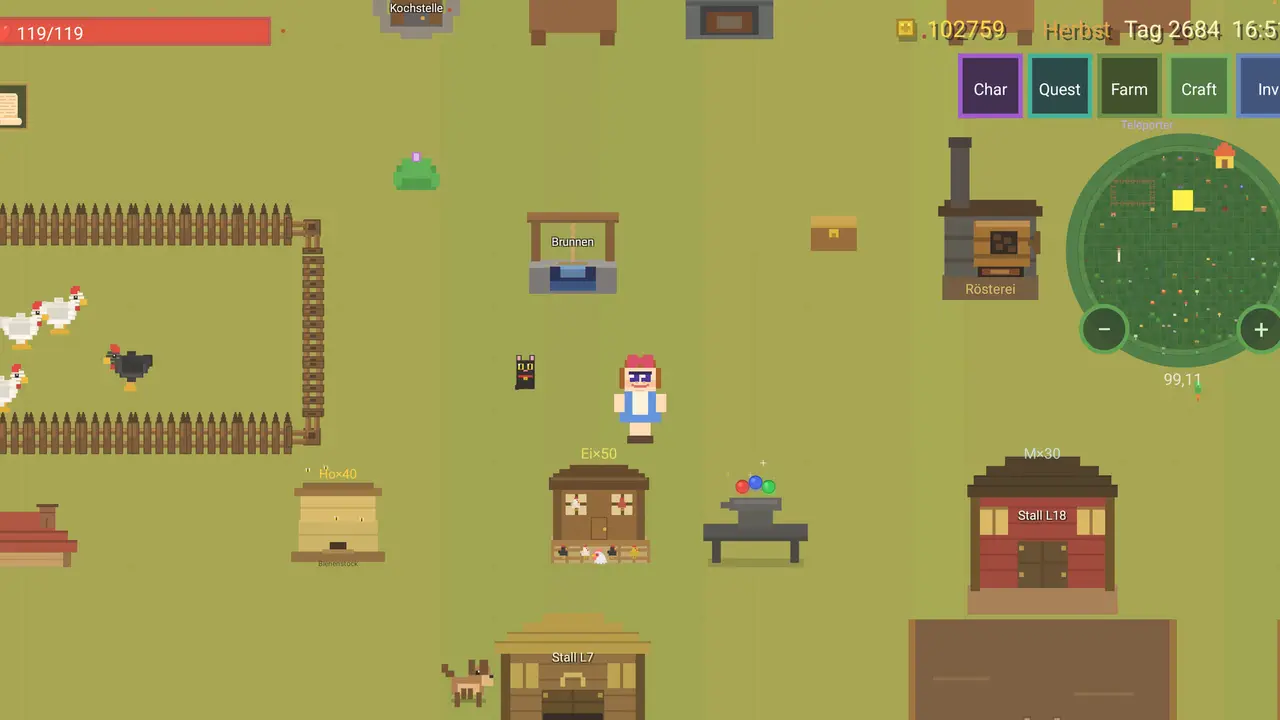
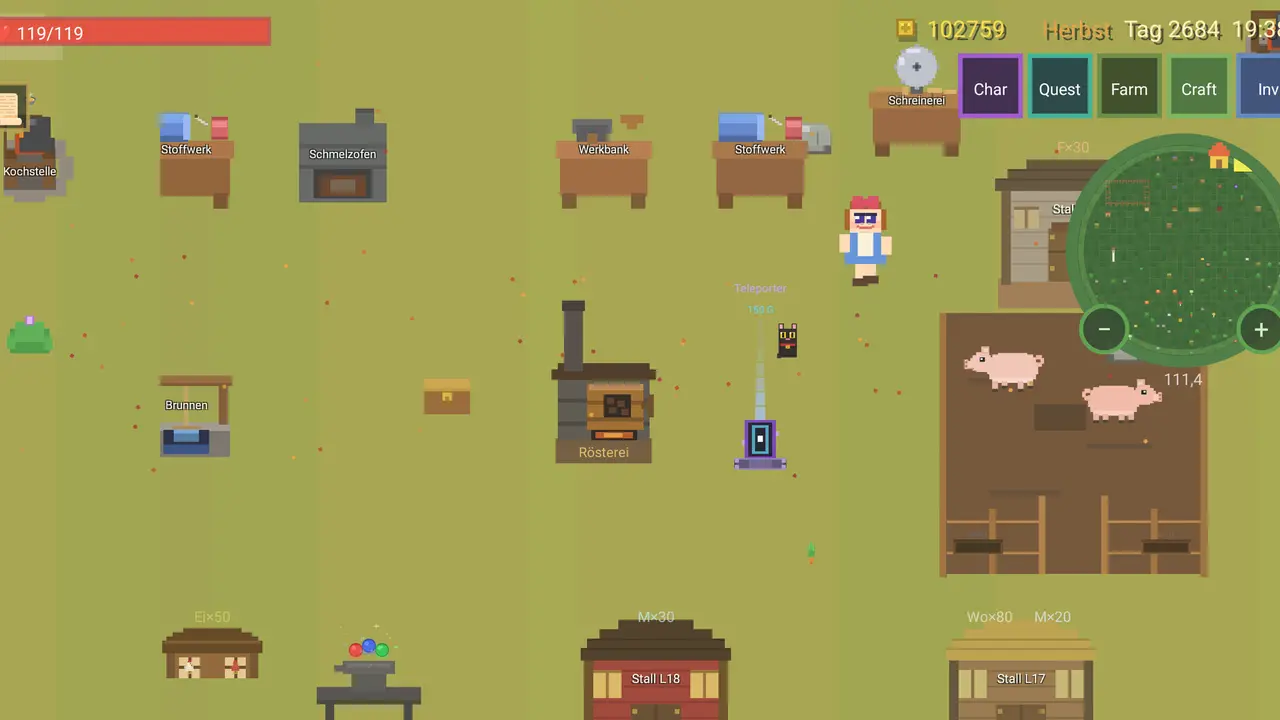
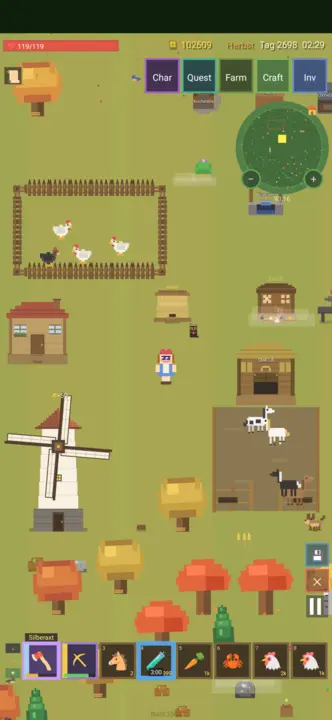
Magtayo ng sakahan mula sa isang bakanteng lupa: linisin ito, taniman, mag-alaga ng mga hayop, humukay ng minahan. Mahigit 300 bagay, 231 recipe, apat na panahon — at kusa itong nagse-save.
Mahigit 300 item231 recipeAnim na uri ng hayopApat na panahonMinahan · pangingisda · pangangasoMouse · keyboard · gamepadOpenGLSDL2 · CairoGNOME / KDE / XFCE22 mga wika
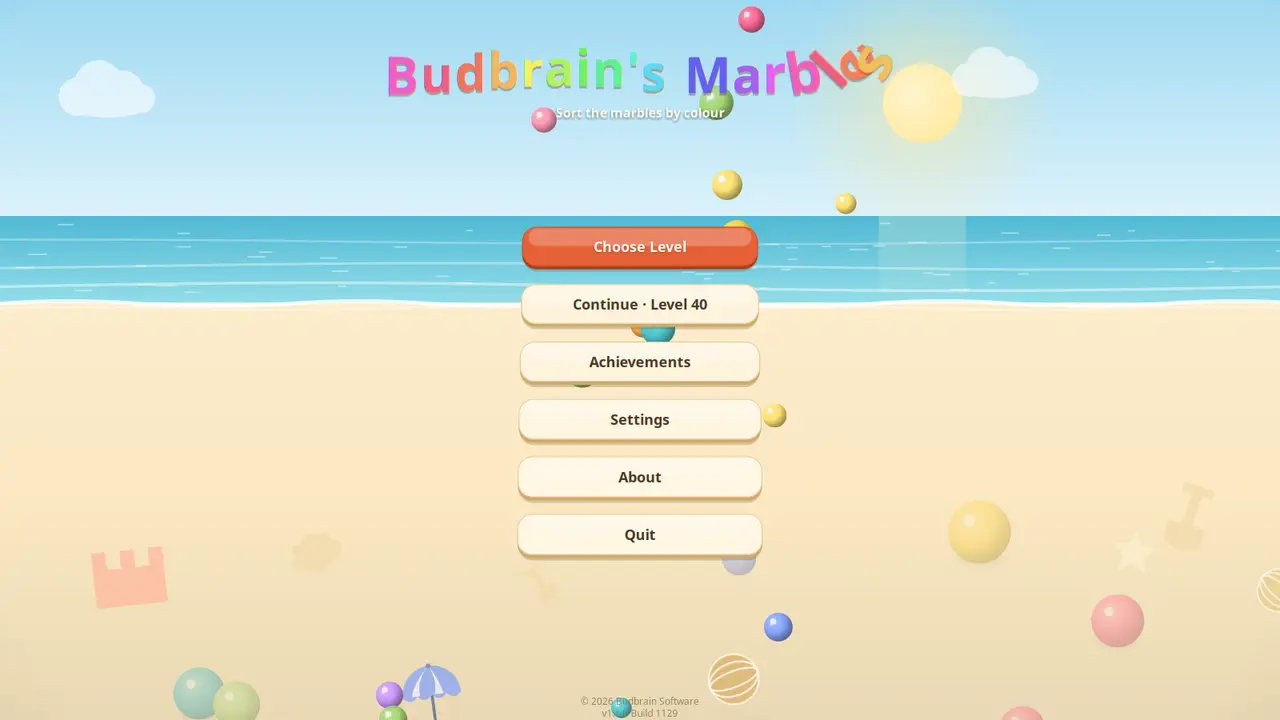
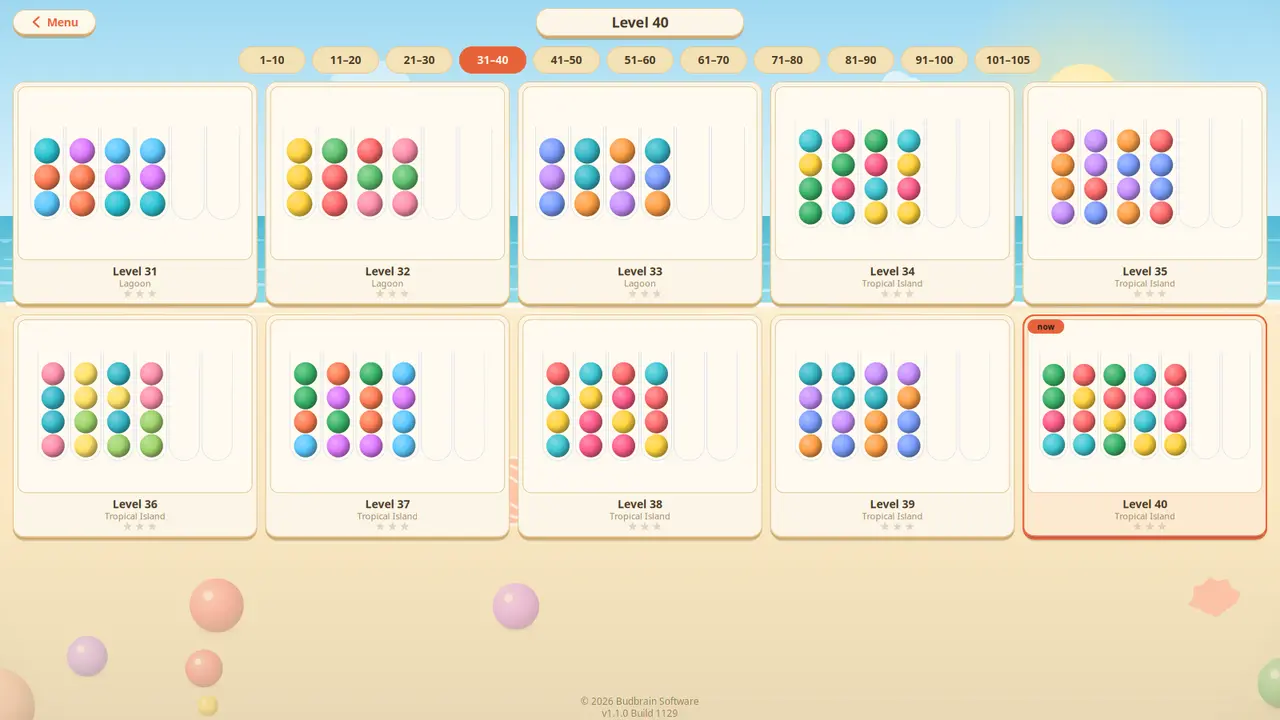
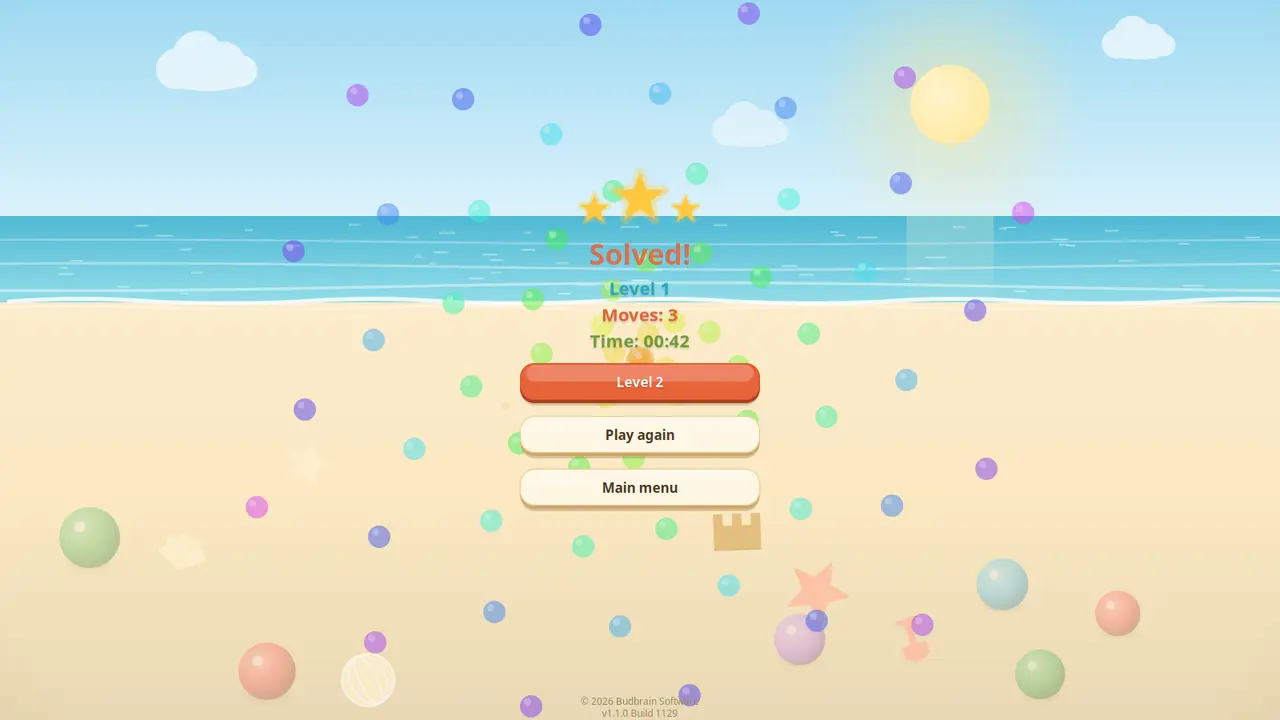
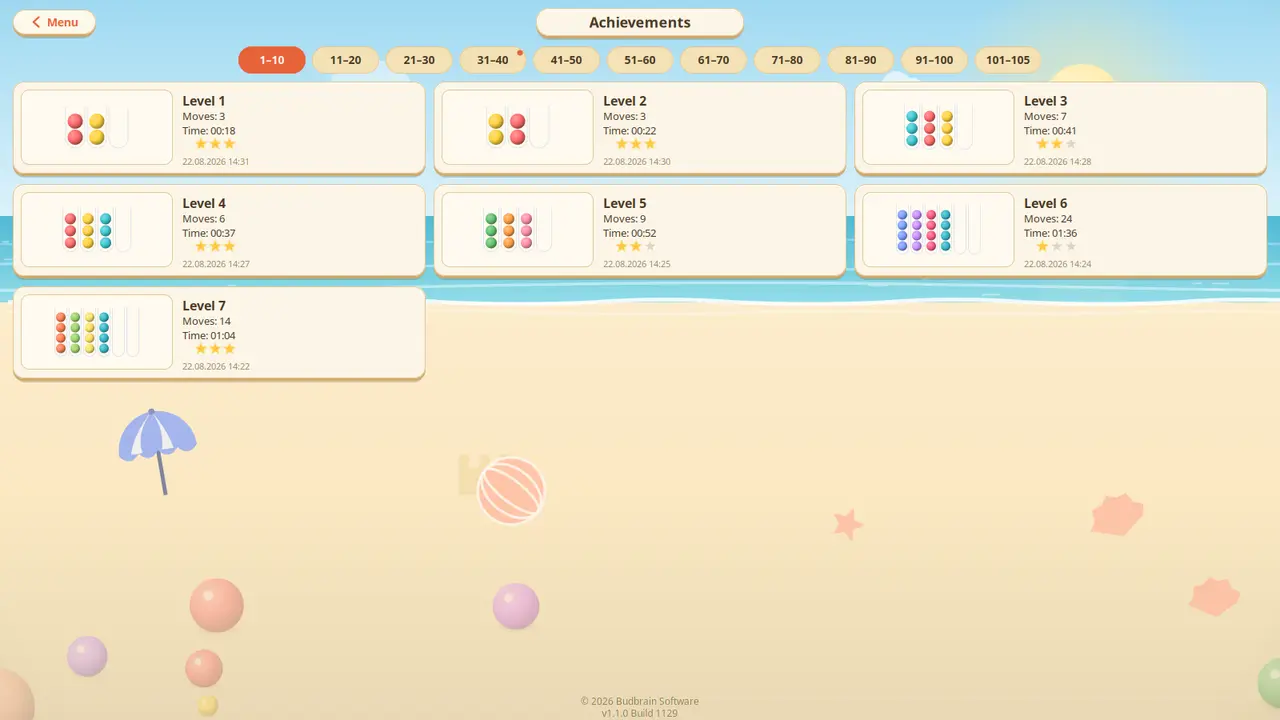
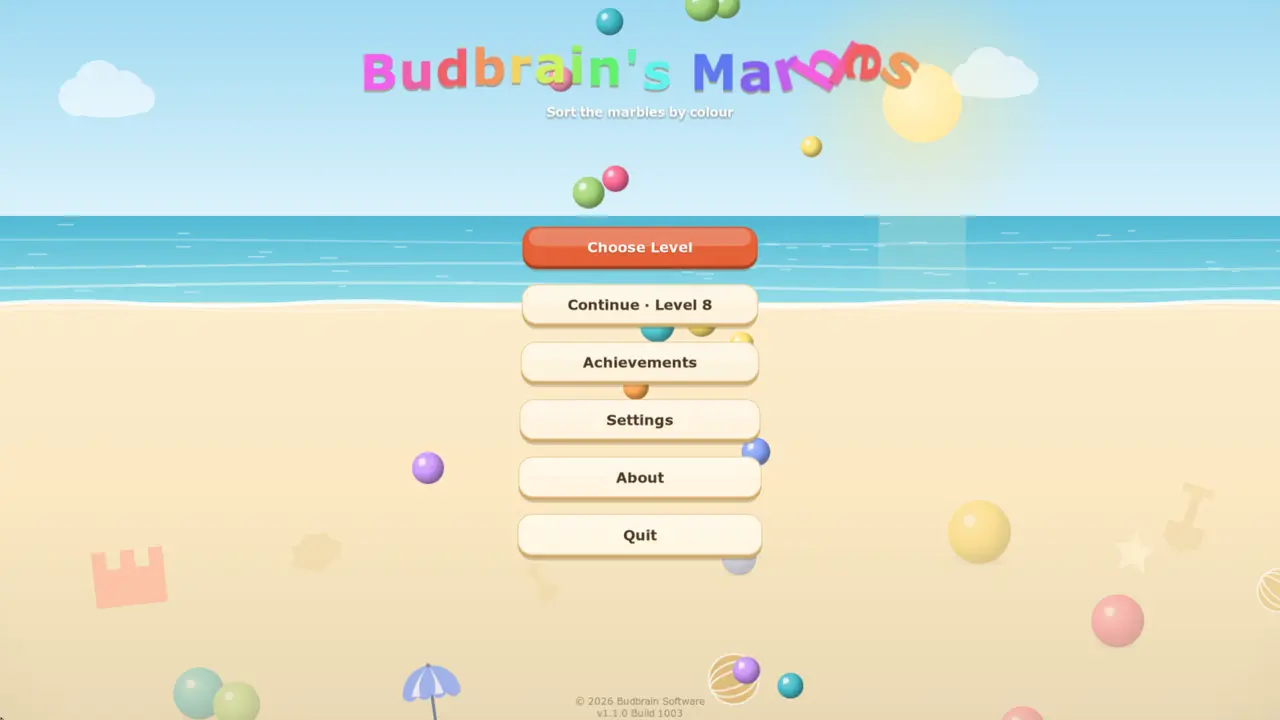
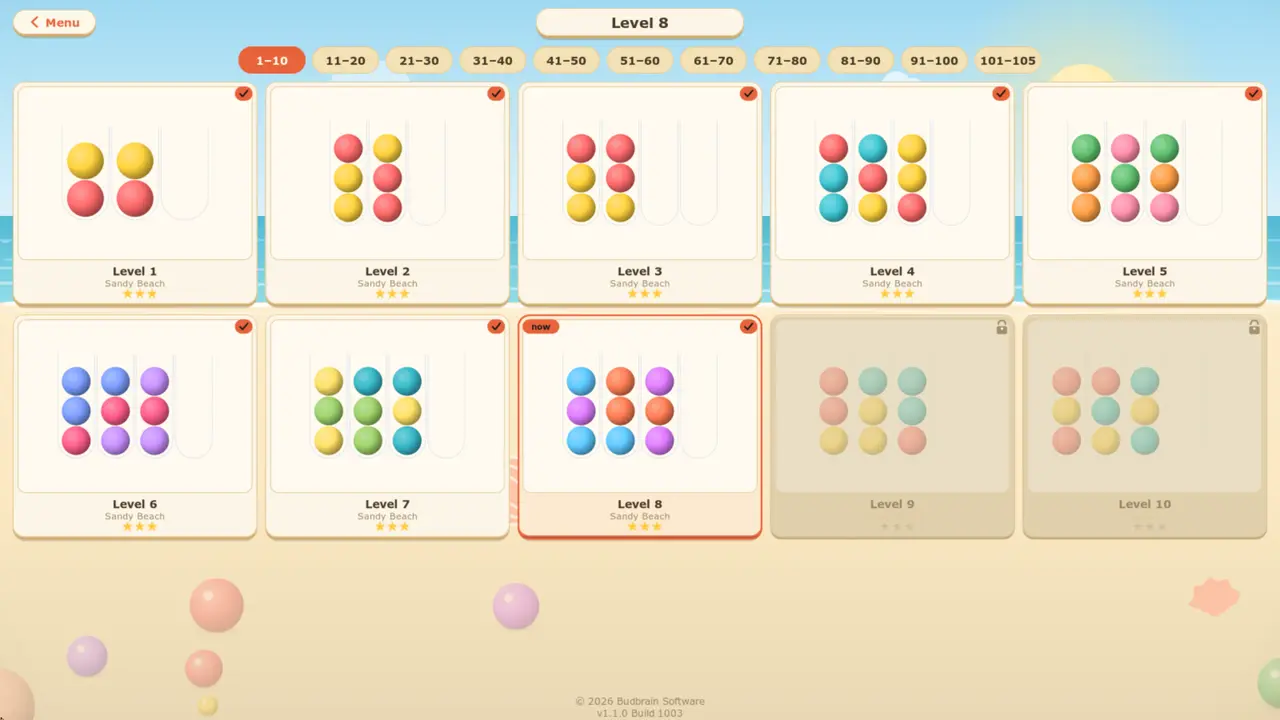
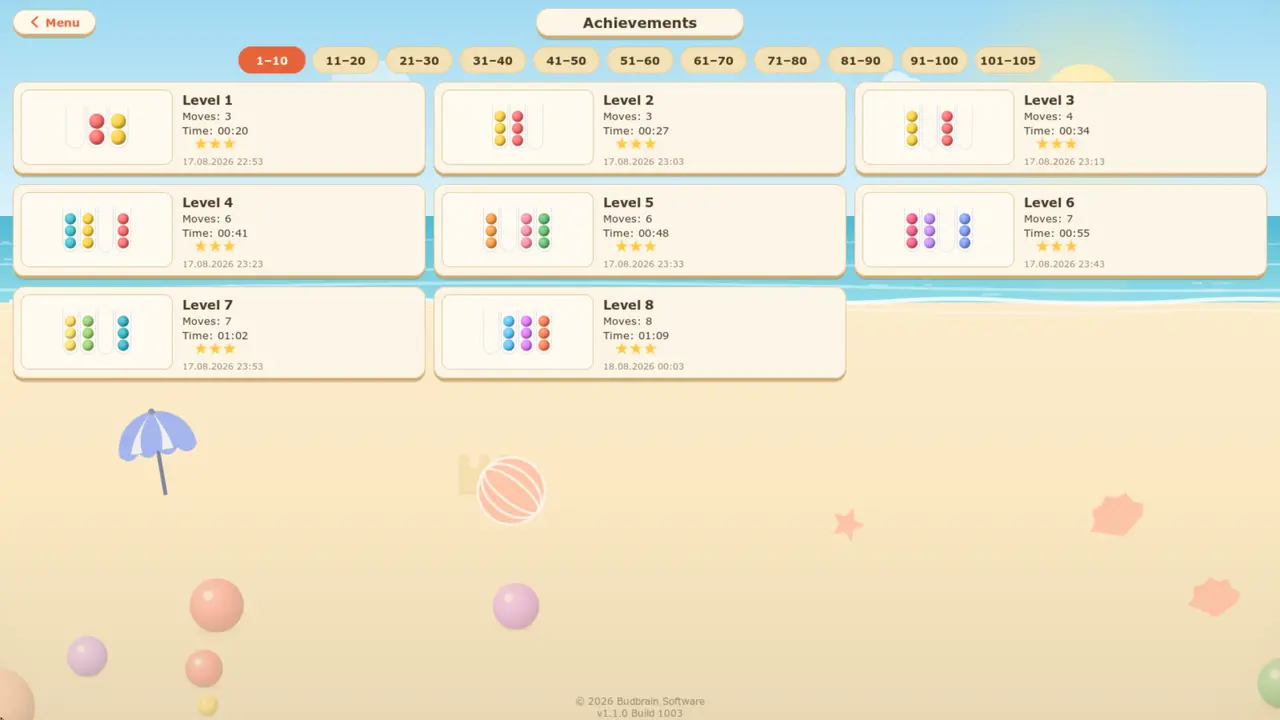
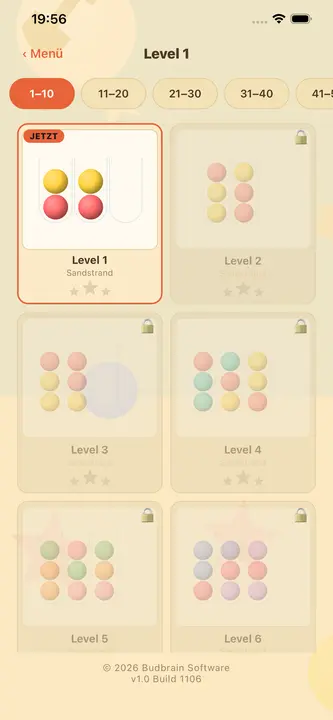
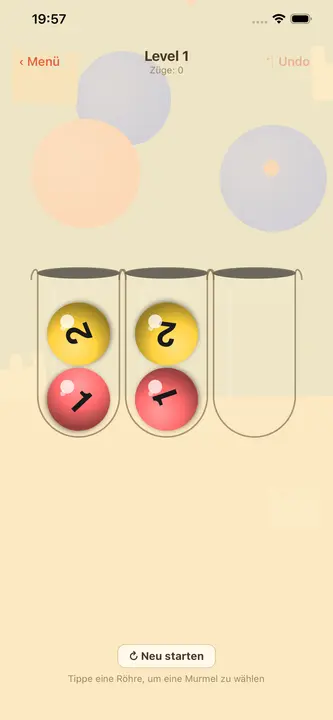
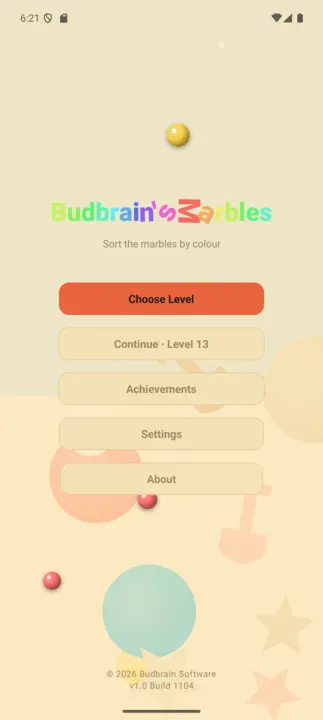
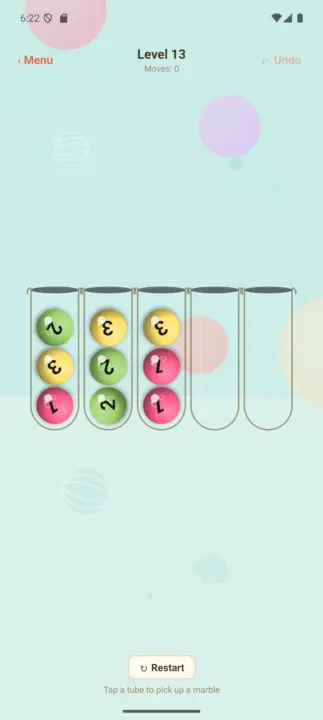
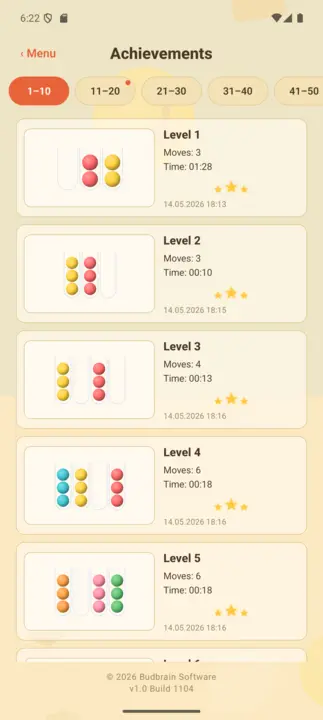
Ayusin ang mga marble ayon sa kulay: pumili ng tubo, saka ang pupuntahan — lilipad pa-arko ang marble sa ibabaw. Isang daan at limang puzzle sa limang beach, at bawat isa ay malulutas.
105 puzzleLimang beachLahat ay malulutasUndo · I-restartPader ng mga tagumpayOpenGLSDL2 · CairoGNOME / KDE / XFCE22 mga wika
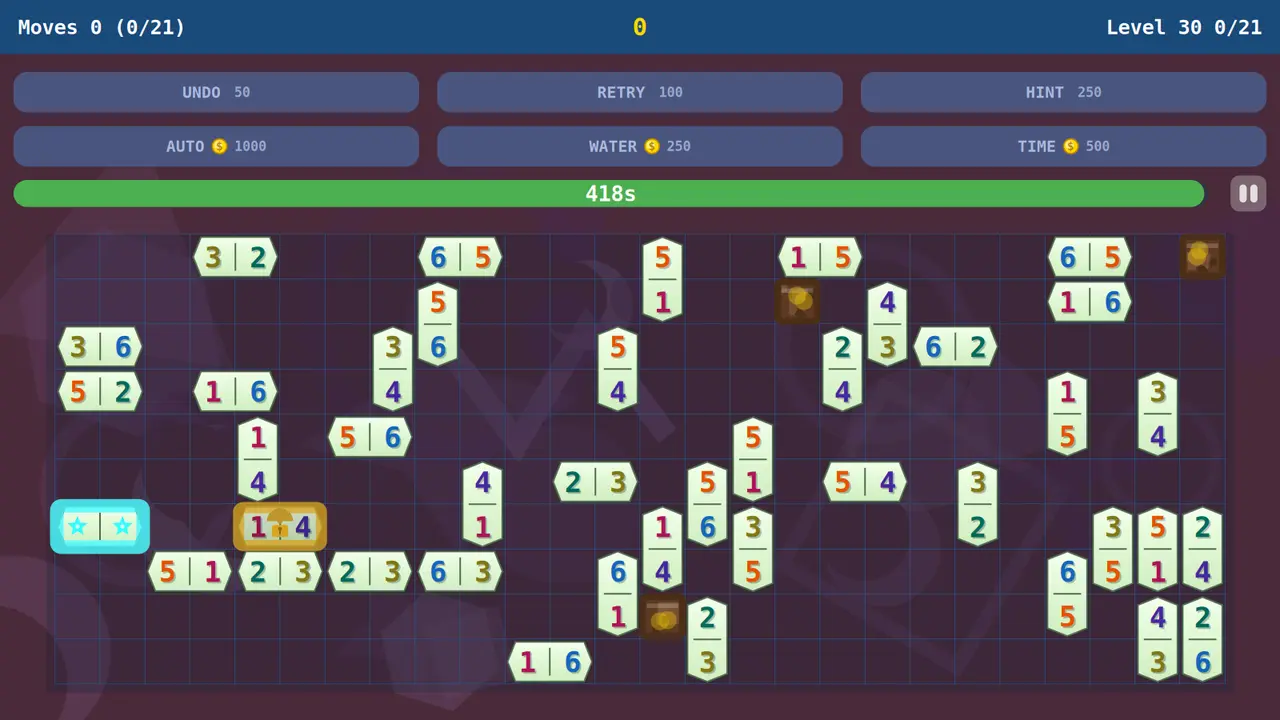
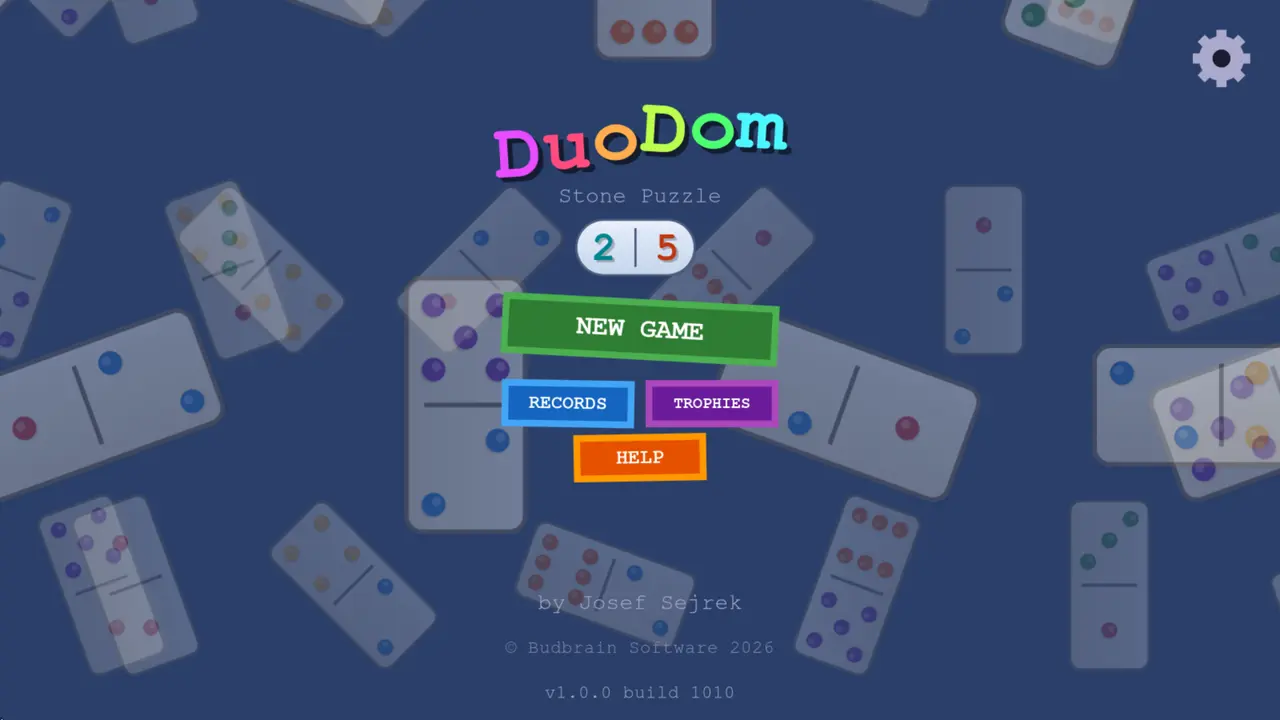
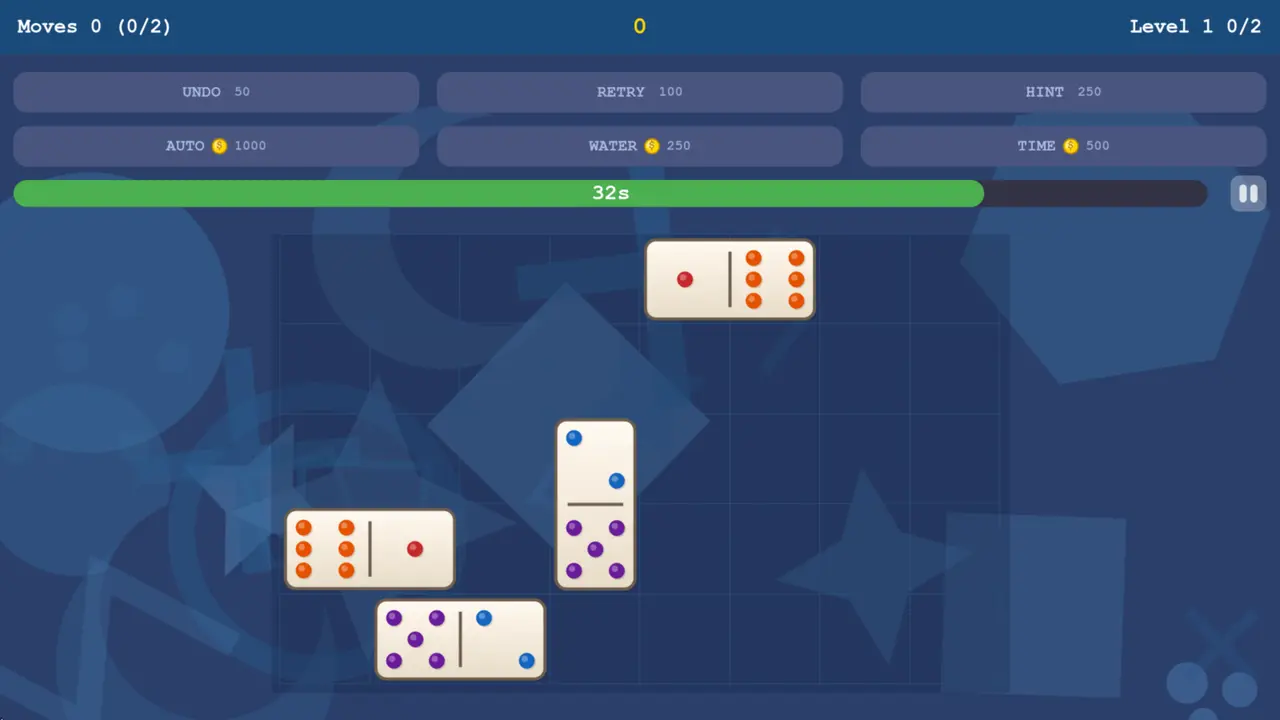
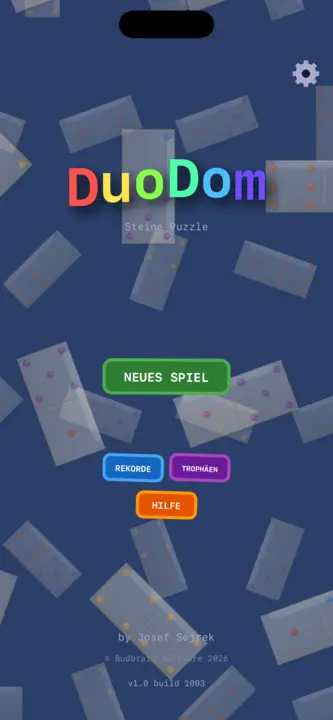
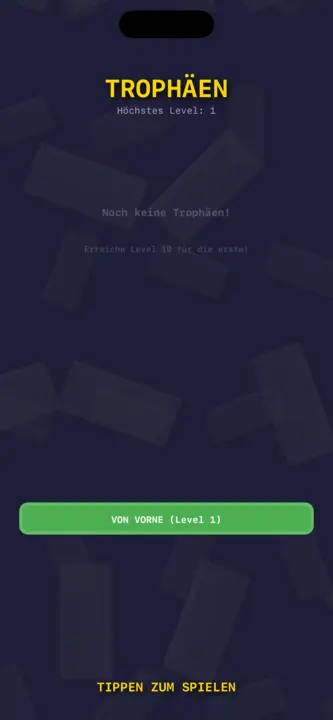
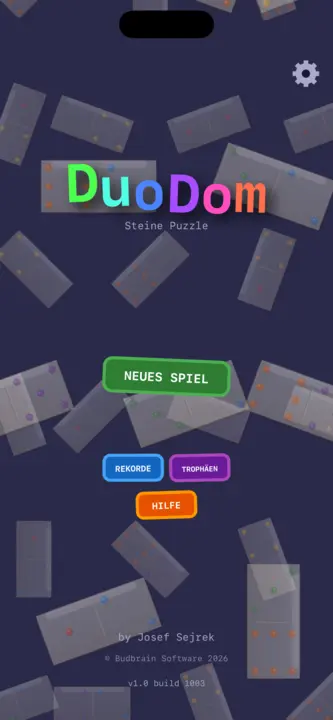
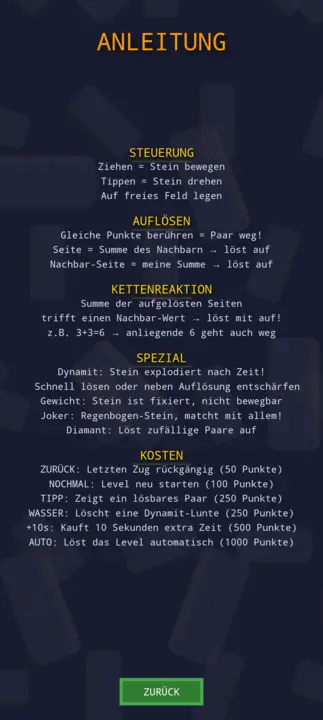
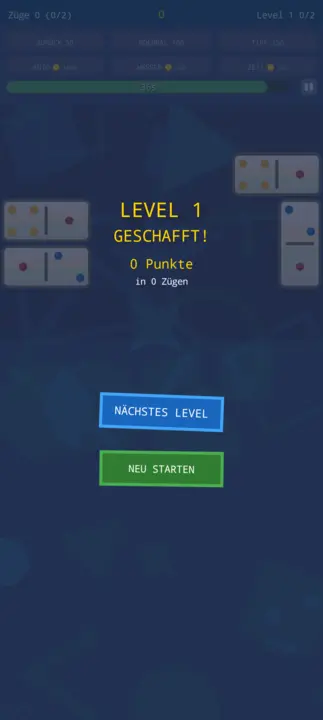
I-slide nang magkakasama ang mga domino: ang magkatugmang tuldok o tamang kabuuan ay nagpapawala ng isang pares. Walang katapusang antas na may dinamita, joker at diamante — at bawat isa ay maaaring ipanalo.
Walang katapusang antas17 uri ng batoDinamita · Joker · DiamanteUndo · Hint · TubigMga tropeo at rekordOpenGLSDL2 · CairoGNOME / KDE / XFCE20 mga wika
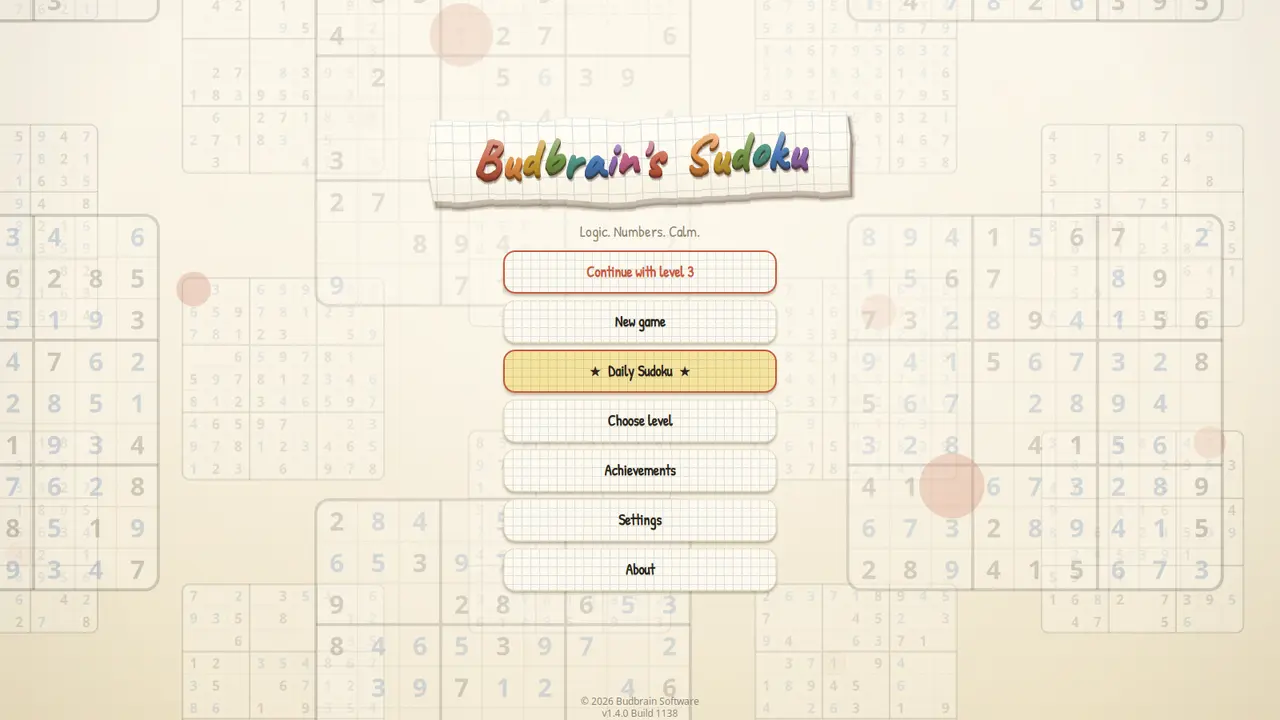
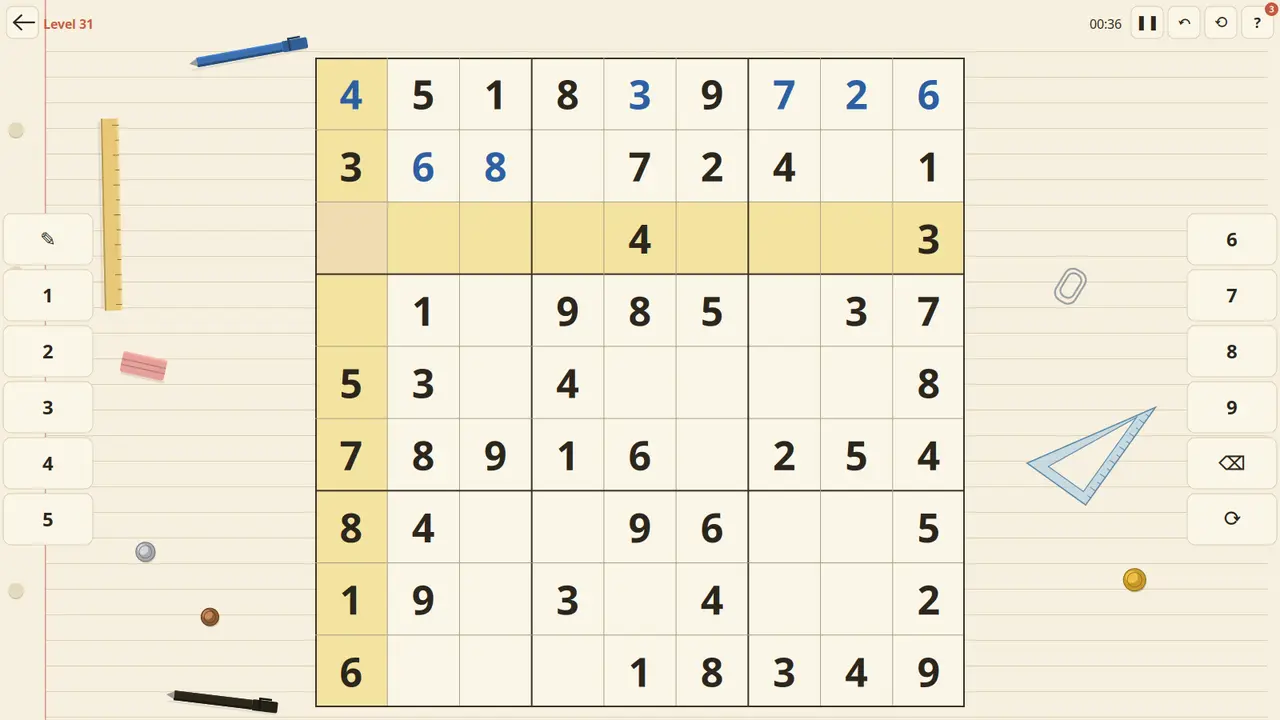
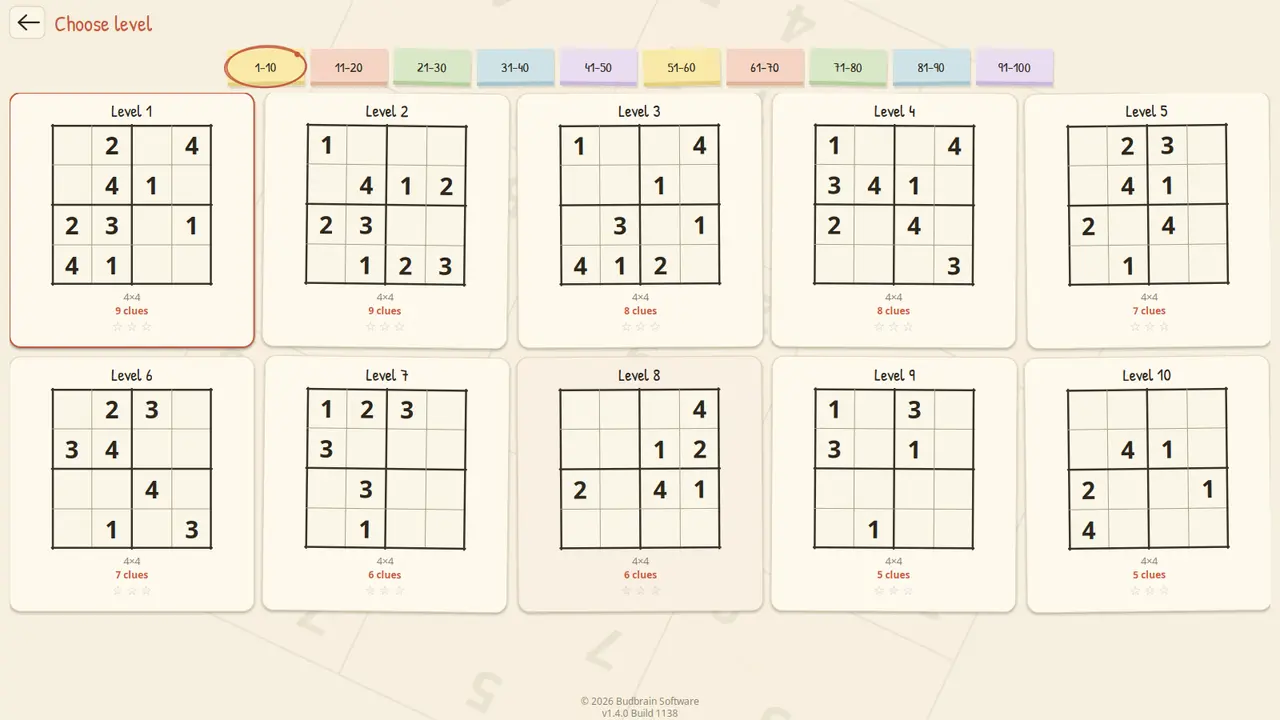
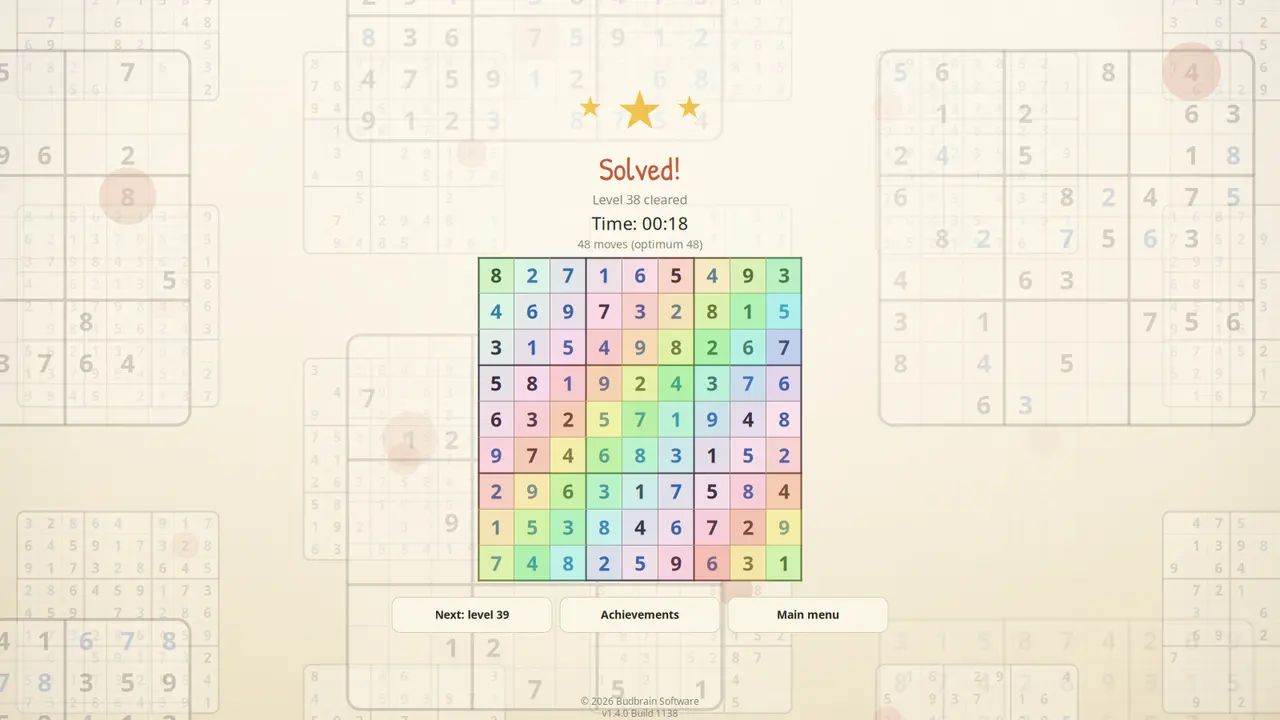
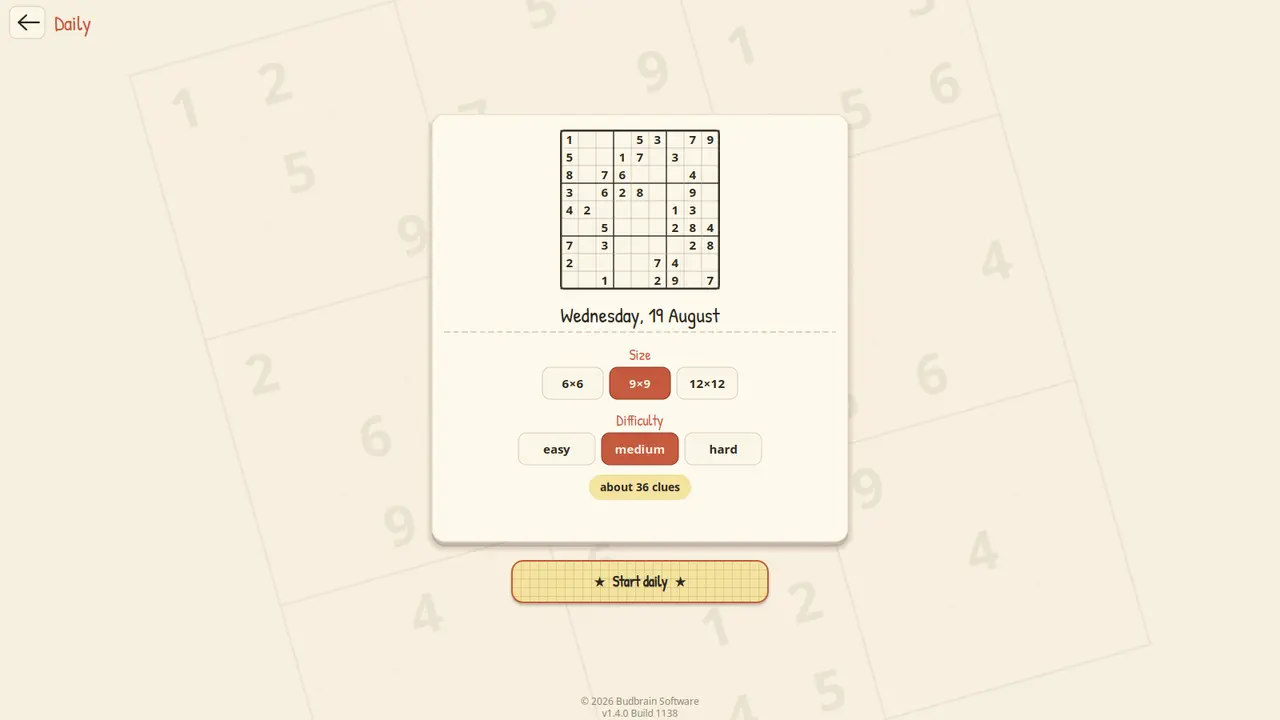
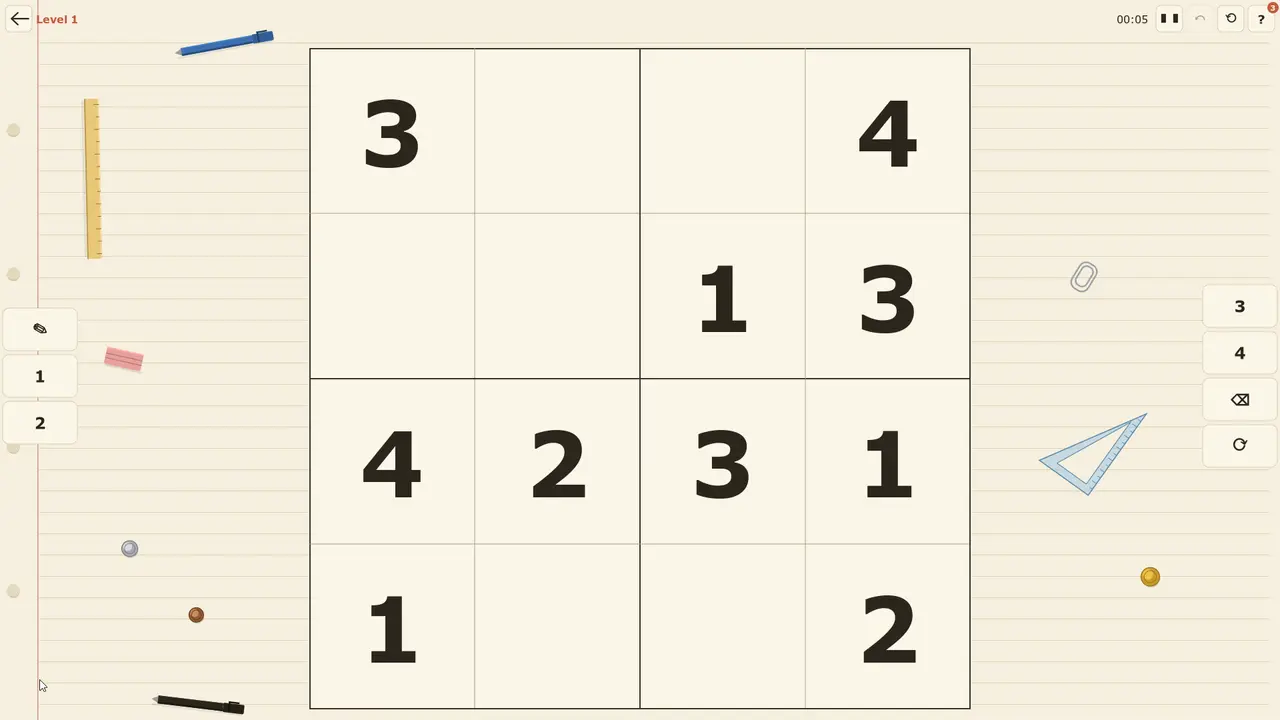
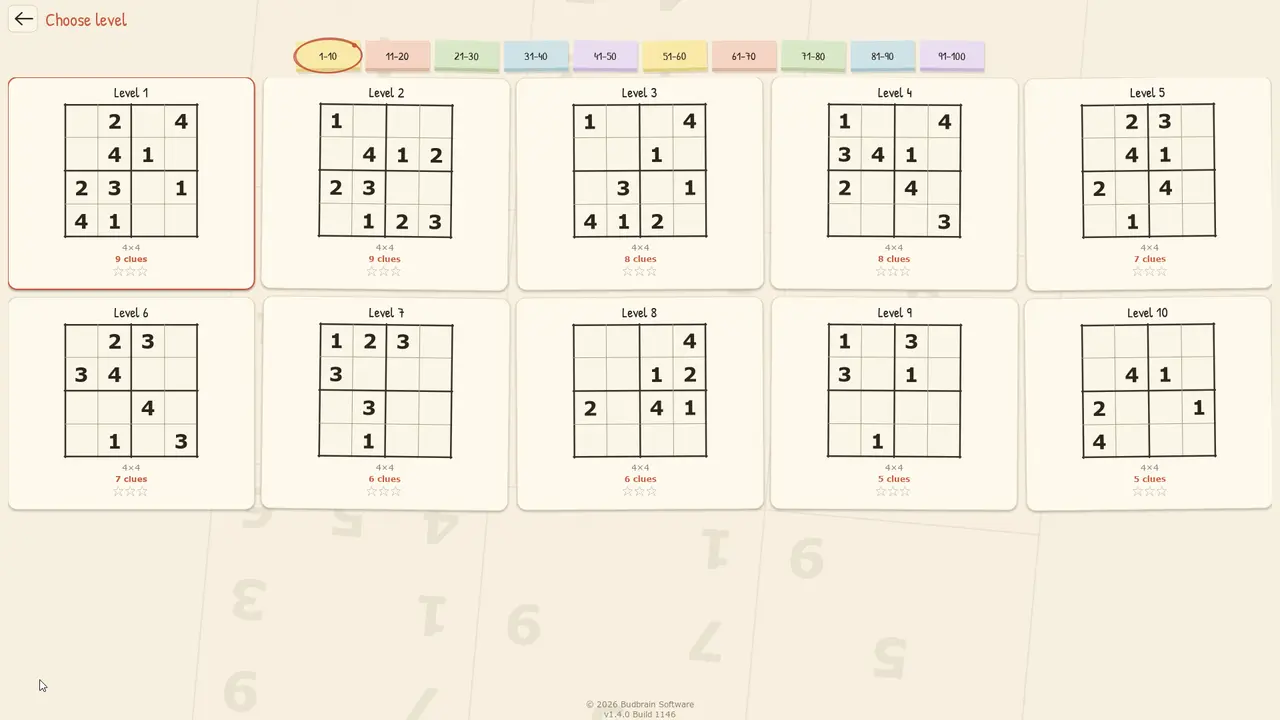
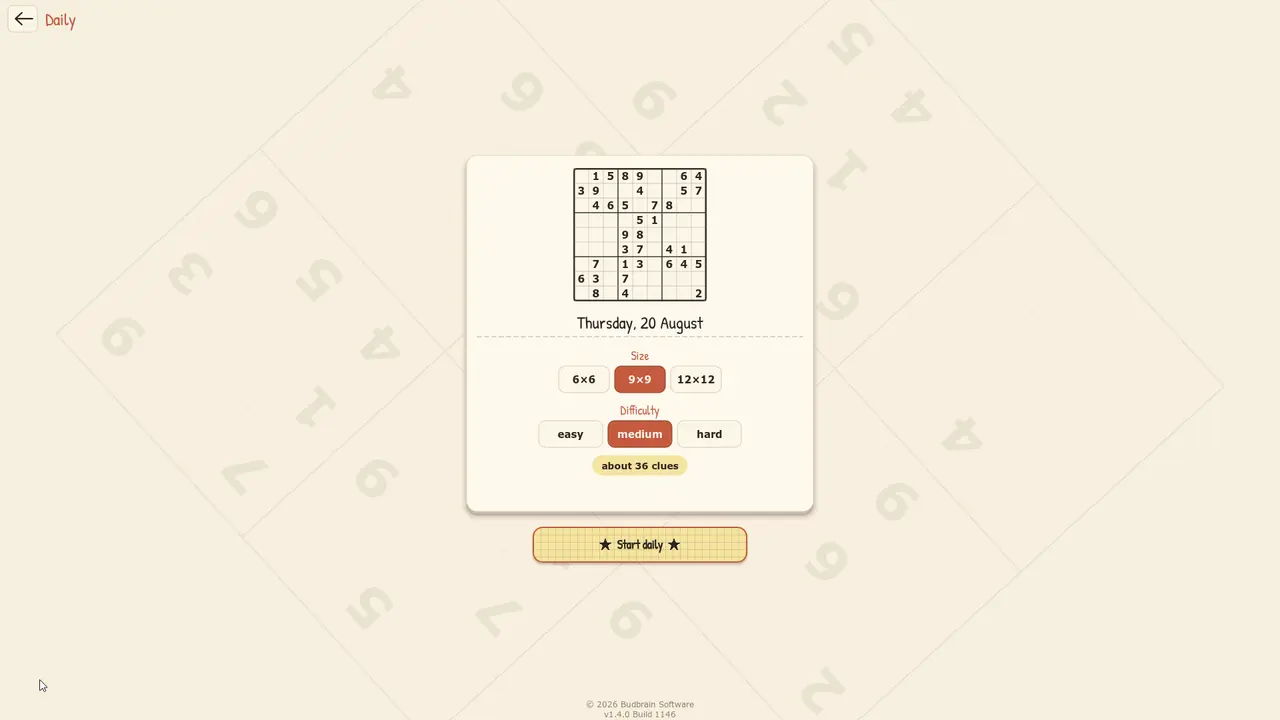
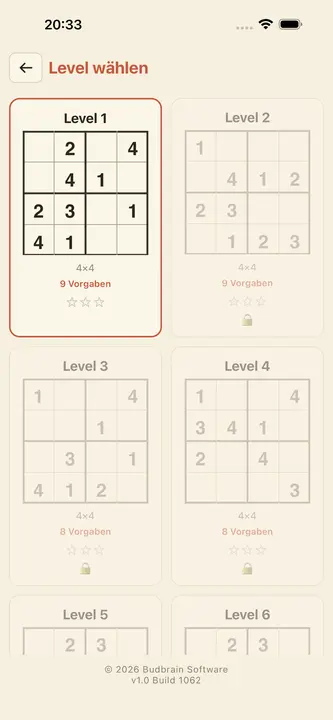
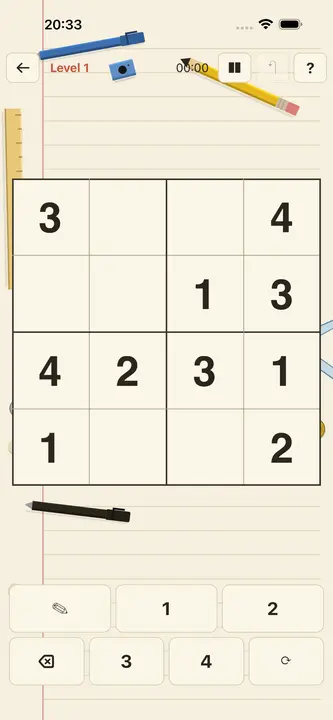
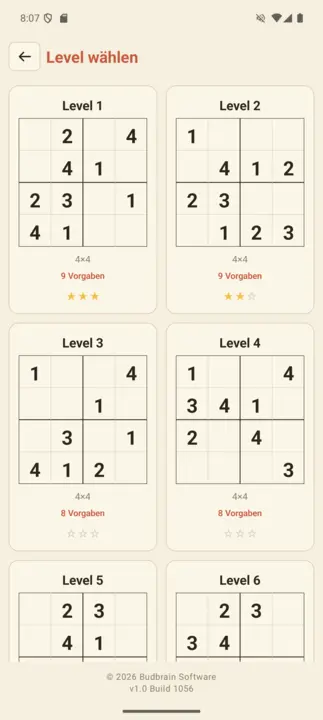
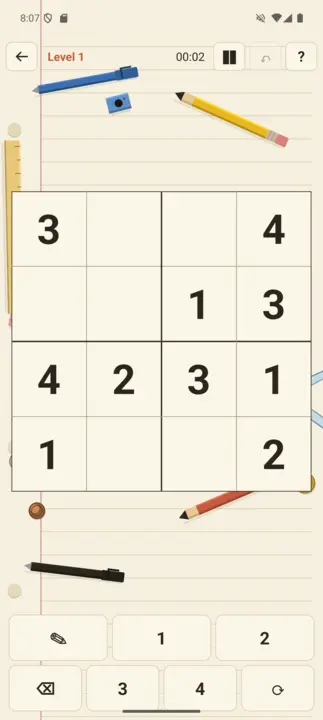
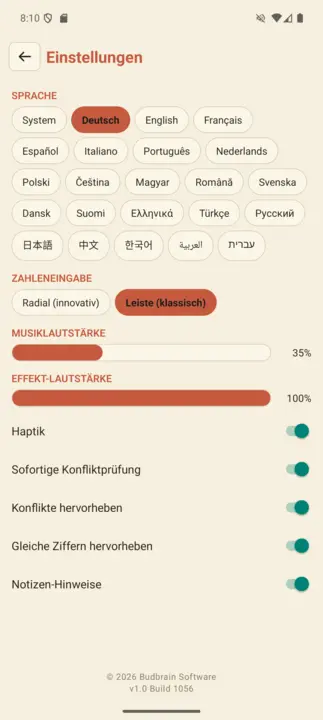
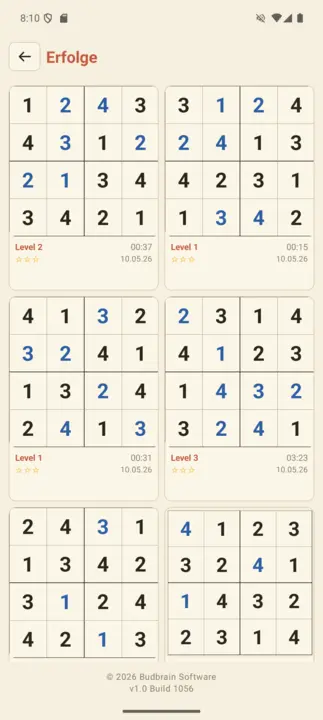
Sudoku mula 4×4 hanggang 25×25: isang daang antas sa papel ng notebook, pang-araw-araw na puzzle at isang pader na naglalaman ng bawat board na nalutas mo.
4×4 – 25×25100 antasPang-araw-araw na puzzleMga tala · hint · undoPader ng mga tagumpaySDL2 · CairoGNOME / KDE / XFCE22 mga wika
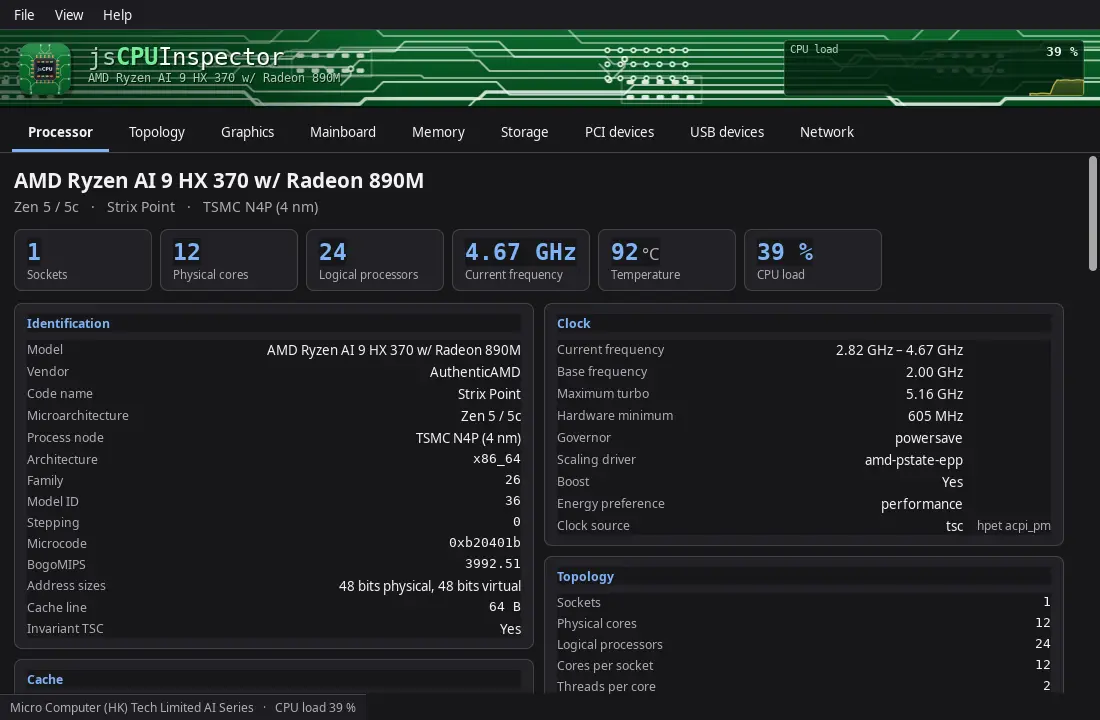
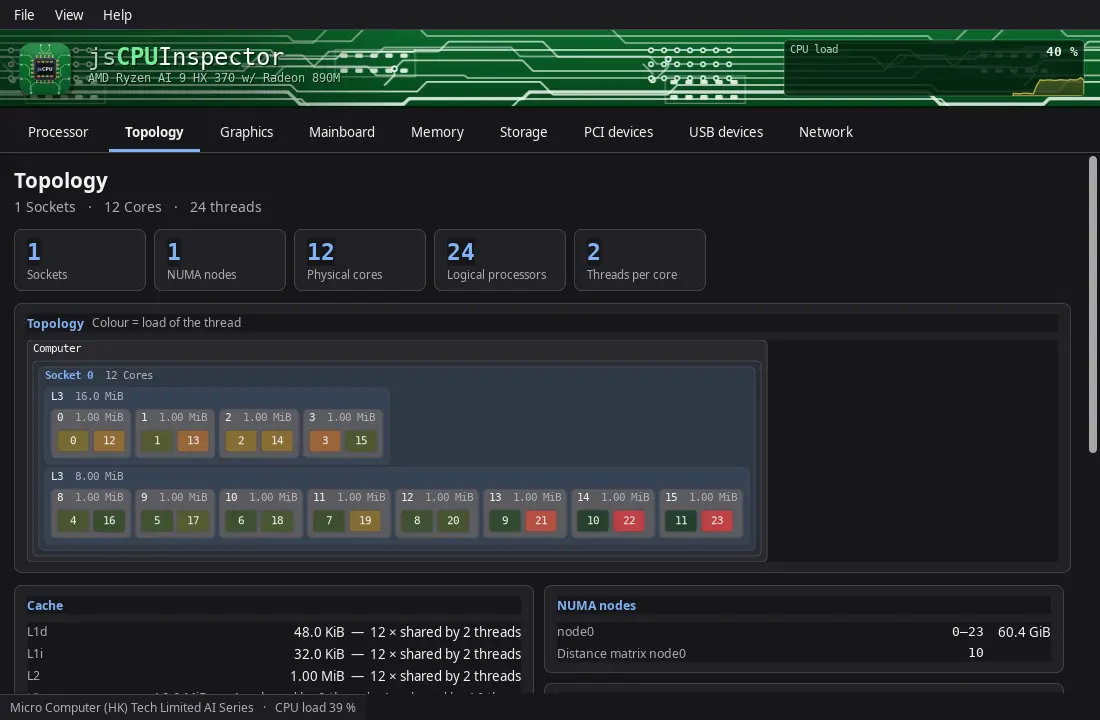
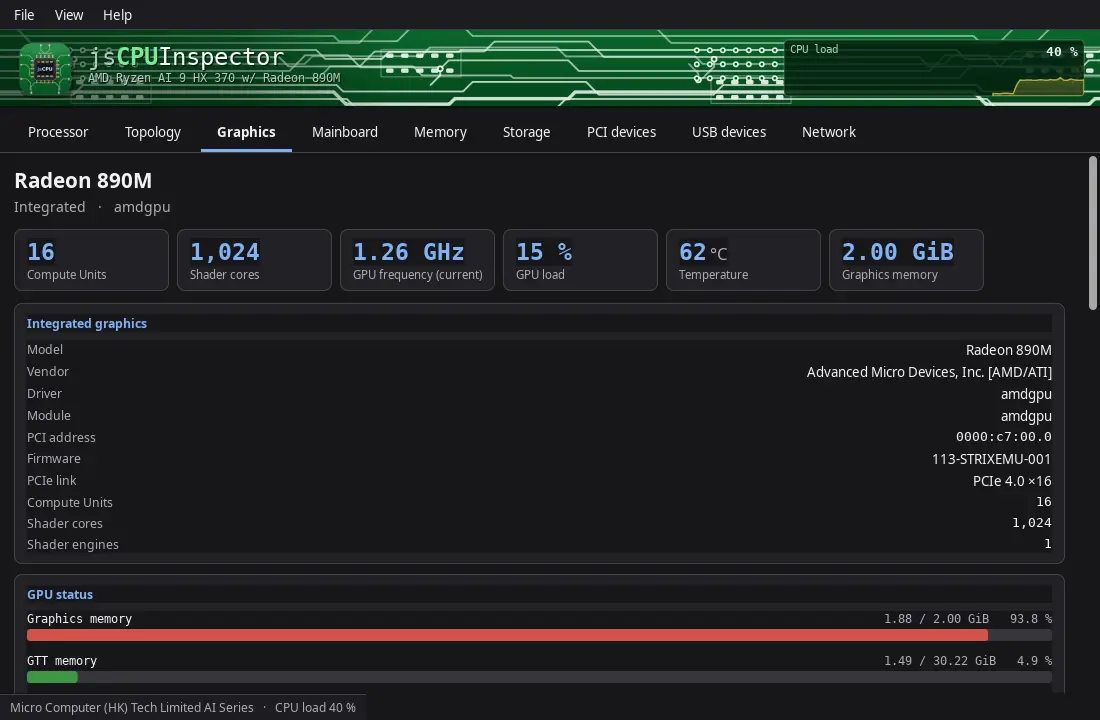
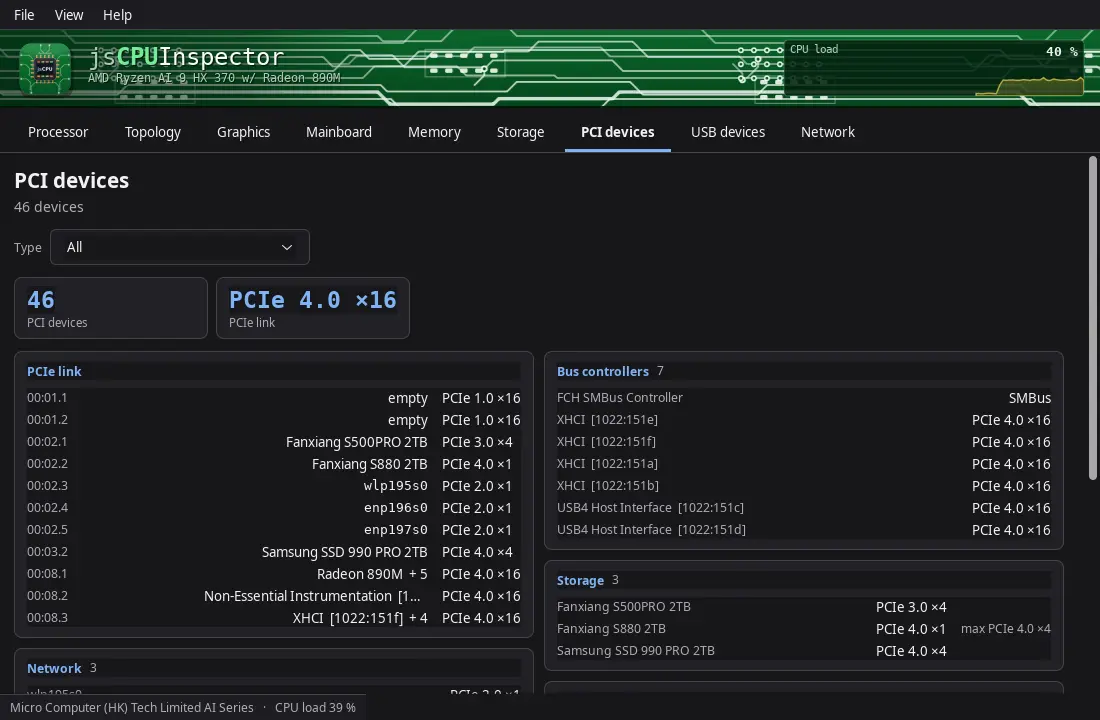
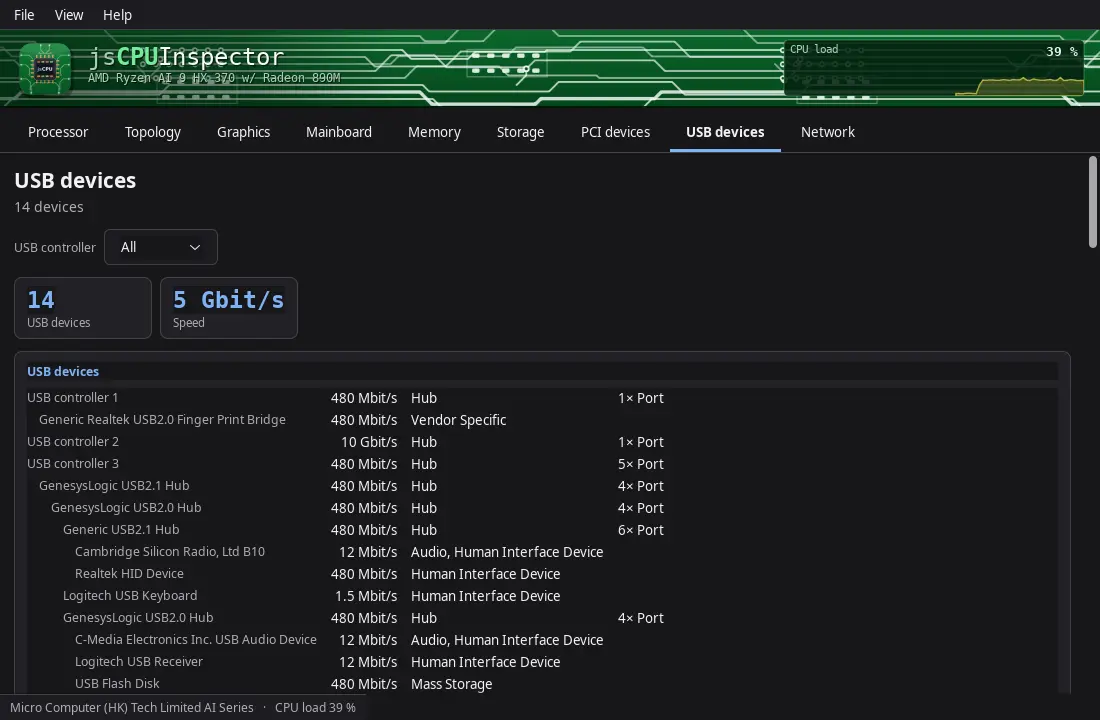
Ipinapakita ang bawat detalye ng processor, mainboard at memorya: mga socket, core at thread, laki ng cache, code name at proseso ng paggawa, ang graphics unit, BIOS at chipset, at bawat memory slot — kasama ang mga drive, PCI, USB at network device.
Live na clock at load bawat coreMga cache level na iginuhit ayon sa sukatCPUIDSMBIOSPCI · USBSMARTGTK3GNOME / KDE / XFCE83 mga wika
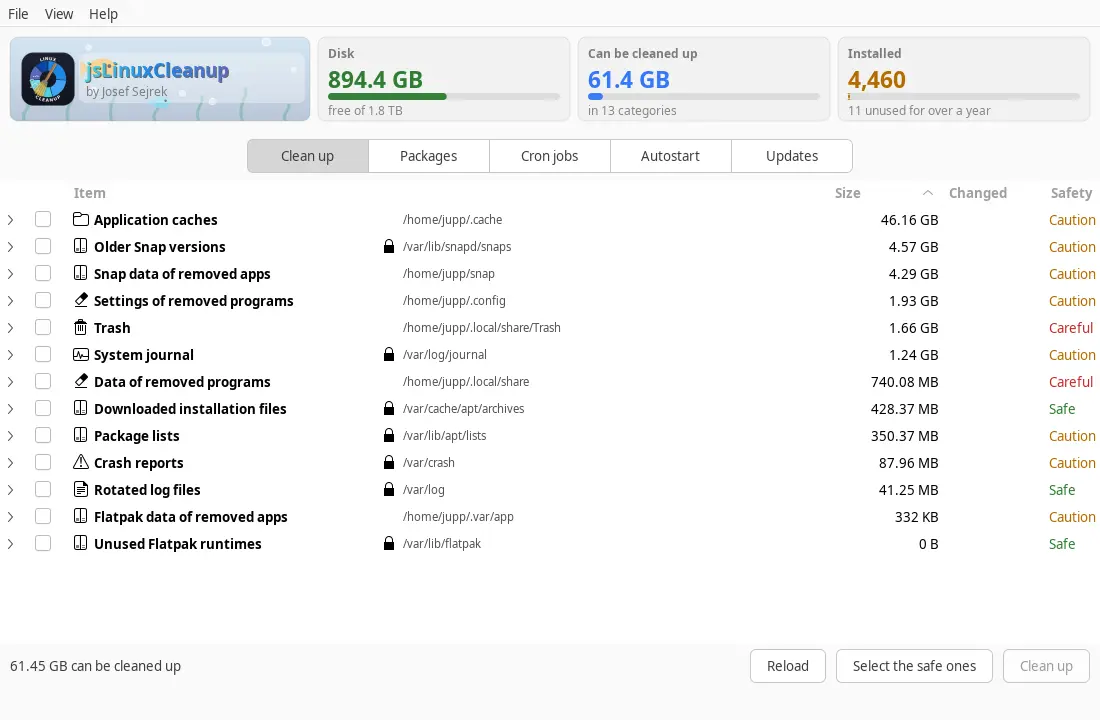
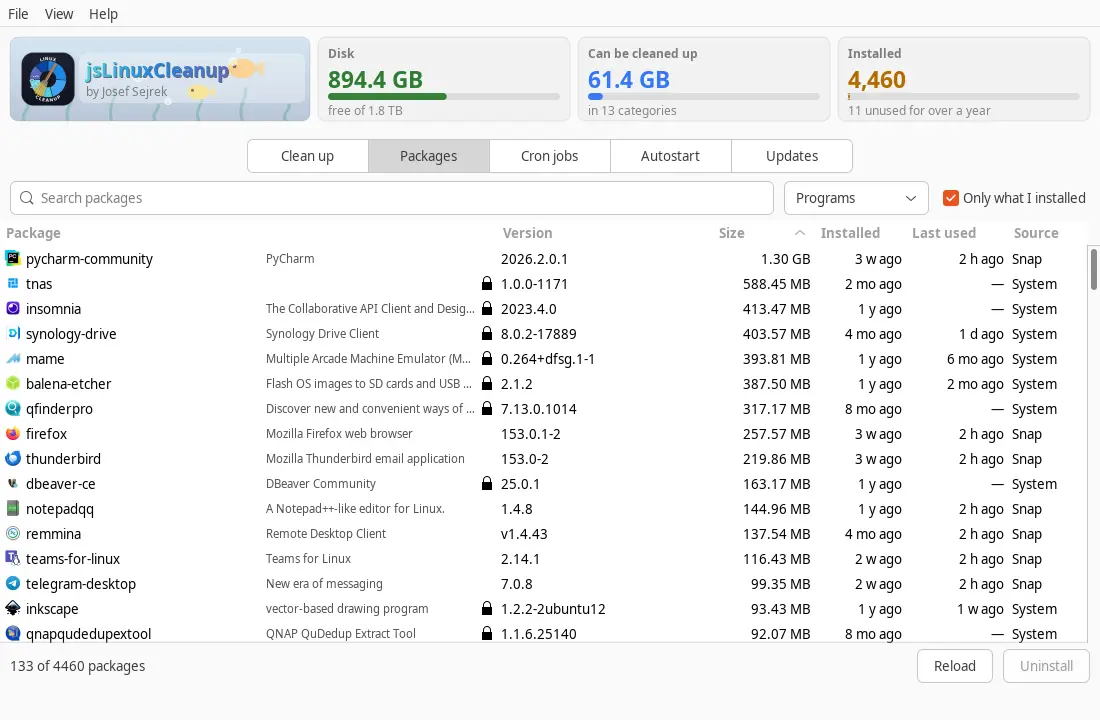
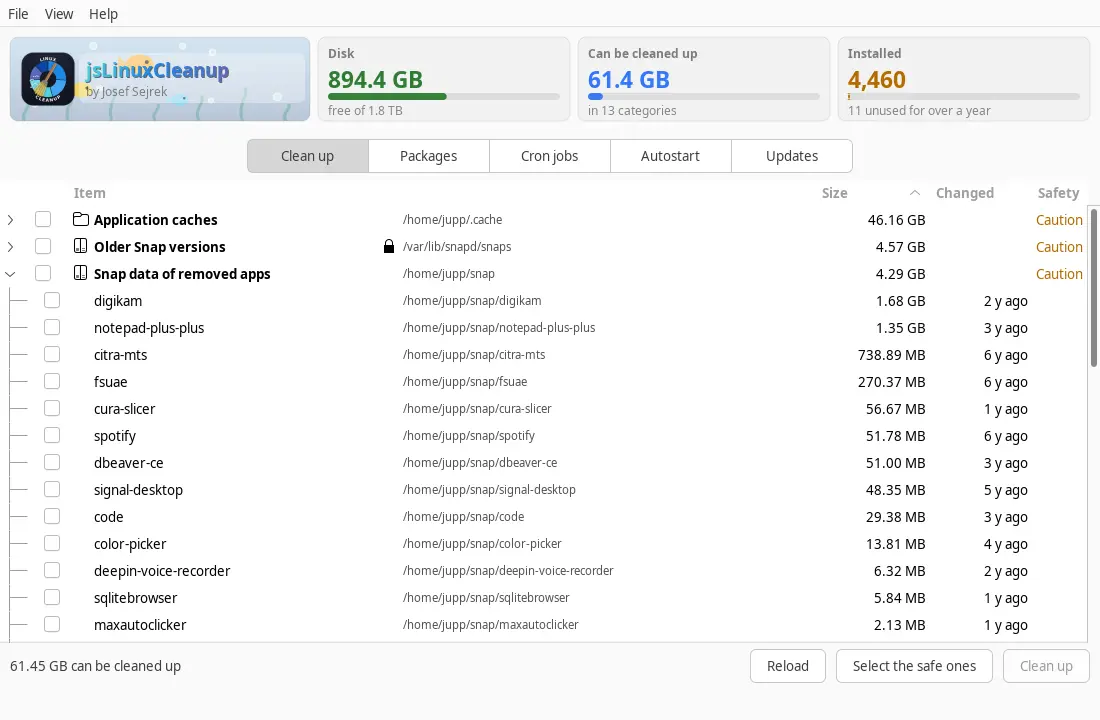
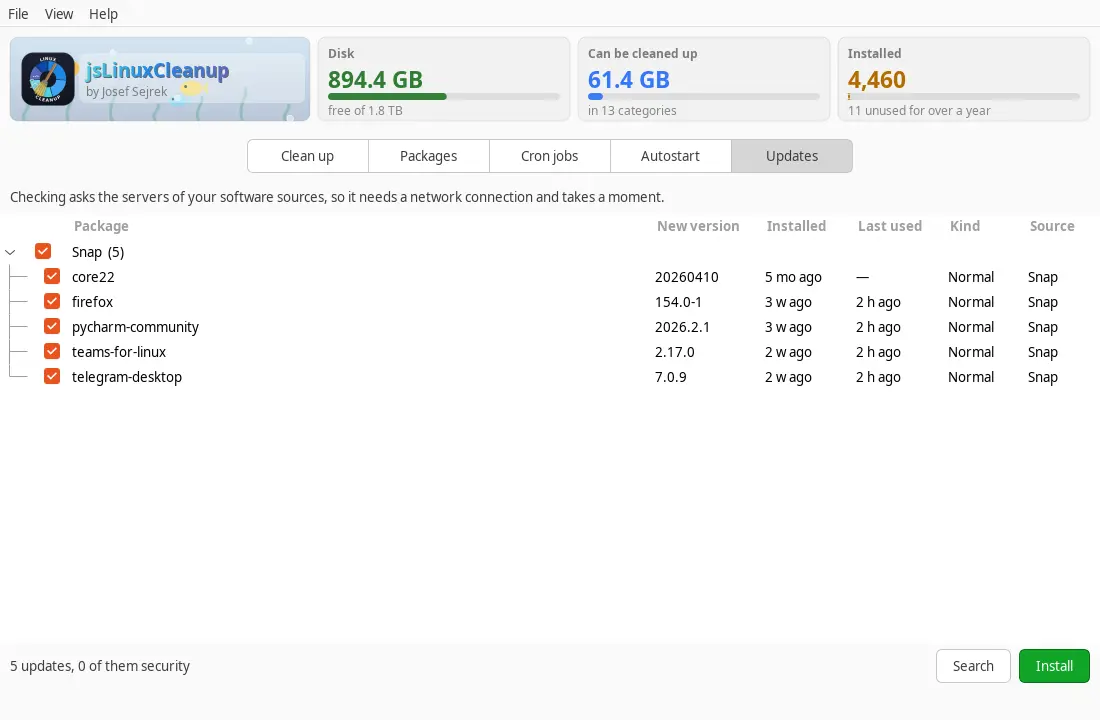
Ipinapakita kung ano ang tahimik na pumupuno sa disk at kung ano ang naka-install: mga log, cache, trash at lipas na bersyon ng package, kasama ang bawat programa na may laki, petsa ng pag-install at huling gamit — kabilang ang mga labi ng inalis na programa, autostart, mga iskedyul at nakabinbing update.
apt · dnf · zypper · pacmanSnap & FlatpakjournaldHuling ginamitMga labi ng inalis na programaMga iskedyulAutostartGTK3GNOME / KDE / XFCE44 mga wika
Ang mga cache gaya ng ~/.gradle, ~/.npm o ~/.cache ay nasa mga nakatagong folder na hindi kayang makita ng isang confined na app nang mag-isa. Patakbuhin nang isang beses ang command at i-restart ang app.
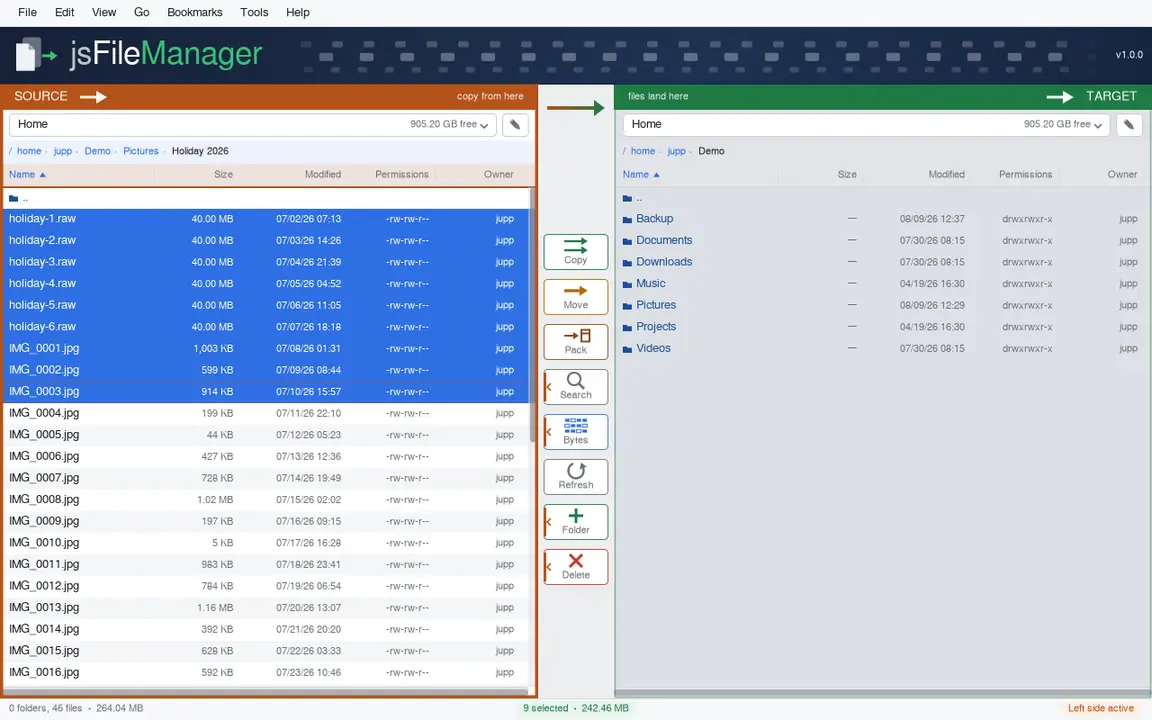
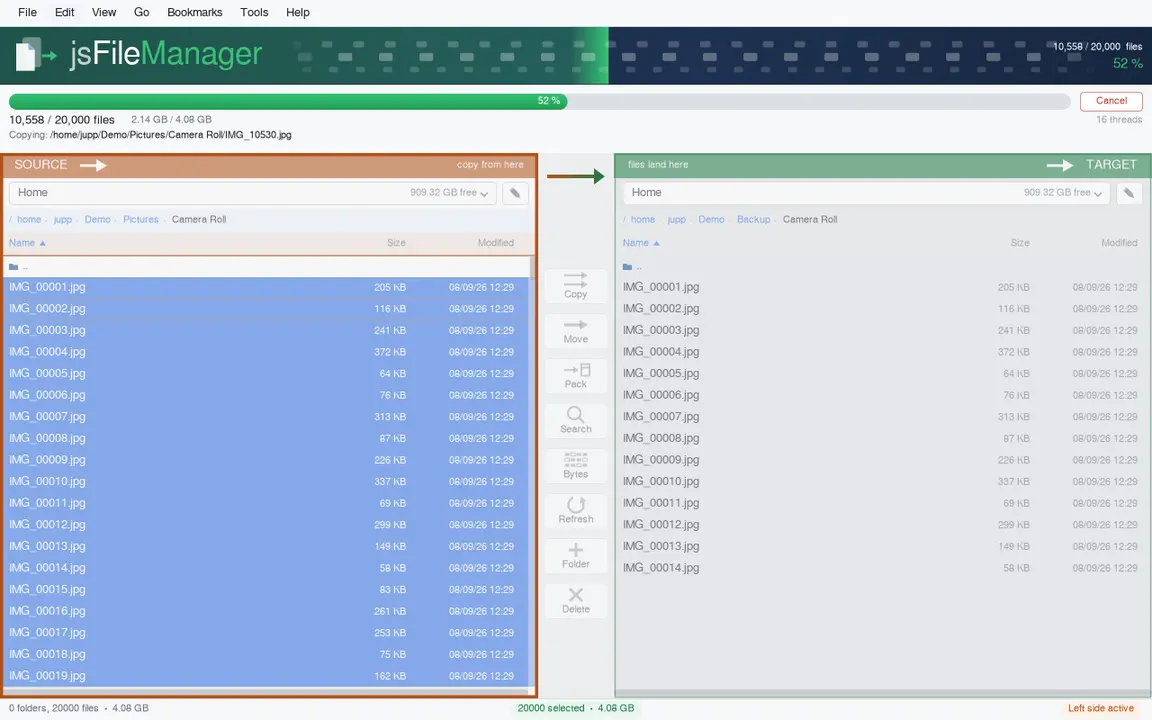
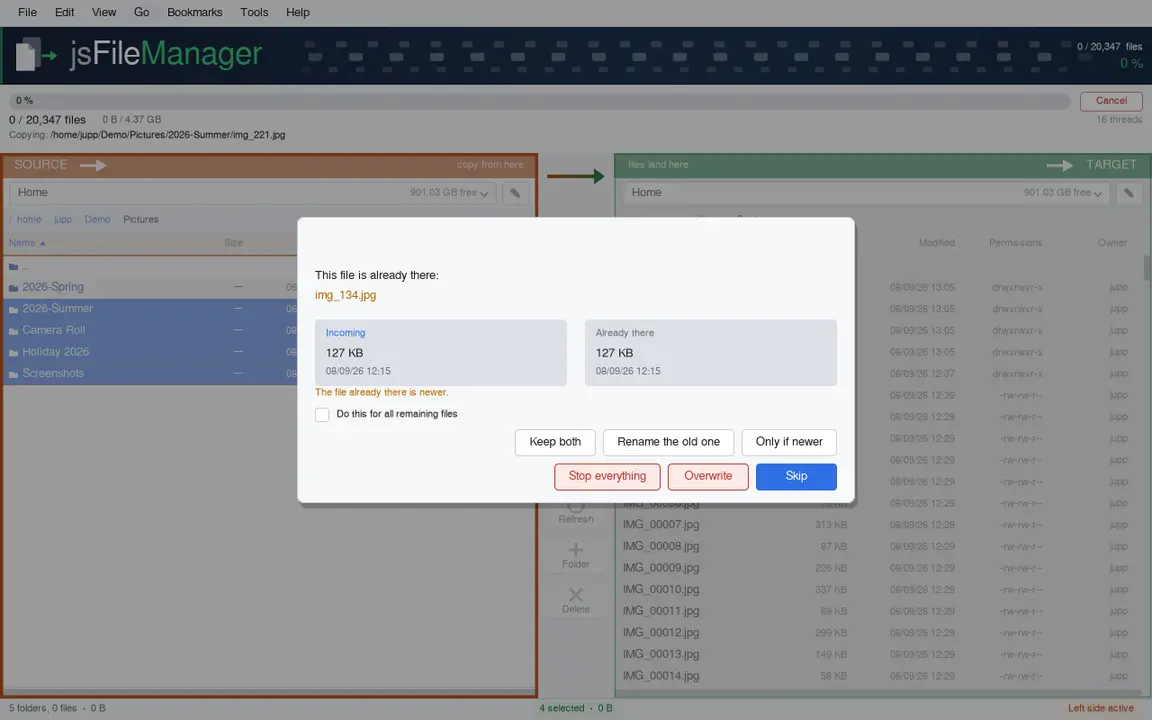
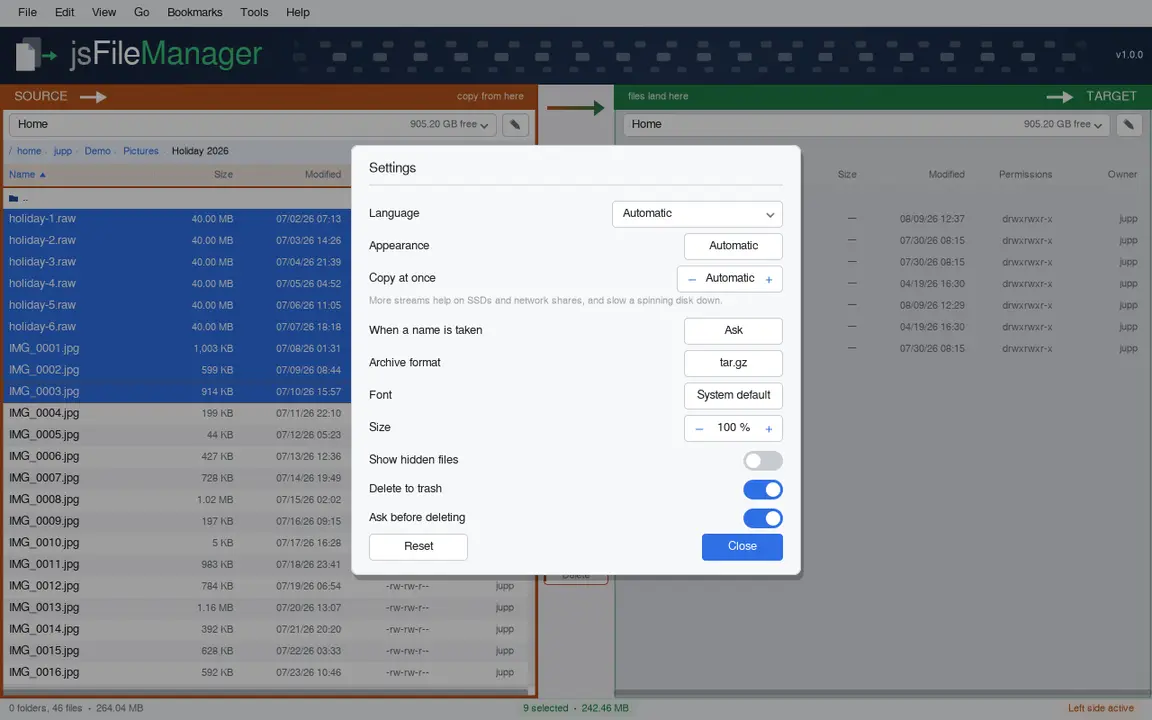
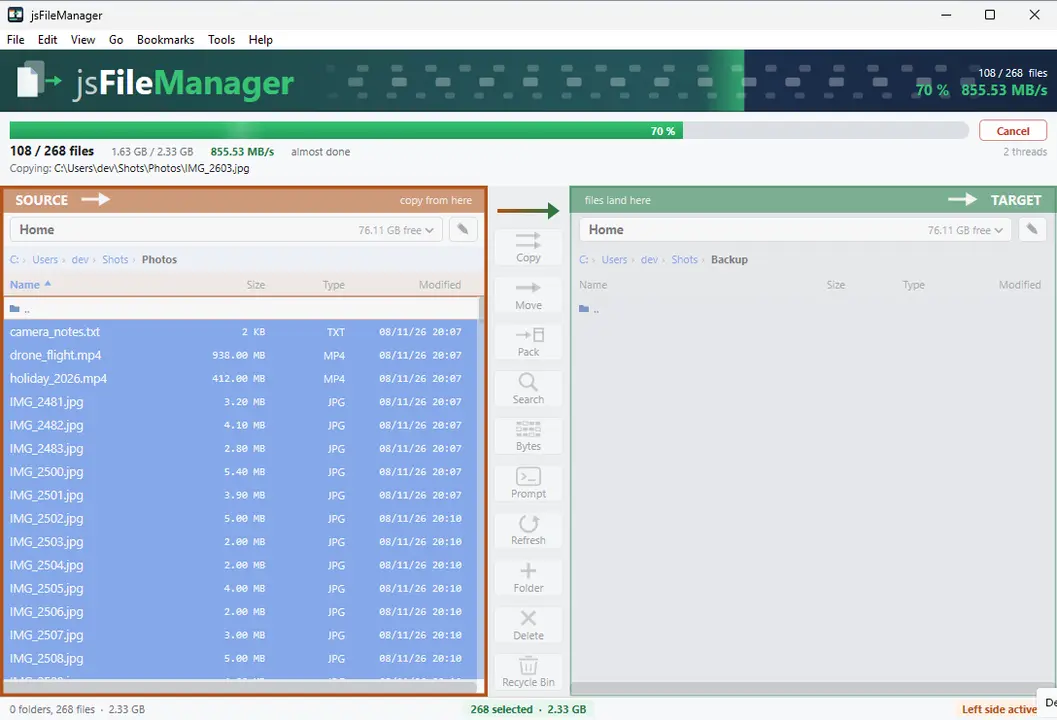
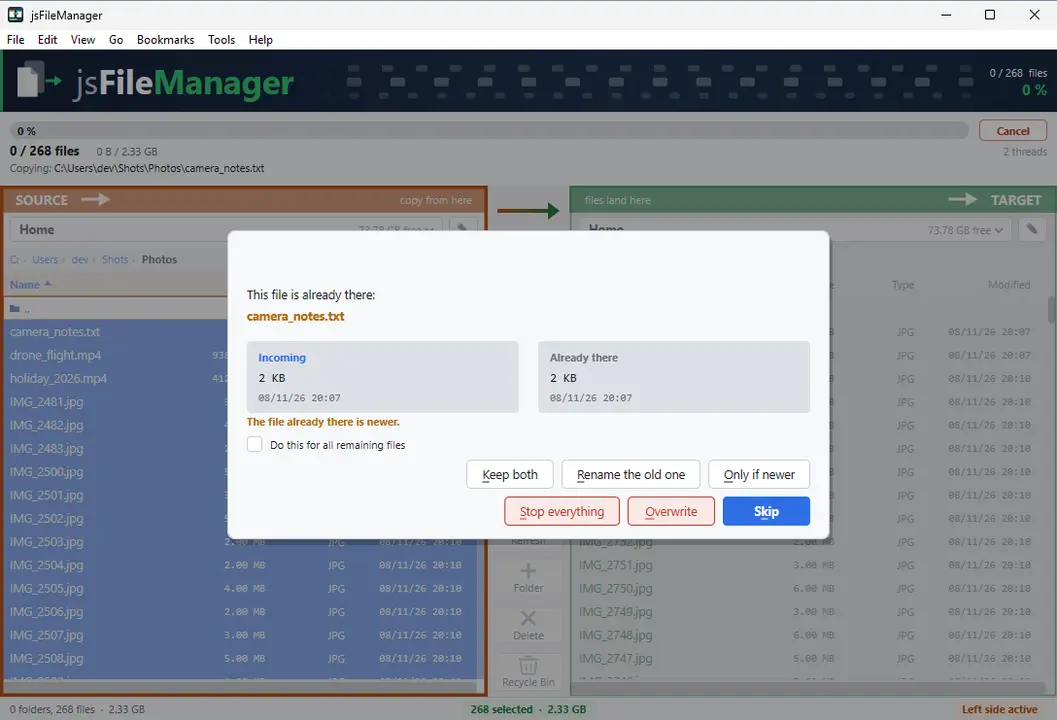
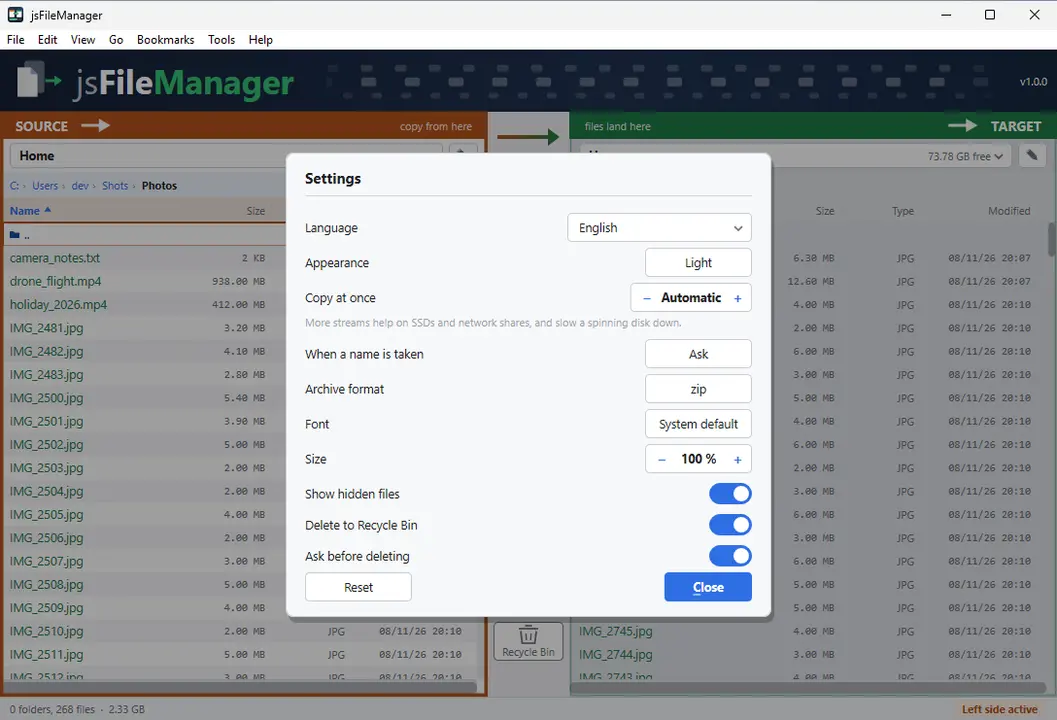
Dalawang folder na magkatabi, na may mga button sa pagitan na naglilipat ng mga file mula sa isang panig patungo sa kabila. Habang tumatakbo ang pagkopya, makikita mo kung hanggang saan na ito, gaano kabilis at ano ang nagkamali.
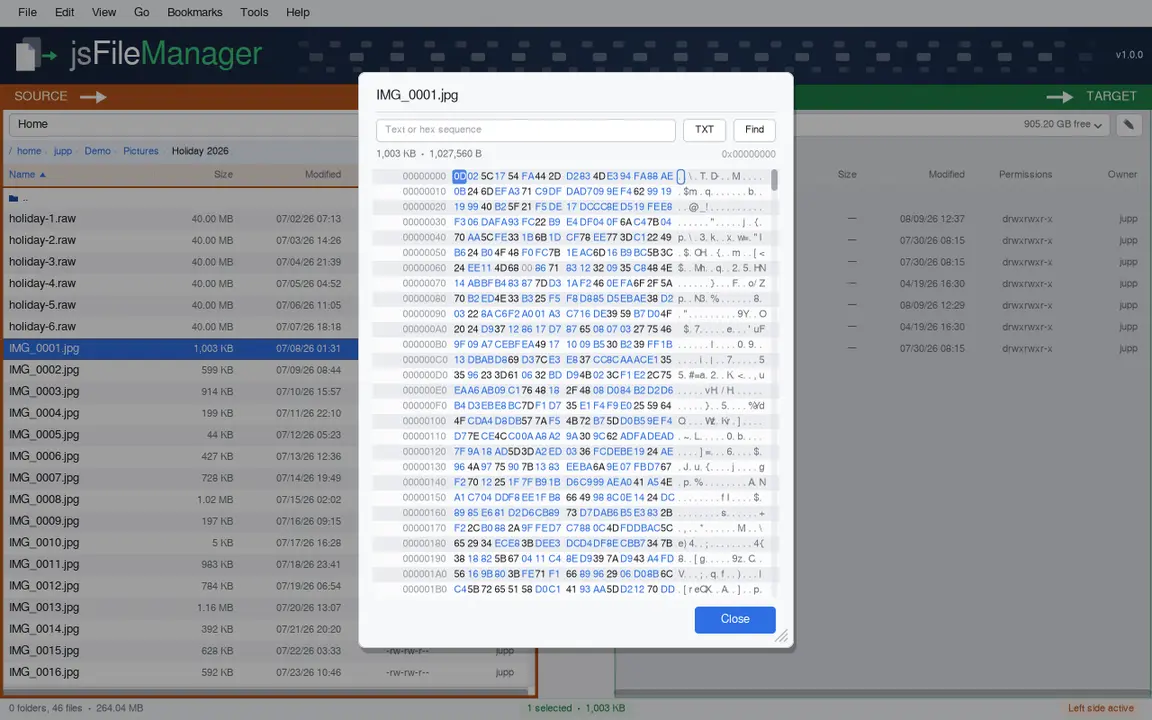
Dalawang folder na magkatabiLive na progresoMga archive at byte viewMga pahintulot at may-ariGTK3GNOME / KDE / XFCE44 mga wika
Magbigay ng access sa mga USB stick, network drive at iba pang folder (Snap)
sudo sh -c 'for i in removable-media system-backup mount-observe; do snap connect jsfilemanager:$i; done'
Sa simula, sarili mong folder lang ang maaabot ng isang snap. Pinapahintulutan din ng command ang mga USB stick at memory card, network drive at mga folder sa labas ng iyo. Patakbuhin ito nang isang beses, saka i-restart ang app — mananatili ang pahintulot.
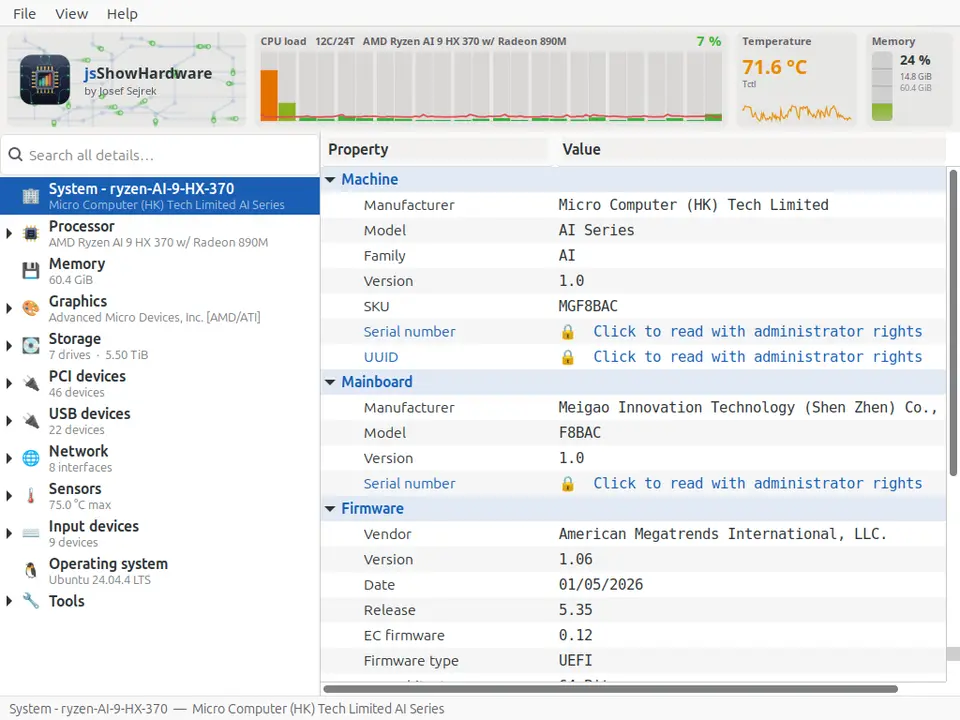
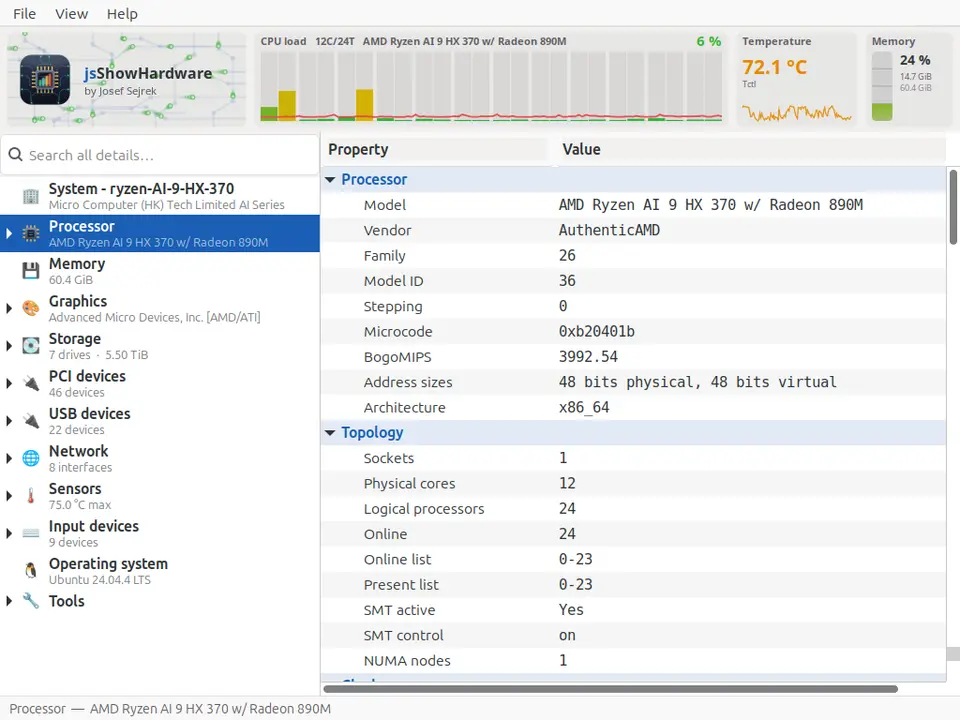
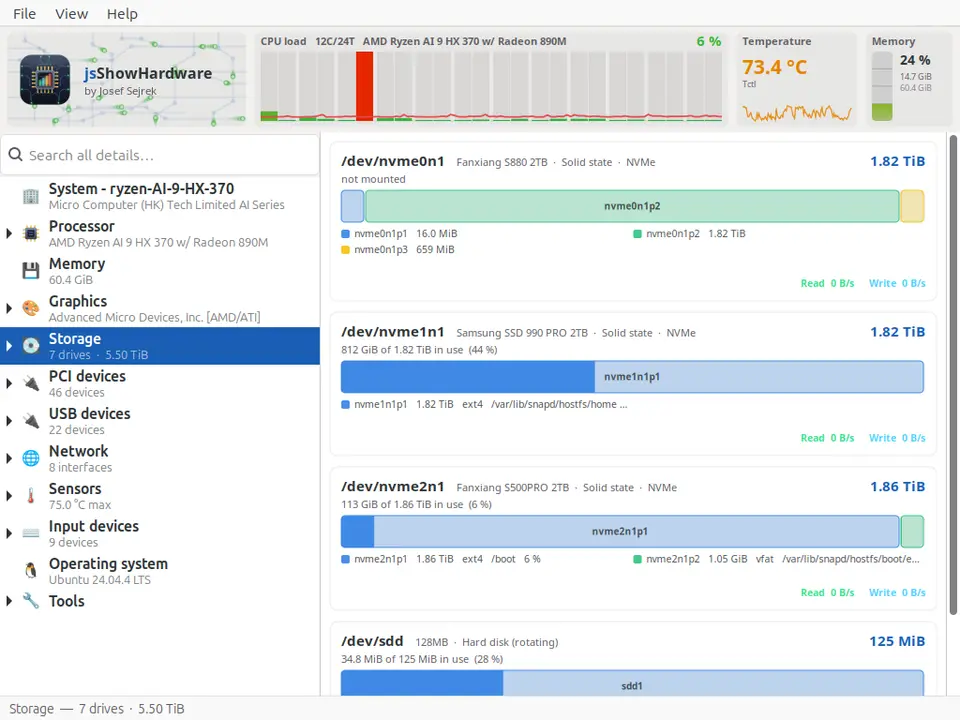
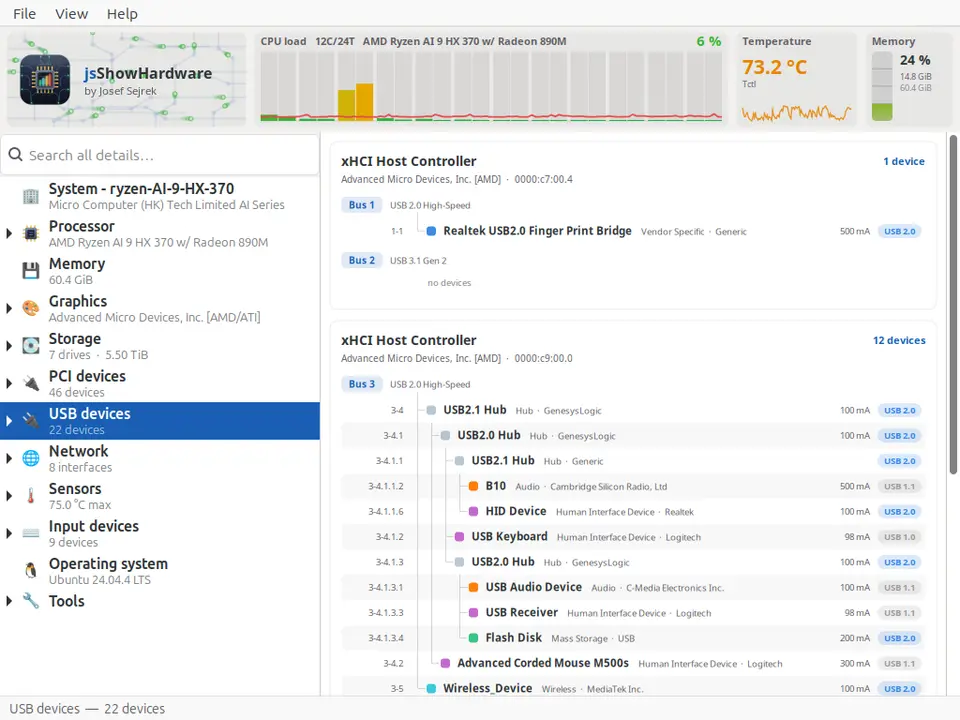
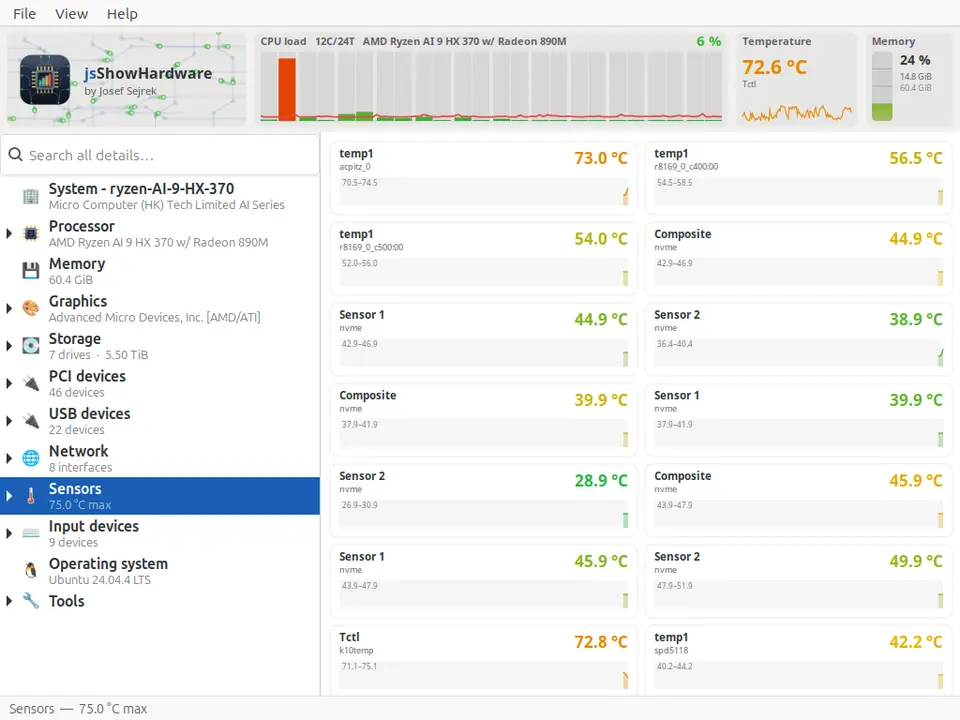
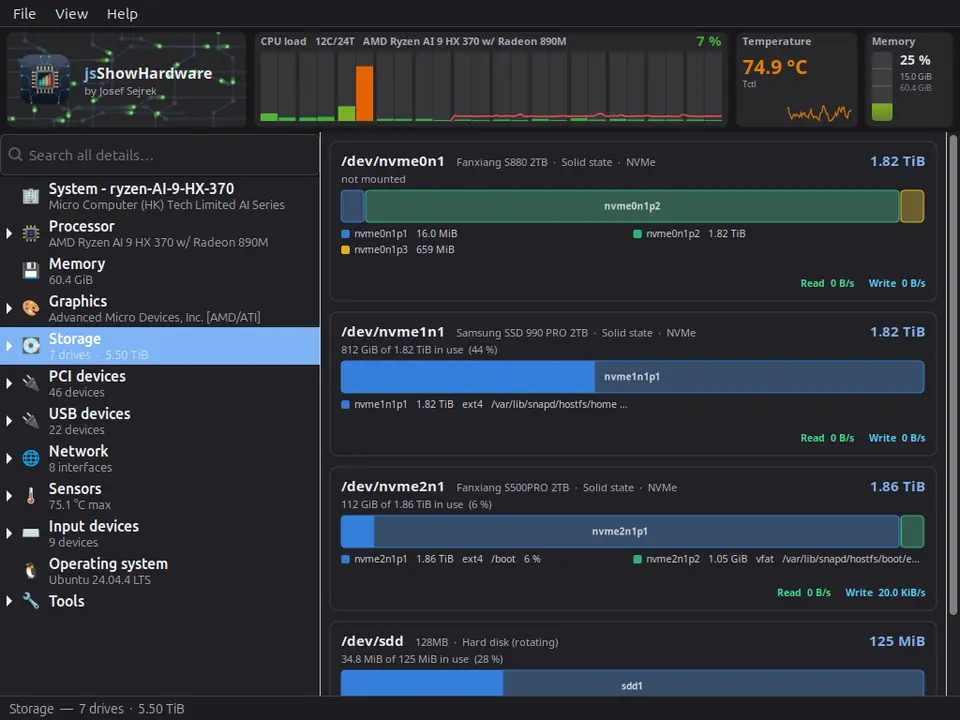
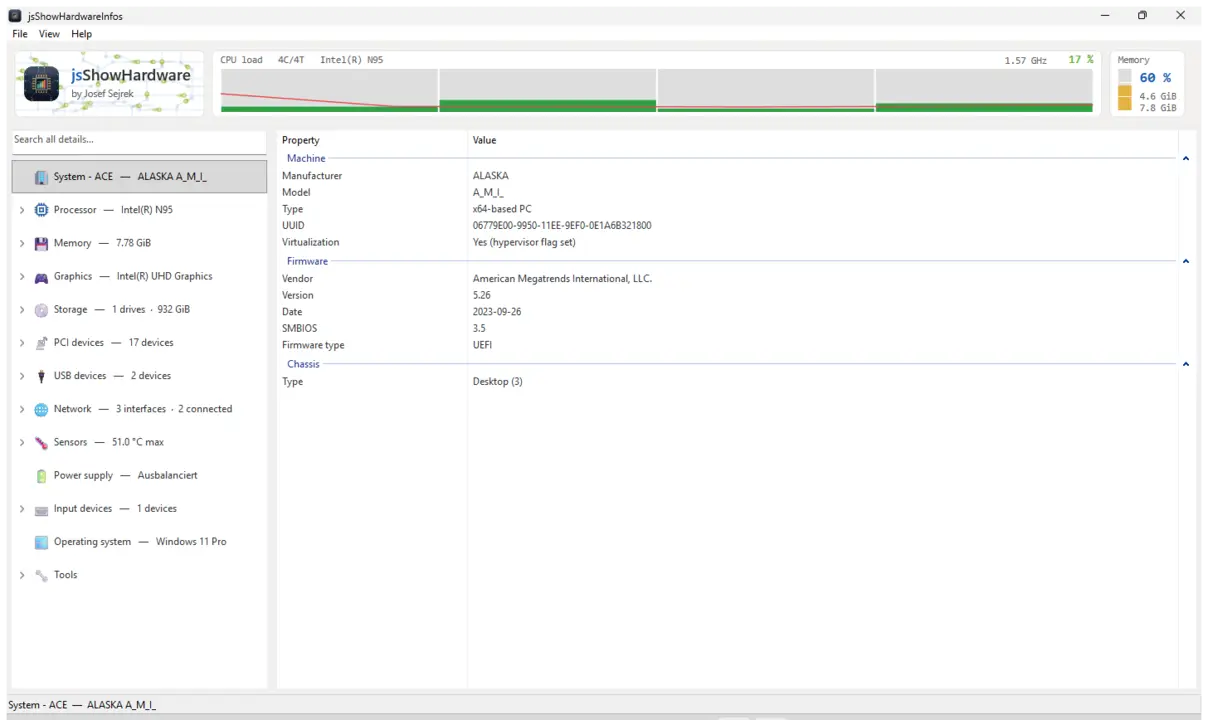
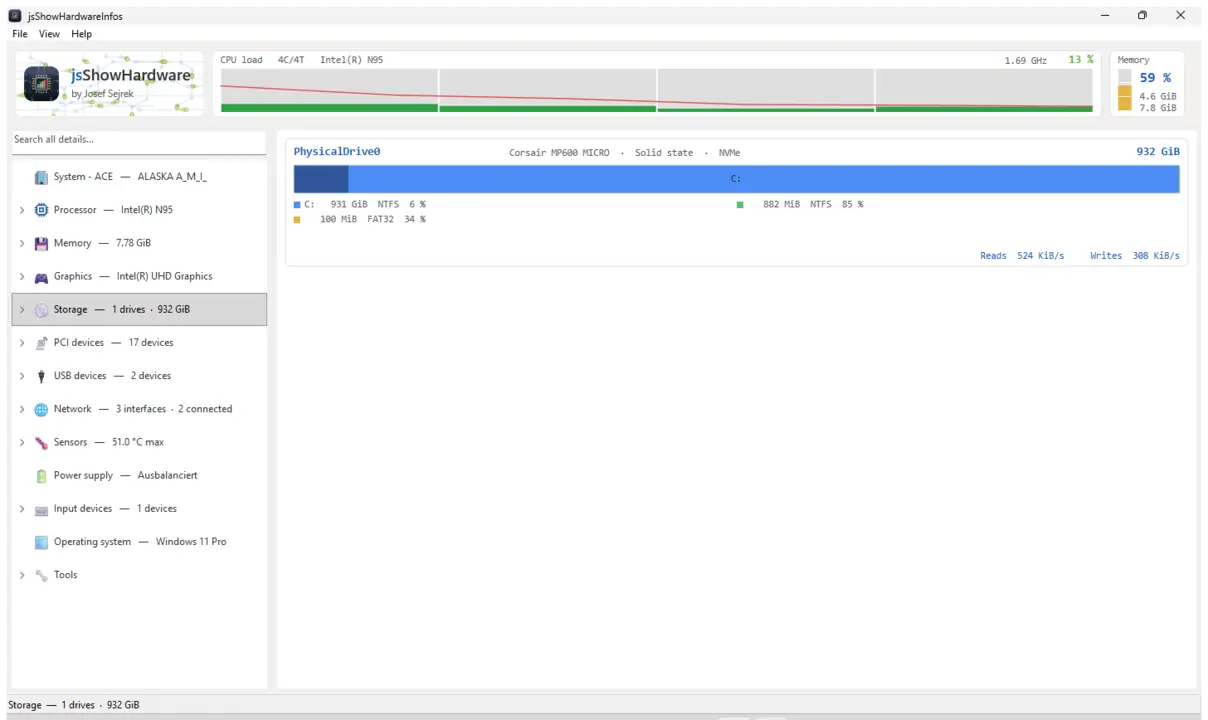
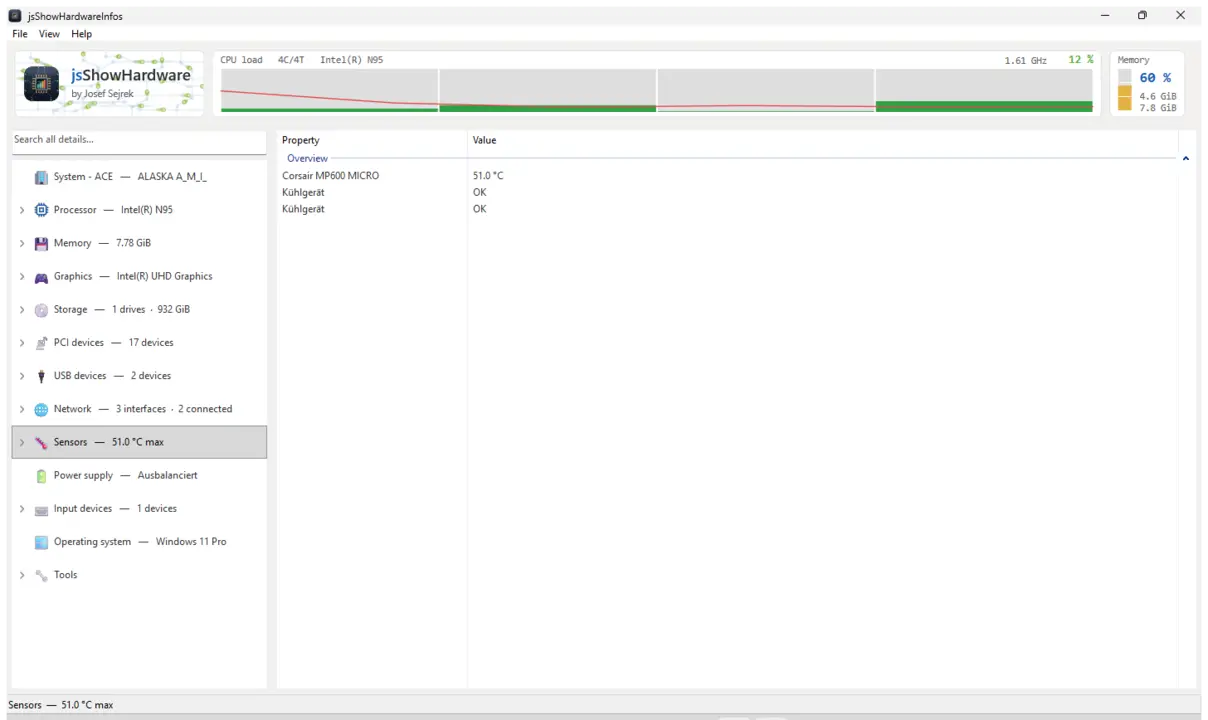
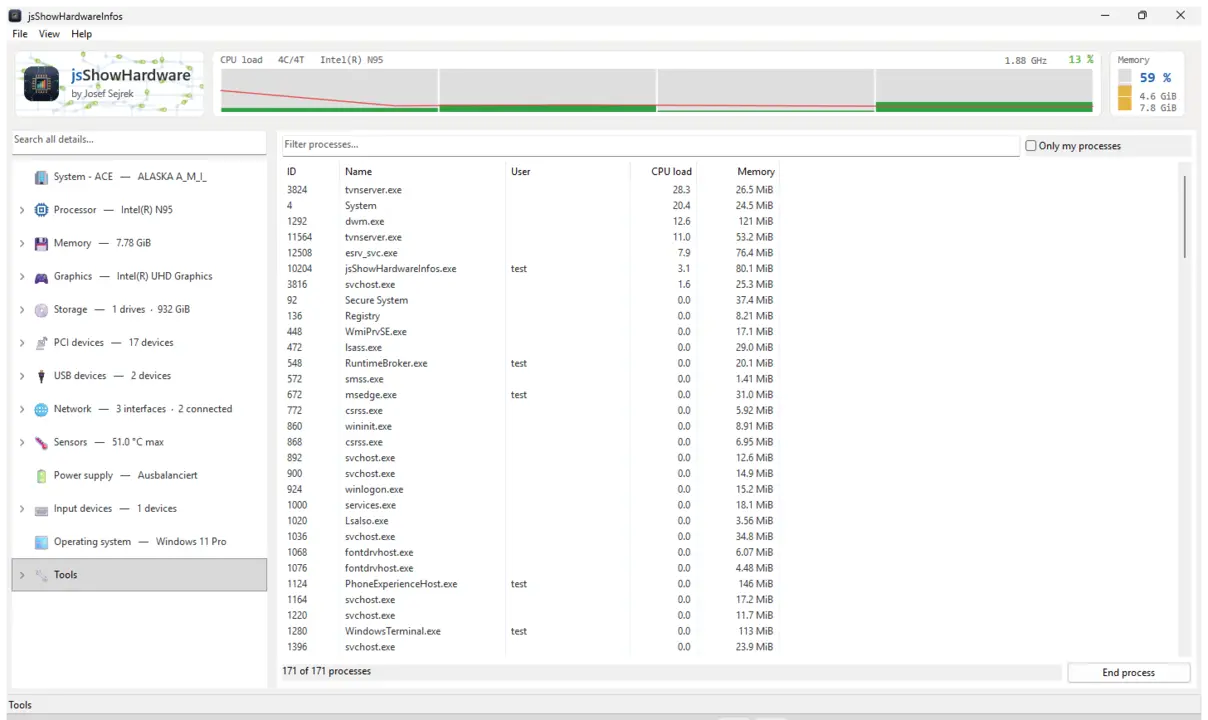
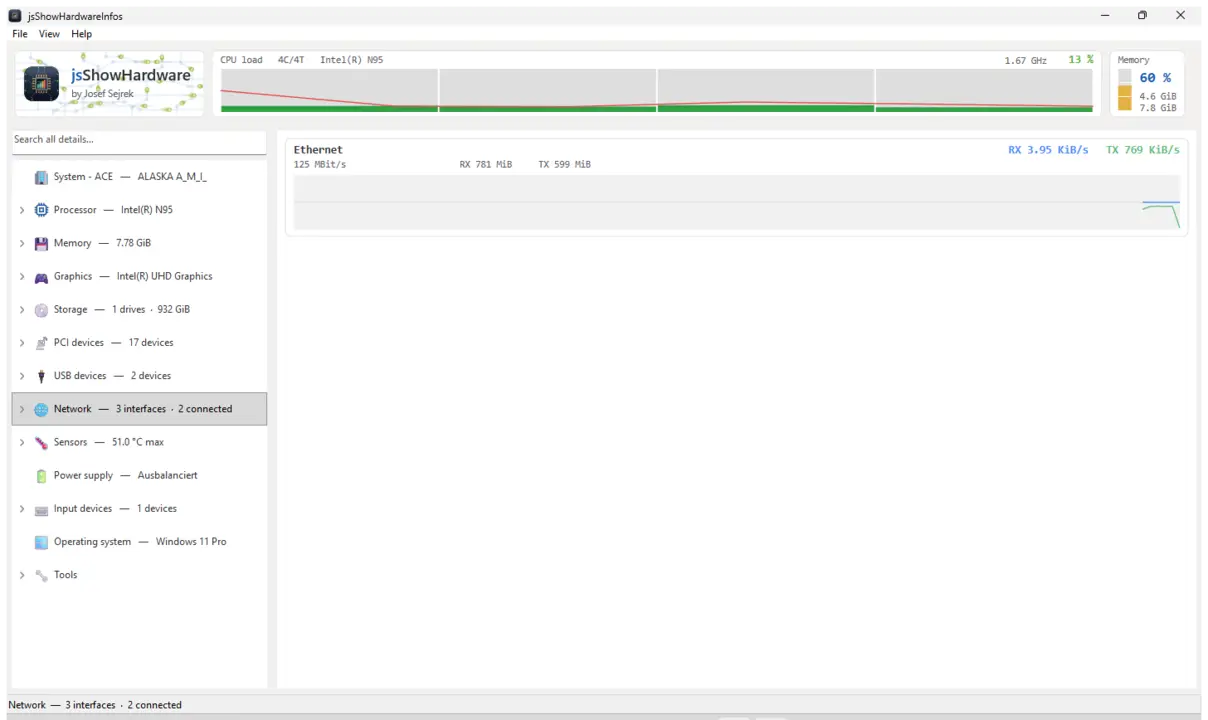
Ipinapakita ang bawat detalye ng hardware na iniuulat ng iyong computer tungkol sa sarili nito — processor, memorya, graphics, mga drive, network, mga sensor at lahat ng nakakabit, bawat isa sa sarili nitong sanga. Kasama ang live na bar na may load at temperatura, paghahanap sa lahat ng value at ulat na maaari mong i-save bilang text file at ibahagi.
CPU / RAM / GPUMga drive at USBMga sensor at temperaturaListahan ng prosesoPaghahanap sa lahat ng valueI-save ang ulatGTK3GNOME / KDE / XFCE44 mga wika
sudo sh -c 'for i in hardware-observe system-observe mount-observe; do snap connect jsshowhardwareinfos:$i; done'
Sa simula, kaunti lang ang nakikita ng isang snap sa computer, kaya walang laman ang temperatura, mga sensor, mga drive at nagamit na espasyo sa disk. Read access lang ang ibinibigay ng command. Pagkatapos, sapat na ang pag-click sa Refresh, hindi kailangan ng restart.
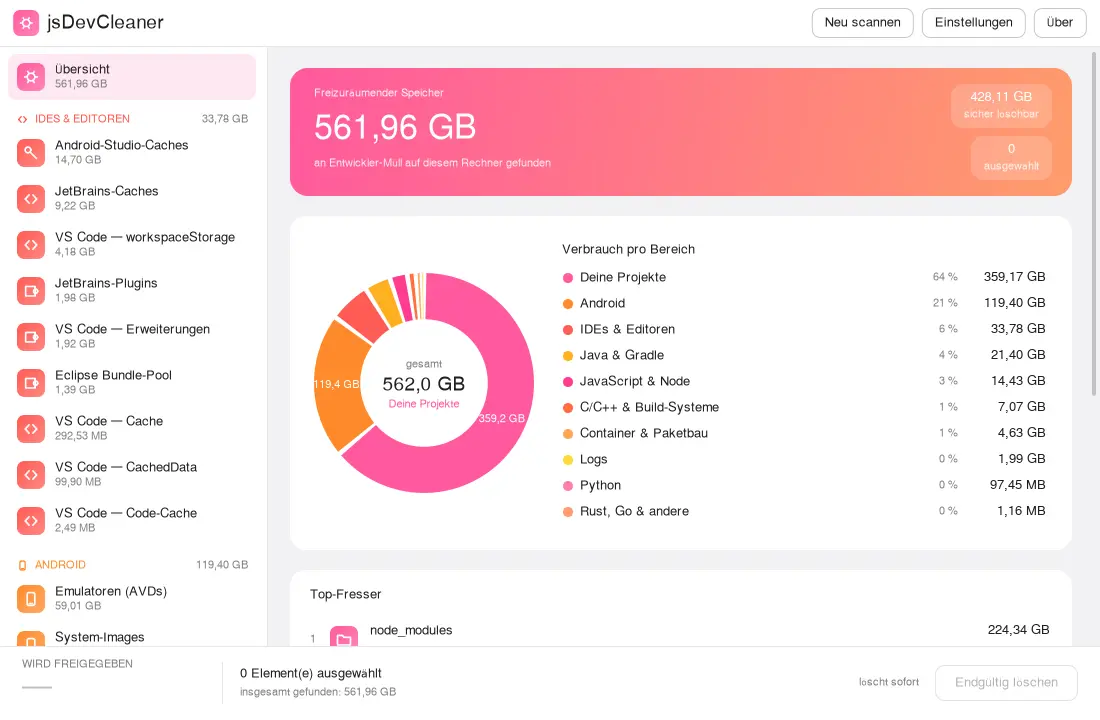
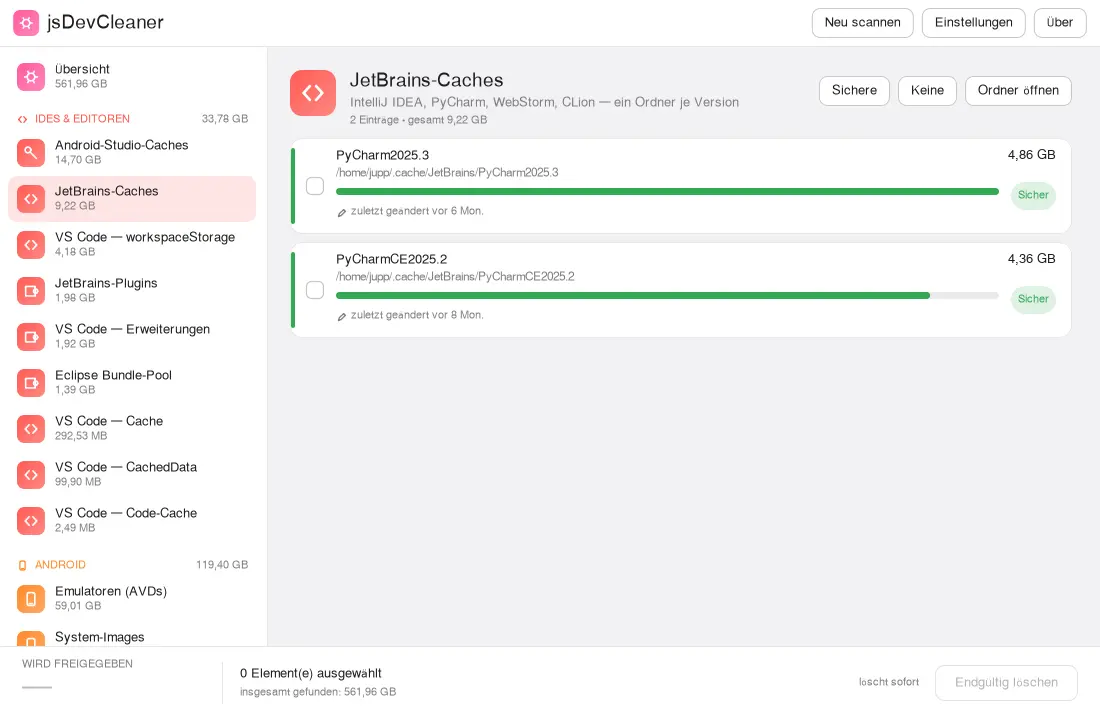
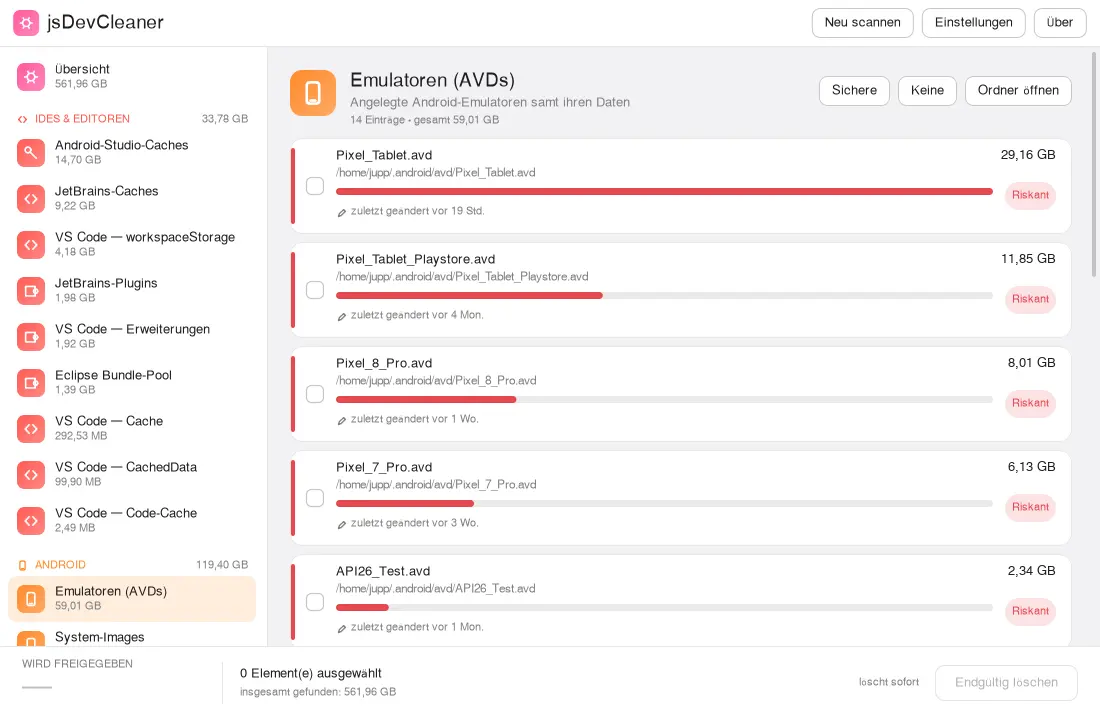
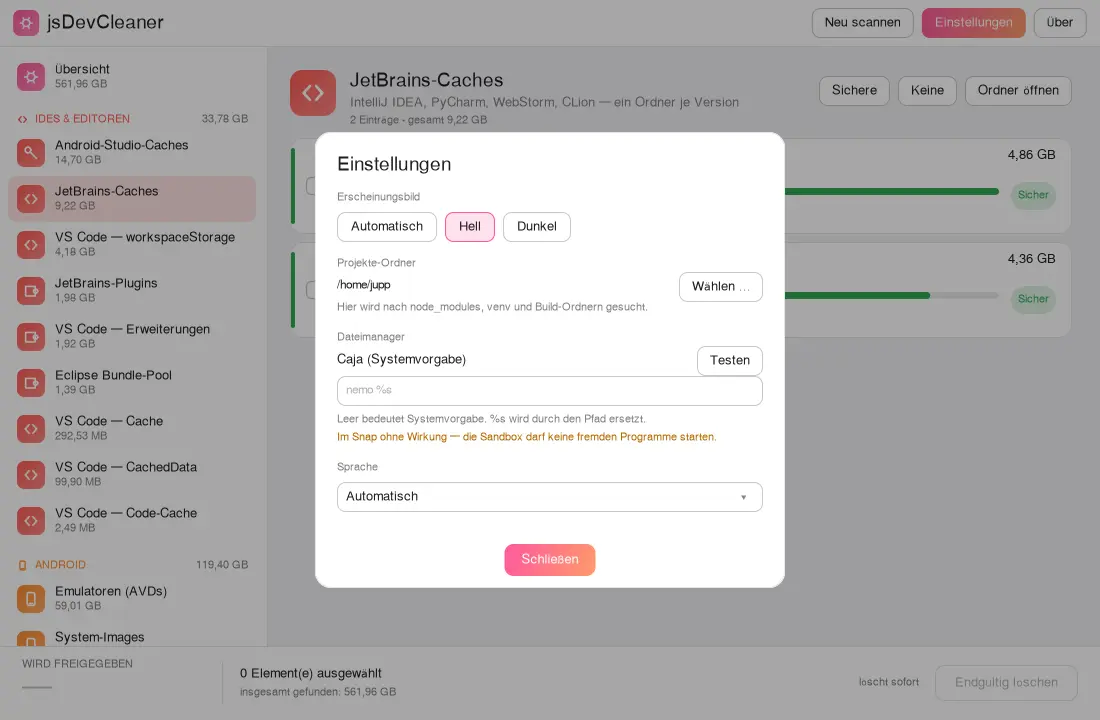
Ipinapakita kung gaano kalaki ang kinukuha ng iyong mga development tool: mga Android SDK at emulator, cache ng editor, mga na-download na package at mga dependency folder sa iyong mga proyekto. Bawat entry ay may rating na ligtas, mag-ingat o mapanganib, at ang mga tinick at kinumpirma mo lang ang aalisin.
Android SDK & AVDsGradle & Mavennpm & YarnIDE-Cachesnode_modulesRating ng panganibAng iyong mga sariling proyektoGTK3GNOME / KDE / XFCE44 mga wika
Ang mga cache gaya ng ~/.gradle, ~/.npm o ~/.cache ay nasa mga nakatagong folder na hindi kayang makita ng isang confined na app nang mag-isa. Patakbuhin nang isang beses ang command at i-restart ang app.
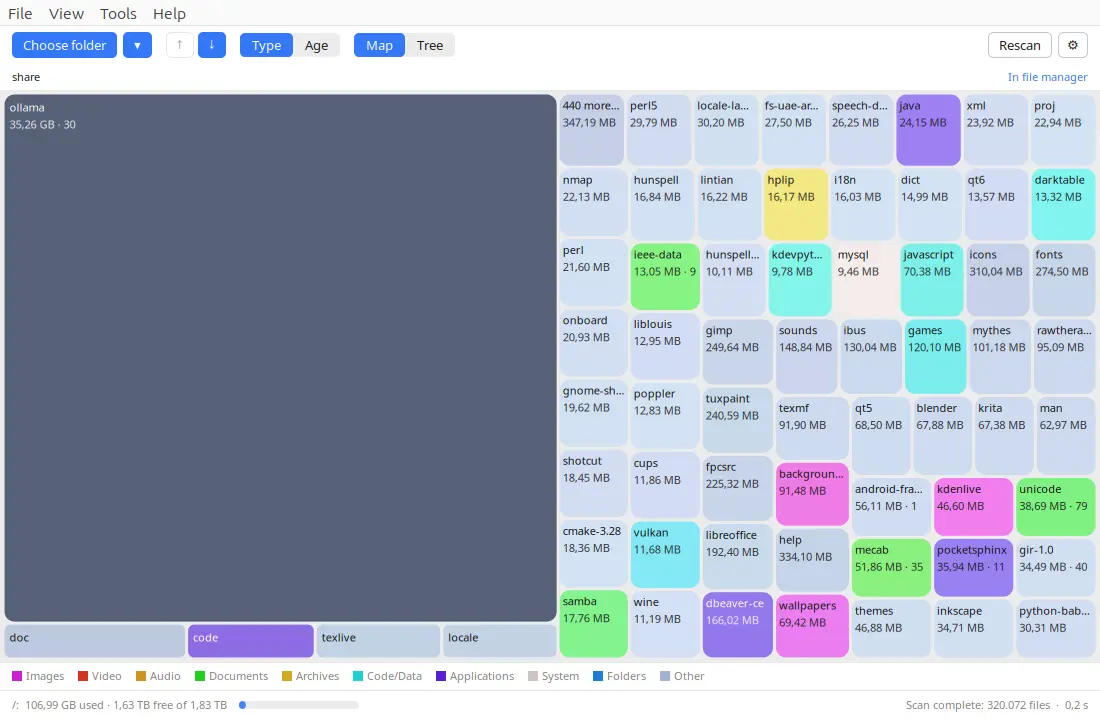
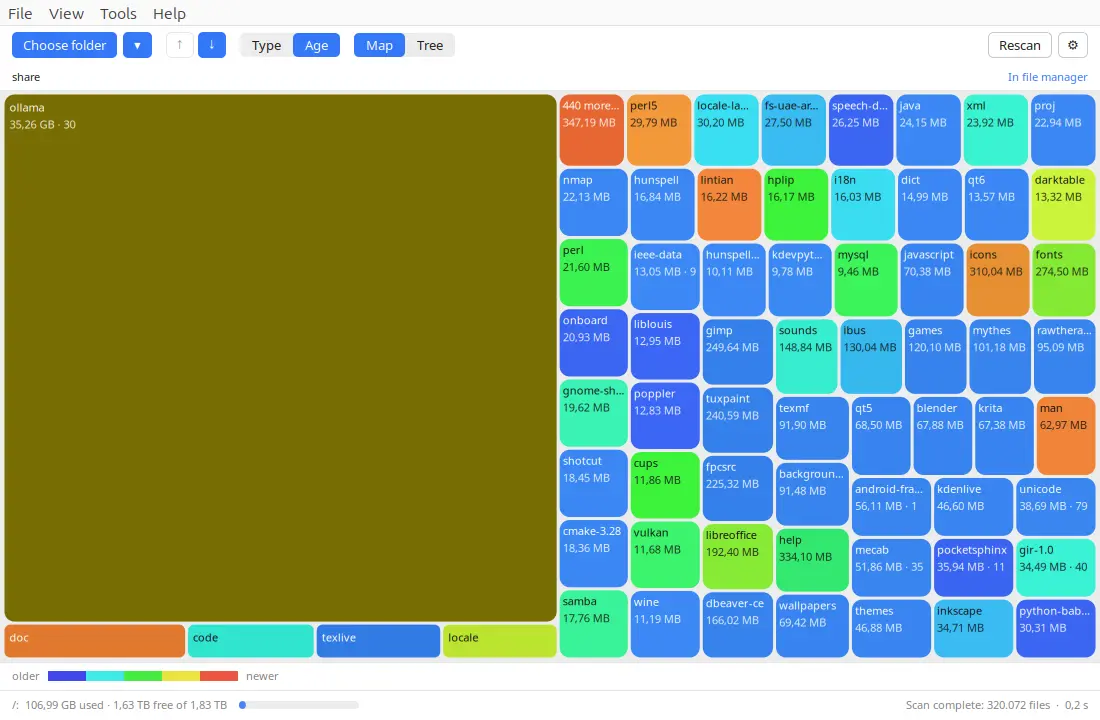
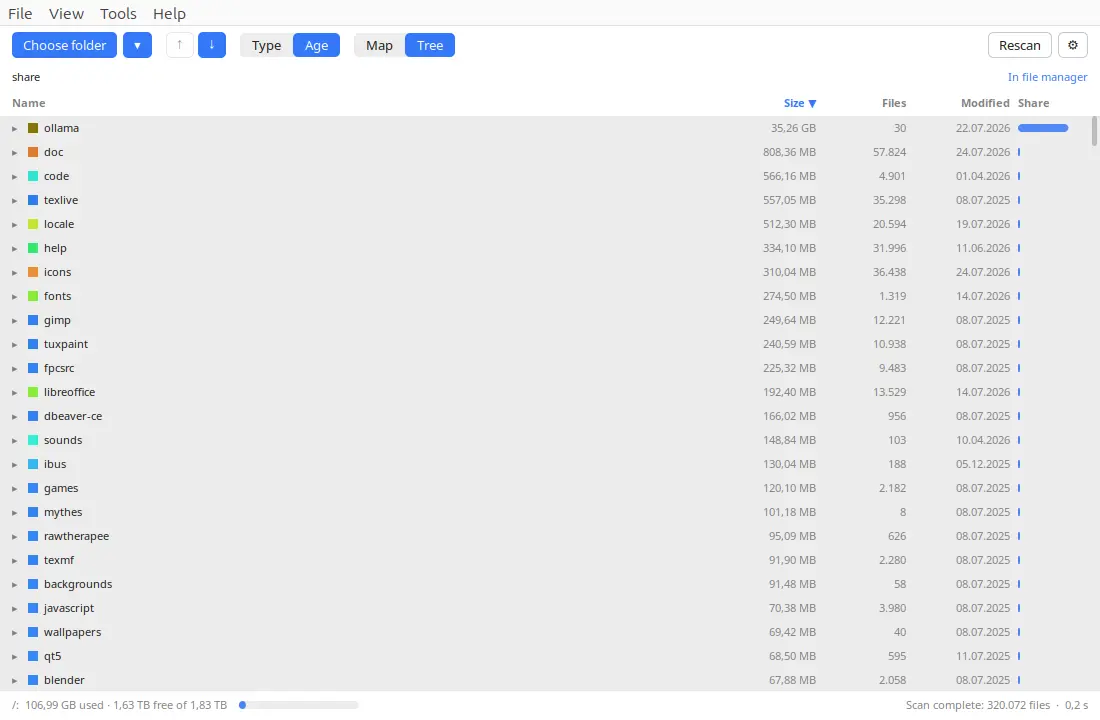
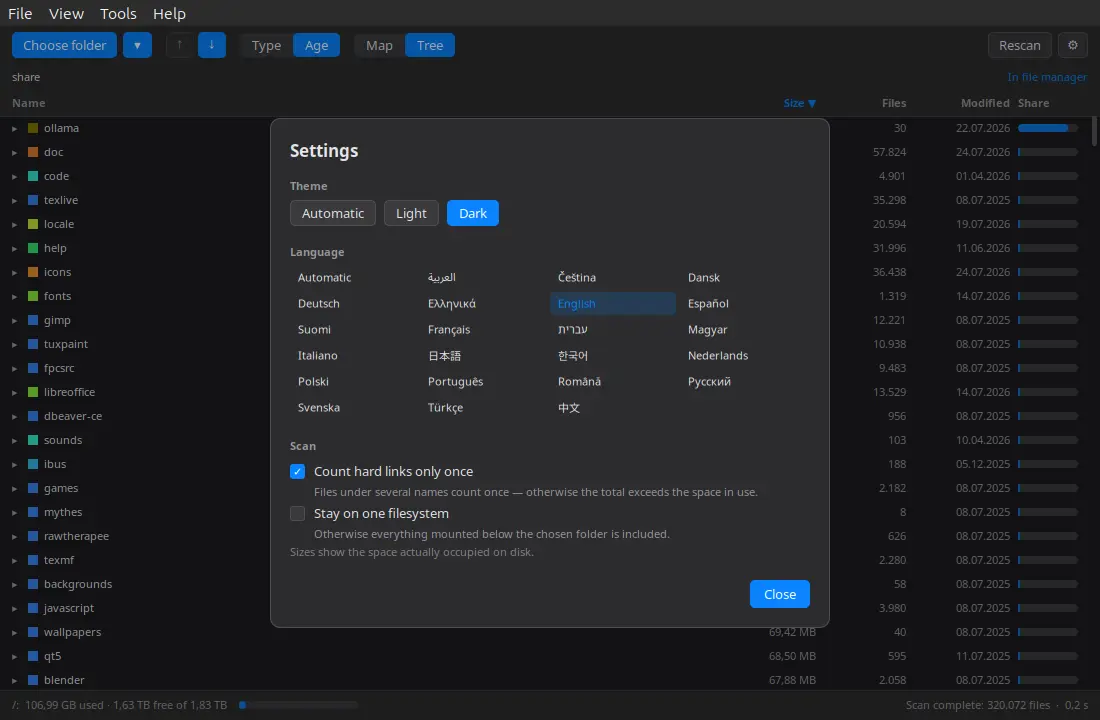
Ipinapakita kung saan napunta ang espasyo ng iyong disk bilang makulay na treemap: pumasok sa detalye, hanapin ang pinakamalalaking kumakain ng espasyo at ilipat nang sabay sa trash ang hindi mo na kailangan. Mga kulay ayon sa uri ng file o edad, may idinagdag na tree view na maaaring ayusin, at may patuloy na kabuuan kung gaano karaming espasyo ang mapapalaya mo.
TreemapHeat-MapDrill-downTree viewJunk-RadarTrash langGTK3GNOME / KDE / XFCE22 mga wika
Gumagana agad ang iyong home directory at mga removable media. Para sa mga system directory gaya ng /usr at /var, patakbuhin nang isang beses ang command at i-restart ang app.
jsSysInfo
v1.14 · C++/GTK3
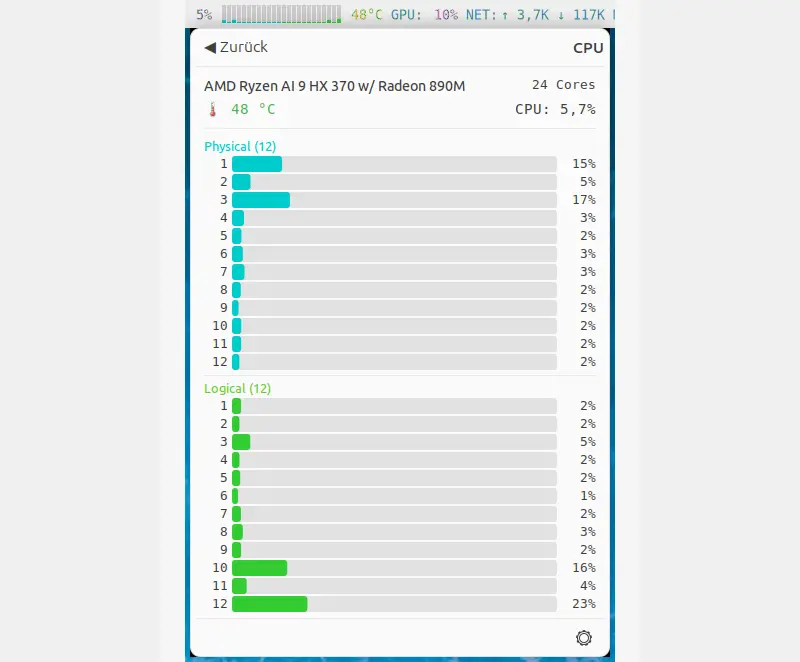
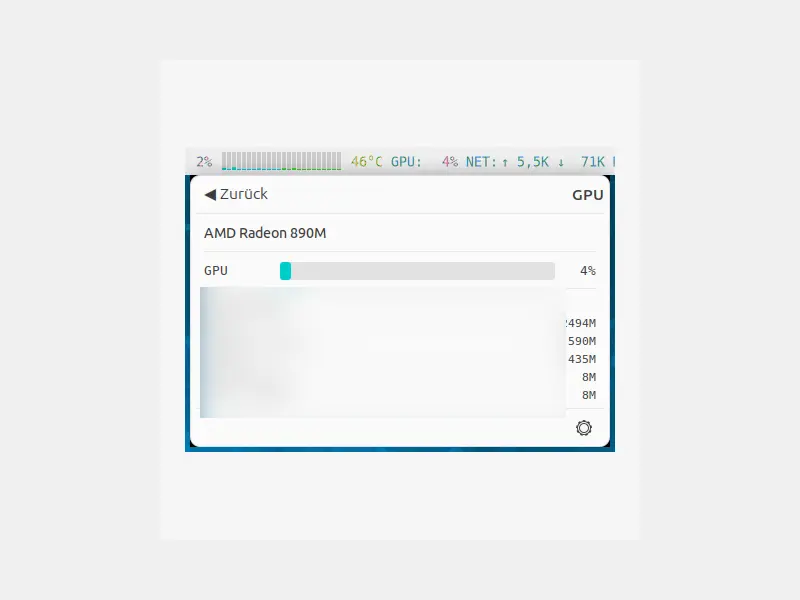
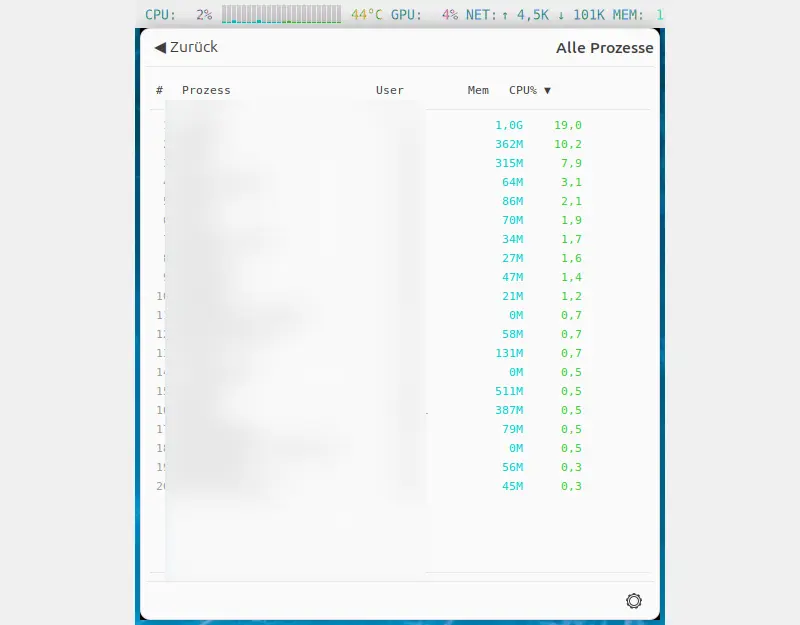
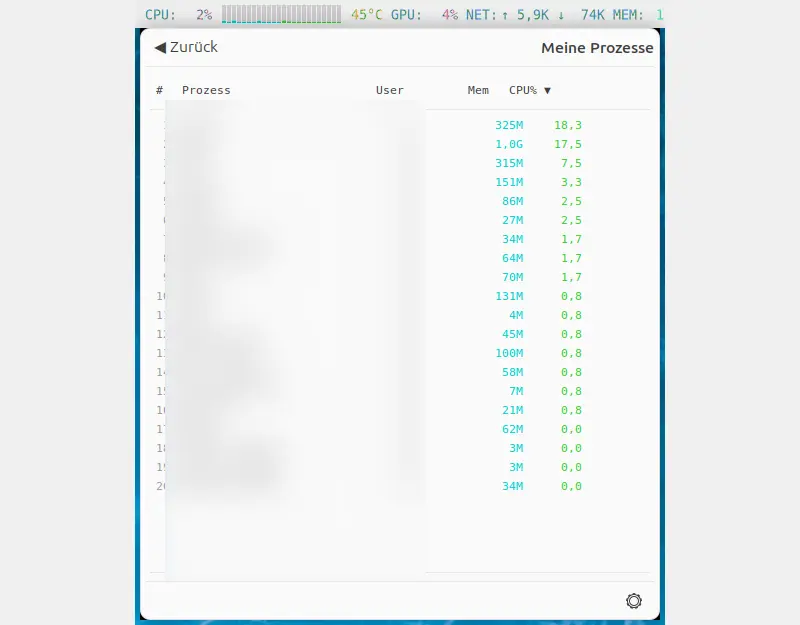
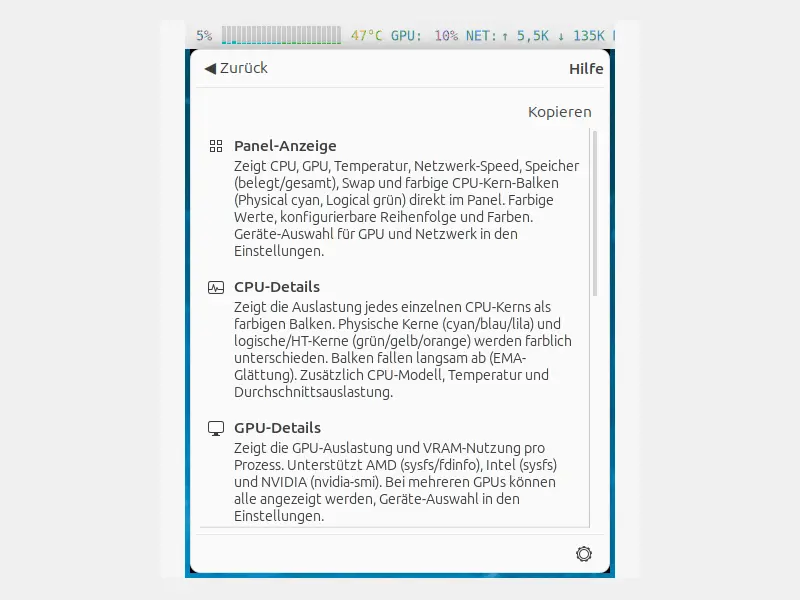
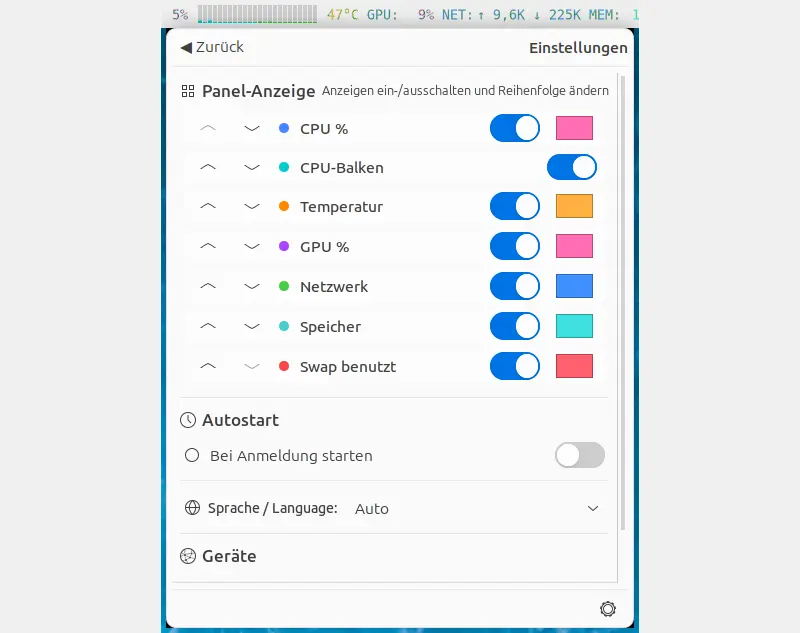
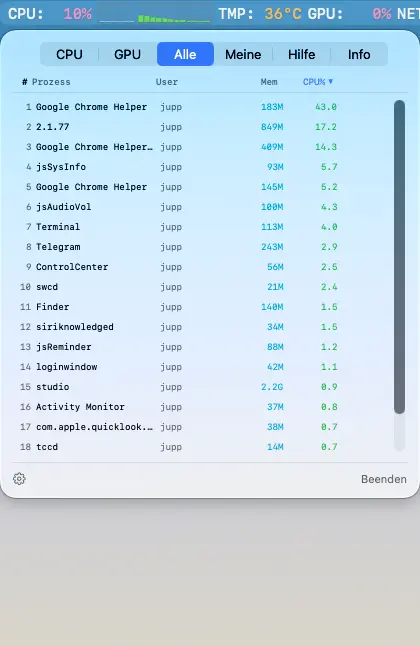
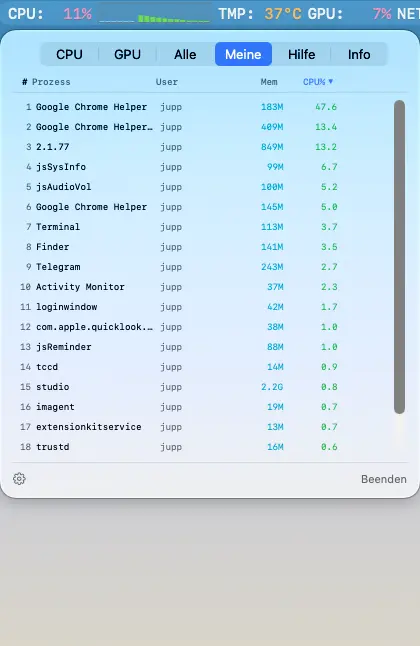
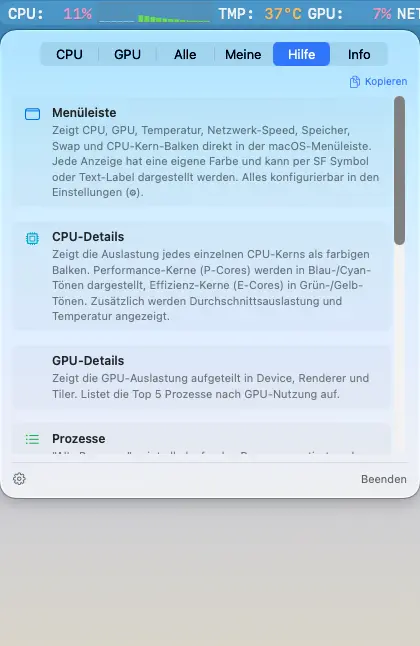
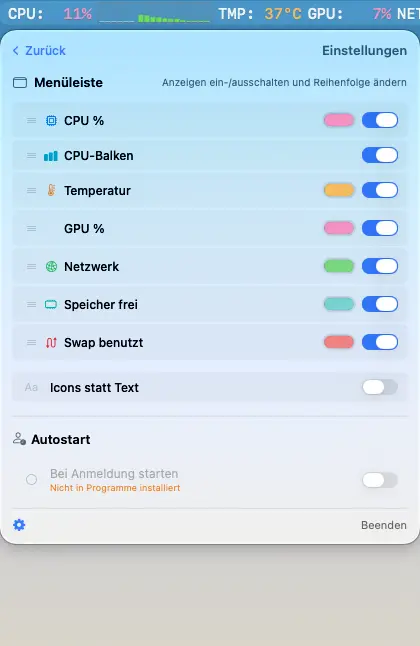
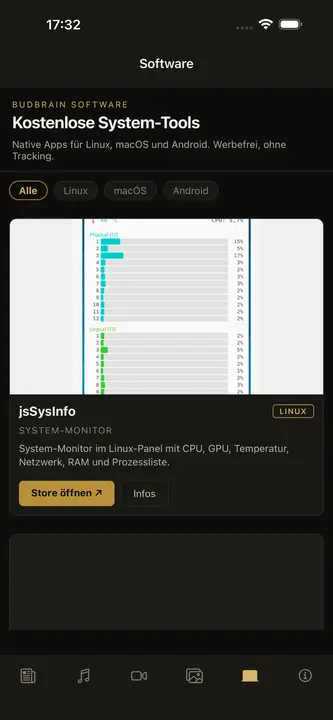
System monitor para sa panel ng Linux. Ipinapakita nang may kulay ang gamit ng CPU, GPU, temperatura, bilis ng network, memorya at swap sa panel ng GNOME/KDE/XFCE.
CPU %Mga CPU barGPU %TemperaturaNetworkRAM & SwapListahan ng prosesoTerminate/KillAutostartAMD / Intel / NVIDIA83 mga wika
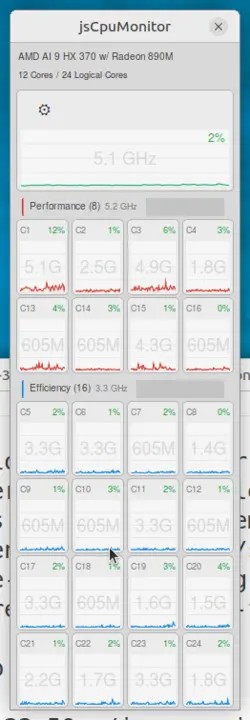
CPU monitor para sa Linux. Lumulutang na window na may chart bawat core, temperatura, frequency at konsumo ng kuryente. Bersyon ng macOS na para sa Linux.
Per-Core ChartsTemperaturaCPU-FrequenzPower (Intel RAPL)83 mga wikaFloating WindowGTK3GNOME / KDE / XFCE
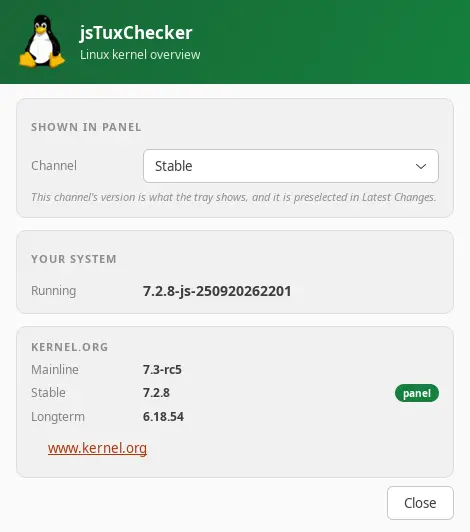
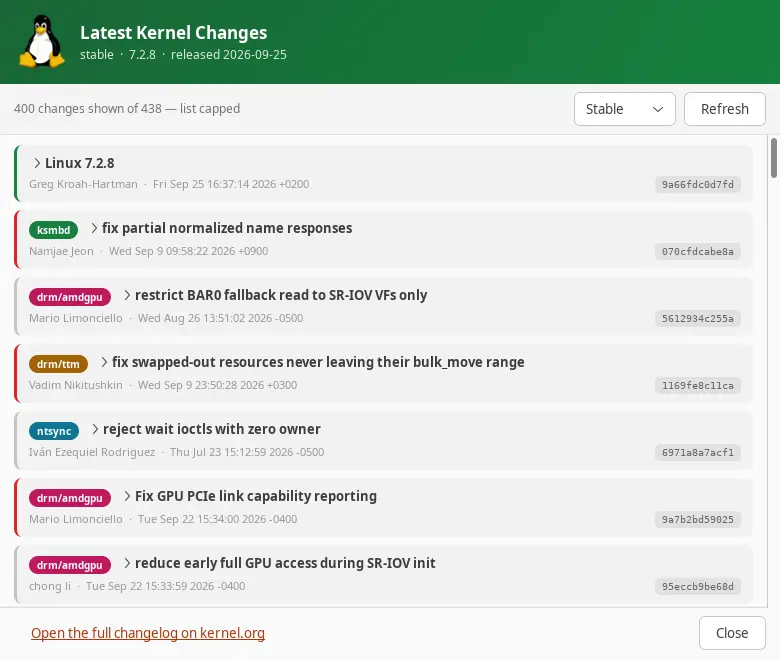
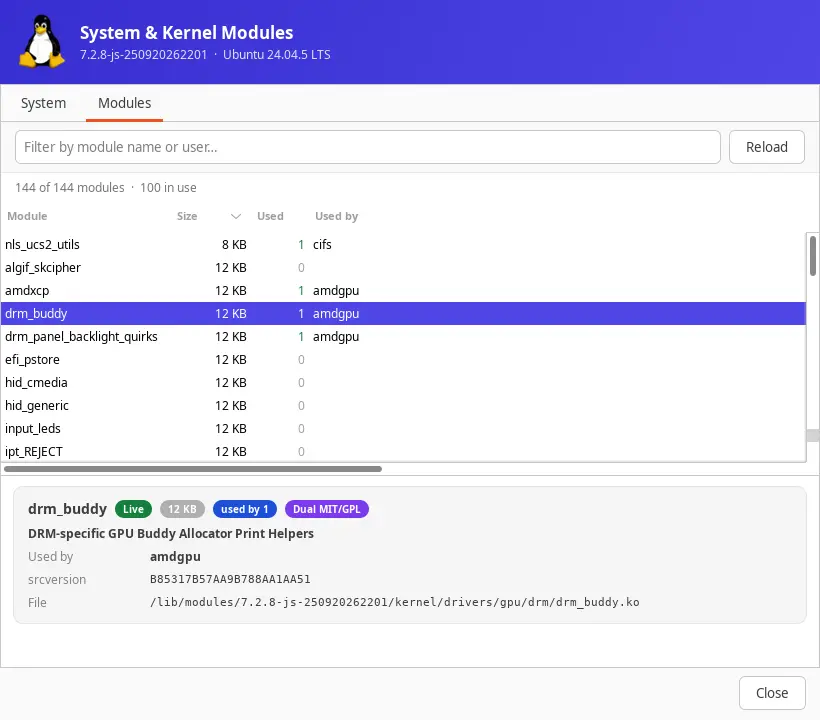
Tagasuri ng bersyon ng Linux kernel para sa system tray. Tinitingnan ang kernel.org para sa mga bagong release ng kernel at ipinapakita sa panel ang mga bersyong mainline, stable at longterm.
Mga laro, audio player, pag-edit ng video at larawan, file manager, pangkalahatang-ideya ng hardware at mga tool ng system para sa Windows
Budbrain Quasarion
v1.0.1 · MSIX · Windows 10/11
Lumipad bilang tutubi sa mga kumikinang na fantasy world at harapin ang mga higanteng hayop.
Ibang higanteng hayop sa dulo ng bawat antasWalong uri ng liwanag para sa iyong tutubi, bawat isa sa walong yugtoMga alitaptap na sumusunod sa daan ng iyong paglipadMga upgrade sa pugad at malaking skill tree na lumalaki kasabay moIsang diamond tunnel na kasabay ng indayog ng musika pagkatapos ng bawat mundoAnim na antas ng hirap, mula Madali hanggang BaliwKeyboard, gamepad o touchSDL2 · Cairo83 mga wika
jsBudbrainFindDblsOrRenameIt
v1.0.0 · MSIX · Windows 10/11
Naghahanap ng mga duplicate na file at inaayos ang mga ito – at pinapalitan ang pangalan ng maraming file nang sabay ayon sa sarili mong mga panuntunan, na may preview at undo.
Nakakahanap ng tunay na duplicate ayon sa nilalaman, anuman ang pangalanNananatili ang pinakabagong file – ikaw ang magpapasyaTrash, ilipat, burahin o i-linkPalitan ang pangalan ayon sa panuntunan na may live previewMaghanap ng file ayon sa pangalan, uri, laki o petsaI-save ang mga paghahanap, magpatakbo ng ilang gawain nang sabayI-undo ang paglilipat at pagpapalit ng pangalanMaliwanag at madilimSDL2 · Cairo47 mga wika
jsBudbrainsFxStudio
v1.0.1 · MSIX · Windows 10/11
Mga live effect para sa lahat ng pinapatugtog ng iyong computer — reverb, echo, pitch at iba pa, hinahalo sa tunog gamit ang fader.
Walong effect: pitch, filter, drive, chorus, flanger, phaser, echo, reverbBawat effect ay may sariling knob at mix faderIsang fader ang naghahalo ng lahat ng effect sa pangunahing mixLive na waveform at level meterMga handa nang setting gaya ng concert hall o canyon echo, at sarili mo“All off” sa isang click — at ibalik sa susunodPinoprotektahan ng limiter ang tainga at mga speakerGumagana kasama ang jsBudbrainEqualizerMute button para kapag tumutunog ang teleponoPiliin ang iyong mga speaker o headphoneMaliit na window na laging nasa ibabawI-set up nang isang beses – hihingi ng pahintulot mo ang WindowsMaliwanag at madilimSDL2 · Direct3D 1144 mga wika
jsBudbrainLimiter
v1.0.0 · MSIX · Windows 10/11
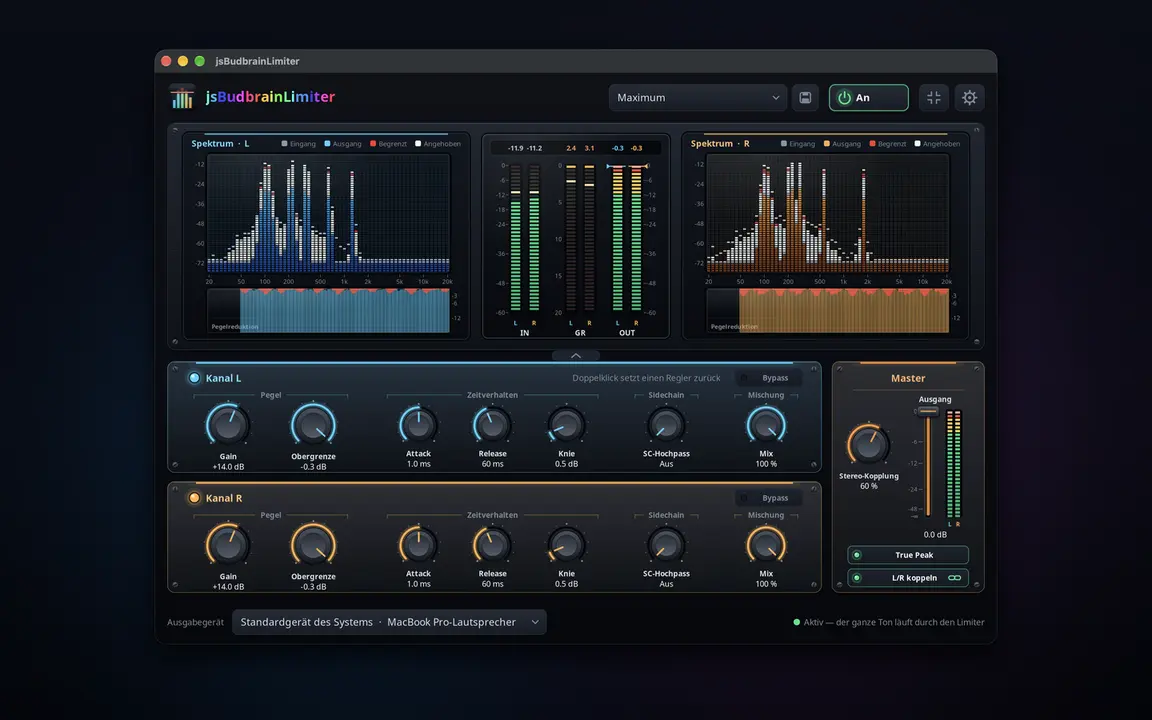
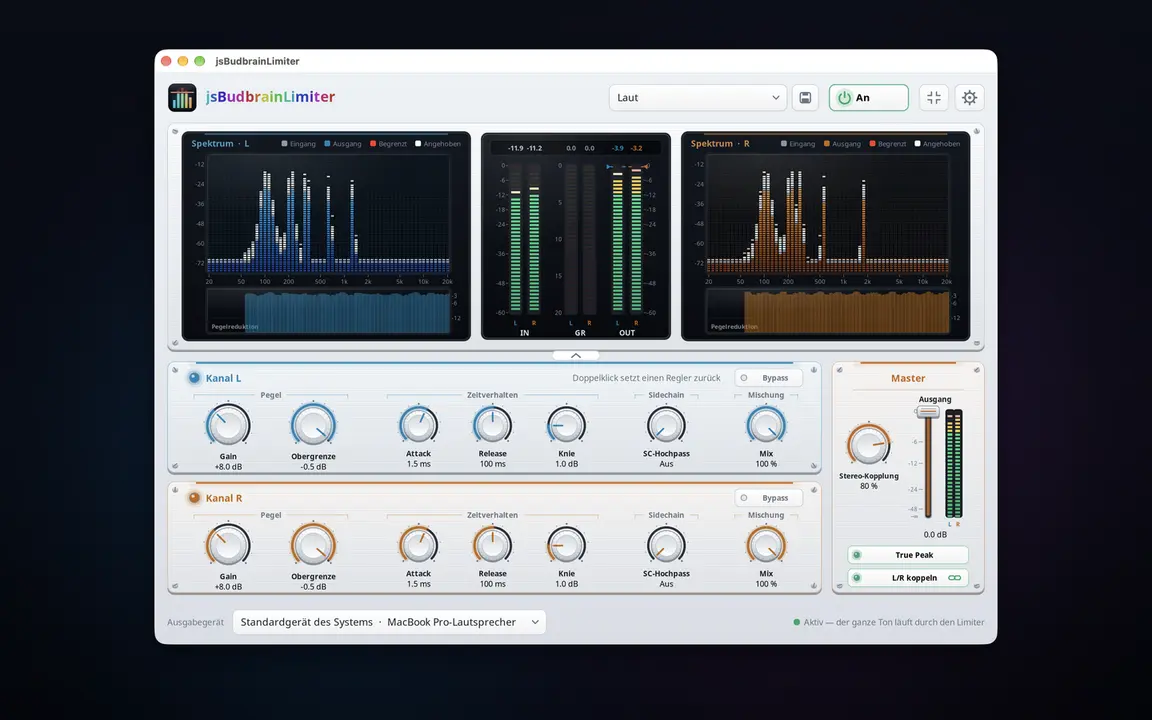
Isang limiter para sa lahat ng pinapatugtog ng iyong computer — mas malakas, nang hindi kailanman lumalampas, na may dalawang spectrum display na nagpapakita ng ginagawa nito.
Magkahiwalay na kontrol para sa kaliwa at kanang channelGain, ceiling, attack, release, knee, sidechain high-pass at mixNahuhuli ng true peak kahit ang pinakamaikling peakOutput fader na may level meter para sa dalawang channelDalawang spectrum display ang nagpapakita kung ano ang itinataas at ano ang nilimitahanKasaysayan ng gain reduction at mga pagbasa ng peakMga handa nang setting, at sarili moGumagana kasama ang jsBudbrainCompressor, jsBudbrainEqualizer at jsBudbrainsFxStudioMute button para kapag tumutunog ang teleponoPiliin ang iyong mga speaker o headphoneMaliit na window na laging nasa ibabawI-set up nang isang beses – hihingi ng pahintulot mo ang WindowsMaliwanag at madilimSDL2 · Direct3D 1144 mga wika
jsBudbrainCompressor
v1.0.1 · MSIX · Windows 10/11
Init ng tube at isang studio compressor para sa lahat ng pinapatugtog ng iyong computer — na may kumikinang na tube at VU meter.
Simulated na tube preamp na may drive, bias at fatBass, mid, treble at presenceCompressor na may threshold, ratio, attack, release, knee, make-up at mixDalawang VU meter na may totoong galaw ng karayomMas maliwanag ang kinang ng mga tube habang mas nagtatrabaho silaMga handa nang setting para sa mga tube at compressor, at sarili moPinoprotektahan ng limiter ang tainga at mga speakerGumagana kasama ang jsBudbrainEqualizer at jsBudbrainsFxStudioMute button para kapag tumutunog ang teleponoPiliin ang iyong mga speaker o headphoneMaliit na window na laging nasa ibabawI-set up nang isang beses – hihingi ng pahintulot mo ang WindowsMaliwanag at madilimSDL2 · Direct3D 1144 mga wika
jsBudbrainLaufwerksTest
v1.0.0 · MSIX · Windows 10/11
Sinusukat kung gaano kabilis sumulat at bumasa ang isang drive — na may dalawang live level meter, chart at pagsusuri sa bawat block.
Live na bilis ng pagsulat at pagbasaAyon sa laki (1–16 GB) o oras (5 s – 16 min)Sinusuri ang bawat blockIpinapakita kung kailan nauubusan ng hininga ang mabilis na driveMga USB stick, memory card, network driveKasaysayan ng lahat ng test, i-save bilang textMag-scale hanggang 1,000,000 MB/s para sa mga server RAIDMaliwanag at madilimSDL2 · Cairo47 mga wika
Budbrain Cave Rescue
v1.0.0 · MSIX · Windows 10/11
Lumipad sa malalalim na kweba ng buwan at ibalik nang ligtas sa tahanan ang mga naipit na astronaut.
100 antas sa sampung mundoTotoong gravityApat na button, wala nang ibaI-upgrade ang iyong barko gamit ang karanasanApat na antas ng hirapGallery ng mga misyon na may mapa ng paglipadKeyboard, mouse o gamepadSDL2 · Cairo44 mga wika
jsBudbrainEqualizer
v1.0.1 · MSIX · Windows 10/11
Isang equalizer para sa lahat ng pinapatugtog ng iyong computer — na may live na spectrum.
Sampung slider, mula malalim na bass hanggang maliwanag na trebleLive na display ng pinapatugtog — kaliwa, kanan o parehoMga handa nang sound setting at sarili mo, nakasave sa isang pangalanMute button para kapag tumutunog ang teleponoPiliin ang iyong mga speaker o headphoneItiklop ang mga slider, ang display lang ang matiraMaliit na window na laging nasa ibabawNagsisimula pag-log in mo, kung gusto moI-set up nang isang beses – hihingi ng pahintulot mo ang WindowsMaliwanag at madilimSDL2 · Direct3D 1144 mga wika
jsBudbrainPlayer
v1.0.0 · MSIX · Windows 10/11
Nagpe-play ng mga recording mula sa isang folder — random o nang pagkakasunod-sunod, sa mga oras na pipiliin mo.
Nagpe-play ng mga recording mula sa isang folder, kasama ang network driveRandom o nang pagkakasunod-sunodSa pagitan lang ng dalawang oras ng arawSa mga araw lang ng linggo na titickan moPinapantay ang mga recording na magkaiba ang lakas ng tunogNagsisimula kasabay ng Windows at kusang nagpapatuloyMP3WASAPI · Direct2D44 mga wika
Budbrain’s Media Editor
v1.0.0 · MSIX · Windows 10/11
Mag-edit ng video o larawan at i-save ito. Paikliin ang pelikula o magdagdag ng mga clip, lagyan ng fade sa pagitan ng mga ito, at i-save ang video sa partikular na laki o format. Ituwid, i-crop at ayusin ang mga larawan, saka i-save bilang JPEG, PNG o WebP.
Putulin at pagdugtunginMga fade at cross-fadeI-crop at ayusin ang mga larawanMga export preset para sa karaniwang platformMga camera raw fileFFmpeg (LGPL)NVENC · AMF · Media FoundationSDL2 · Direct3D 1144 mga wika
Astonischika
v1.0.0 · MSIX · Windows 10/11
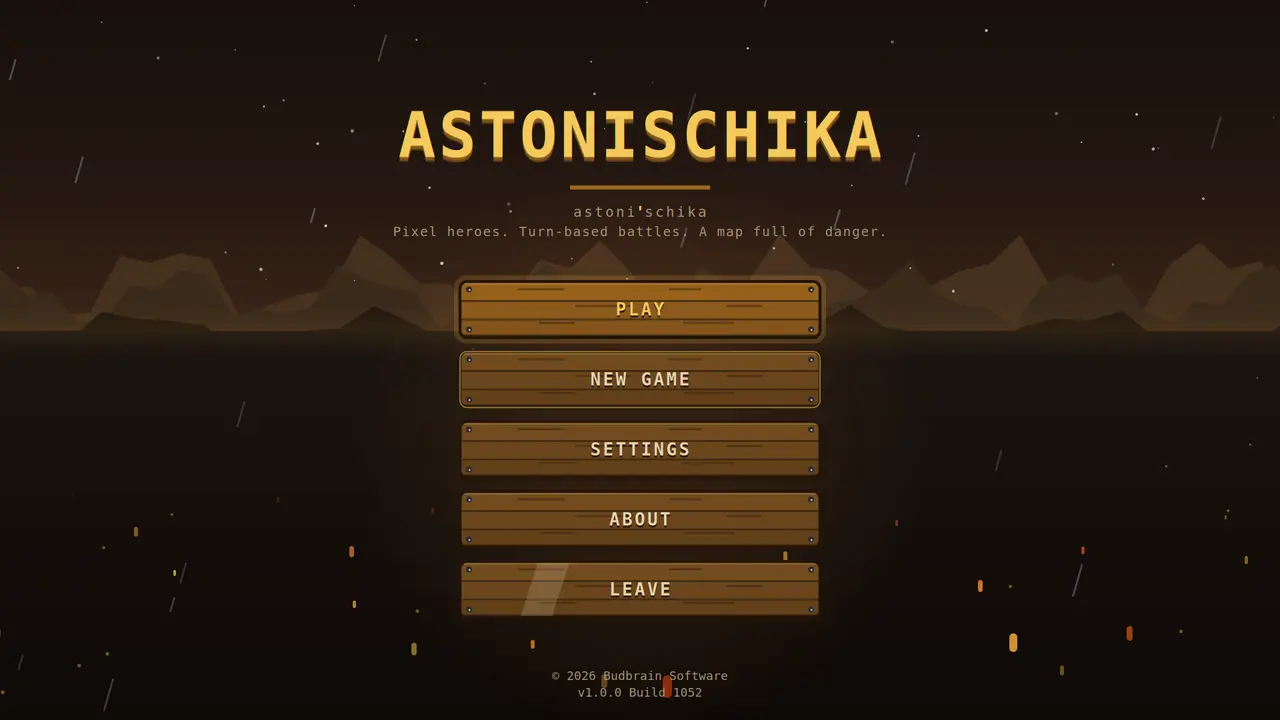
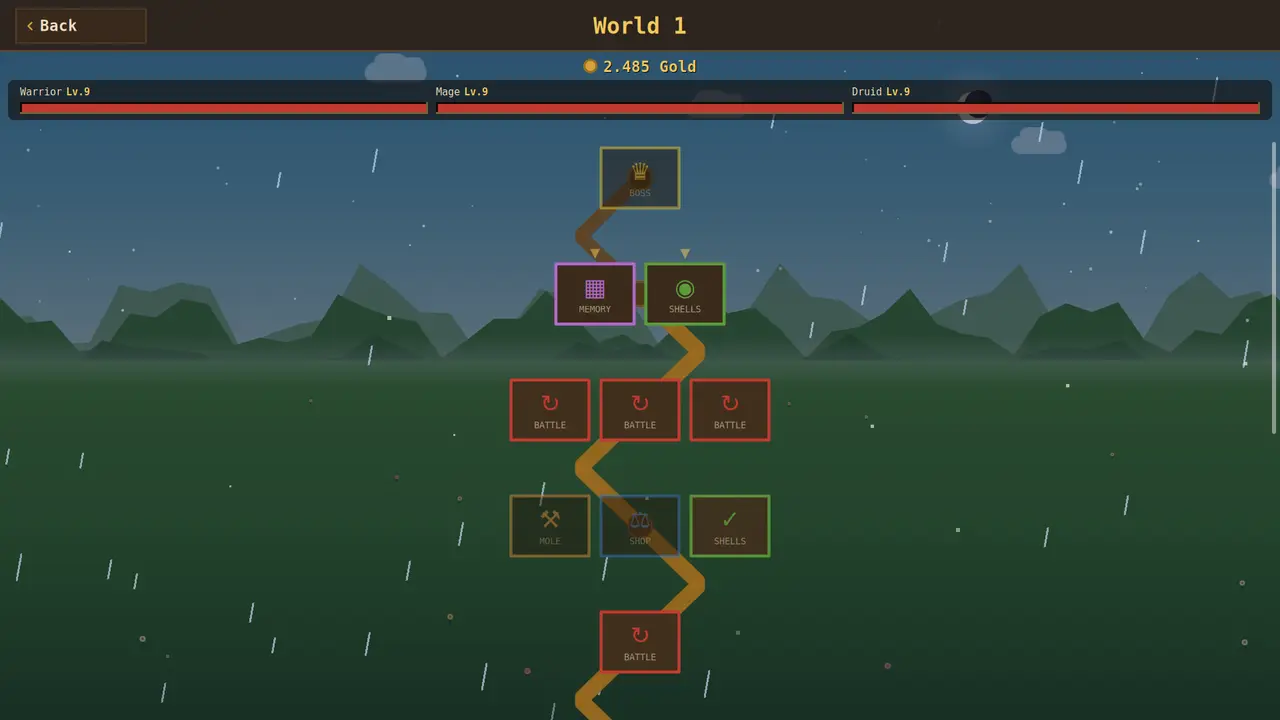
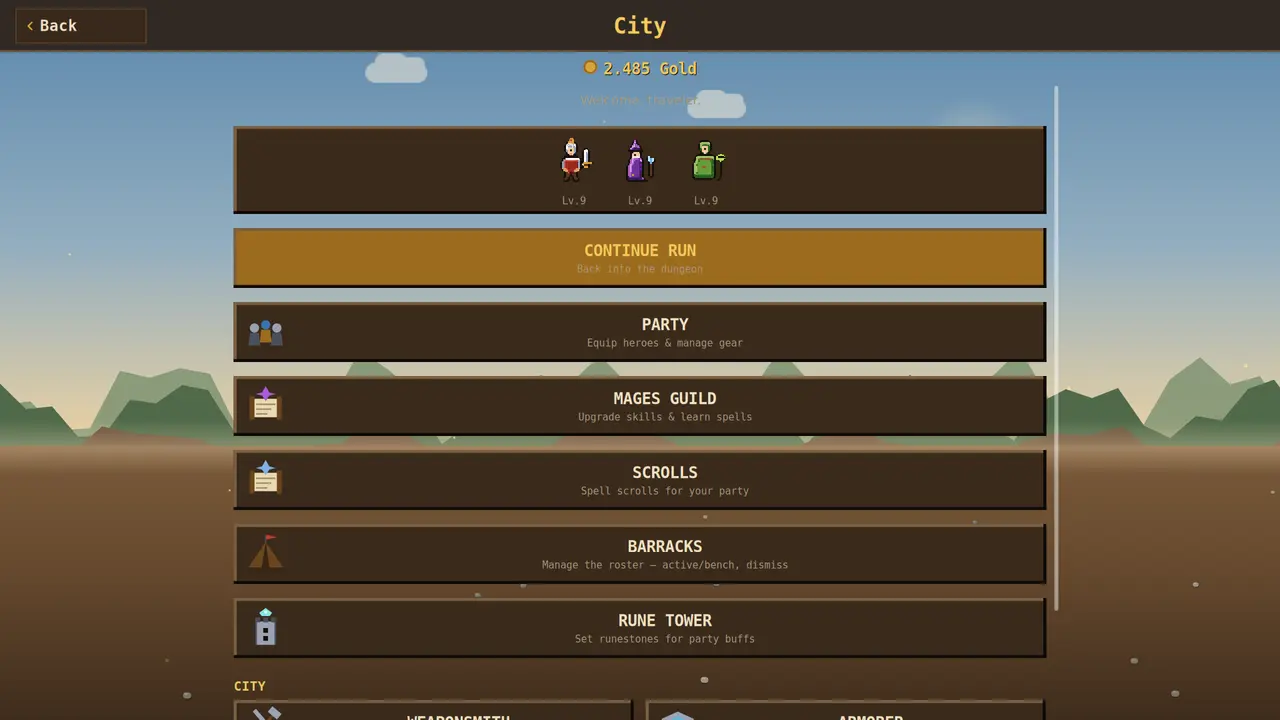
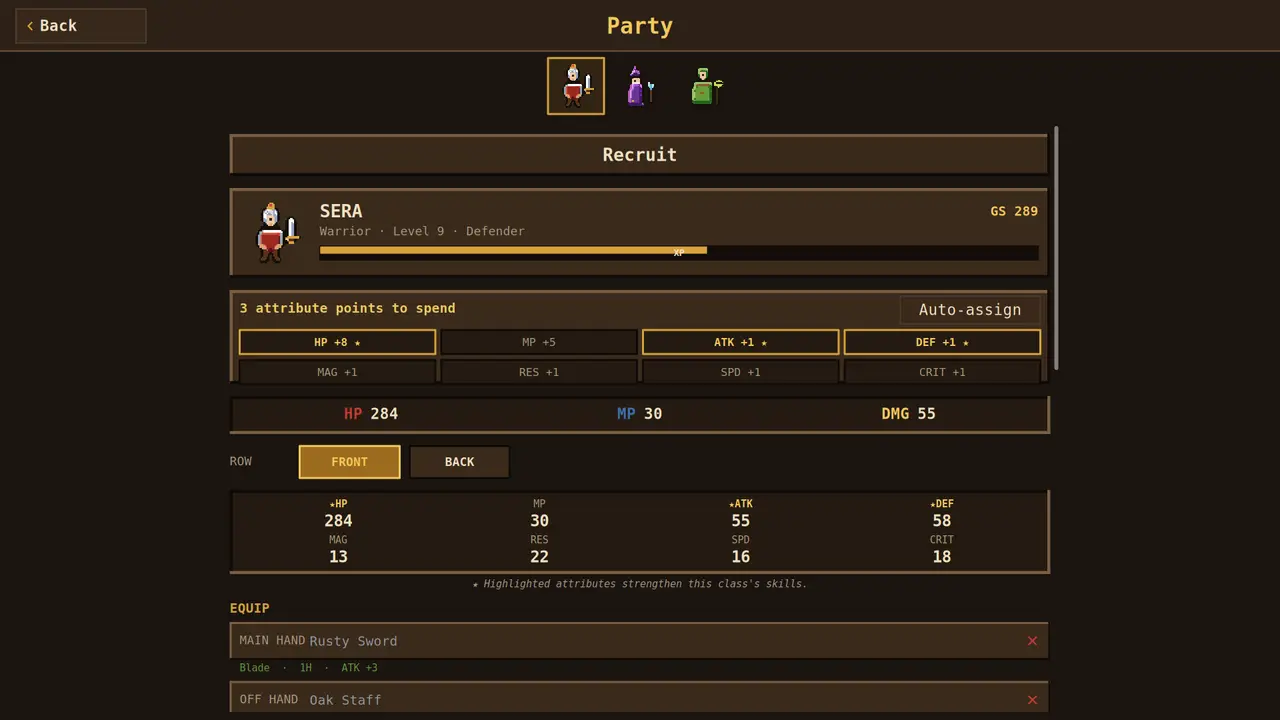
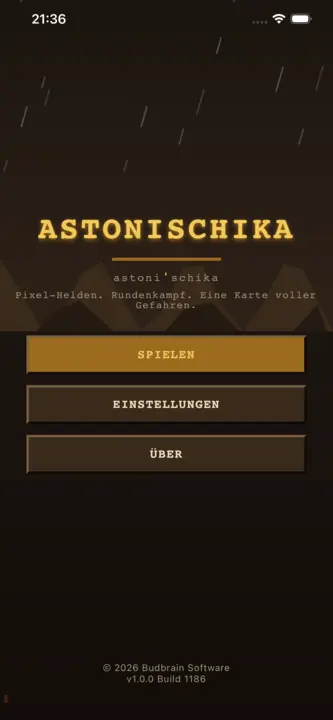
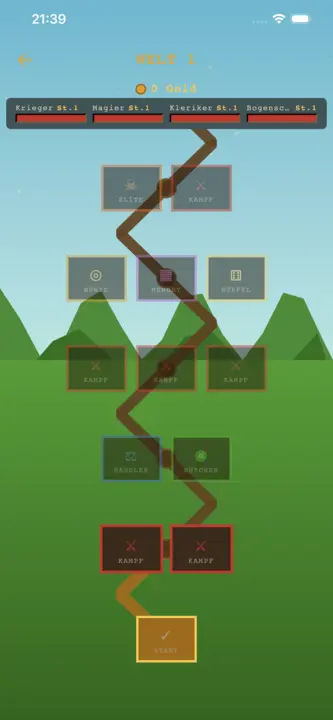
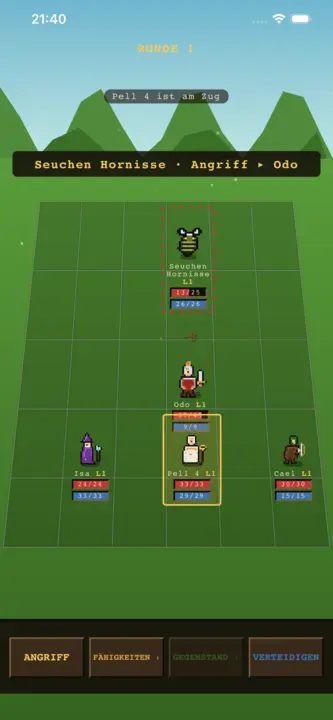
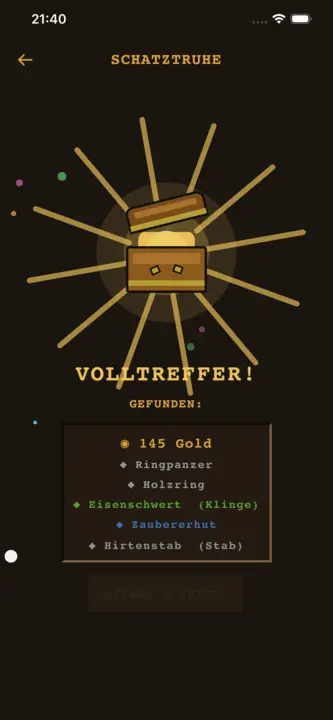
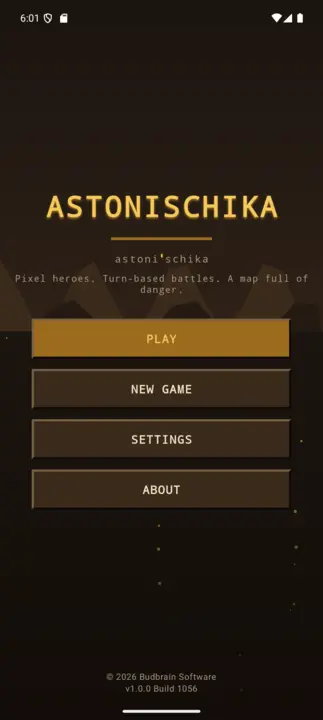
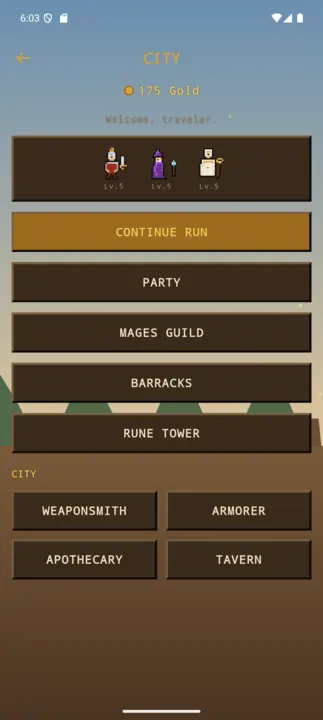
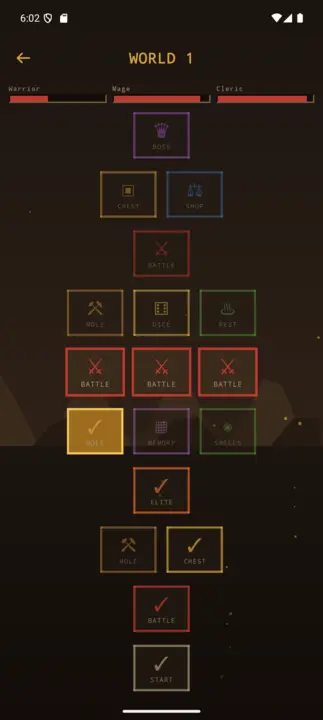
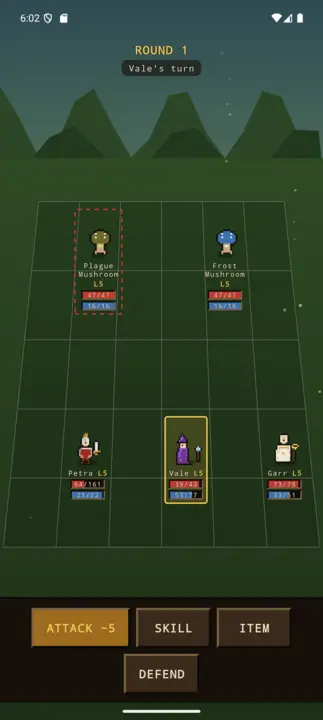
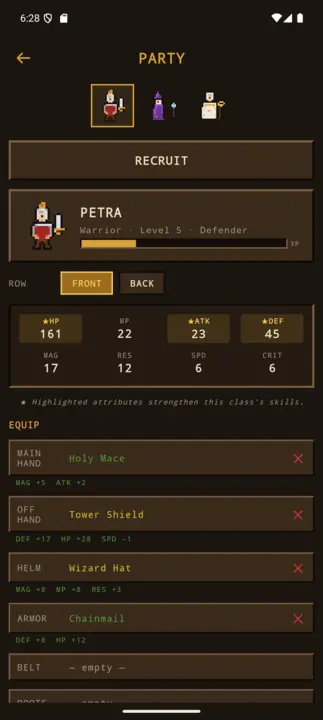
Pixel role-playing: pumili ng tatlong bayani, turn-based na labanan, loot, mapang puno ng panganib.
Party-RPGPixel-ArtTurn-based3 sa 8 na bayaniLoot at gearCity hubSDL2 · Cairo44 mga wika
Budbrain’s Chess
v1.0.0 · MSIX · Windows 10/11
Isang daang antas ng chess laban sa computer, mula 150 hanggang 1900 ELO. Sa mga unang antas ay may handicap ang kalaban, saka lumalakas antas bawat antas. May hint na tumutulong, kumukurap ang mga piyesang nanganganib, maaaring bawiin ang bawat galaw — at bawat larong napanalunan mo ay nananatili sa gallery.
100 antas150 hanggang 1900 ELOKalaban na may handicapHint at undoGallery ng mga napanalunang laroSDL2 · Cairo22 mga wika
BlobPop
v1.0.0 · MSIX · Windows 10/11
Isang daang antas sa limang mundo: tumutok, mag-click, pagsamahin ang tatlo ng isang kulay. Bawat ilang tira ay bumababa ng isang hanay ang board — linisin ito bago umabot sa ilalim at makakakuha ka ng tatlong bituin. Kasama ang endless mode na may talaan ng high score.
100 antasLimang mundoEndless modeAraw at gabiTalaan ng high scoreSDL2 · Cairo22 mga wika
Budbrain’s Puzzle
v1.1.0 · MSIX · Windows 10/11
Apatnapung larawan bilang jigsaw puzzle, bawat isa sa anim na laki mula tatlumpu hanggang isang daan at sampung piraso. Ang pirasong malapit sa lugar nito ay kusang kumakabit — buksan ang rotation kung gusto mong mas mahirap.
Apatnapung larawanAnim na laki30 hanggang 110 pirasoUmiikot na mga pirasoMga tagumpayAng iyong mga sariling kulaySDL2 · Cairo22 mga wika
FarmIsFun
v1.0.1 · MSIX · Windows 10/11
Magtayo ng sakahan mula sa isang bakanteng lupa: linisin ito, taniman, mag-alaga ng mga hayop, humukay ng minahan. Mahigit 300 bagay, 231 recipe, apat na panahon — at kusa itong nagse-save.
Mahigit 300 item231 recipeAnim na uri ng hayopApat na panahonMinahan · pangingisda · pangangasoMouse · keyboard · gamepadSDL2 · Cairo22 mga wika
Budbrain’s Mahjong
v1.1.1 · MSIX · Windows 10/11
Mahjong solitaire na may isang daang antas: nawawala ang dalawang magkaparehong libreng tile, sampung hand-drawn na mesa, at bawat board na nalinis mo ay nakatago bilang larawan.
100 antasSampung mesaTip · Shuffle · UndoPader ng mga tagumpaySDL2 · Cairo22 mga wika
Budbrain’s Marbles
v1.1.0 · MSIX · Windows 10/11
Ayusin ang mga marble ayon sa kulay: pumili ng tubo, saka ang pupuntahan — lilipad pa-arko ang marble sa ibabaw. Isang daan at limang puzzle sa limang beach, at bawat isa ay malulutas.
105 puzzleLimang beachLahat ay malulutasUndo · I-restartPader ng mga tagumpaySDL2 · Cairo22 mga wika
DuoDom
v1.0.0 · MSIX · Windows 10/11
I-slide nang magkakasama ang mga domino: ang magkatugmang tuldok o tamang kabuuan ay nagpapawala ng isang pares. Walang katapusang antas na may dinamita, joker at diamante — at bawat isa ay maaaring ipanalo.
Walang katapusang antas17 uri ng batoDinamita · Joker · DiamanteUndo · Hint · TubigMga tropeo at rekordSDL2 · Cairo20 mga wika
Budbrain’s Sudoku
v1.4.1 · MSIX · Windows 10/11
Sudoku mula 4×4 hanggang 25×25: isang daang antas sa papel ng notebook, pang-araw-araw na puzzle at isang pader na naglalaman ng bawat board na nalutas mo.
4×4 – 25×25100 antasPang-araw-araw na puzzleMga tala · hint · undoPader ng mga tagumpaySDL2 · Cairo22 mga wika
jsFileManager
v1.0.0 · Win32/Direct2D · Windows 10/11
Isang file manager na may dalawang file browser na magkatabi: sa kaliwa kung saan nagmumula ang mga file, sa kanan kung saan dapat mapunta, at sa pagitan ang mga button — kopyahin, ilipat, i-pack, hanapin, hex view, bagong folder, burahin.
Dalawang folder na magkatabiLive na progresoMga drive at USBMga archive at byte viewDrag & DropMaliwanag at madilim44 mga wika
jsShowHardwareInfos
v1.0 · Win32/Direct2D · Windows 10/11
Ipinapakita ang bawat detalye ng hardware na iniuulat ng iyong PC tungkol sa sarili nito — processor, memorya, graphics, mga drive, port, network at mga sensor, bawat isa sa sarili nitong sanga. Kasama ang live na bar na may load at temperatura, paghahanap sa lahat ng value at ulat na maaari mong i-save bilang text file o kopyahin sa clipboard.
CPU / RAM / GPUMga drive at USBMga sensor at temperaturaListahan ng prosesoPaghahanap sa lahat ng valueI-save ang ulatMaliwanag at madilim44 mga wika
Where Did My Storage Go?
v1.0 · Win32/Direct2D · Windows 10/11
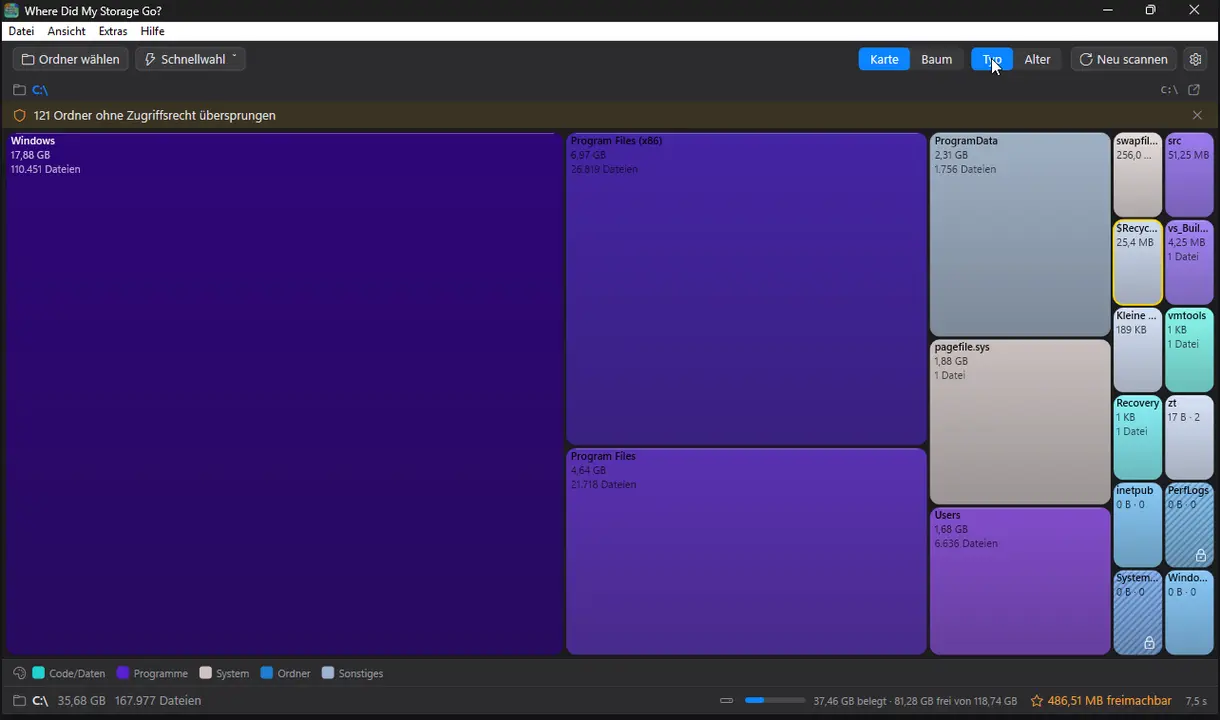
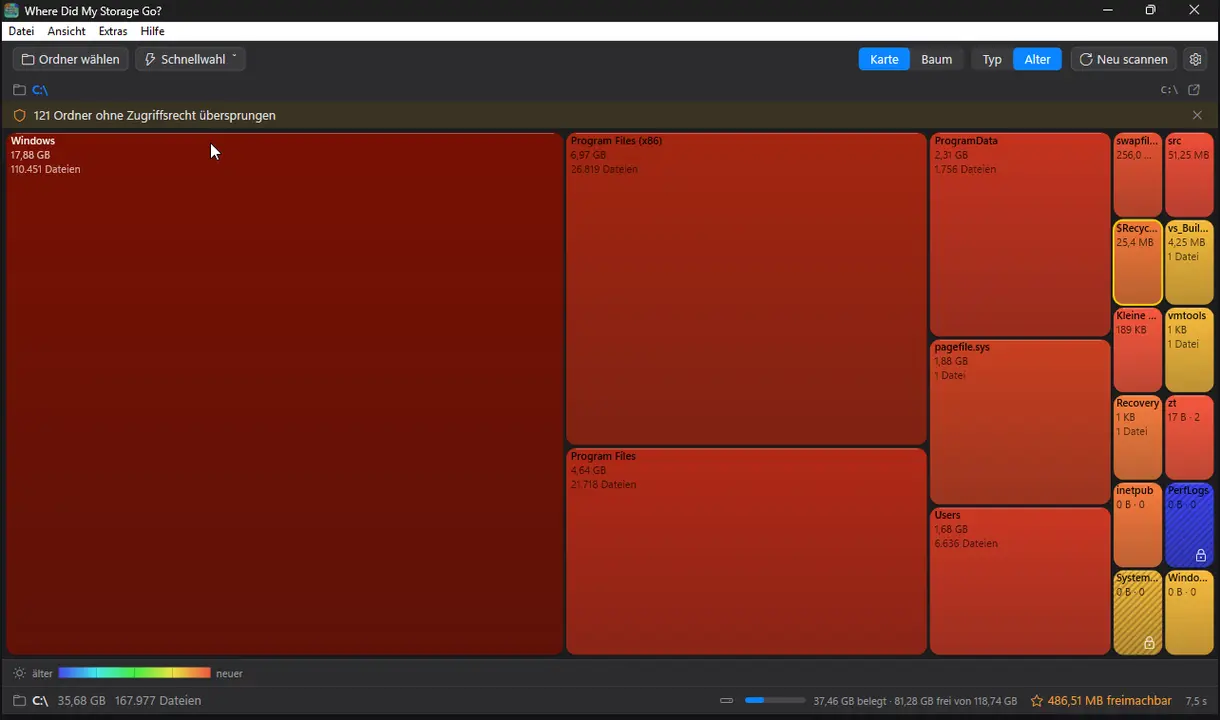
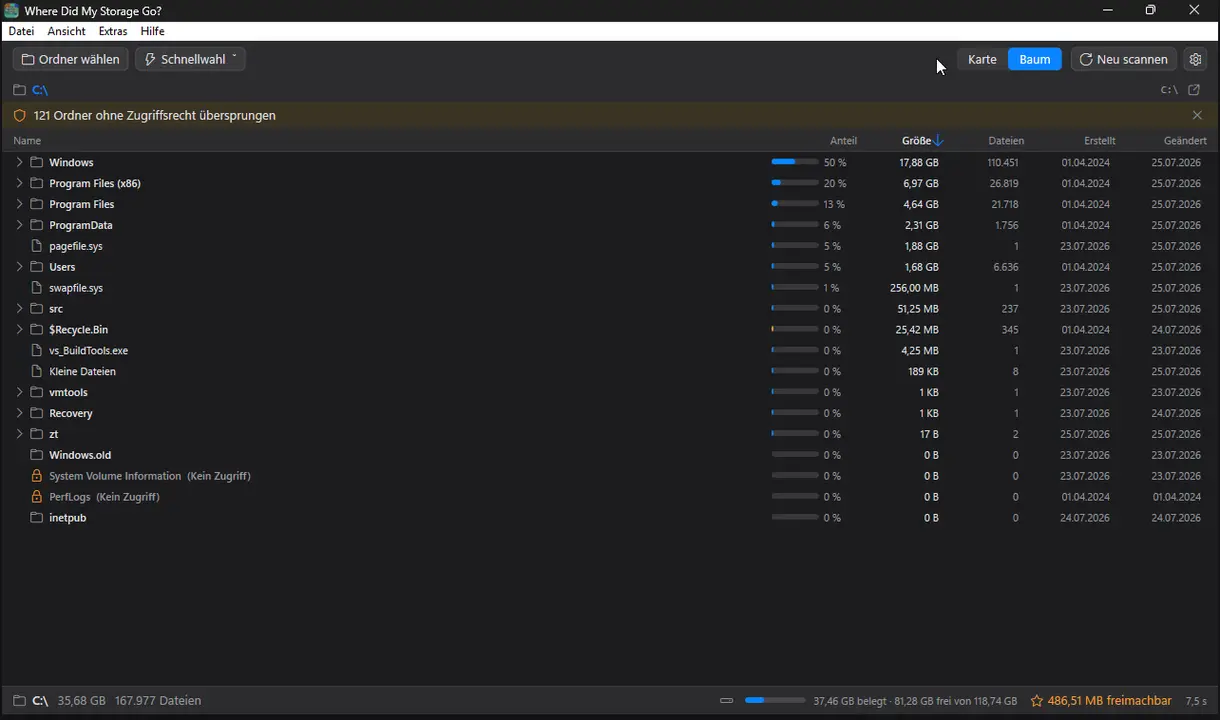
Tingnan sa isang sulyap kung ano ang pumupuno sa iyong drive — mga folder bilang mapang may code ng kulay, eksaktong laki, pagbura na sa Recycle Bin lang.
TreemapHeat-MapDrill-downTree viewJunk-RadarTrash langMulti-Core-ScanMaliwanag at madilim22 mga wika
jsCPUMonitor
v1.0 · Win32/Direct2D · Windows 10/11
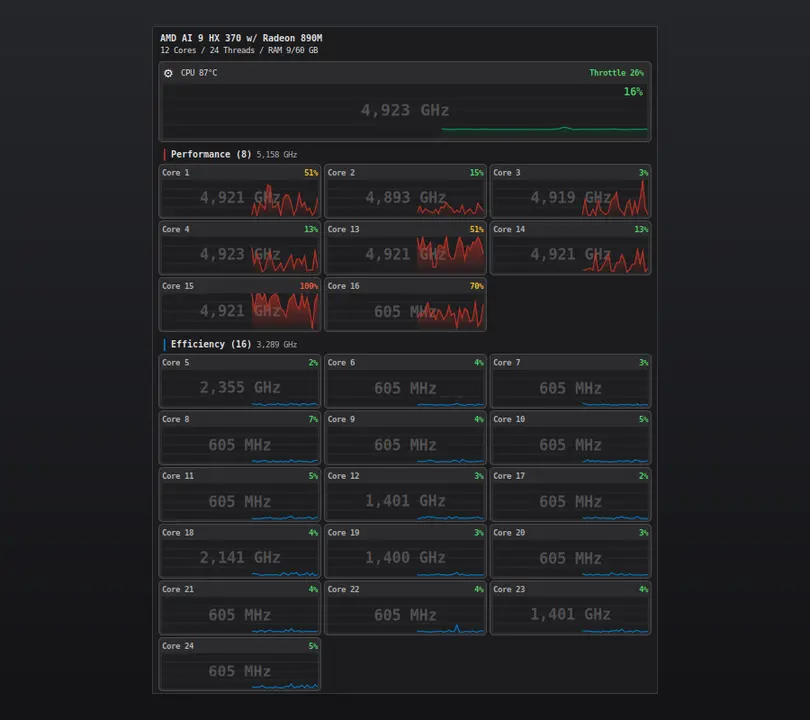
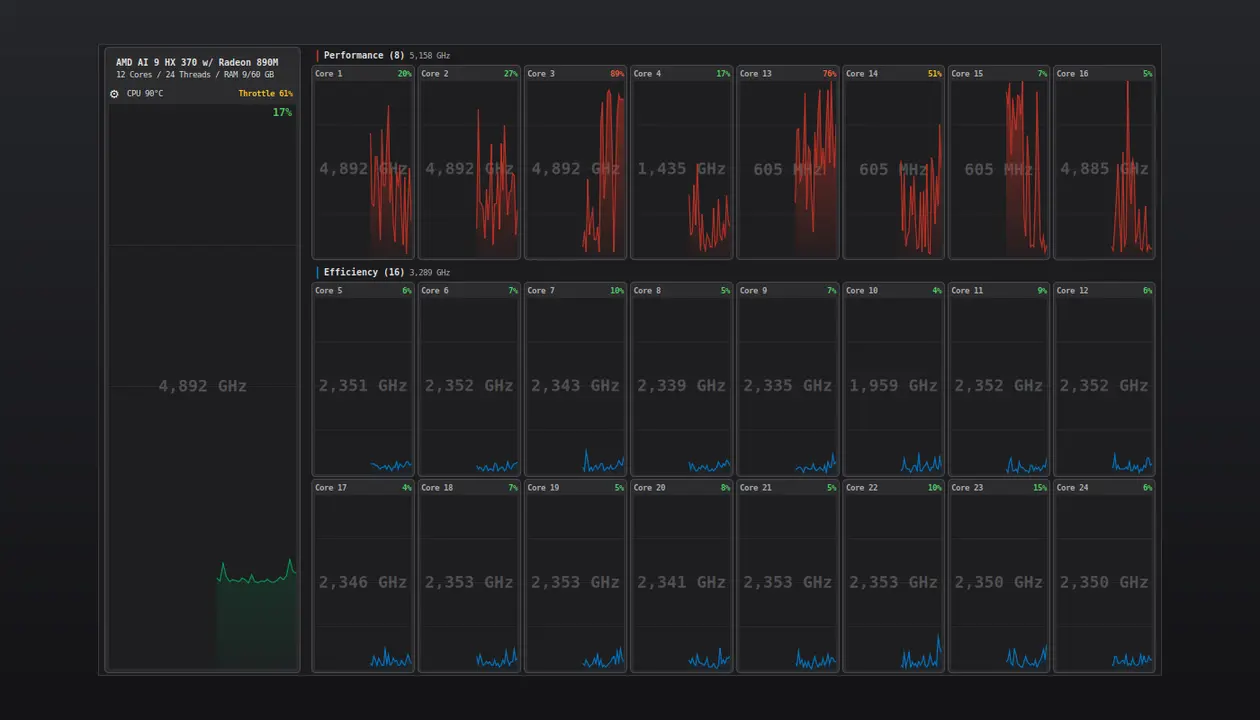
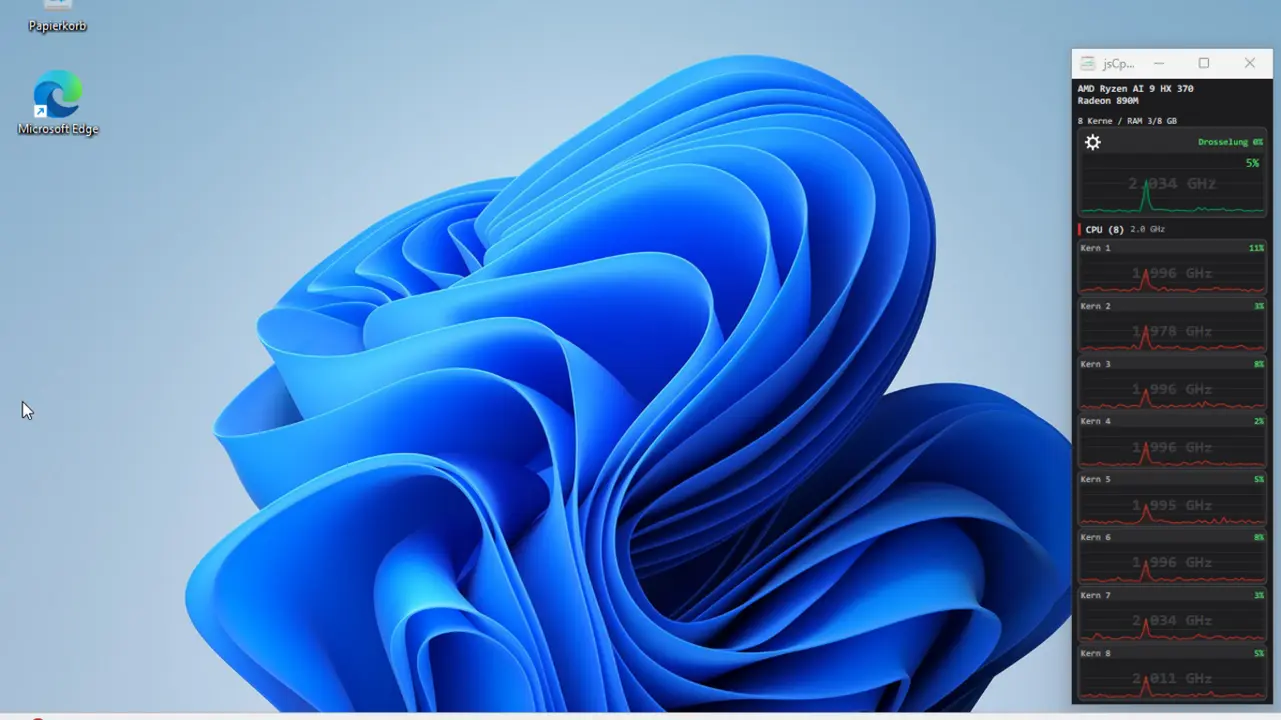
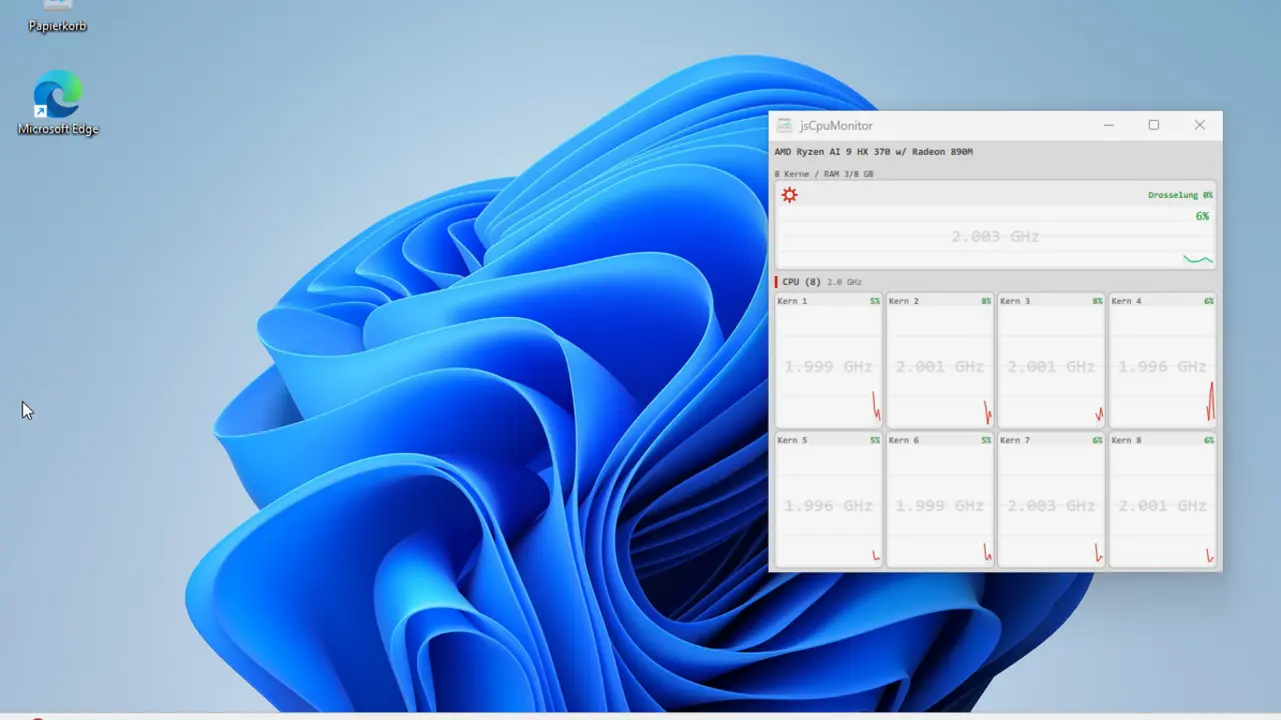
CPU monitor para sa Windows: isang manipis na window strip na may live history chart para sa bawat core, bilis ng clock, mga grupo ng performance/efficiency core, memorya at temperatura. Native na ginawa gamit ang Win32 at Direct2D.
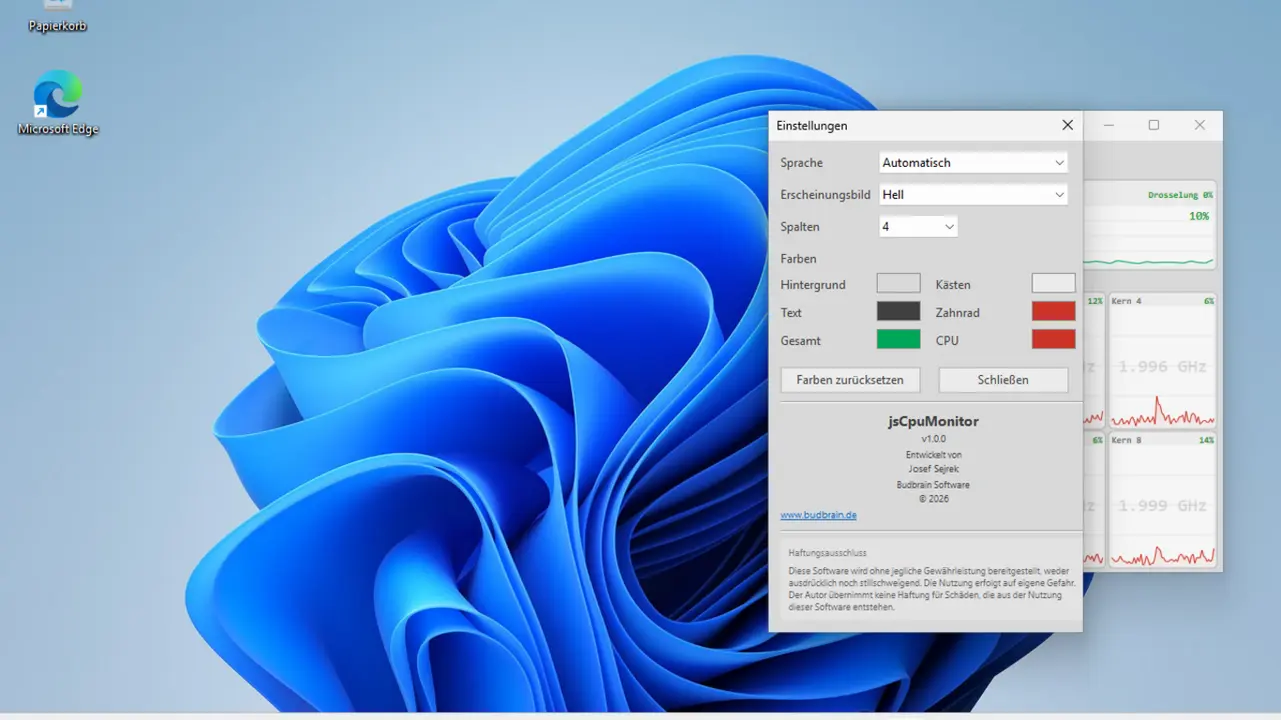
Per-Core ChartsBilis ng clockPagtukoy ng P/E coreTemperaturaRAMLaging nasa ibabawMaliwanag at madilimMga custom na kulay22 mga wika
Mga laro, audio tool, tool sa menu bar, panlinis ng cache at pagsusuri ng espasyo sa disk para sa macOS
Pag-install: Hindi sertipikado ng Apple ang mga app na ito (walang notarization). Magpapakita ang macOS ng babala sa unang pagbukas. Ganito ito mai-install pa rin:
I-download at i-unzip ang ZIP file
Buksan ang Terminal (Applications → Utilities → Terminal)
Pumunta sa na-unzip na folder: cd ~/Downloads/AppName
Patakbuhin ang install script: bash install.sh
Kinokopya ng script ang app sa /Applications, inaalis ang quarantine flag, at binubuksan ang app.
Walang install.sh? Kung walang script sa ZIP, ilipat nang mano-mano ang .app sa /Applications, saka sa Terminal: xattr -cr /Applications/AppName.app at i-double-click para buksan.
jsBudbrainLimiter
v1.0.0 · Mac App Store · macOS 14.2+
Isang limiter para sa lahat ng pinapatugtog ng iyong computer — mas malakas, nang hindi kailanman lumalampas, na may dalawang spectrum display na nagpapakita ng ginagawa nito.
Magkahiwalay na kontrol para sa kaliwa at kanang channelGain, ceiling, attack, release, knee, sidechain high-pass at mixNahuhuli ng true peak kahit ang pinakamaikling peakOutput fader na may level meter para sa dalawang channelDalawang spectrum display ang nagpapakita kung ano ang itinataas at ano ang nilimitahanKasaysayan ng gain reduction at mga pagbasa ng peakMga handa nang setting, at sarili moGumagana kasama ang jsBudbrainCompressor, jsBudbrainEqualizer at jsBudbrainsFxStudioMute button para kapag tumutunog ang teleponoPiliin ang iyong mga speaker o headphoneMaliit na window na laging nasa ibabawI-set up nang isang beses – hihingi ng pahintulot mo ang macOSMaliwanag at madilimApple Silicon44 mga wika
jsBudbrainCompressor
v1.0.1 · Mac App Store · macOS 14.2+
Init ng tube at isang studio compressor para sa lahat ng pinapatugtog ng iyong computer — na may kumikinang na tube at VU meter.
Simulated na tube preamp na may drive, bias at fatBass, mid, treble at presenceCompressor na may threshold, ratio, attack, release, knee, make-up at mixDalawang VU meter na may totoong galaw ng karayomMas maliwanag ang kinang ng mga tube habang mas nagtatrabaho silaMga handa nang setting para sa mga tube at compressor, at sarili moPinoprotektahan ng limiter ang tainga at mga speakerGumagana kasama ang jsBudbrainEqualizer at jsBudbrainsFxStudioMute button para kapag tumutunog ang teleponoPiliin ang iyong mga speaker o headphoneMaliit na window na laging nasa ibabawI-set up nang isang beses – hihingi ng pahintulot mo ang macOSMaliwanag at madilimApple Silicon44 mga wika
jsBudbrainsFxStudio
v1.0.1 · Mac App Store · macOS 14.2+
Mga live effect para sa lahat ng pinapatugtog ng iyong computer — reverb, echo, pitch at iba pa, hinahalo sa tunog gamit ang fader.
Walong effect: pitch, filter, drive, chorus, flanger, phaser, echo, reverbBawat effect ay may sariling knob at mix faderIsang fader ang naghahalo ng lahat ng effect sa pangunahing mixLive na waveform at level meterMga handa nang setting gaya ng concert hall o canyon echo, at sarili mo“All off” sa isang click — at ibalik sa susunodPinoprotektahan ng limiter ang tainga at mga speakerGumagana kasama ang jsBudbrainEqualizerMute button para kapag tumutunog ang teleponoPiliin ang iyong mga speaker o headphoneMaliit na window na laging nasa ibabawI-set up nang isang beses – hihingi ng pahintulot mo ang macOSMaliwanag at madilimApple Silicon44 mga wika
jsBudbrainEqualizer
v1.0.2 · Mac App Store · macOS 14.2+
Isang equalizer para sa lahat ng pinapatugtog ng iyong computer — na may live na spectrum.
Sampung slider, mula malalim na bass hanggang maliwanag na trebleLive na display ng pinapatugtog — kaliwa, kanan o parehoMga handa nang sound setting at sarili mo, nakasave sa isang pangalanMute button para kapag tumutunog ang teleponoPiliin ang iyong mga speaker o headphoneItiklop ang mga slider, ang display lang ang matiraMaliit na window na laging nasa ibabawNagsisimula pag-log in mo, kung gusto moI-set up nang isang beses – hihingi ng pahintulot mo ang macOSMaliwanag at madilimApple Silicon44 mga wika
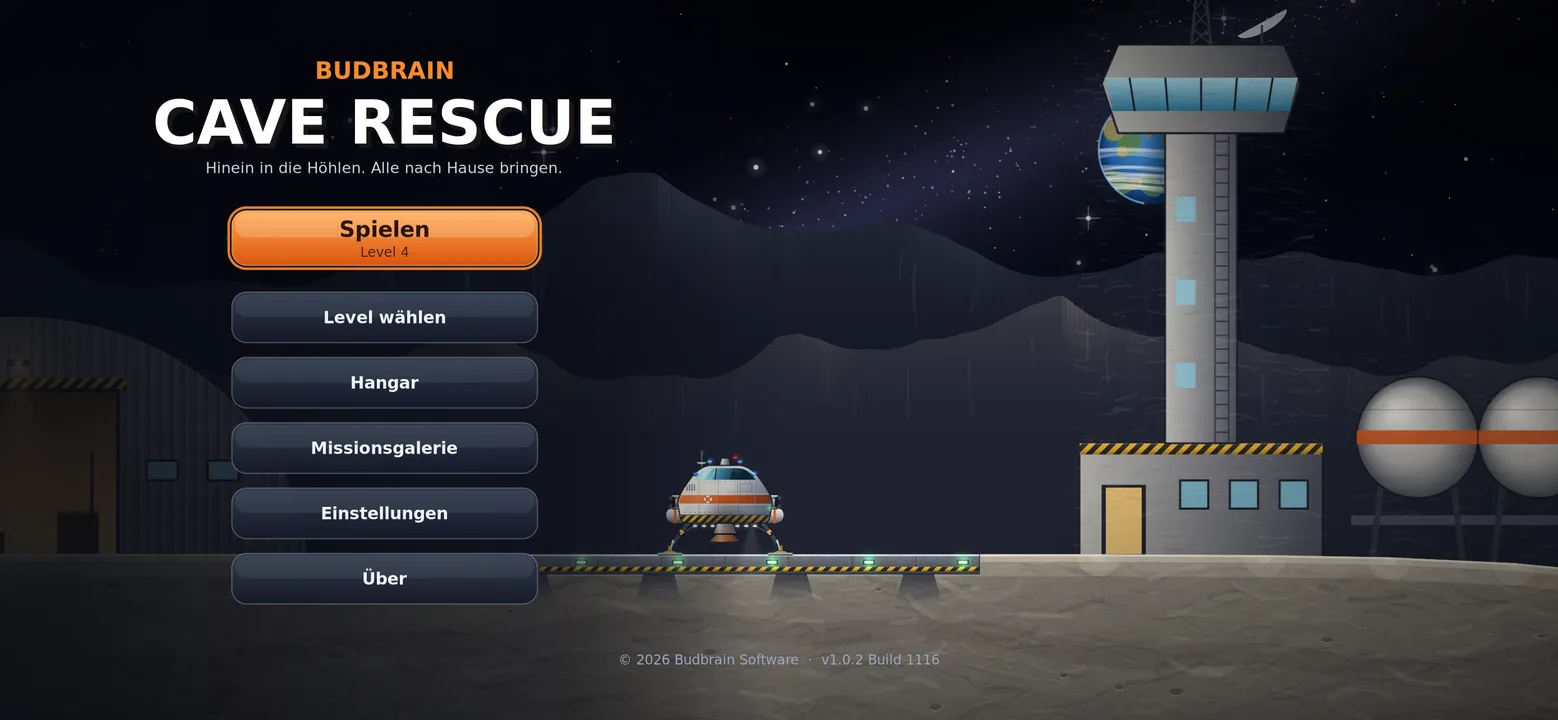
Budbrain Cave Rescue
v1.0.1 · Mac App Store · macOS 12+
Lumipad sa malalalim na kweba ng buwan at ibalik nang ligtas sa tahanan ang mga naipit na astronaut.
100 antas sa sampung mundoTotoong gravityApat na button, wala nang ibaI-upgrade ang iyong barko gamit ang karanasanApat na antas ng hirapGallery ng mga misyon na may mapa ng paglipadKeyboard, mouse o gamepadApple Silicon44 mga wika
jsCPUMonitor
v1.4 · Swift/SwiftUI · macOS
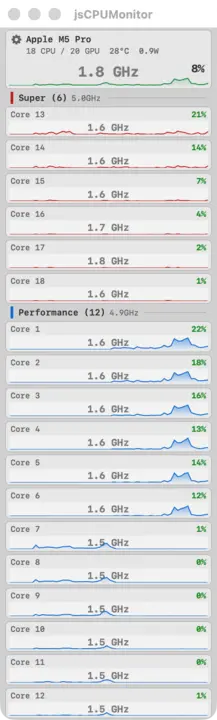
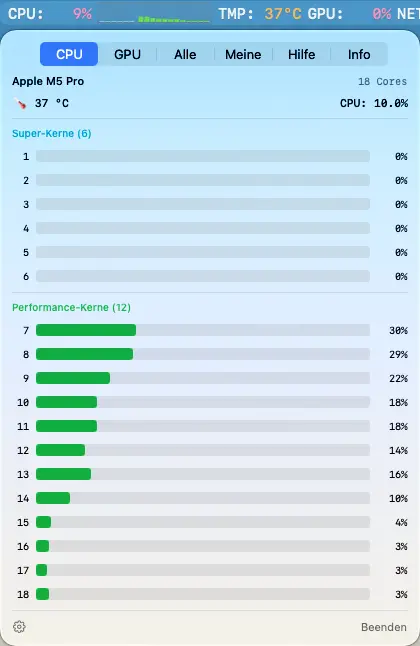
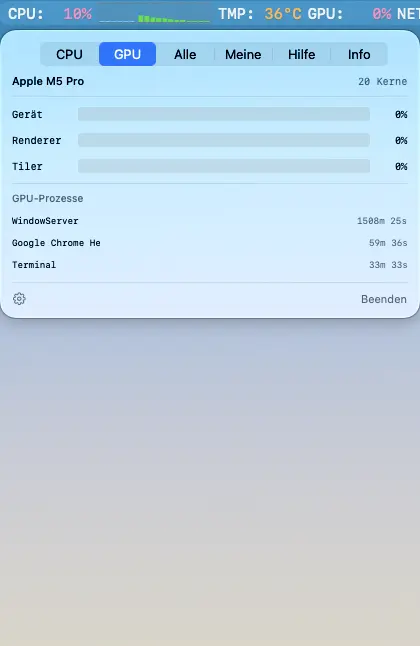
Real-time na pagsubaybay sa CPU para sa macOS. Lumulutang na window na may chart bawat core, temperatura, frequency at konsumo ng kuryente para sa Apple Silicon.
Per-Core ChartsSuper/Performance/EfficiencyTemperatur ZIP langCPU-Frequenz ZIP langPowerFloating WindowApple SiliconLaunch at Login
Hindi mababasa ng store app ang mga value na may markang „ZIP lang“: tumatakbo ito sa loob ng sandbox ng Apple. Magagawa ito ng direktang download. Kapalit nito, hindi ito notarised — sundin ang mga tagubilin sa itaas sa unang pagbukas.
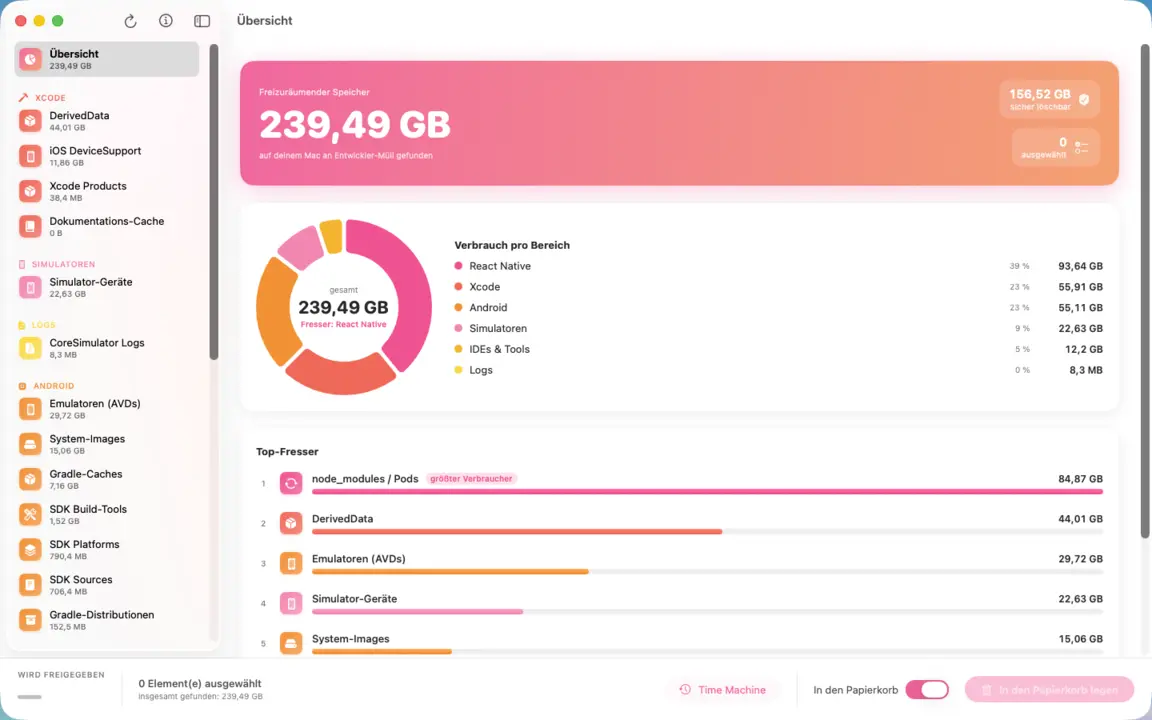
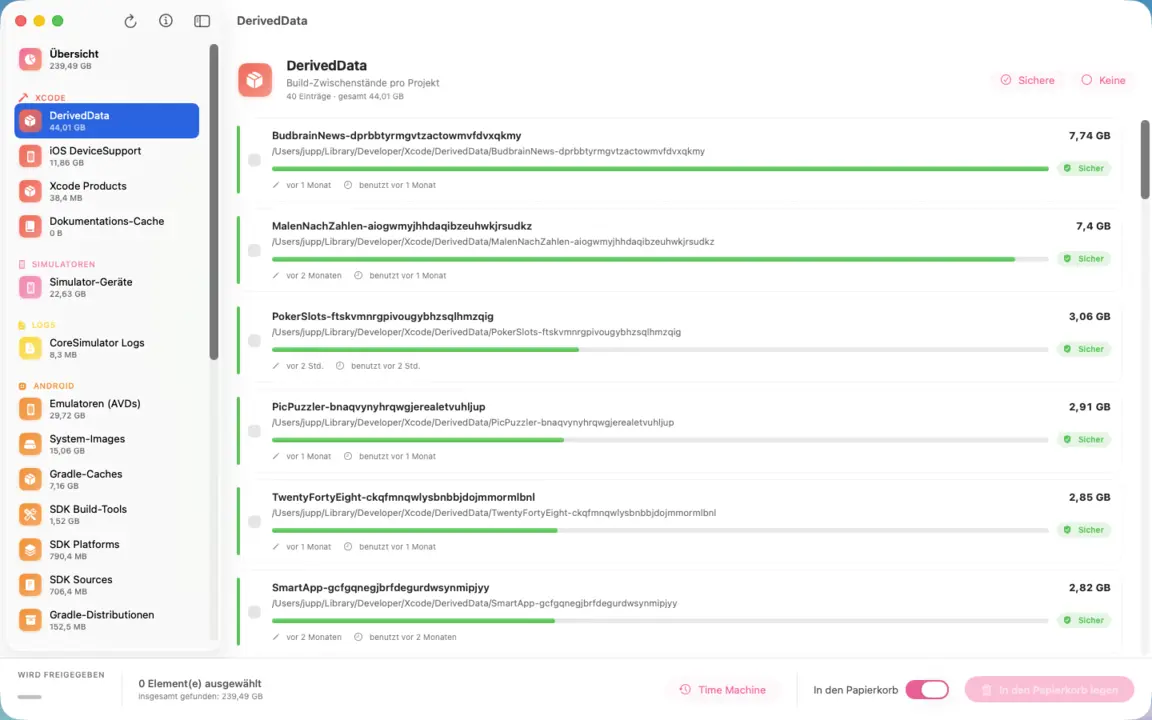
Nililinis ang kalat ng developer sa iyong Mac: mga Xcode archive, DerivedData at simulator, mga Android SDK, mga npm at Pods folder, cache ng editor. Ipinapakita ng pie chart sa isang sulyap kung aling bahagi ang pinakamalaki ang kinukuha; bawat entry ay may path, laki at huling gamit. Ang mga tinick mo lang ang aalisin — at lahat ay pupunta sa Trash.
Xcode & DerivedDataSimulatorenAndroid SDK & AVDsnpm, Yarn & PodsIDE-CachesRating ng panganibAng iyong mga sariling proyektoTrash langApple Silicon
Where Did My Storage Go?
v1.0 · Swift/SwiftUI · macOS 14+
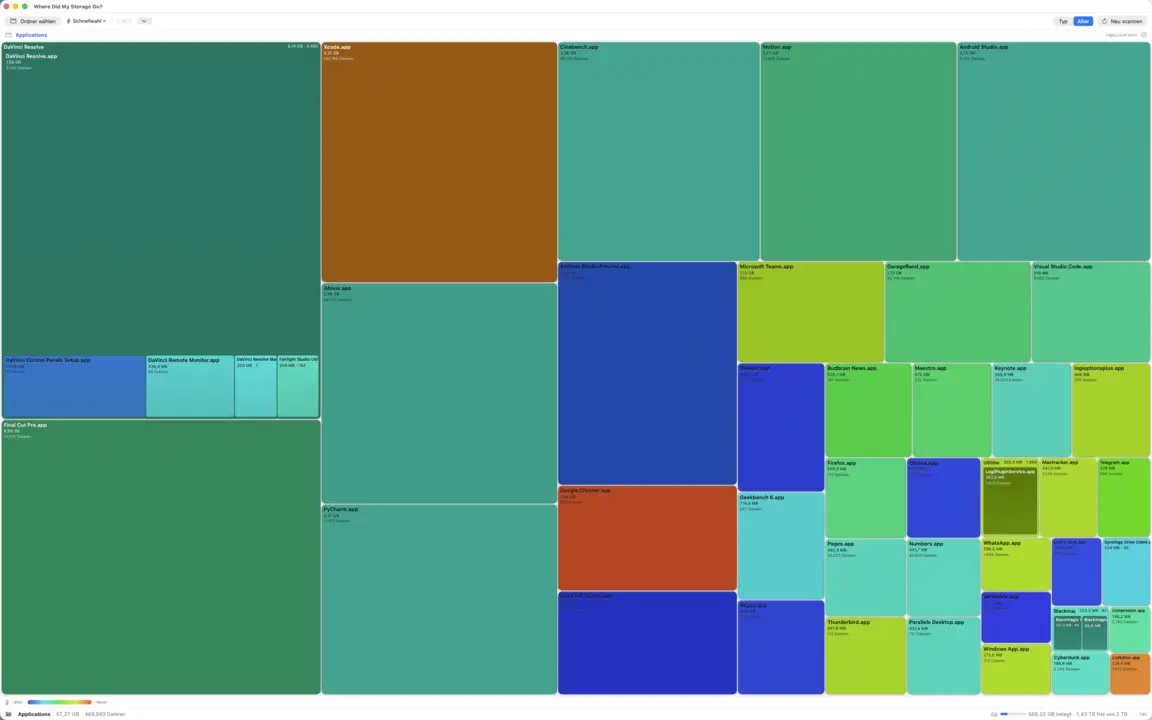
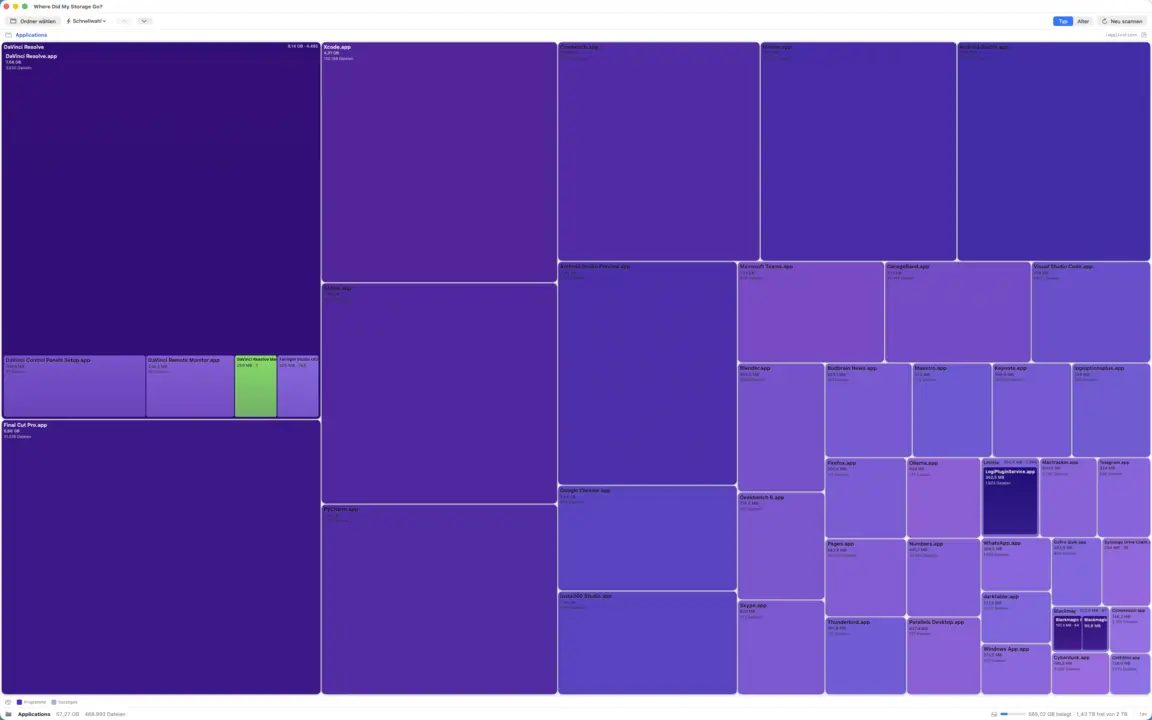
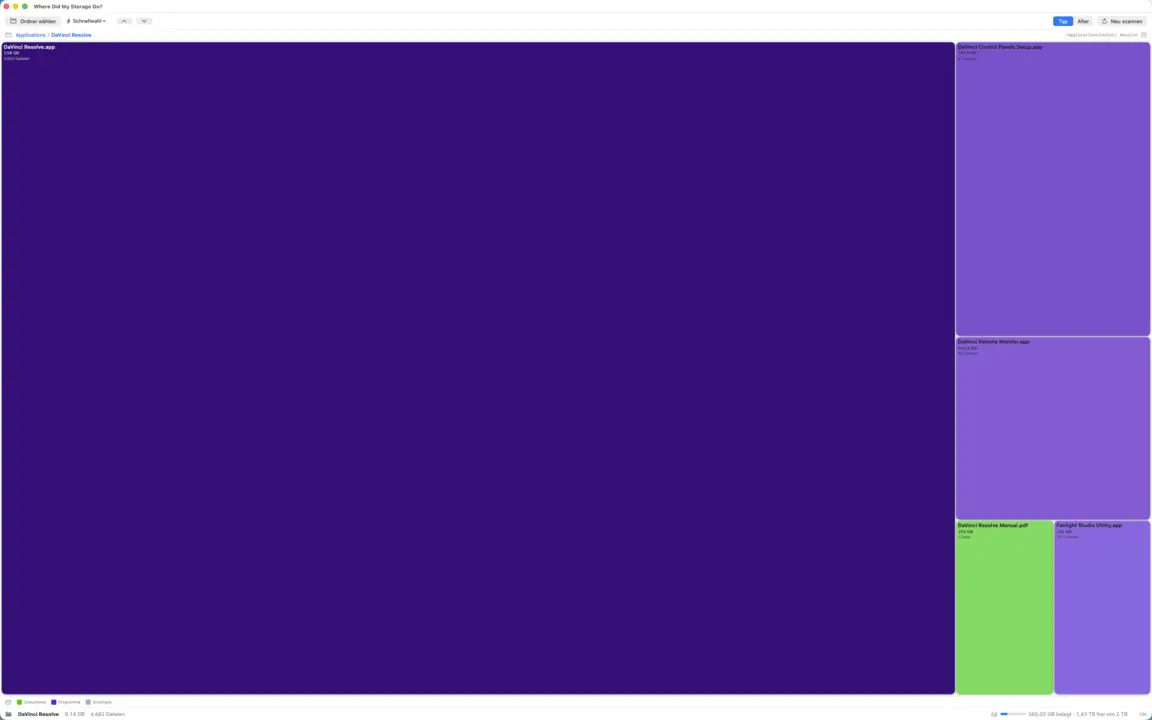
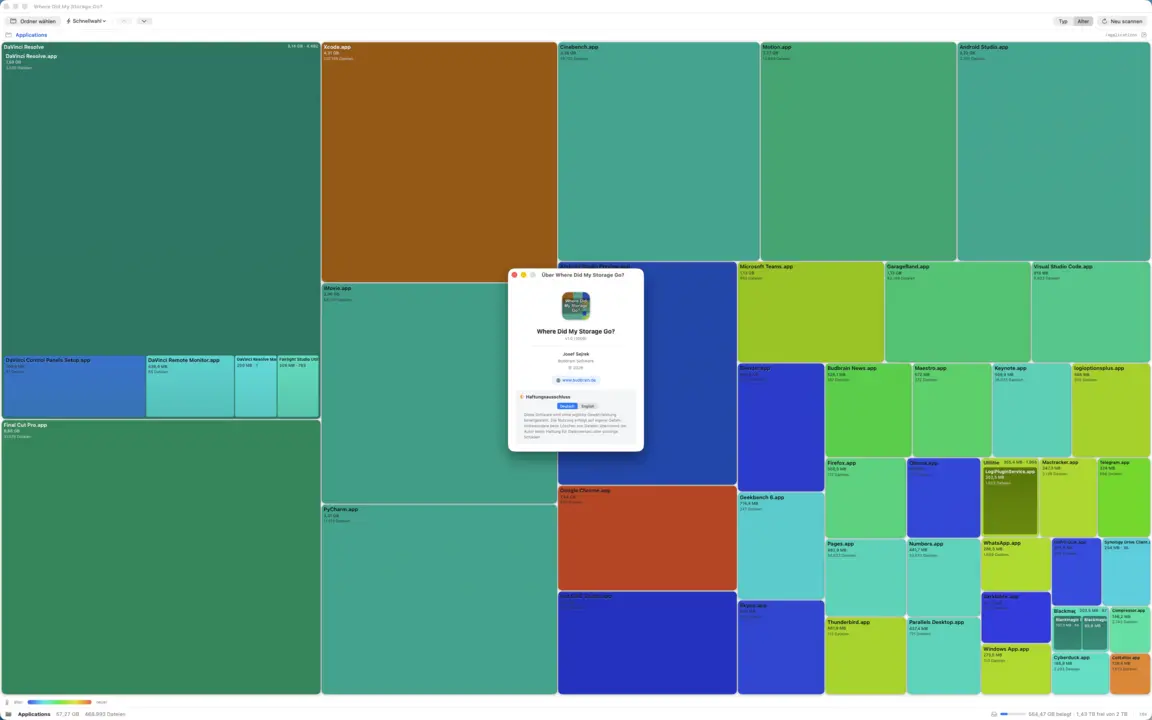
Ipinapakita kung saan napunta ang espasyo ng iyong disk bilang makulay na treemap: pumasok sa detalye, hanapin ang pinakamalalaking kumakain ng espasyo at ipadala ang kalat diretso sa Trash. Napakabilis na multi-core scan, heat map at junk radar. Gumagana nang offline.
TreemapHeat-MapDrill-downJunk-RadarMulti-Core-ScanReveal in FinderTrash langApp Sandbox
jsSysInfo
v1.2 · Swift/SwiftUI · macOS 14+
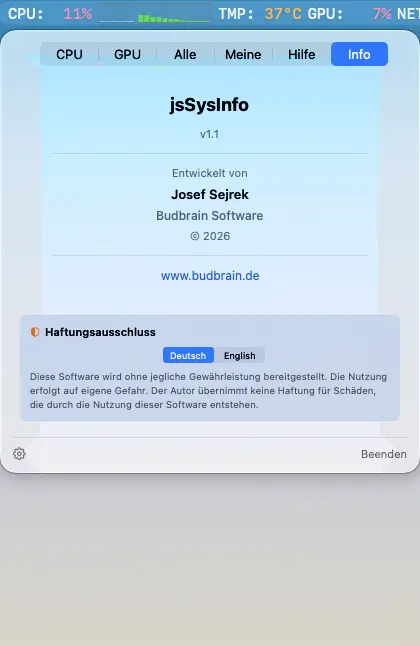
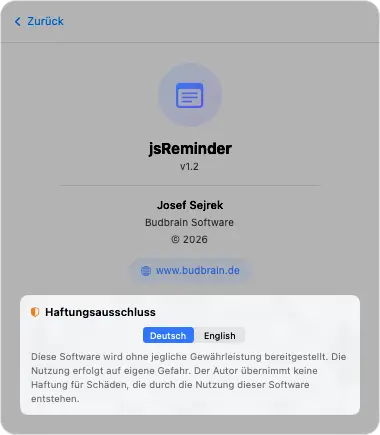
System monitor para sa menu bar ng macOS. Gamit ng CPU, GPU, temperatura, bilis ng network at CPU bar bawat core mismo sa menu bar. Available din para sa Linux (tingnan sa itaas).
CPU %CPU-BalkenGPU %TemperaturNetzwerkRAM & SwapProzesslisteApple SiliconUniversal BinaryDE / EN
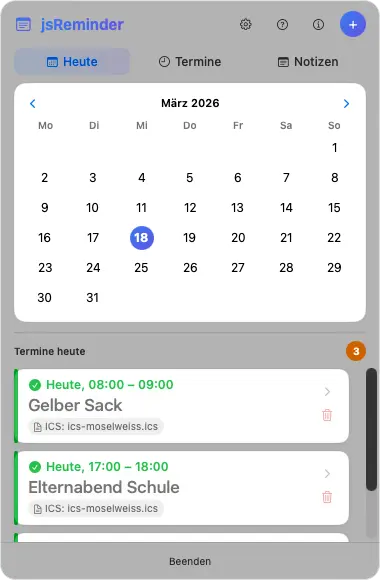
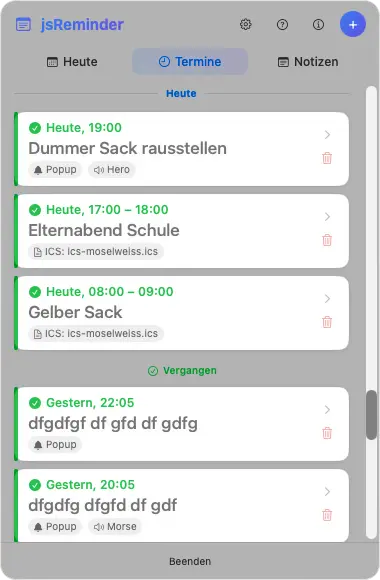
Notes at reminder app sa menu bar. Kalendaryo na may tanaw ng araw, appointment at notes, umuulit na event, pag-import ng kalendaryo (ICS), backup/export.
KalendaryoMga appointmentMga talaAlarm / SoundUmuulitICS ImportBackup/ExportAutostartDE / EN
jsMenueGroups
Swift/SwiftUI · macOS 14+
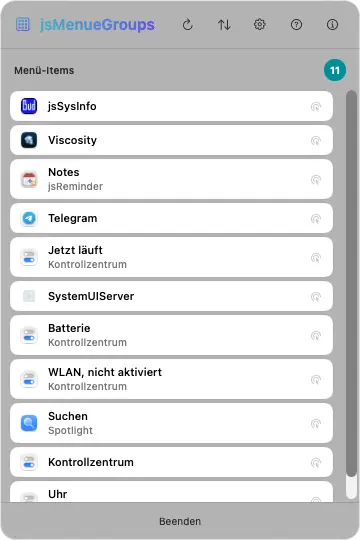
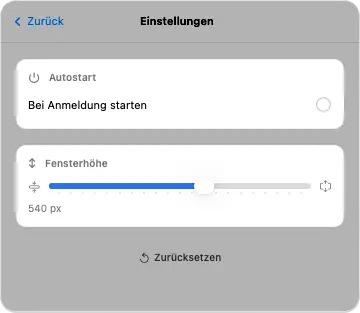
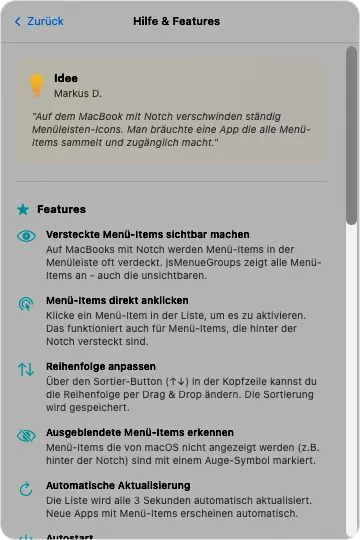
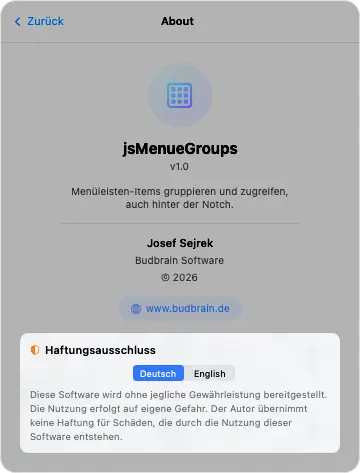
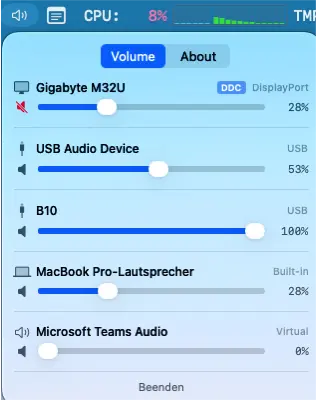
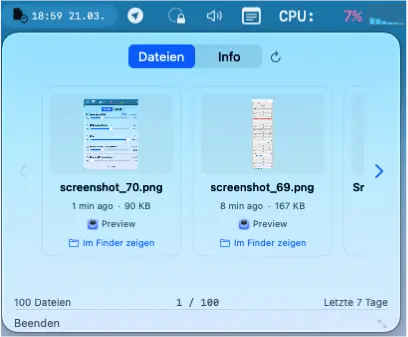
Organizer ng menu bar. Pinagsasama at ipinapakita ang mga item sa menu bar na nakatago sa likod ng notch ng MacBook. Direktang maaabot sa isang click.
Menu Bar ItemsNotch-WorkaroundPagpapasa ng clickPagtukoy ng icon
Mga libreng iOS game at app para sa iPhone at iPad
Budbrain Cave Rescue
v1.0.2 · iPhone & iPad · iOS 16+
Lumipad sa malalalim na kweba ng buwan at ibalik nang ligtas sa tahanan ang mga naipit na astronaut.
100 antas sa sampung mundoTotoong gravityApat na button, wala nang ibaI-upgrade ang iyong barko gamit ang karanasanApat na antas ng hirapGallery ng mga misyon na may mapa ng paglipad44 mga wika
Budbrain’s Klickeridu
Capacitor · iOS 13+
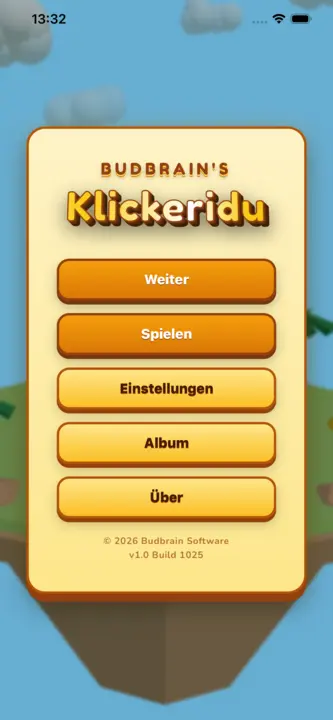
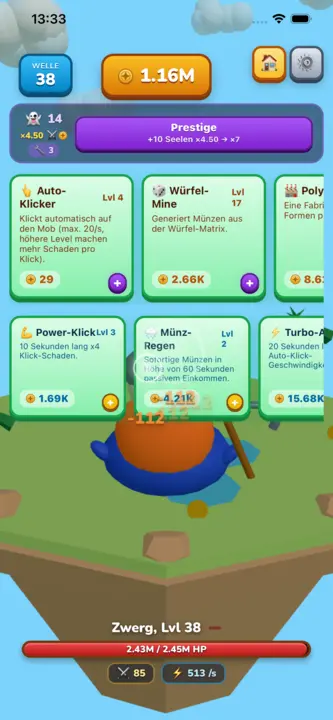
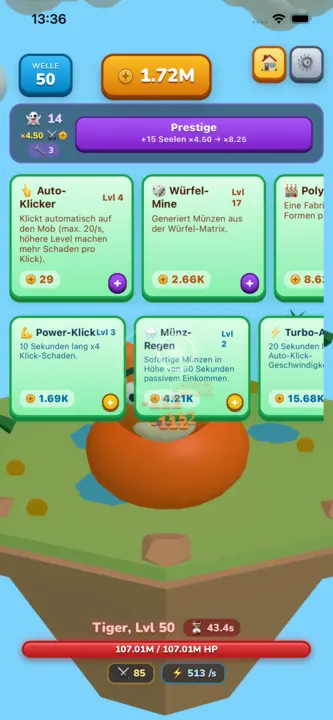
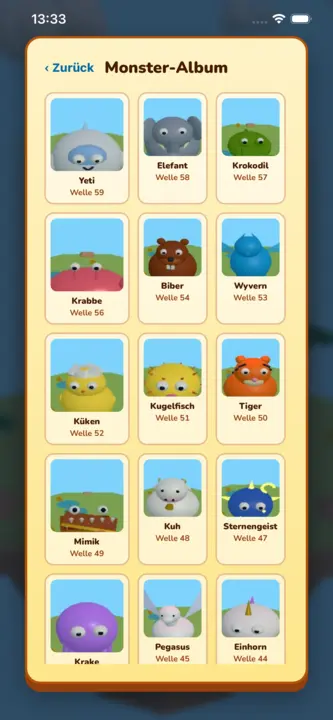
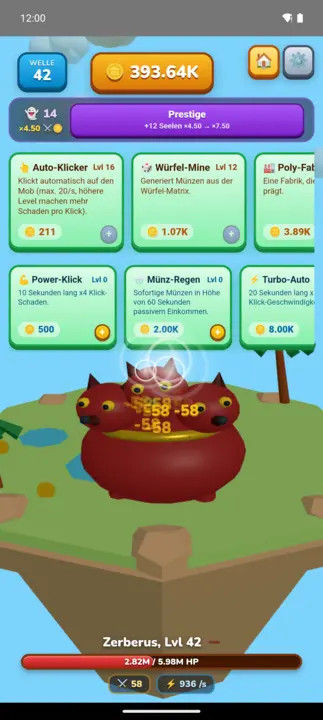
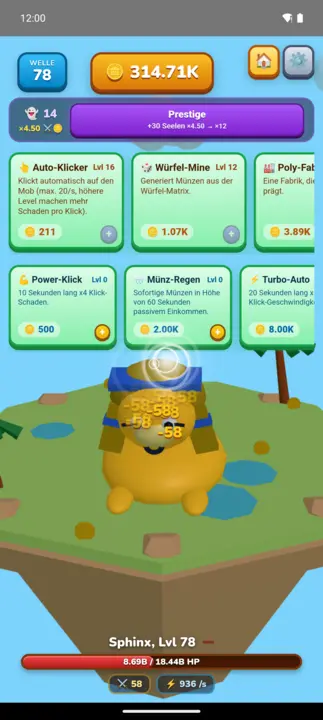
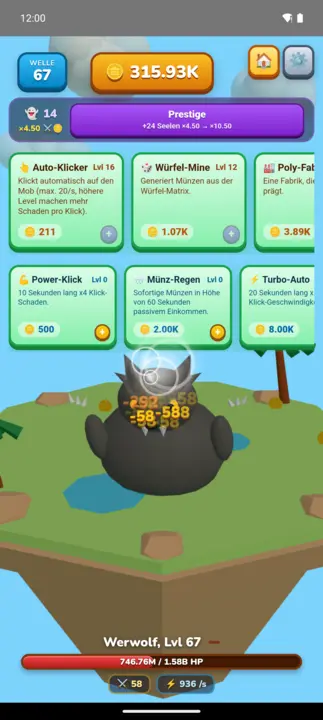
Isang cuddly na 3D idle clicker sa isang lumulutang na isla: i-tap ang karakter, kumita ng barya, bumili ng upgrade at labanan ang 100 gawang-kamay na halimaw, alon bawat alon. Bawat ikasampung alon ay may boss na may timer; ni-reset ng prestige ang lahat at ginagawang permanenteng mas malakas ang bawat takbo.
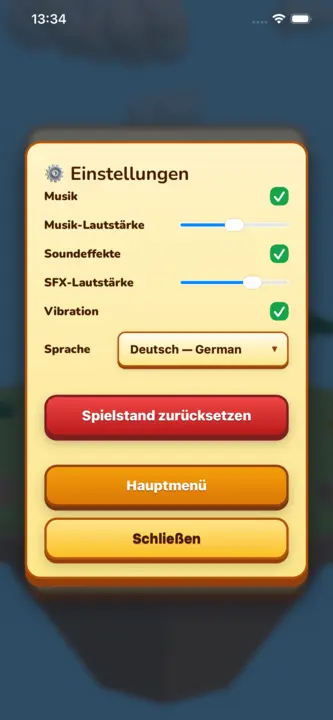
Idle-Clicker100 3D na halimaw10 upgrade · 3 skillPrestige at mga kaluluwaAlbum ng halimaw22 mga wikaGumagana nang offline
Budbrain’s Media Editor
React Native · iOS 15+
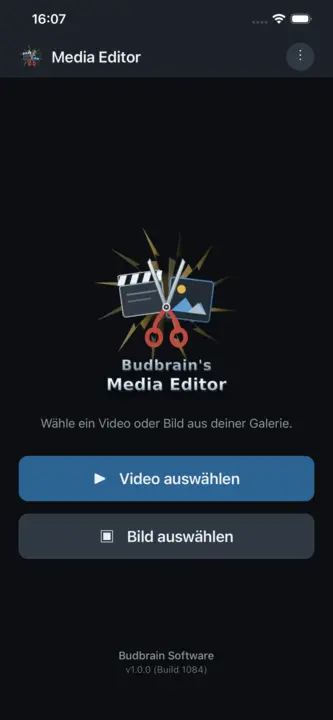
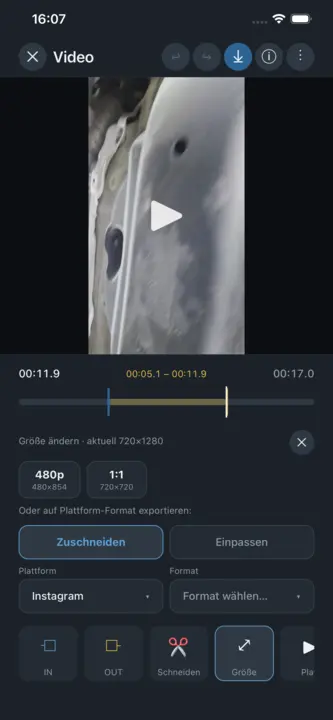
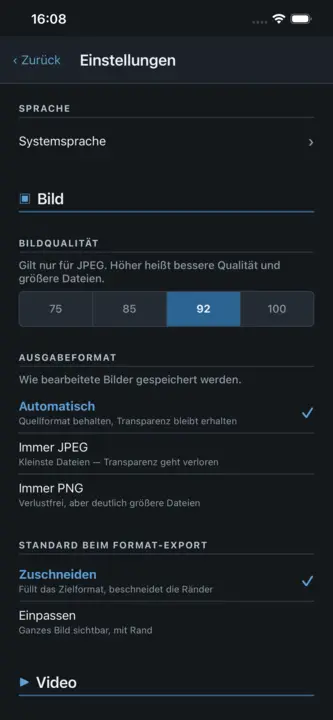
Ang Budbrain Media Editor ay nagpuputol ng iyong mga video at nag-e-edit ng iyong mga larawan — mismo sa iyong device. Bawat pag-edit ay sumusulat ng bagong file. Ang nasa gallery mo ay hindi kailanman binabago o pinapalitan.
I-trim ang videoI-edit ang mga larawanHindi ginagalaw ang orihinal4K · 1080p · 720pEXIF22 mga wikaGumagana nang offline
Budbrain’s Poker Slots
React Native · iOS 15+
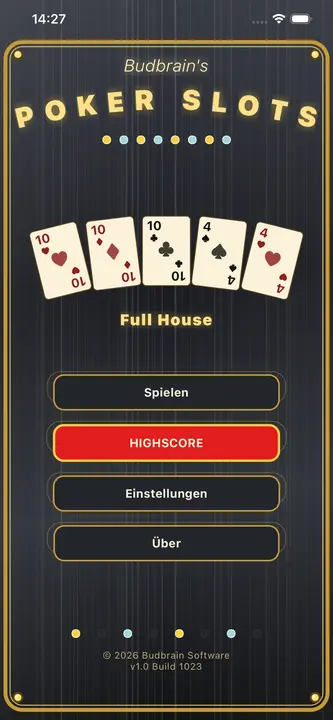
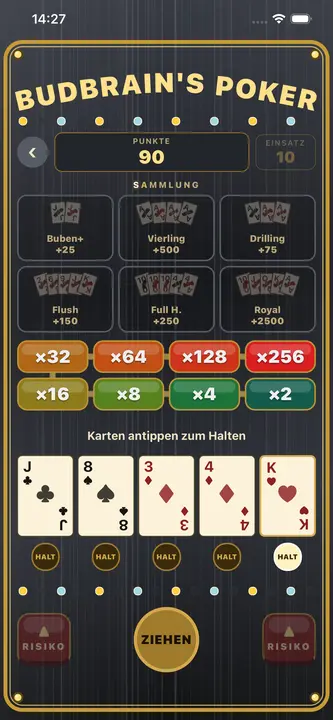
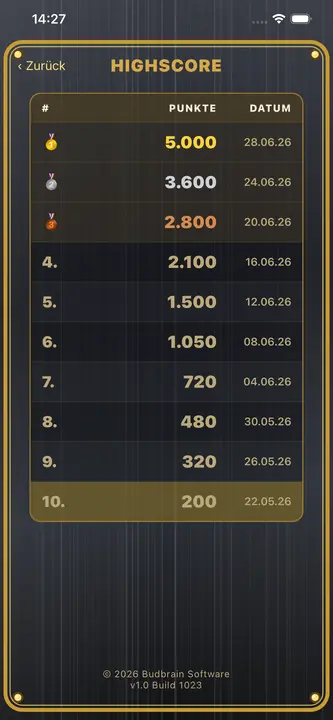
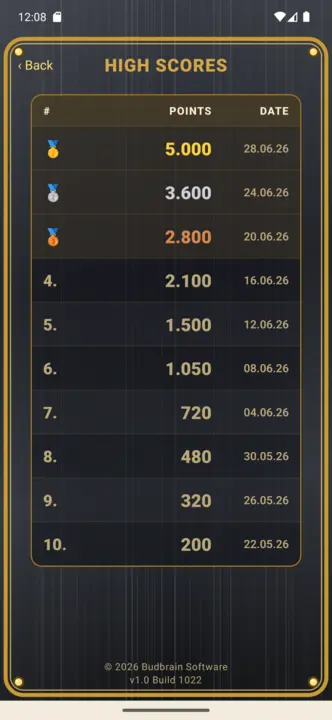
Ang Budbrain Poker Slots ay isang video-poker slot machine na kahawig ng mga klasikong arcade. Nilalaro lamang ito gamit ang virtual na fun coin: walang totoong pera, walang pagbili, walang payout. Paalala: Simulated na pagsusugal. Ang larong ito ay hindi nag-aalok ng pagsusugal gamit ang totoong pera o pagkakataong manalo ng totoong pera o premyo. Ang pagsasanay o tagumpay sa larong ito ay hindi nangangahulugan ng tagumpay sa hinaharap sa pagsusugal gamit ang totoong pera.
Video PokerHold at drawGamble ladderFun coin langSimulated na pagsusugal22 mga wikaGumagana nang offline
Budbrain’s Mahjong
React Native · iOS 15+
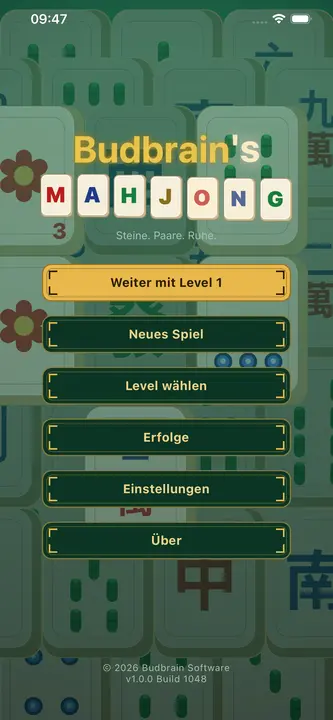
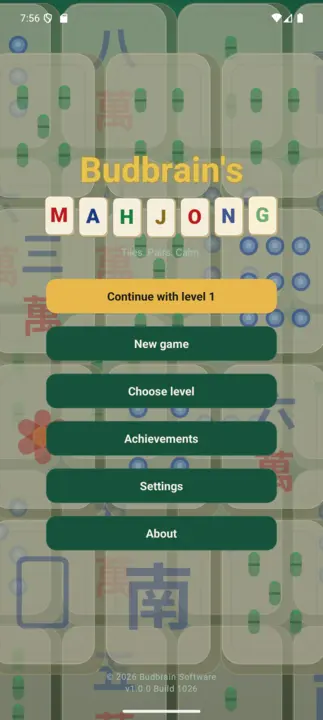
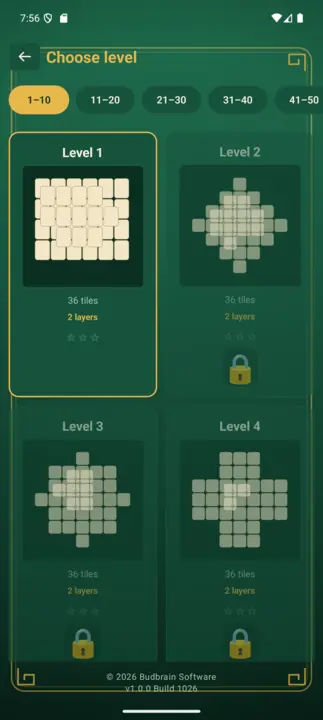
Isang maingat na ginawang Mahjong Solitaire na may mga hand-drawn na tile: 100 antas sa 10 yugto, mula sa banayad na simula na 36 tile hanggang sa buong set na 144 tile. I-tap ang dalawang magkaparehong libreng tile para alisin ang buong layout. Garantisadong masosolusyunan ang bawat deal, may shuffle function, 10 Chinese gaming-table na tema, 3-star na rating at gallery. 22 wika. Gumagana nang offline.
Mahjong Solitaire100 LevelsMga hand-drawn na tileGarantisadong may solusyon3-star na rating22 mga wikaGumagana nang offline
Astonischika
React Native · iOS 15+
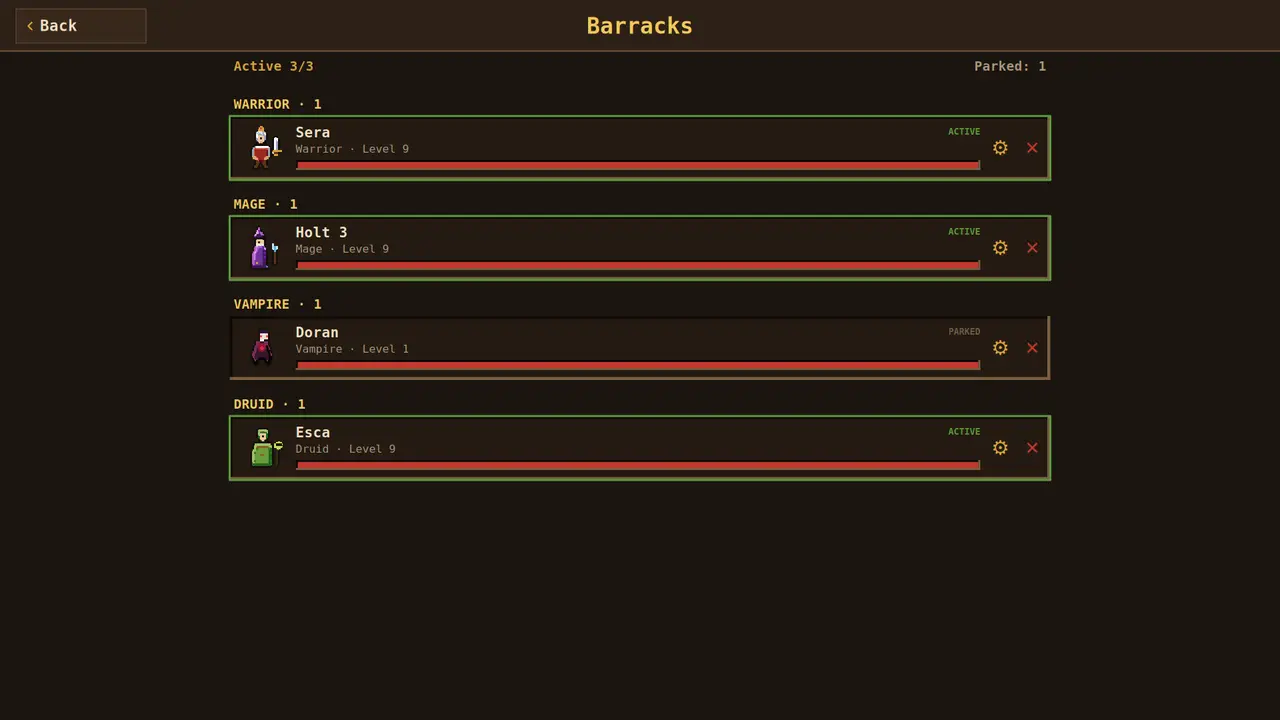
Isang hand-pixeled, turn-based na party RPG: bumuo ng party na may 3 mula sa 6 na uri ng bayani (Mandirigma, Salamangkero, Pari, Magnanakaw, Bampira, Druid) at umakyat sa sangang node map – lumaban sa mga halimaw, magpahinga sa campfire, looban ang mga kaban at bisitahin ang mga mangangalakal hanggang sa boss. Nag-level up ang mga bayani, gumagastos ng attribute point at nagsusuot ng nakuhang gamit sa anim na antas ng pambihira. Ang lungsod ay permanenteng hub na may mga mangangalakal at tavern; kapag bigo ang isang takbo, mananatili ang iyong mga bayani (roguelite). 22 wika. Gumagana nang offline.
Party-RPGPixel-ArtTurn-based3 sa 6 na bayaniLoot at gearCity hub22 mga wikaGumagana nang offline
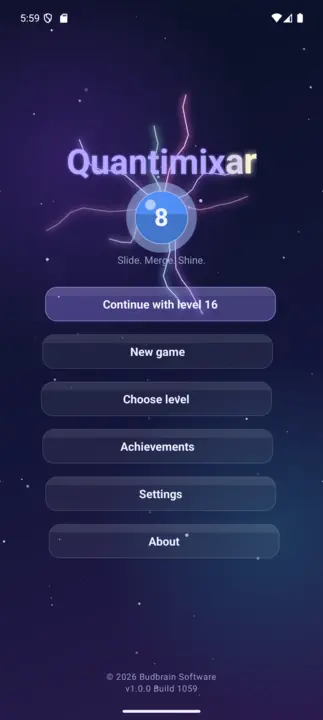
Quantimixar
React Native · iOS 15+
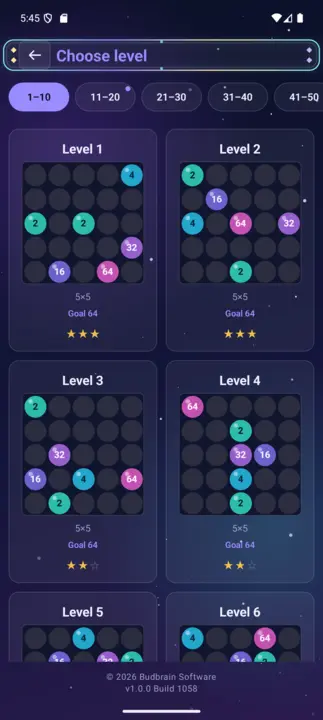
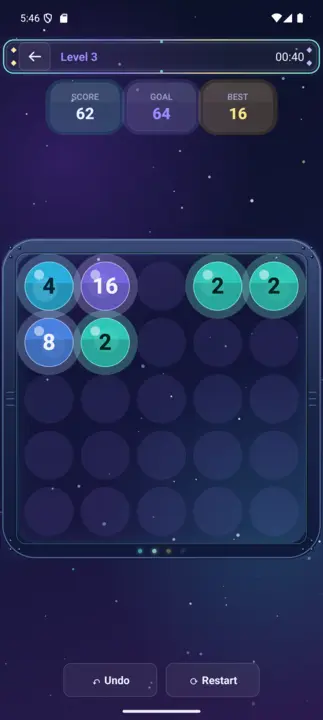
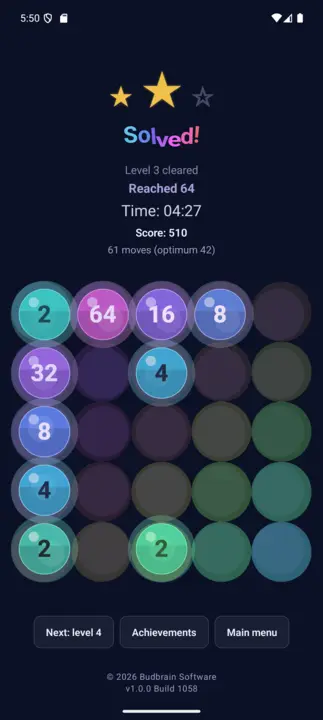
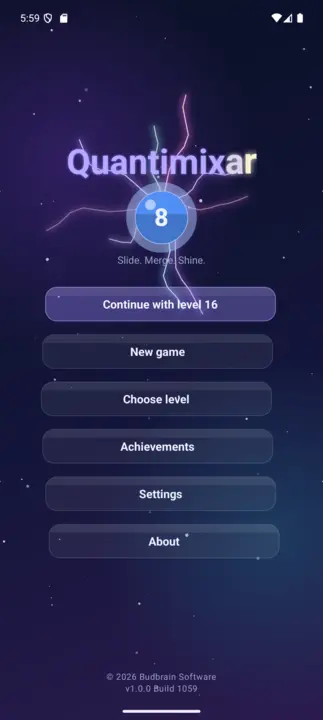
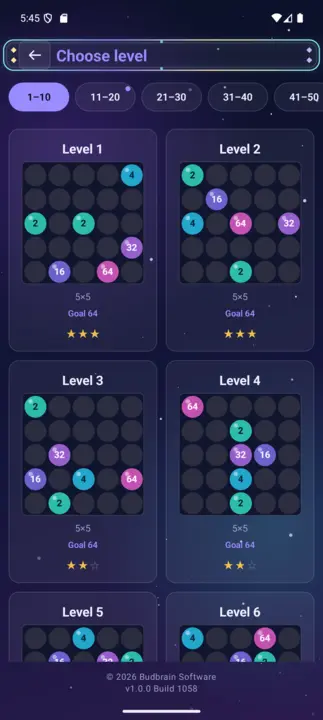
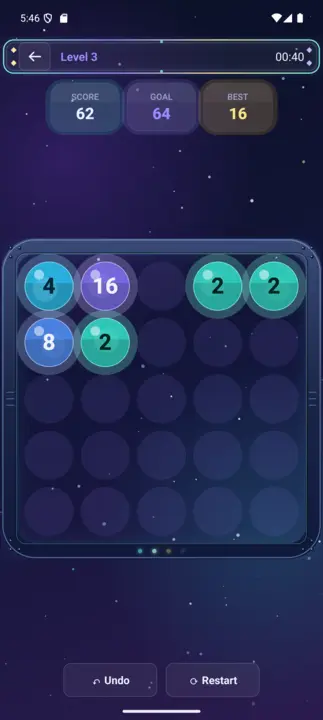
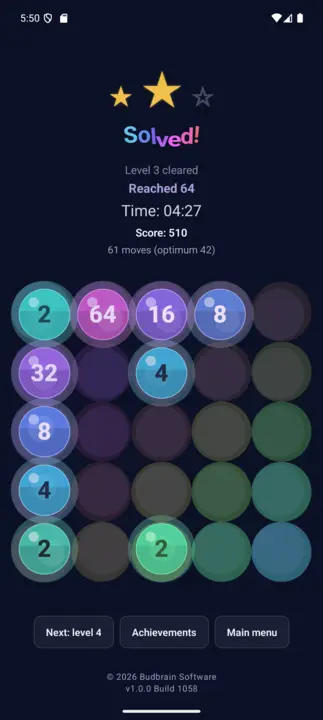
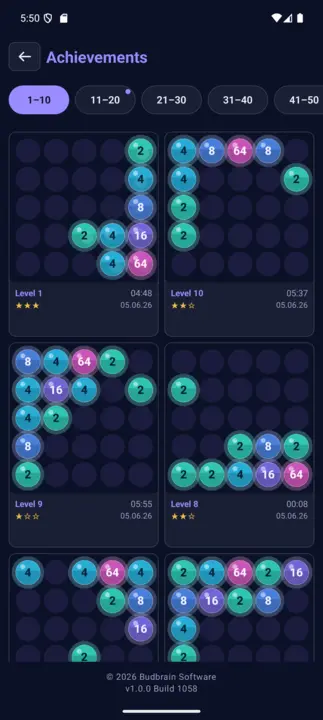
Number-merging na puzzle na may hitsurang deep space: i-swipe ang kumikinang na glass marble para pagsamahin at pagsanib ang magkaparehong halaga. Isang 100-antas na kampanya mula 64 hanggang 8192 sa 4×4, 5×5 at 6×6 na board, na may mga espesyal na cell (×2, ÷2, butas, bomba), 3-star na rating at gallery ng mga tagumpay. 22 wika. Gumagana nang offline.
Merge-Puzzle100 Levels4×4 – 6×6hanggang 8192Mga espesyal na cell at bomba3-star na rating22 mga wikaGumagana nang offline
Budbrain's Sudoku
React Native · iOS 15+
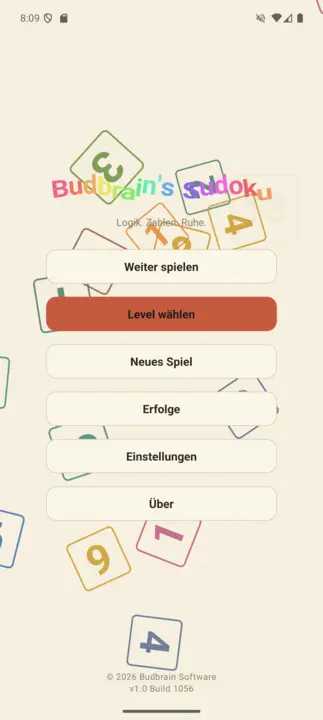
Isang maingat na ginawang Sudoku sa mainit na disenyo ng notebook: 100 antas sa 10 yugto, mula sa banayad na 4×4 hanggang sa mapanghamong 25×25 – kasama ang mga parihabang kahon. 3-star na rating bawat antas, gallery ng mga tagumpay, buong suporta sa VoiceOver at TalkBack. Gumagana nang offline.
100 Levels4×4 – 25×253-star na ratingMga tagumpayVoiceOver22 mga wikaGumagana nang offline
Budbrain's Puzzle
React Native · iOS 15+
Klasikong jigsaw puzzle na may mga orihinal na larawang personal na kinuha ni Josef Sejrek. 6 na antas ng hirap mula Madali (12 piraso) hanggang Grandmaster (300 piraso), totoong hugis ng jigsaw na may mga umbok at puwang, pinch-to-zoom at gallery ng mga tagumpay. Gumagana nang offline.
Jigsaw Puzzle6 antas ng hirap12–300 mga pirasoMga orihinal na larawanPinch-to-ZoomMga tagumpayGumagana nang offline
DuoDom
SwiftUI · iOS 17+
Isang relaks na sliding puzzle sa pixel-art retro style: i-slide ang mga bato sa mga bakanteng parisukat hanggang magtagpo ang dalawang magkapareho – mawawala ang mga ito nang magkapares. Garantisadong may solusyon ang bawat antas dahil sa built-in na solver. Mga highscore, tropeo, 20 wika, 60 FPS.
Pixel ArtSliding puzzleSinuri ng solverHighscoresMga tropeo20 mga wika60 FPSGumagana nang offline
jsKassenrechner
React Native · iOS 15+
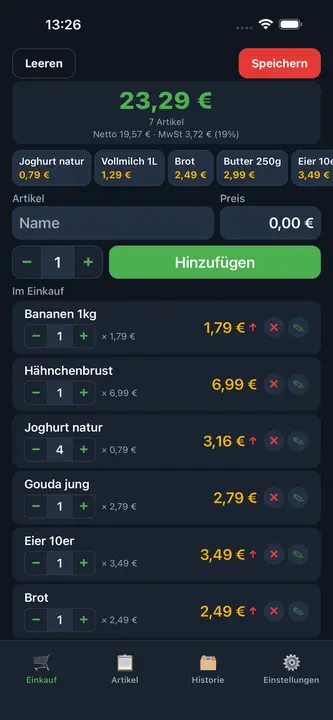
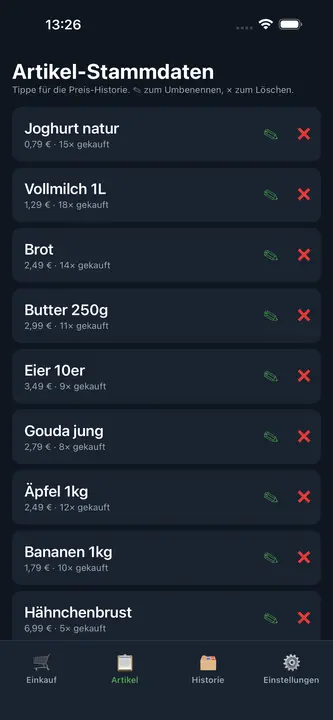
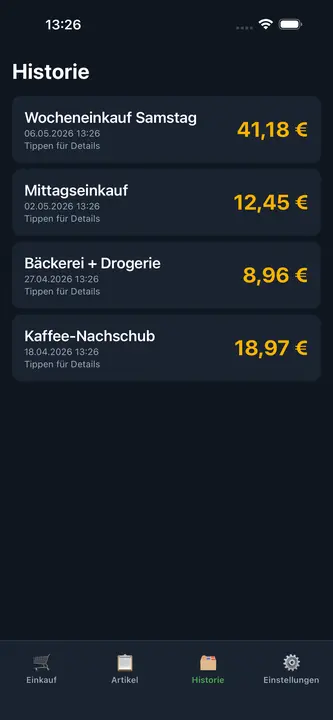
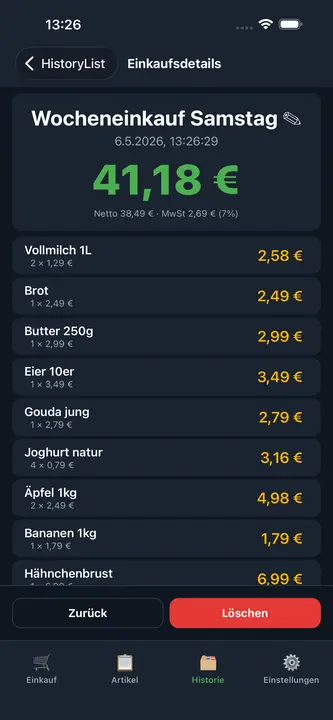
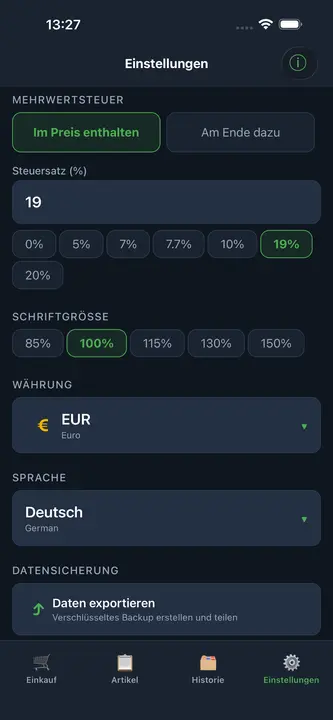
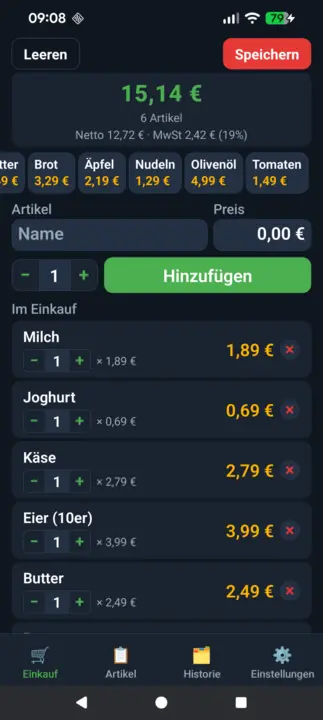
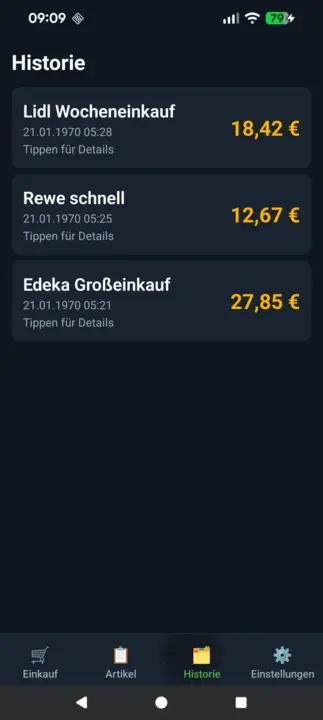
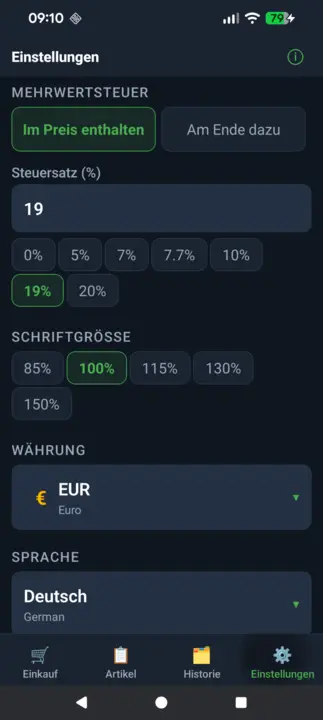
Mabilis na shopping calculator para sa iPhone at iPad: magdagdag ng mga item sa cart at tingnan ang live na kabuuan mismo sa tindahan. May flexible na kalkulasyon ng VAT, quick-add na mga item, kasaysayan ng presyo, kasaysayan ng pagbili at naka-encrypt na backup. Gumagana nang offline.
Live na kabuuanKalkulasyon ng VATQuick-AddKasaysayan ng presyoNaka-encrypt na backupMaraming currencyGumagana nang offline
Budbrain News
React Native · iOS 15+
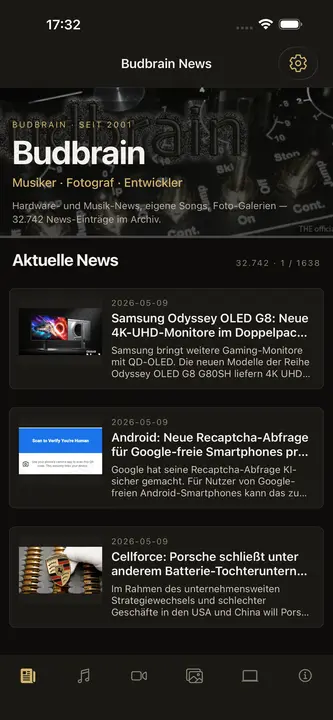
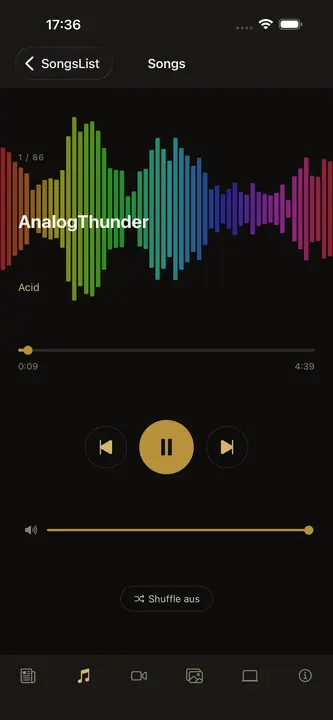
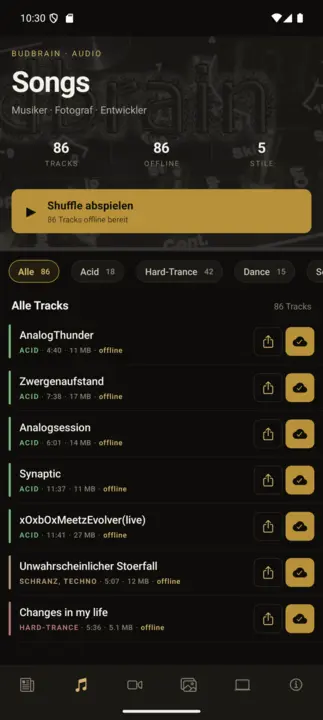
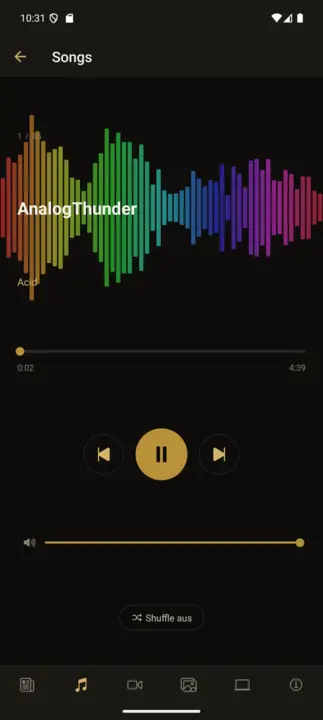
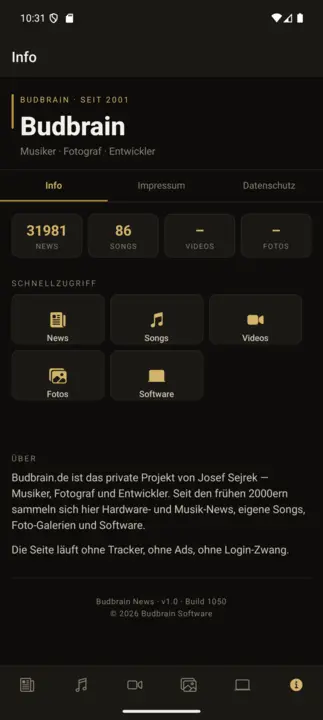
Ang opisyal na companion app ng budbrain.de – ang tahanan ng musika at mga proyekto ni Josef Sejrek mula pa noong 2001. 86 na orihinal na kanta na kasama at gumagana nang offline, isang song player na may real-time na oscilloscope, live na news feed, mga video sa YouTube at mga Flickr photo gallery. Interface sa 22 wika.
86 TracksOffline na playerOscilloscopeLive-NewsYouTubeMga Flickr gallery22 mga wikaShuffle
Budbrain's Marbles
React Native · iOS 15+
Isang cozy na puzzle sa pag-aayos ng mga marble: i-tap ang tubo para kunin ang marble sa ibabaw, i-tap ang isa pang tubo para ihulog ito – ayusin ang bawat tubo sa iisang kulay. 105 antas na na-verify ng BFS sa 5 beach world, 3-star na rating, gallery ng mga tagumpay, makintab na 3D na marble. 22 wika. Gumagana nang offline.
105 Levels5 beach world3-star na ratingMga tagumpay3D na marble22 mga wikaGumagana nang offline
Budbrain's Chess
React Native · iOS 15+
100 antas ng chess laban sa AI sa mainit na parchment theme – mula ELO 150 para sa mga baguhan hanggang ELO 1900 para sa mga manlalaro ng club. May mga hint, undo, gallery ng mga tagumpay at 22 wika. Gumagana nang offline.
100 LevelsELO 150 – 1900Hint & UndoMga tagumpayParchment theme22 mga wikaGumagana nang offline
Budbrain's Solitaire
React Native · iOS 15+
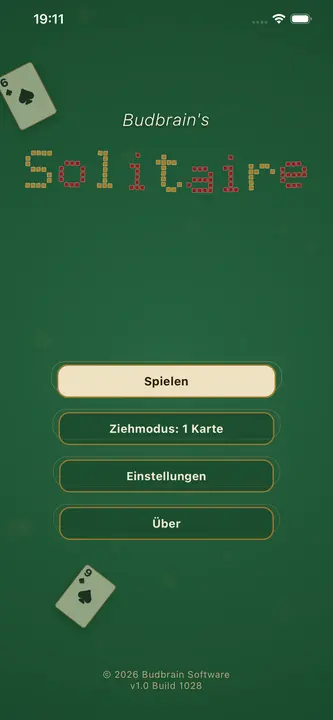
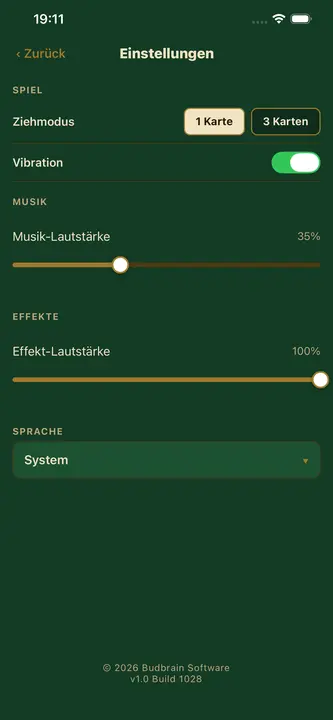
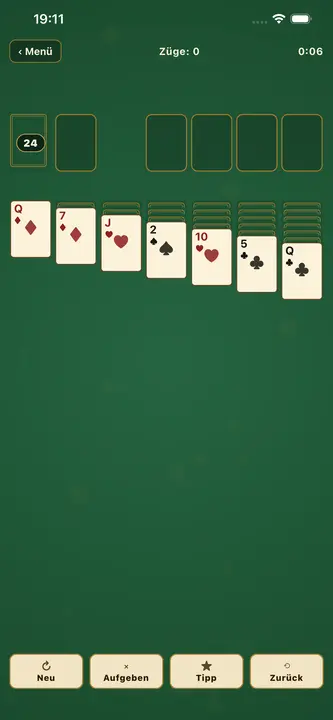
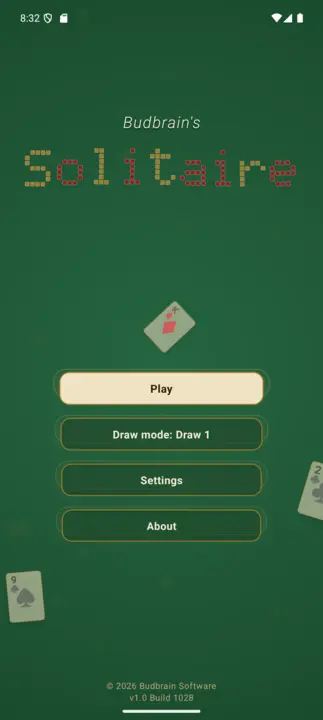
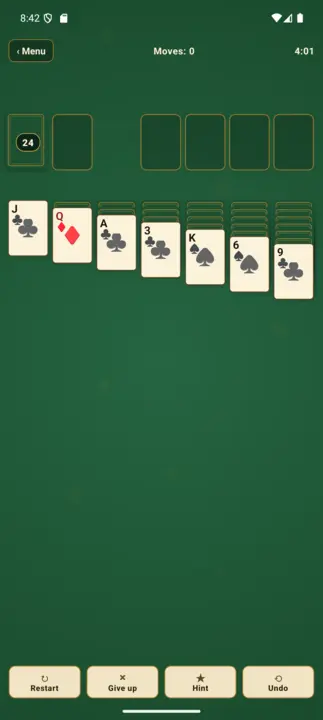
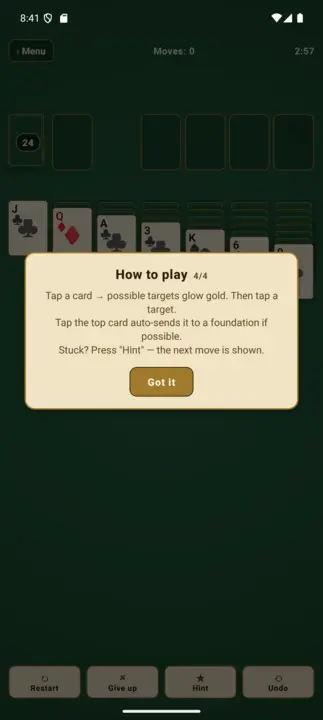
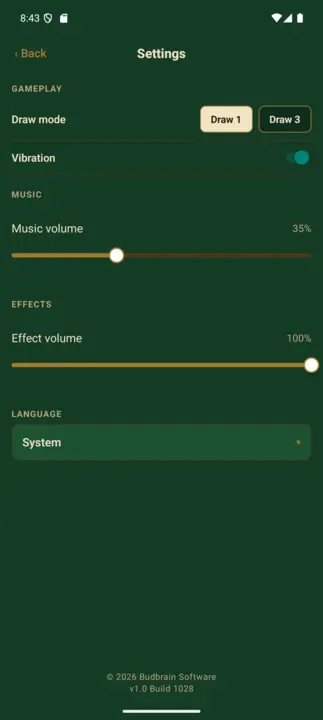
Klasikong Klondike solitaire sa mainit na berdeng parchment style – parang lumang card room na may felt na mesa. May Draw-1 at Draw-3 mode, tap-tap na kontrol (gintong highlight ng target), hint button, undo, auto-finish at coach overlay para sa mga baguhan. 22 wika, buong suporta sa VoiceOver. Gumagana nang offline.
KlondikeDraw 1 at Draw 3Tap-tap na kontrolHint & UndoAuto-finishVoiceOver22 mga wikaGumagana nang offline
BlobPop
React Native · iOS 15+
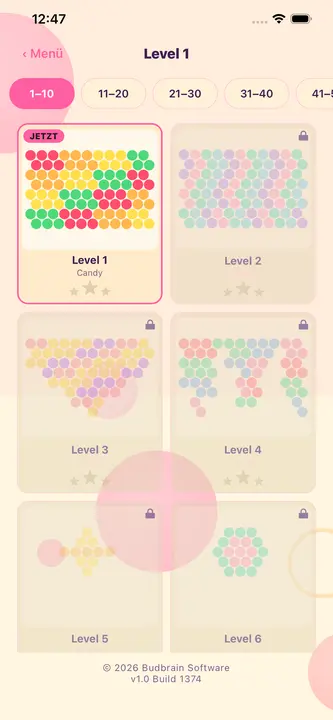
Arcade na bubble shooter: tumutok, bumaril, pumutok. Pagtugmain ang tatlong bula na magkapareho ang kulay para pasabugin ang mga grupo at magsimula ng cascade. 100 antas sa 5 makukulay na mundo na may 3-star na iskor, kasama ang endless arcade mode. 22 wika. Gumagana nang offline.
Bubble Shooter100 Levels5 makukulay na mundoEndless arcade mode3-star na rating22 mga wikaGumagana nang offline
Mga libreng Android game at app
Budbrain’s Klickeridu
Capacitor · Android 5.1+
Isang cuddly na 3D idle clicker sa isang lumulutang na isla: i-tap ang karakter, kumita ng barya, bumili ng upgrade at labanan ang 100 gawang-kamay na halimaw, alon bawat alon. Bawat ikasampung alon ay may boss na may timer; ni-reset ng prestige ang lahat at ginagawang permanenteng mas malakas ang bawat takbo.
Idle-Clicker100 3D na halimaw10 upgrade · 3 skillPrestige at mga kaluluwaAlbum ng halimaw22 mga wikaGumagana nang offline
Budbrain’s Sudoku
React Native · Android 7+
Isang maingat na ginawang Sudoku sa mainit na disenyo ng notebook: 100 antas sa 10 yugto, mula sa banayad na 4×4 hanggang sa mapanghamong 25×25 – kasama ang mga parihabang kahon. 3-star na rating bawat antas, gallery ng mga tagumpay, buong suporta sa VoiceOver at TalkBack. Gumagana nang offline.
100 Levels4×4 – 25×253-star na ratingMga tagumpayTalkBack22 mga wikaGumagana nang offline
Budbrain’s Marbles
React Native · Android 7+
Isang cozy na puzzle sa pag-aayos ng mga marble: i-tap ang tubo para kunin ang marble sa ibabaw, i-tap ang isa pang tubo para ihulog ito – ayusin ang bawat tubo sa iisang kulay. 105 antas na na-verify ng BFS sa 5 beach world, 3-star na rating, gallery ng mga tagumpay, makintab na 3D na marble. 22 wika. Gumagana nang offline.
105 Levels5 beach world3-star na ratingMga tagumpay3D na marble22 mga wikaGumagana nang offline
FarmIsFun
Kotlin · Android 7+
Isang pixel-art na farming game: nagsisimula ka sa wala, pumuputol ng puno, bumabasag ng bato at gumagawa ng kagamitan, sandata at gusali mula sa iyong naipon. Bungkalin ang mga bukid, mag-alaga ng manok at baka, ipagtanggol ang sarili laban sa lobo at oso, magbenta sa mangangalakal, tumanggap ng mga quest at magpahinga sa tatlong arcade machine – sa lahat ng apat na panahon.
Pixel-ArtMangolekta at gumawaMagtayo at magsakaLumaban at makipagkalakalanMga quest at minigameOpsyonal na cloud saveApp sa German lang
Budbrain’s Nonogram’s
React Native · Android 7+
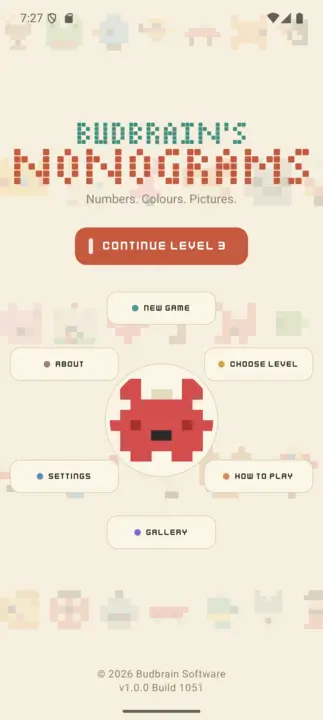
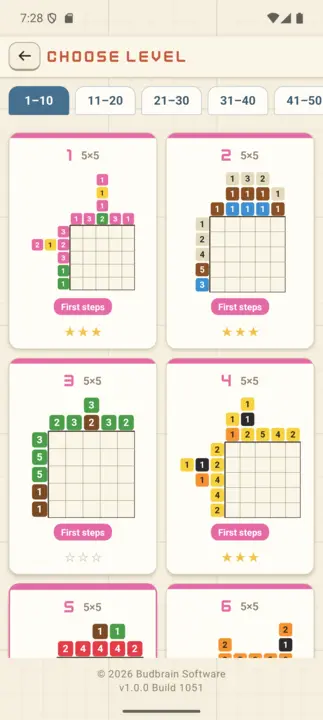
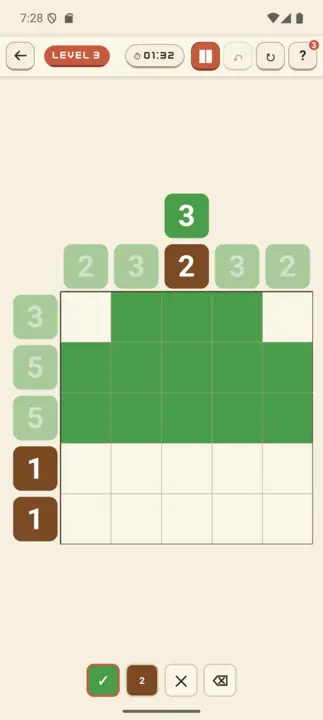
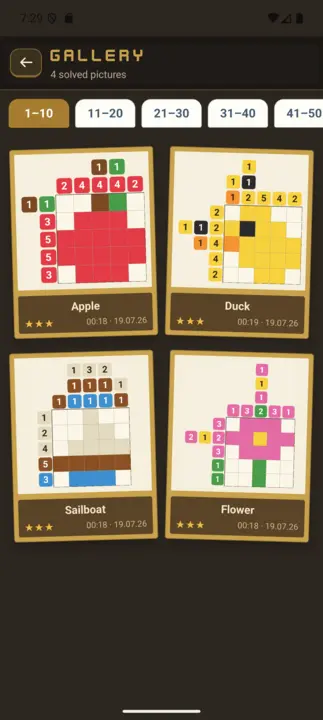
Ang Budbrain's Nonogram's ay isang maingat na ginawang nonogram game na may 100 antas ng larawan — mula sa maliliit na 5×5 na motif para sa mga baguhan hanggang sa malalaking 20×20 na larawan para sa mga eksperto. Kulayan ang nakatagong larawan gamit ang mga may kulay na numero sa gilid. Ang mga bloke na magkapareho ang kulay ay nangangailangan ng puwang sa pagitan, ang mga bloke na magkaiba ang kulay ay maaaring magkadikit.
100 antas sa 10 yugtoMulticolour na picross3-star na ratingGallery22 mga wikaGumagana nang offline
Budbrain’s Poker Slots
React Native · Android 7+
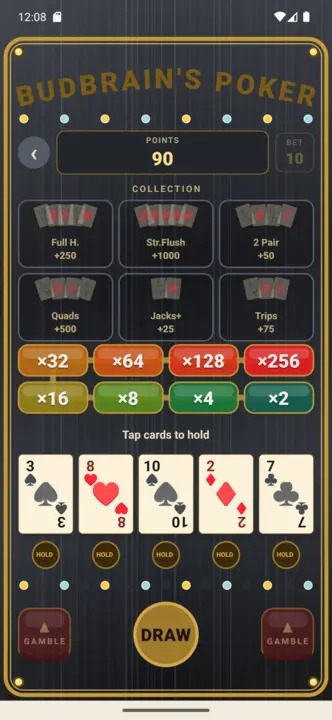
Ang Budbrain Poker Slots ay isang video-poker slot machine na kahawig ng mga klasikong arcade. Nilalaro lamang ito gamit ang virtual na fun coin: walang totoong pera, walang pagbili, walang payout. Paalala: Simulated na pagsusugal. Ang larong ito ay hindi nag-aalok ng pagsusugal gamit ang totoong pera o pagkakataong manalo ng totoong pera o premyo. Ang pagsasanay o tagumpay sa larong ito ay hindi nangangahulugan ng tagumpay sa hinaharap sa pagsusugal gamit ang totoong pera.
Video PokerHold at drawGamble ladderFun coin langSimulated na pagsusugal22 mga wikaGumagana nang offline
Budbrain’s Media Editor
React Native · Android 7+
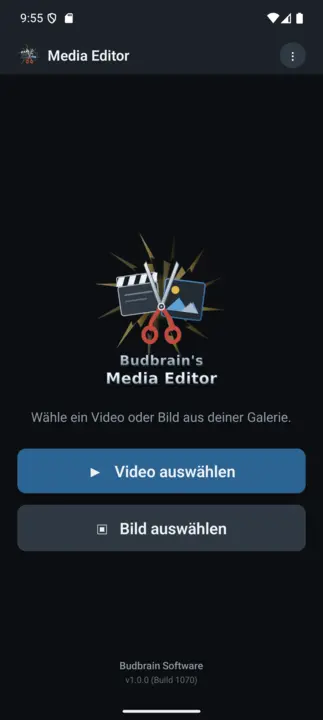
Ang Budbrain Media Editor ay nagpuputol ng iyong mga video at nag-e-edit ng iyong mga larawan — mismo sa iyong device. Bawat pag-edit ay sumusulat ng bagong file. Ang nasa gallery mo ay hindi kailanman binabago o pinapalitan.
I-trim ang videoI-edit ang mga larawanHindi ginagalaw ang orihinal4K · 1080p · 720pEXIF22 mga wikaGumagana nang offline
Budbrain’s Mahjong
React Native · Android 7+
Isang maingat na ginawang Mahjong Solitaire na may mga hand-drawn na tile: 100 antas sa 10 yugto, mula sa banayad na simula na 36 tile hanggang sa buong set na 144 tile. I-tap ang dalawang magkaparehong libreng tile para alisin ang buong layout. Garantisadong masosolusyunan ang bawat deal, may shuffle function, 10 Chinese gaming-table na tema, 3-star na rating at gallery. 22 wika. Gumagana nang offline.
Mahjong Solitaire100 LevelsMga hand-drawn na tileGarantisadong may solusyon3-star na rating22 mga wikaGumagana nang offline
Budbrain's Solitaire
React Native · Android 7+
Klasikong Klondike solitaire sa mainit na berdeng parchment style – parang lumang card room na may felt na mesa. May Draw-1 at Draw-3 mode, tap-tap na kontrol (gintong highlight ng target), hint button, undo, auto-finish at coach overlay para sa mga baguhan. 22 wika, buong suporta sa VoiceOver. Gumagana nang offline.
KlondikeDraw 1 at Draw 3Tap-tap na kontrolHint & UndoAuto-finish22 mga wikaGumagana nang offline
Astonischika
React Native · Android 7+
Isang hand-pixeled, turn-based na party RPG: bumuo ng party na may 3 mula sa 6 na uri ng bayani (Mandirigma, Salamangkero, Pari, Magnanakaw, Bampira, Druid) at umakyat sa sangang node map – lumaban sa mga halimaw, magpahinga sa campfire, looban ang mga kaban at bisitahin ang mga mangangalakal hanggang sa boss. Nag-level up ang mga bayani, gumagastos ng attribute point at nagsusuot ng nakuhang gamit sa anim na antas ng pambihira. Ang lungsod ay permanenteng hub na may mga mangangalakal at tavern; kapag bigo ang isang takbo, mananatili ang iyong mga bayani (roguelite). 22 wika. Gumagana nang offline.
Party-RPGPixel-ArtTurn-based3 sa 6 na bayaniLoot at gearCity hub22 mga wikaGumagana nang offline
Quantimixar
React Native · Android 7+
Number-merging na puzzle na may hitsurang deep space: i-swipe ang kumikinang na glass marble para pagsamahin at pagsanib ang magkaparehong halaga. Isang 100-antas na kampanya mula 64 hanggang 8192 sa 4×4, 5×5 at 6×6 na board, na may mga espesyal na cell (×2, ÷2, butas, bomba), 3-star na rating at gallery ng mga tagumpay. 22 wika. Gumagana nang offline.
Merge-Puzzle100 Levels4×4 – 6×6hanggang 8192Mga espesyal na cell at bomba3-star na rating22 mga wikaGumagana nang offline
BlobPop
React Native · Android 7+
Arcade na bubble shooter: tumutok, bumaril, pumutok. Pagtugmain ang tatlong bula na magkapareho ang kulay para pasabugin ang mga grupo at magsimula ng cascade. 100 antas sa 5 makukulay na mundo na may 3-star na iskor, kasama ang endless arcade mode. 22 wika. Gumagana nang offline.
Bubble Shooter100 Levels5 makukulay na mundoEndless arcade mode3-star na rating22 mga wikaGumagana nang offline
Budbrain's Chess
React Native · Android 7+
100 antas ng chess laban sa AI sa mainit na parchment theme – mula ELO 150 para sa mga baguhan hanggang ELO 1900 para sa mga manlalaro ng club. May mga hint, undo, gallery ng mga tagumpay at 22 wika. Gumagana nang offline.
100 LevelsELO 150 – 1900Hint & UndoMga tagumpayParchment theme22 mga wikaGumagana nang offline
Budbrain News
React Native · Android 7+
Ang opisyal na companion app ng budbrain.de – ang tahanan ng musika at mga proyekto ni Josef Sejrek mula pa noong 2001. 86 na orihinal na kanta na kasama at gumagana nang offline, isang song player na may real-time na oscilloscope, live na news feed, mga video sa YouTube at mga Flickr photo gallery. Interface sa 22 wika.
86 TracksOffline na playerOscilloscopeLive-NewsYouTubeMga Flickr gallery22 mga wikaShuffle
Dino Warrior
Kotlin · Android 7+
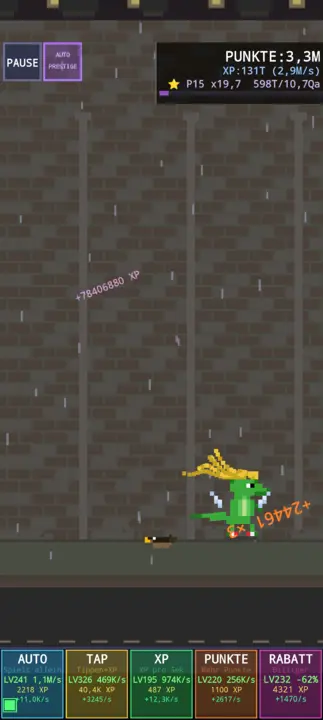
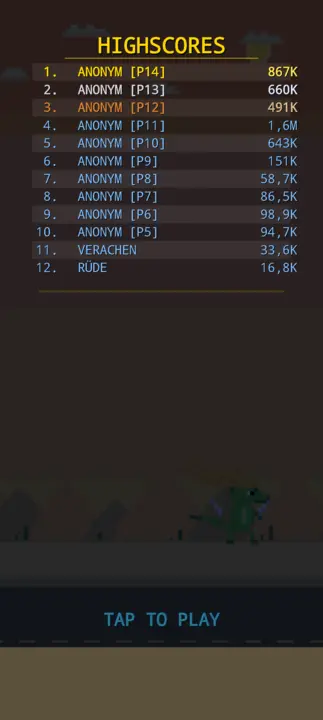
Pixel art na endless runner. Kontrolin ang isang dino na tumatalon sa mga hadlang, mangolekta ng mga item, bumili ng upgrade sa tindahan. 5 biome, kombinasyon ng kagamitan, chiptune na musika. Ideya: Vera Sejrek.
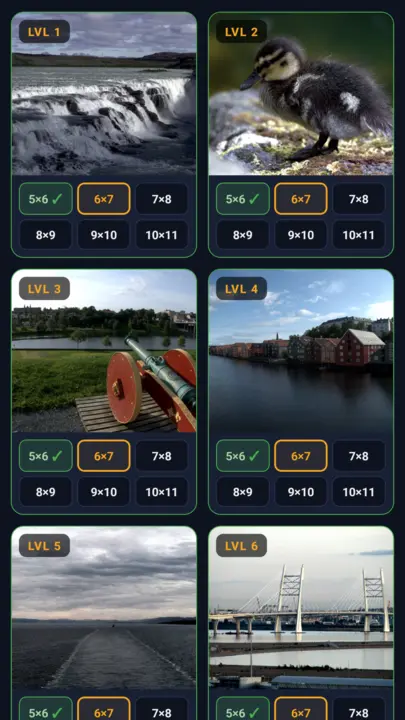
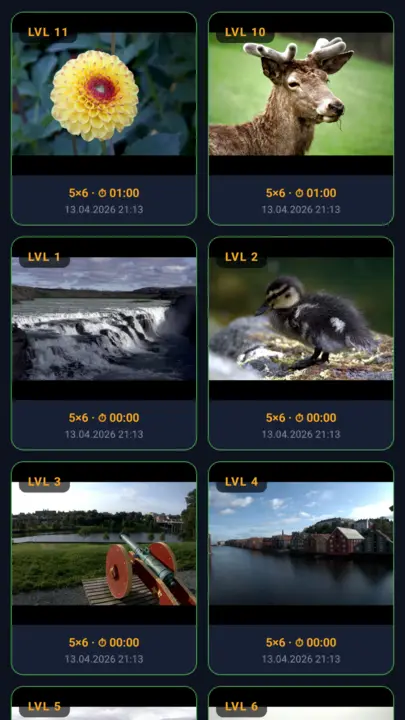
Klasikong jigsaw puzzle na may 40 piling larawan at sariling gallery na mga larawan. 6 na antas ng hirap mula Madali (5×6) hanggang Grandmaster (10×11), totoong piraso ng puzzle na may bezier curve, 22 wika, gallery ng mga tagumpay. Offline.
Jigsaw Puzzle40 FotosSariling mga larawan6 antas ng hirap22 mga wikaMga tagumpayGumagana nang offline
DuoDom
Kotlin · Android 7+
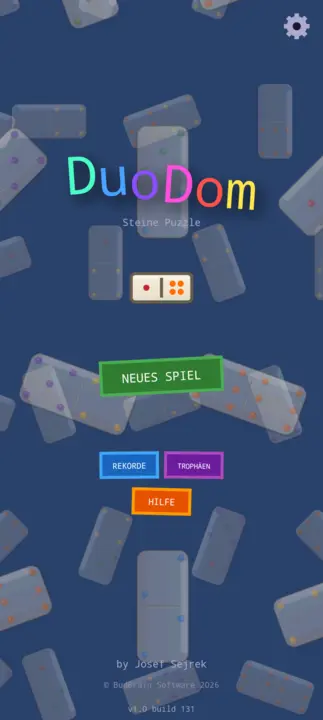
Pixel art na stone puzzle: i-slide ang mga bato sa mga bakanteng katabing cell sa 6×6 na grid – nawawala ang magkakapareho. Alisin ang lahat ng pares para manalo. May pagsusuri ng solusyon sa paggawa ng antas, mga tropeo, highscore, 20 wika, mga sintetikong tunog.
Pixel Art6×6 GridPagsusuri ng solusyonMga tropeoHighscores20 mga wika60 FPSGumagana nang offline
jsKassenrechner
React Native · Android 7+
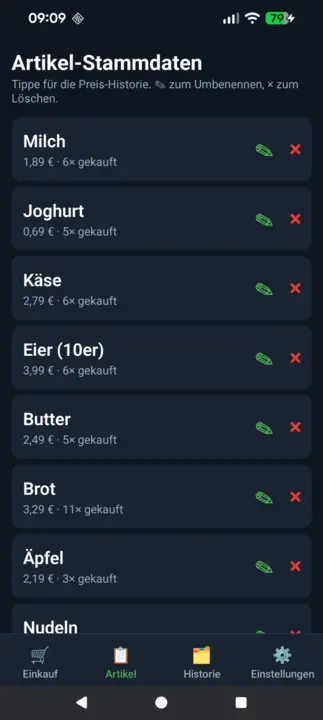
Mabilis na shopping calculator para sa Android: magdagdag ng mga item sa cart at tingnan ang live na kabuuan mismo sa tindahan. May numpad na parang cash register, master data ng artikulo na may kasaysayan ng presyo, autocomplete, flexible na VAT, kasaysayan ng pagbili at naka-encrypt na backup. Gumagana nang offline.
Live na kabuuanKassen-NumpadKasaysayan ng presyoKalkulasyon ng VATNaka-encrypt na backup22 mga wikaMaraming currencyGumagana nang offline
jsCPUInfo
Kotlin · Android 7.1+
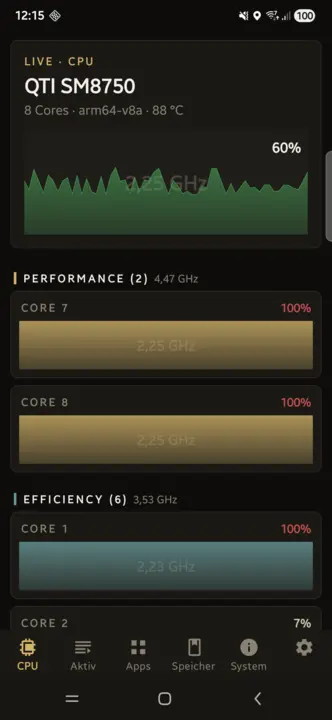
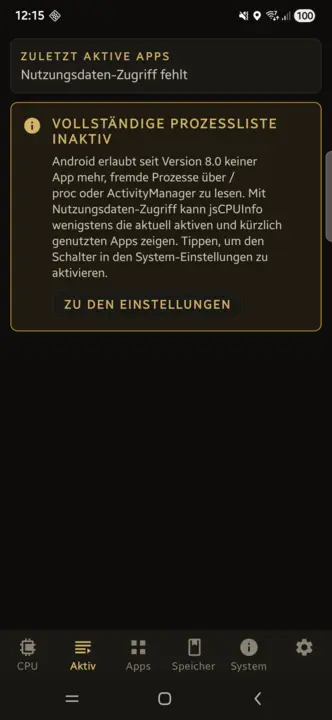
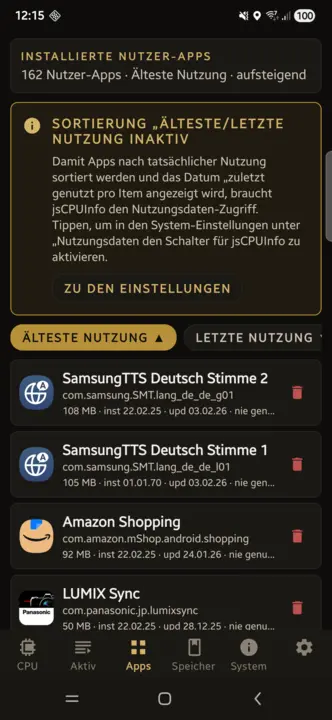
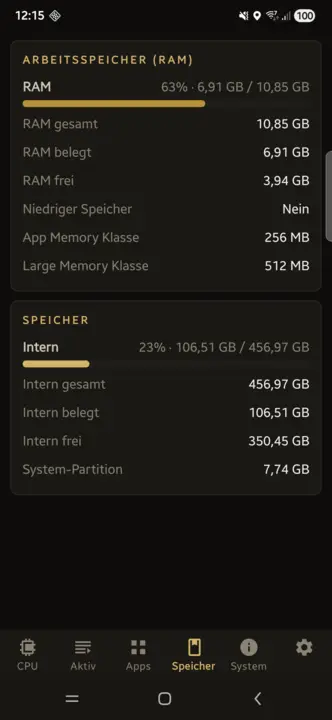
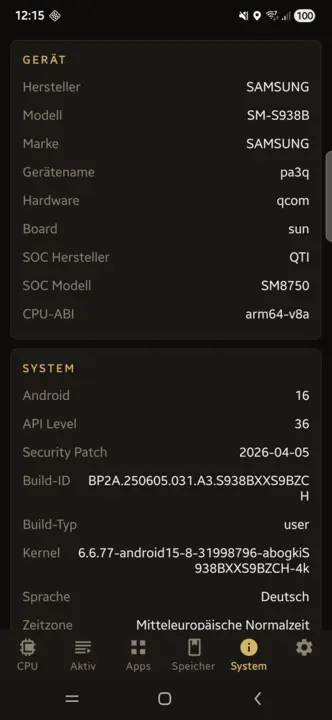
Live na CPU bawat core na may gamit, frequency at temperatura. Mga aktibong app at naka-install na package na may isang tap na pag-uninstall, mga charge cycle at state-of-health ng baterya, RAM, storage, display, mga pamantayan ng Wi-Fi, mga camera at bawat sensor – offline.
Live na CPU bawat coreMga aktibong appIsang tap na pag-uninstallMga cycle ng bateryaMga sensor22 mga wikaGumagana nang offline
Paano ko ibe-verify ang SHA256 hash ng na-download kong file?
Ang SHA256 hash ay isang digital na fingerprint. Ihambing ang hash ng na-download mong file sa nakasaad sa pahinang ito. Kung magkapareho ang dalawa, hindi nabago ang file.
Linux
Magbukas ng terminal at ilagay ang sumusunod na command (iangkop ang pangalan ng file):
sha256sum ~/Downloads/filename.zip
macOS
Buksan ang Terminal (Applications → Utilities → Terminal) at ilagay:
shasum -a 256 ~/Downloads/filename.zip
Windows
Buksan ang PowerShell (Windows key, i-type ang "PowerShell", Enter) at ilagay:
Dieses Angebot ist ein privates, nicht-kommerzielles Projekt. Budbrain Software ist kein eingetragenes Unternehmen, sondern ein privates Softwareprojekt von Josef Sejrek. Es erfolgt keine gewerbliche Tatigkeit. Samtliche hier angebotene Software wird kostenlos und ohne Gewinnerzielungsabsicht bereitgestellt.
Umsatzsteuer
Es wird keine Umsatzsteuer-Identifikationsnummer gemass § 27a Umsatzsteuergesetz angegeben, da es sich um ein rein privates, nicht-kommerzielles Angebot handelt.
Verantwortlich fur den Inhalt gemass § 18 Abs. 2 MStV
Josef Sejrek
Koblenzer Strasse 95
56073 Koblenz
Streitschlichtung
Die Europaische Kommission stellt eine Plattform zur Online-Streitbeilegung (OS) bereit: ec.europa.eu/consumers/odr.
Wir sind nicht bereit oder verpflichtet, an Streitbeilegungsverfahren vor einer Verbraucherschlichtungsstelle teilzunehmen, da es sich um ein nicht-kommerzielles Angebot handelt.
This is a private, non-commercial project. Budbrain Software is not a registered company but a private software project by Josef Sejrek. No commercial activity takes place. All software offered here is provided free of charge and without intent to generate profit.
VAT
No VAT identification number is provided as this is a purely private, non-commercial offering.
Responsible for content according to § 18 para. 2 MStV
Josef Sejrek Koblenzer Strasse 95 56073 Koblenz
Dispute Resolution
The European Commission provides a platform for online dispute resolution (ODR): ec.europa.eu/consumers/odr.
We are neither willing nor obliged to participate in dispute resolution proceedings before a consumer arbitration board, as this is a non-commercial offering.
Die Inhalte dieser Seite wurden mit grosster Sorgfalt erstellt. Fur die Richtigkeit, Vollstandigkeit und Aktualitat der Inhalte kann jedoch keine Gewahr ubernommen werden. Als privater Anbieter bin ich gemass § 7 Abs. 1 DDG fur eigene Inhalte auf diesen Seiten nach den allgemeinen Gesetzen verantwortlich. Eine Verpflichtung zur Uberwachung ubermittelter oder gespeicherter fremder Informationen besteht jedoch nicht (§§ 8–10 DDG).
2. Haftung fur Links
Diese Seite enthalt Links zu externen Webseiten Dritter, auf deren Inhalte ich keinen Einfluss habe. Fur die Inhalte der verlinkten Seiten ist stets der jeweilige Anbieter oder Betreiber verantwortlich. Die verlinkten Seiten wurden zum Zeitpunkt der Verlinkung auf mogliche Rechtsverstossse uberpruft. Rechtswidrige Inhalte waren zum Zeitpunkt der Verlinkung nicht erkennbar. Eine permanente inhaltliche Kontrolle der verlinkten Seiten ist jedoch ohne konkrete Anhaltspunkte einer Rechtsverletzung nicht zumutbar. Bei Bekanntwerden von Rechtsverletzungen werden derartige Links umgehend entfernt.
3. Software-Haftungsausschluss
Die auf dieser Seite angebotene Software wird „as is“ (so wie sie ist) und ohne jegliche Gewahrleistung bereitgestellt — weder ausdruecklich noch stillschweigend, einschliesslich, aber nicht beschrankt auf die Gewahrleistung der Marktgangigkeit, der Eignung fur einen bestimmten Zweck und der Nichtverletzung von Rechten Dritter.
Die Nutzung der Software erfolgt vollstandig auf eigene Gefahr. Der Autor ubernimmt keinerlei Haftung fur:
Direkte, indirekte, zufallige, besondere oder Folgeschaden jeglicher Art
Datenverlust oder Beschadigung von Dateien, Betriebssystemen oder Hardware
Ausfallzeiten, entgangenen Gewinn oder Betriebsunterbrechungen
Sicherheitslucken oder Schaeden durch Dritte, die sich aus der Nutzung der Software ergeben
Inkompatibilitaten mit bestimmten Systemkonfigurationen oder Software-Versionen
Dies gilt auch dann, wenn auf die Moglichkeit solcher Schaden hingewiesen wurde.
4. Lizenz
Die angebotene Software wird als Freeware kostenlos zur Nutzung bereitgestellt. Der Quellcode wird nicht veroeffentlicht. Alle Rechte am Quellcode verbleiben beim Autor. Eine Dekompilierung, Reverse Engineering oder sonstige Rueckgewinnung des Quellcodes ist nicht gestattet.
5. Keine Gewahrleistung fur Verfugbarkeit
Es besteht kein Anspruch auf Verfugbarkeit dieser Webseite oder der angebotenen Downloads. Der Betrieb kann jederzeit ohne Vorankundigung eingestellt, verandert oder eingeschrankt werden.
6. Urheberrecht
Die durch den Seitenbetreiber erstellten Inhalte und Werke auf diesen Seiten unterliegen dem deutschen Urheberrecht. Die Vervielfaltigung, Bearbeitung, Verbreitung und jede Art der Verwertung ausserhalb der Grenzen des Urheberrechts bedurfen der schriftlichen Zustimmung des Autors. Downloads und Kopien dieser Seite sind nur fur den privaten, nicht kommerziellen Gebrauch gestattet, soweit die Software-Lizenz nichts anderes erlaubt.
The contents of this website have been created with the utmost care. However, no guarantee can be given for the accuracy, completeness and timeliness of the content.
2. Liability for Links
This site contains links to third-party websites over whose content we have no influence. The respective provider is always responsible for the content of the linked pages. The linked pages were checked for possible legal violations at the time of linking. Illegal content was not recognizable at the time of linking.
3. Software Disclaimer
The software offered on this site is provided "as is" and without any warranty — neither express nor implied, including but not limited to warranties of merchantability, fitness for a particular purpose, and non-infringement.
Use of the software is entirely at your own risk. The author assumes no liability for:
Direct, indirect, incidental, special or consequential damages of any kind
Data loss or damage to files, operating systems or hardware
Downtime, lost profits or business interruptions
Security vulnerabilities or damage by third parties resulting from use of the software
Incompatibilities with specific system configurations or software versions
4. License
The software is provided as freeware for free use. The source code is not published. All rights to the source code remain with the author. Decompilation, reverse engineering or any other recovery of the source code is not permitted.
5. No Guarantee of Availability
There is no entitlement to the availability of this website or the offered downloads. Operation may be discontinued, changed or restricted at any time without notice.
6. Copyright
The content and works created by the site operator are subject to German copyright law. Reproduction, editing, distribution and any kind of use beyond the limits of copyright law require the written consent of the author.
Josef Sejrek
Koblenzer Strasse 95
56073 Koblenz
E-Mail:
2. Allgemeines zur Datenverarbeitung
Diese Webseite wird als rein statische HTML-Seite betrieben. Es wird keinerlei serverseitige Datenverarbeitung durch den Seitenbetreiber durchgefuhrt. Insbesondere:
Es wird ausschliesslich ein technisch-funktionales Sprach-Cookie (bb_lang) gesetzt - nur durch Ihre aktive Sprachwahl ausgelost (siehe unten)
Es werden keine Tracking- oder Analysedienste eingesetzt (kein Google Analytics, kein Matomo, keine Pixel)
Es werden keine personenbezogenen Daten erhoben, gespeichert oder verarbeitet
Es gibt keine Kontaktformulare, Newsletter-Anmeldungen oder Benutzerkonten
Es werden keine externen Schriftarten, CDNs oder Social-Media-Plugins eingebunden
Sprach-Cookie (bb_lang): Wenn Sie uber den Sprachumschalter eine Sprache wahlen, wird ein einzelnes Cookie namens bb_lang gesetzt, das ausschliesslich Ihr Sprachkurzel (z.B. en) enthalt und fur die gesamte Domain budbrain.de gilt (Hauptseite sowie /budbrain-software/ und /testing/). Kein Tracking, keine Profilbildung, keine Weitergabe an Dritte. Das Cookie ist rein technisch-funktional, wird nur durch Ihre aktive Sprachwahl ausgelost und ist als unbedingt erforderlich nach § 25 Abs. 2 TDDDG einwilligungsfrei (Art. 6 Abs. 1 lit. f DSGVO). Es lauft nach einem Jahr ab und kann jederzeit im Browser geloscht werden.
3. Hosting / Server-Logfiles
Der Webserver-Hoster kann im Rahmen des technischen Betriebs automatisch Server-Logfiles erfassen (z.B. IP-Adresse, Browsertyp, Zugriffszeitpunkt). Diese Daten werden ausschliesslich vom Hoster verarbeitet und sind fur den Seitenbetreiber nicht einsehbar oder auswertbar. Rechtsgrundlage hierfur ist Art. 6 Abs. 1 lit. f DSGVO (berechtigtes Interesse an einem stabilen und sicheren Betrieb).
4. Downloads
Beim Herunterladen von Dateien (ZIP, DEB, RPM, APK) werden keine personenbezogenen Daten durch den Seitenbetreiber verarbeitet. Es kann jedoch sein, dass der Hoster den Download-Vorgang in Server-Logfiles protokolliert (siehe Punkt 3).
5. Externe Links
Diese Seite enthalt Links zu externen Diensten (z.B. Snap Store / snapcraft.io). Beim Anklicken dieser Links verlassen Sie diese Webseite. Fur die Datenverarbeitung auf den verlinkten Seiten gelten deren jeweilige Datenschutzerklarungen.
6. Datenverarbeitung durch die Apps
Die auf dieser Seite angebotenen Apps verarbeiten Daten ausschliesslich lokal auf dem Gerat des Nutzers. Im Einzelnen:
jsShowHardwareInfos (Linux): Liest die Hardware- und Systemdaten des Rechners (Prozessor, Speicher, Grafik, Laufwerke, Netzwerk, Sensoren, angeschlossene Geräte, laufende Prozesse) ausschliesslich lokal aus. Keine Netzwerkkommunikation. Ein Bericht wird nur dann als Textdatei auf dem Gerät gespeichert, wenn der Nutzer ihn ausdrücklich speichert; ansonsten werden nur Einstellungen auf dem Gerät abgelegt. Stürzt die App ab, wird ein Absturzbericht lokal geschrieben; das E-Mail-Programm mit diesem Bericht wird nur geöffnet, wenn der Nutzer im Dialog zustimmt – automatisch versendet wird nichts.
jsDevCleaner (macOS): Liest ausschliesslich Datei-Metadaten (Name, Groesse, Aenderungs- und Zugriffsdatum) im einmalig freigegebenen Benutzerordner – Dateiinhalte werden nicht gelesen. Die Freigabe erfolgt ueber den Standard-Dialog von macOS und wird als sicherheitsbezogenes Lesezeichen gespeichert; ein vollstaendiger Festplattenzugriff wird nicht verlangt. Die App stellt keine Internetverbindung her. Entfernte Objekte wandern ausschliesslich in den Papierkorb und behalten ihren Ursprungsort, sodass sie sich zurueckstellen lassen. Gespeichert werden nur die Freigabe und die Einstellungen auf dem Geraet.
jsDevCleaner (Linux): Ermittelt die Grössen von Entwickler-Caches und Projektordnern ausschliesslich lokal, keine Netzwerkkommunikation. Geloescht wird nur, was der Nutzer ausgewaehlt und in einem Dialog bestaetigt hat; die Loeschung erfolgt endgueltig, nicht in den Papierkorb. Gespeichert werden nur Einstellungen auf dem Gerat.
jsSysInfo (Linux/macOS): Liest Systemdaten (CPU, GPU, RAM, Netzwerk) ausschliesslich lokal aus. Keine Netzwerkkommunikation.
jsTuxChecker (Linux): Ruft die offentlich zugangliche Webseite kernel.org ab, um Kernel-Versionen zu prufen. Es werden keine personenbezogenen Daten an kernel.org ubermittelt.
jsReminder (macOS): Speichert Notizen und Termine ausschliesslich lokal auf dem Gerat.
jsShowHardwareInfos (Windows): Liest die Hardware- und Systemdaten des PCs (Prozessor, Arbeitsspeicher, Grafik, Datenträger, Anschlüsse, Netzwerk, Sensoren, laufende Prozesse) ausschliesslich lokal aus und zeigt sie nur an. Die App stellt von sich aus keine Internetverbindung her. Gespeichert werden nur Einstellungen sowie Fenstergrösse, Fensterposition und Spaltenbreite auf dem Gerat. Einzelne Angaben gibt Windows nur an Programme mit Administratorrechten heraus; dafuer startet sich die App erst neu, wenn der Nutzer die Nachfrage der Benutzerkontensteuerung bestatigt. Ein Bericht wird nur dann als Textdatei gespeichert oder in die Zwischenablage kopiert, wenn der Nutzer es auslöst. Stürzt die App ab, wird ein Absturzbericht lokal geschrieben; versendet wird er nur, wenn der Nutzer den E-Mail-Versand selbst auslöst.
jsCPUMonitor (Windows): Liest CPU-Auslastung, Taktfrequenz, Arbeitsspeicher und - sofern das Gerat sie bereitstellt - die CPU-Temperatur ausschliesslich lokal aus. Gespeichert werden nur Einstellungen und Fensterposition auf dem Gerat. Die App stellt von sich aus keine Internetverbindung her.
Where Did My Storage Go? (Windows): Analysiert Datei-Grossen ausschliesslich lokal, keine Netzwerkkommunikation. Dateiinhalte werden nicht gelesen. Loschen erfolgt nur in den Papierkorb. Gespeichert werden nur Einstellungen und Fensterposition auf dem Gerat.
Where Did My Storage Go? (macOS): Analysiert Datei-Grossen ausschliesslich lokal, keine Netzwerkkommunikation. Loschen erfolgt nur in den Papierkorb.
Where Did My Storage Go? (Linux): Analysiert Datei-Grossen ausschliesslich lokal, keine Netzwerkkommunikation. Loschen erfolgt nur in den Papierkorb. Gespeichert werden nur Einstellungen auf dem Gerat.
jsFileManager (Windows): Zeigt die Ordner an, die der Nutzer öffnet, und führt ausschliesslich die Vorgänge aus, die er auslöst (kopieren, verschieben, umbenennen, packen, entpacken, löschen). Gelesen werden Datei- und Ordnernamen, Grössen, Datumsangaben und Attribute; Dateiinhalte nur beim Kopieren, Verschieben und Packen sowie in der Byte-Ansicht – und nur für die vom Nutzer gewählten Dateien. Keine Netzwerkkommunikation, keine Telemetrie. Lokal gespeichert werden nur Einstellungen, Fenstergrösse und -position, Lesezeichen, zuletzt besuchte Ordner und ein Protokoll der Vorgänge dieser Sitzung; Dateiinhalte werden nicht gespeichert. Gelöschtes wandert standardmässig in den Papierkorb.
jsFileManager (Linux): Wie die Windows-Fassung – zeigt die vom Nutzer geöffneten Ordner an und führt nur die von ihm ausgelösten Vorgänge aus. Keine Netzwerkkommunikation. Lokal gespeichert werden nur Einstellungen, Lesezeichen, zuletzt besuchte Ordner und ein Protokoll der Vorgänge dieser Sitzung. Gelöschtes wandert standardmässig in den Papierkorb.
jsBudbrainPlayer (Linux): Spielt Audiodateien aus dem Ordner ab, den der Nutzer angibt, und liest dort nur Namen, Grösse und Zeitstempel der passenden Dateien – ausschliesslich lesend. Die App stellt von sich aus keine Internetverbindung her; ist der Ordner eine Netzwerkfreigabe, besteht die Verbindung nur zu diesem vom Nutzer angegebenen Gerät. Lokal gespeichert werden die Einstellungen (verschlüsselt), ein technisches Protokoll der laufenden Sitzung und bei einem Absturz ein Absturzbericht im Laufzeitordner der Sitzung; versendet wird nichts. Autostart-Eintrag und Verknüpfung auf dem Schreibtisch entstehen nur, wenn der Nutzer „Beim Anmelden starten“ einschaltet.
jsBudbrainEqualizer (Linux): Leitet den Ton, den der Rechner abspielt, über ein virtuelles Ausgabegerät im Tonserver des Desktops (PipeWire oder PulseAudio), verändert ihn nach den Reglern und gibt ihn an das gewählte Gerät weiter. Der Ton wird ausschliesslich im Arbeitsspeicher und nur für Sekundenbruchteile verarbeitet – weder aufgezeichnet noch gespeichert, ausgewertet oder versendet; ein Mikrofon benutzt die App nicht. Von sich aus stellt sie keine Internetverbindung her. Im Konfigurationsordner des Benutzerkontos liegen die verschlüsselten Einstellungen, ein bei jedem Start neu angelegtes Protokoll zur Fehlersuche und eine Sperrdatei gegen den doppelten Start. Nach einem Absturz fragt die App beim nächsten Start, ob der Bericht per E-Mail gesendet werden soll; von selbst wird nichts versendet. Eine Autostart-Datei entsteht nur, wenn der Nutzer „Beim Anmelden starten“ einschaltet.
jsBudbrainCompressor (Linux): Leitet den Ton, den der Rechner abspielt, über ein virtuelles Ausgabegerät im Tonserver des Desktops (PipeWire oder PulseAudio), bearbeitet ihn mit der simulierten Röhre und dem Kompressor nach den Reglern und gibt ihn an das gewählte Gerät weiter – laufen gleichzeitig jsBudbrainEqualizer oder jsBudbrainsFxStudio, geben diese ihren Ton an das virtuelle Gerät des Kompressors weiter. Der Ton wird ausschliesslich im Arbeitsspeicher und nur für Sekundenbruchteile verarbeitet – weder aufgezeichnet noch gespeichert, ausgewertet oder versendet; ein Mikrofon benutzt die App nicht. Von sich aus stellt sie keine Internetverbindung her. Im Konfigurationsordner des Benutzerkontos liegen die verschlüsselten Einstellungen samt einer verschlüsselten Sicherung der vorigen Fassung, ein bei jedem Start neu angelegtes Protokoll zur Fehlersuche und eine Sperrdatei gegen den doppelten Start. Nach einem Absturz fragt die App beim nächsten Start, ob der Bericht per E-Mail gesendet werden soll; von selbst wird nichts versendet. Eine Autostart-Datei entsteht nur, wenn der Nutzer „Beim Anmelden starten“ einschaltet.
jsBudbrainLimiter (Linux): Leitet den Ton, den der Rechner abspielt, über ein virtuelles Ausgabegerät im Tonserver des Desktops (PipeWire oder PulseAudio), begrenzt und hebt ihn nach den Reglern an und gibt ihn an das gewählte Gerät weiter – laufen gleichzeitig jsBudbrainCompressor, jsBudbrainEqualizer oder jsBudbrainsFxStudio, geben diese ihren Ton an das virtuelle Gerät des Limiters weiter. Der Ton wird ausschliesslich im Arbeitsspeicher und nur für Sekundenbruchteile verarbeitet – weder aufgezeichnet noch gespeichert, ausgewertet oder versendet; ein Mikrofon benutzt die App nicht. Von sich aus stellt sie keine Internetverbindung her. Im Konfigurationsordner des Benutzerkontos liegen die verschlüsselten Einstellungen samt einer verschlüsselten Sicherung der vorigen Fassung, ein bei jedem Start neu angelegtes Protokoll zur Fehlersuche und eine Sperrdatei gegen den doppelten Start. Nach einem Absturz fragt die App beim nächsten Start, ob der Bericht per E-Mail gesendet werden soll; von selbst wird nichts versendet. Eine Autostart-Datei entsteht nur, wenn der Nutzer „Beim Anmelden starten“ einschaltet.
jsBudbrainSoundEditor (Linux): Öffnet und speichert nur die Audiodateien, die der Nutzer auswählt, und bearbeitet sie im Arbeitsspeicher; abgespielt wird über den Tonserver des Desktops (PipeWire oder PulseAudio). Mikrofon oder ein anderer Eingang werden nur benutzt, wenn der Nutzer eine Aufnahme startet oder die Anzeige des Eingangspegels einschaltet (ab Werk aus). Weder Dateien noch Ton werden ausgewertet oder versendet; von sich aus stellt die App keine Internetverbindung her. Im Konfigurationsordner liegen die verschlüsselten Einstellungen (darunter die Pfade der zuletzt geöffneten Dateien und der beim Beenden offenen Tabs) samt verschlüsselter Sicherung und ein bei jedem Start neu angelegtes Protokoll; im Zwischenspeicher-Ordner vorübergehend ausgelagerte Rückgängig-Schritte und die laufende Aufnahme. Nach einem Absturz fragt die App beim nächsten Start, ob der Bericht per E-Mail gesendet werden soll; von selbst wird nichts versendet.
jsBudbrainLaufwerksTest (Windows): Misst die Geschwindigkeit eines Laufwerks mit einer Testdatei aus Zufallsdaten, die die App in den vom Nutzer gewählten Ordner schreibt, zurückliest und wieder löscht – auch beim Abbruch, beim Beenden und nach einem Absturz; eigene Dateien des Nutzers liest und verändert sie nicht. Für die Laufwerksliste fragt sie Windows, welche Laufwerke es gibt, wie viel Platz frei ist und, soweit gemeldet, Modell und Art des Laufwerks; diese Angaben werden nur angezeigt. Die App läuft mit den normalen Benutzerrechten und trägt selbst nichts in die Registrierung oder die Systemordner von Windows ein. Von sich aus stellt sie keine Internetverbindung her; Messergebnisse bleiben auf dem Gerät. Im Ordner des Benutzerkontos liegen die verschlüsselten Einstellungen (darunter der zuletzt gewählte Ordner und der Verlauf der Messungen) samt verschlüsselter Sicherung und ein bei jedem Start neu angelegtes Protokoll. Als Textdatei gespeichert wird der Verlauf nur, wenn der Nutzer es auslöst, an dem Ort, den er wählt. Nach einem Absturz fragt die App beim nächsten Start, ob der Bericht per E-Mail gesendet werden soll; von selbst wird nichts versendet.
jsBudbrainLaufwerksTest (Linux): Misst die Geschwindigkeit eines Laufwerks mit einer Testdatei aus Zufallsdaten, die die App in den vom Nutzer gewählten Ordner schreibt, zurückliest und wieder löscht – auch beim Abbruch, beim Beenden und nach einem Absturz; eigene Dateien des Nutzers liest und verändert sie nicht. Für die Laufwerksliste liest sie aus dem System, welche Laufwerke eingehängt sind, wie viel Platz frei ist und, soweit gemeldet, Modell und Art des Geräts; diese Angaben werden nur angezeigt. Von sich aus stellt die App keine Internetverbindung her; Messergebnisse bleiben auf dem Gerät. Im Konfigurationsordner liegen die verschlüsselten Einstellungen (darunter der zuletzt gewählte Ordner und der Verlauf der Messungen) samt verschlüsselter Sicherung und ein bei jedem Start neu angelegtes Protokoll. Als Textdatei gespeichert wird der Verlauf nur, wenn der Nutzer es auslöst, an dem Ort, den er wählt. Nach einem Absturz fragt die App beim nächsten Start, ob der Bericht per E-Mail gesendet werden soll; von selbst wird nichts versendet.
jsBudbrainFindDblsOrRenameIt (Windows): Durchsucht nur die Ordner, die der Nutzer auswählt. Gelesen werden Namen, Größe und Zeitstempel der Dateien und, um Doppelte zu erkennen, ihr Inhalt, aus dem Prüfsummen berechnet werden; diese Angaben werden nur angezeigt und nur im Arbeitsspeicher gehalten. In den Papierkorb gelegt, verschoben, gelöscht, umbenannt oder durch eine Verknüpfung ersetzt wird nur, was der Nutzer markiert und in der Rückfrage bestätigt hat. Dateien, die nur in der Cloud liegen, werden beim Vergleich nach Inhalt nicht gelesen und nicht heruntergeladen. Von sich aus stellt die App keine Internetverbindung her. Lokal gespeichert werden die verschlüsselten Einstellungen (darunter die gewählten Ordner, Regeln, gespeicherten Suchen und Aufträge), ein verschlüsselter Verlauf der letzten 30 Vorgänge zum Rückgängigmachen, je eine verschlüsselte Sicherung und ein bei jedem Start neu angelegtes Protokoll; einzelne Treffer werden nicht gespeichert. Nach einem Absturz fragt die App beim nächsten Start, ob der Bericht per E-Mail gesendet werden soll; von selbst wird nichts versendet.
jsBudbrainFindDblsOrRenameIt (Linux): Durchsucht nur die Ordner, die der Nutzer auswählt. Gelesen werden Namen, Größe und Zeitstempel der Dateien und, um Doppelte zu erkennen, ihr Inhalt, aus dem Prüfsummen berechnet werden; diese Angaben werden nur angezeigt und nur im Arbeitsspeicher gehalten. In den Papierkorb des Systems gelegt, verschoben, gelöscht, umbenannt oder durch eine Verknüpfung ersetzt wird nur, was der Nutzer markiert und in der Rückfrage bestätigt hat. Von sich aus stellt die App keine Internetverbindung her. Lokal gespeichert werden die verschlüsselten Einstellungen (darunter die gewählten Ordner, Regeln, gespeicherten Suchen und Aufträge), ein verschlüsselter Verlauf der letzten 30 Vorgänge zum Rückgängigmachen, je eine verschlüsselte Sicherung und ein bei jedem Start neu angelegtes Protokoll; einzelne Treffer werden nicht gespeichert. Nach einem Absturz fragt die App beim nächsten Start, ob der Bericht per E-Mail gesendet werden soll; von selbst wird nichts versendet.
jsNetMonitor (Linux): Zeigt an, was der Rechner im Netzwerk tut (Geräte, Datenmengen, Verbindungen, die Programme dahinter und die Gegenstellen), liest diese Angaben ausschliesslich aus dem eigenen System und zeigt sie nur auf dem Bildschirm an; gelesen werden nur Zähler und Verbindungsangaben, nie der Inhalt des Datenverkehrs, und am Netzwerk wird nichts verändert. Von sich aus stellt die App keine Verbindung zu Servern von Budbrain oder Dritten her. Um statt einer Adresse einen Rechnernamen zu zeigen, fragt sie über das Betriebssystem den Namensserver des Systems nach den Namen der Gegenstellen bestehender Verbindungen – abschaltbar unter „Hostnamen auflösen“. Das Land einer Adresse ermittelt sie aus einer mitgelieferten Datenbank, ohne Abfrage im Internet. Im Konfigurationsordner des Benutzerkontos liegen die verschlüsselten Einstellungen, die verschlüsselte Datenmenge je Gerät und Tag, der verschlüsselte Verlauf des gesamten Datenverkehrs bis zu einem Jahr (ohne Geräte- oder Verbindungsangaben), ein Protokoll zur Fehlersuche ohne Adressen oder Gegenstellen und eine Sperrdatei gegen den doppelten Start; eine Liste der Verbindungen wird nicht gespeichert. Nach einem Absturz fragt die App beim nächsten Start, ob der Bericht per E-Mail gesendet werden soll; von selbst wird nichts versendet.
jsBudbrainsFxStudio (Linux): Leitet den Ton, den der Rechner abspielt, über ein virtuelles Ausgabegerät im Tonserver des Desktops (PipeWire oder PulseAudio), mischt die eingestellten Effekte hinein und gibt ihn an das gewählte Gerät weiter – läuft gleichzeitig jsBudbrainEqualizer, an dessen virtuelles Gerät. Der Ton wird ausschliesslich im Arbeitsspeicher und nur für Sekundenbruchteile verarbeitet – weder aufgezeichnet noch gespeichert, ausgewertet oder versendet; ein Mikrofon benutzt die App nicht. Von sich aus stellt sie keine Internetverbindung her. Im Konfigurationsordner des Benutzerkontos liegen die verschlüsselten Einstellungen samt einer verschlüsselten Sicherung der vorigen Fassung, ein bei jedem Start neu angelegtes Protokoll zur Fehlersuche und eine Sperrdatei gegen den doppelten Start. Nach einem Absturz fragt die App beim nächsten Start, ob der Bericht per E-Mail gesendet werden soll; von selbst wird nichts versendet. Eine Autostart-Datei entsteht nur, wenn der Nutzer „Beim Anmelden starten“ einschaltet.
jsBudbrainEqualizer (Windows): Verändert den Ton, den Windows an Lautsprecher oder Kopfhörer gibt, als Klangeffekt im Audiodienst von Windows. Eingerichtet wird dieser Effekt nur, wenn der Nutzer darauf klickt und in der Abfrage von Windows zustimmt; „Aus Windows entfernen“ in den Einstellungen macht es rückgängig. Der Ton wird ausschliesslich im Arbeitsspeicher und nur für Sekundenbruchteile verarbeitet – weder aufgezeichnet noch gespeichert, ausgewertet oder versendet; ein Mikrofon benutzt die App nicht. Von sich aus stellt sie keine Internetverbindung her. Im eigenen Ordner des Windows-Benutzerkontos (%APPDATA%\jsBudbrainEqualizer) liegen die verschlüsselten Einstellungen und technische Protokolle zur Fehlersuche; solange der Effekt eingerichtet ist, schreibt er zusätzlich ein kleines Protokoll unter %ProgramData%\jsBudbrainEqualizer. Nach einem Absturz fragt die App beim nächsten Start, ob der Bericht per E-Mail gesendet werden soll; von selbst wird nichts versendet. Ein Starteintrag entsteht nur, wenn der Nutzer „Beim Anmelden starten“ einschaltet.
jsBudbrainsFxStudio (Windows): Verändert den Ton, den Windows an Lautsprecher oder Kopfhörer gibt, als Klangeffekt im Audiodienst von Windows und mischt die eingestellten Effekte hinein nach den Reglern – ist zugleich jsBudbrainEqualizer eingerichtet, bearbeiten die Effekte den Ton vor ihm. Eingerichtet wird dieser Effekt nur, wenn der Nutzer darauf klickt und in der Abfrage von Windows zustimmt; „Aus Windows entfernen“ in den Einstellungen macht es rückgängig. Der Ton wird ausschliesslich im Arbeitsspeicher und nur für Sekundenbruchteile verarbeitet – weder aufgezeichnet noch gespeichert, ausgewertet oder versendet; ein Mikrofon benutzt die App nicht. Von sich aus stellt sie keine Internetverbindung her. Im eigenen Ordner des Windows-Benutzerkontos (%APPDATA%\jsBudbrainsFxStudio) liegen die verschlüsselten Einstellungen samt einer verschlüsselten Sicherung der vorigen Fassung und technische Protokolle zur Fehlersuche; solange der Effekt eingerichtet ist, schreibt er zusätzlich ein kleines Protokoll unter %ProgramData%\jsBudbrainsFxStudio. Nach einem Absturz fragt die App beim nächsten Start, ob der Bericht per E-Mail gesendet werden soll; von selbst wird nichts versendet. Ein Starteintrag entsteht nur, wenn der Nutzer „Beim Anmelden starten“ einschaltet.
jsBudbrainCompressor (Windows): Verändert den Ton, den Windows an Lautsprecher oder Kopfhörer gibt, als Klangeffekt im Audiodienst von Windows und bearbeitet ihn mit der simulierten Röhre und dem Kompressor nach den Reglern – sind zugleich jsBudbrainEqualizer oder jsBudbrainsFxStudio eingerichtet, bearbeitet er den Ton vor ihnen. Eingerichtet wird dieser Effekt nur, wenn der Nutzer darauf klickt und in der Abfrage von Windows zustimmt; „Aus Windows entfernen“ in den Einstellungen macht es rückgängig. Der Ton wird ausschliesslich im Arbeitsspeicher und nur für Sekundenbruchteile verarbeitet – weder aufgezeichnet noch gespeichert, ausgewertet oder versendet; ein Mikrofon benutzt die App nicht. Von sich aus stellt sie keine Internetverbindung her. Im eigenen Ordner des Windows-Benutzerkontos (%APPDATA%\jsBudbrainCompressor) liegen die verschlüsselten Einstellungen samt einer verschlüsselten Sicherung der vorigen Fassung und technische Protokolle zur Fehlersuche; solange der Effekt eingerichtet ist, schreibt er zusätzlich ein kleines Protokoll unter %ProgramData%\jsBudbrainCompressor. Nach einem Absturz fragt die App beim nächsten Start, ob der Bericht per E-Mail gesendet werden soll; von selbst wird nichts versendet. Ein Starteintrag entsteht nur, wenn der Nutzer „Beim Anmelden starten“ einschaltet.
jsBudbrainLimiter (Windows): Verändert den Ton, den Windows an Lautsprecher oder Kopfhörer gibt, als Klangeffekt im Audiodienst von Windows und begrenzt ihn mit dem Limiter nach den Reglern – sind zugleich jsBudbrainCompressor, jsBudbrainEqualizer oder jsBudbrainsFxStudio eingerichtet, bearbeitet er den Ton vor ihnen. Eingerichtet wird dieser Effekt nur, wenn der Nutzer darauf klickt und in der Abfrage von Windows zustimmt; „Aus Windows entfernen“ in den Einstellungen macht es rückgängig. Der Ton wird ausschliesslich im Arbeitsspeicher und nur für Sekundenbruchteile verarbeitet – weder aufgezeichnet noch gespeichert, ausgewertet oder versendet; ein Mikrofon benutzt die App nicht. Von sich aus stellt sie keine Internetverbindung her. Im eigenen Ordner des Windows-Benutzerkontos (%APPDATA%\jsBudbrainLimiter) liegen die verschlüsselten Einstellungen samt einer verschlüsselten Sicherung der vorigen Fassung und technische Protokolle zur Fehlersuche; solange der Effekt eingerichtet ist, schreibt er zusätzlich ein kleines Protokoll unter %ProgramData%\jsBudbrainLimiter. Nach einem Absturz fragt die App beim nächsten Start, ob der Bericht per E-Mail gesendet werden soll; von selbst wird nichts versendet. Ein Starteintrag entsteht nur, wenn der Nutzer „Beim Anmelden starten“ einschaltet.
jsBudbrainEqualizer (macOS): Nimmt den Ton der anderen Programme über die dafür vorgesehene Schnittstelle von macOS (Core Audio) entgegen, bearbeitet ihn den Klang mit den zehn Reglern nach den Reglern und gibt ihn an das gewählte Gerät weiter – laufen gleichzeitig jsBudbrainsFxStudio, jsBudbrainCompressor oder jsBudbrainLimiter, nimmt sie den Ton von FxStudio entgegen bzw. gibt ihn an die App hinter ihr weiter, statt ihn doppelt erklingen zu lassen. macOS fragt beim ersten Start, ob die App auf den Systemton zugreifen darf; die Freigabe lässt sich in den Systemeinstellungen unter „Datenschutz & Sicherheit“ jederzeit zurücknehmen. Den Bildschirm liest die App nicht. Der Ton wird ausschliesslich im Arbeitsspeicher und nur für Sekundenbruchteile verarbeitet – weder aufgezeichnet noch gespeichert, ausgewertet oder versendet; ein Mikrofon benutzt die App nicht. Von sich aus stellt sie keine Internetverbindung her. Sie läuft in der Sandbox von macOS und schreibt nur in ihren eigenen Container (~/Library/Containers/com.budbrain.jsbudbrainequalizer): die verschlüsselten Einstellungen, ein bei jedem Start neu angelegtes Protokoll zur Fehlersuche, eine Sperrdatei gegen den doppelten Start und einen Zwischenspeicher der Systemschriften. Nach einem Absturz fragt die App beim nächsten Start, ob der Bericht per E-Mail gesendet werden soll; von selbst wird nichts versendet. Ein Anmeldeobjekt entsteht nur, wenn der Nutzer „Beim Anmelden starten“ einschaltet.
jsBudbrainsFxStudio (macOS): Nimmt den Ton der anderen Programme über die dafür vorgesehene Schnittstelle von macOS (Core Audio) entgegen, bearbeitet ihn mit den eingestellten Effekten nach den Reglern und gibt ihn an das gewählte Gerät weiter – laufen gleichzeitig jsBudbrainEqualizer, jsBudbrainCompressor oder jsBudbrainLimiter, gibt sie ihren Ton an die App hinter ihr weiter, statt ihn doppelt erklingen zu lassen. macOS fragt beim ersten Start, ob die App auf den Systemton zugreifen darf; die Freigabe lässt sich in den Systemeinstellungen unter „Datenschutz & Sicherheit“ jederzeit zurücknehmen. Den Bildschirm liest die App nicht. Der Ton wird ausschliesslich im Arbeitsspeicher und nur für Sekundenbruchteile verarbeitet – weder aufgezeichnet noch gespeichert, ausgewertet oder versendet; ein Mikrofon benutzt die App nicht. Von sich aus stellt sie keine Internetverbindung her. Sie läuft in der Sandbox von macOS und schreibt nur in ihren eigenen Container (~/Library/Containers/com.budbrain.jsbudbrainsfxstudio): die verschlüsselten Einstellungen samt einer verschlüsselten Sicherung des vorigen Stands, ein bei jedem Start neu angelegtes Protokoll zur Fehlersuche, eine Sperrdatei gegen den doppelten Start und einen Zwischenspeicher der Systemschriften. Nach einem Absturz fragt die App beim nächsten Start, ob der Bericht per E-Mail gesendet werden soll; von selbst wird nichts versendet. Ein Anmeldeobjekt entsteht nur, wenn der Nutzer „Beim Anmelden starten“ einschaltet.
jsBudbrainCompressor (macOS): Nimmt den Ton der anderen Programme über die dafür vorgesehene Schnittstelle von macOS (Core Audio) entgegen, bearbeitet ihn mit der simulierten Röhre und dem Kompressor nach den Reglern und gibt ihn an das gewählte Gerät weiter – laufen gleichzeitig jsBudbrainsFxStudio, jsBudbrainEqualizer oder jsBudbrainLimiter, nimmt sie den Ton von der App vor ihr entgegen bzw. gibt ihn an jsBudbrainLimiter weiter, statt ihn doppelt erklingen zu lassen. macOS fragt beim ersten Start, ob die App auf den Systemton zugreifen darf; die Freigabe lässt sich in den Systemeinstellungen unter „Datenschutz & Sicherheit“ jederzeit zurücknehmen. Den Bildschirm liest die App nicht. Der Ton wird ausschliesslich im Arbeitsspeicher und nur für Sekundenbruchteile verarbeitet – weder aufgezeichnet noch gespeichert, ausgewertet oder versendet; ein Mikrofon benutzt die App nicht. Von sich aus stellt sie keine Internetverbindung her. Sie läuft in der Sandbox von macOS und schreibt nur in ihren eigenen Container (~/Library/Containers/com.budbrain.jsbudbraincompressor): die verschlüsselten Einstellungen samt einer verschlüsselten Sicherung des vorigen Stands, ein bei jedem Start neu angelegtes Protokoll zur Fehlersuche, eine Sperrdatei gegen den doppelten Start und einen Zwischenspeicher der Systemschriften. Nach einem Absturz fragt die App beim nächsten Start, ob der Bericht per E-Mail gesendet werden soll; von selbst wird nichts versendet. Ein Anmeldeobjekt entsteht nur, wenn der Nutzer „Beim Anmelden starten“ einschaltet.
jsBudbrainLimiter (macOS): Nimmt den Ton der anderen Programme über die dafür vorgesehene Schnittstelle von macOS (Core Audio) entgegen, bearbeitet ihn mit dem Limiter nach den Reglern und gibt ihn an das gewählte Gerät weiter – laufen gleichzeitig jsBudbrainsFxStudio, jsBudbrainEqualizer oder jsBudbrainCompressor, nimmt sie den Ton von der App vor ihr entgegen, statt ihn doppelt erklingen zu lassen. macOS fragt beim ersten Start, ob die App auf den Systemton zugreifen darf; die Freigabe lässt sich in den Systemeinstellungen unter „Datenschutz & Sicherheit“ jederzeit zurücknehmen. Den Bildschirm liest die App nicht. Der Ton wird ausschliesslich im Arbeitsspeicher und nur für Sekundenbruchteile verarbeitet – weder aufgezeichnet noch gespeichert, ausgewertet oder versendet; ein Mikrofon benutzt die App nicht. Von sich aus stellt sie keine Internetverbindung her. Sie läuft in der Sandbox von macOS und schreibt nur in ihren eigenen Container (~/Library/Containers/com.budbrain.jsbudbrainlimiter): die verschlüsselten Einstellungen samt einer verschlüsselten Sicherung des vorigen Stands, ein bei jedem Start neu angelegtes Protokoll zur Fehlersuche, eine Sperrdatei gegen den doppelten Start und einen Zwischenspeicher der Systemschriften. Nach einem Absturz fragt die App beim nächsten Start, ob der Bericht per E-Mail gesendet werden soll; von selbst wird nichts versendet. Ein Anmeldeobjekt entsteht nur, wenn der Nutzer „Beim Anmelden starten“ einschaltet.
Dino Warrior (Android): Speichert Spielstand und Highscore ausschliesslich lokal auf dem Gerat (SharedPreferences). Keine Netzwerkkommunikation.
PicPuzzler (Android): Speichert Spielfortschritt, Erfolge und Einstellungen ausschliesslich lokal auf dem Gerat. Optional koennen eigene Bilder aus der Geraetegalerie als Puzzle verwendet werden - diese werden ausschliesslich lokal verarbeitet. Keine Netzwerkkommunikation.
Budbrain’s Sudoku (Windows, Linux, iOS, Android): Ein Spiel ohne Konto und ohne Anmeldung. Es liest und schreibt ausschliesslich seinen eigenen Ordner; auf sonstige Dateien greift es nicht zu. Keine Netzwerkkommunikation, keine Telemetrie, keine Bestenliste – auch das tägliche Rätsel wird im Spiel selbst aus dem Datum berechnet und nicht abgerufen. Lokal gespeichert werden nur Einstellungen, Fenstergrösse und -position, der Spielstand, der Fortschritt und zu jedem gelösten Rätsel ein Bild des Bretts für die Erfolgs-Wand. Diese Daten enthalten nichts über die Person, die spielt.
Budbrain's Poker Slots (iOS, Android): Reines Unterhaltungsspiel mit virtuellen Fun-Coins - keine Echtgeld-Einsatze, keine In-App-Kaufe, keine Auszahlungen. Alle Spieldaten (Coin-Stand, Bestenliste, Sammlung, Einstellungen) werden ausschliesslich lokal auf dem Gerat gespeichert und verlassen es nicht. Die App benotigt keine Internetverbindung und stellt auch keine her. Angefordert wird nur die Berechtigung Vibration. Beim Deinstallieren werden alle lokal gespeicherten Daten geloscht.
Budbrain's Media Editor (iOS, Android): Verarbeitet Videos und Bilder ausschliesslich lokal auf dem Gerat. Die Auswahl erfolgt uber die System-Medienauswahl des Betriebssystems, die App erhalt dadurch nur Zugriff auf die konkret ausgewahlte Datei. Originaldateien werden nie verandert oder uberschrieben - jede Bearbeitung erzeugt eine neue Datei. Gespeichert werden nur Einstellungen auf dem Gerat. In exportierte Dateien schreibt die App eine Signatur in die Metadaten (Programmname, Version und Bearbeitungsdatum). Die im Store veroffentlichte Version stellt keine Netzwerkverbindung her.
Budbrain’s Nonogram’s (Android): Ein Spiel ohne Konto und ohne Anmeldung. Alle Spieldaten (das laufende Rätsel, der Fortschritt und die Sterne je Level, die Bilder der gelösten Rätsel für die Galerie sowie die Einstellungen) werden ausschliesslich lokal auf dem Gerät in einer Datenbank im App-Verzeichnis gespeichert und verlassen es nicht. Die App benötigt keine Internetverbindung und stellt auch keine her; sie besitzt nicht einmal die Internet-Berechtigung. Angefordert wird nur die Berechtigung Vibration für das optionale haptische Feedback. Beim Deinstallieren werden alle lokal gespeicherten Daten gelöscht.
FarmIsFun (Android): Spielfortschritt, Inventar, Farm-Zustand, Aufträge, Crafting-Warteschlangen und Einstellungen werden ausschliesslich lokal auf dem Gerät gespeichert. Optional lässt sich in den Spieleinstellungen eine Cloud-Speicherung über Google Drive einschalten; der Spielstand liegt dann im app-eigenen Bereich des Google-Kontos des Nutzers, auf den nur diese App zugreift, und übertragen werden ausschliesslich Spieldaten – keine Namen, E-Mail-Adressen oder Standortdaten. Die Internet-Berechtigung wird nur für diese Cloud-Speicherung benötigt; ist sie ausgeschaltet, stellt die App keine Netzwerkverbindung her. Keine Analyse- oder Tracking-Werkzeuge, kein eigener Server.
FarmIsFun (Windows): Speichert Spielstände, deren rollende Sicherungen und die Einstellungen (Sprache, Lautstärke, Fenstergrösse) ausschliesslich lokal im eigenen Ordner des Windows-Benutzerkontos unter %APPDATA%\jsFarmIsFun. Auf sonstige Dateien des Geräts greift das Spiel nicht zu. Es stellt keine Internetverbindung her – es enthält dafür keine Funktion – und schreibt auch keinen Absturzbericht. Ein Bildschirmfoto entsteht nur, wenn der Nutzer es mit F12 selbst auslöst.
Budbrain’s Klickeridu (iOS): Spielfortschritt (Münzen, Welle, Upgrades, Skills, Seelen), das Monster-Album und die Einstellungen werden ausschliesslich lokal im App-Verzeichnis gespeichert. Kein Konto, keine Anmeldung, kein Nutzerprofil. Die App stellt von sich aus keine Netzwerkverbindung her: keine Cloud, keine Online-Gegner, keine Schriften von fremden Servern – alle Schriften sind in die App eingebettet.
Budbrain’s Mahjong (iOS, Android, Linux): Speichert das laufende Spiel, die gelösten Level samt der dabei erzeugten Bilder für die Erfolgs-Galerie sowie die Einstellungen ausschliesslich lokal auf dem Gerät. Keine Netzwerkkommunikation, keine besonderen Berechtigungen.
Budbrain’s Solitaire (iOS, Android): Reines Offline-Kartenspiel. Laufende Partie, Tutorial-Stand und Einstellungen werden ausschliesslich lokal auf dem Gerät gespeichert. Keine Netzwerkkommunikation, keine besonderen Berechtigungen.
Budbrain’s Chess (iOS, Android): Gespielt wird offline gegen eine Schach-Engine auf dem Gerät. Laufende Partie, Level-Fortschritt, Bewertung, die Bilder gewonnener Partien und die Einstellungen bleiben ausschliesslich lokal. Kein Konto, keine Anmeldung, keine Online-Gegner, keine Netzwerkkommunikation.
Budbrain’s Marbles (iOS, Android, Linux): Speichert Spielzustand, gelöste Level und Einstellungen ausschliesslich lokal auf dem Gerät. Keine Netzwerkkommunikation, keine besonderen Berechtigungen.
Budbrain’s Puzzle (iOS): Speichert den Puzzle-Zustand, die gelösten Puzzles und die Einstellungen ausschliesslich lokal auf dem Gerät. Keine Netzwerkkommunikation, keine besonderen Berechtigungen.
Budbrain’s Puzzle (Linux): Legt genau zwei Dateien im eigenen Datenverzeichnis an ($XDG_DATA_HOME/jsPicPuzzler, in der Snap-Fassung im Datenverzeichnis des Snaps): die Einstellungen und den Spielstand samt der Liste der gelösten Puzzles. Beide sind verschlüsselt abgelegt – nicht wegen personenbezogener Daten, die enthalten sie nicht, sondern damit ein Spielstand nicht nebenbei verändert wird. Auf sonstige Dateien greift das Spiel nicht zu. Es stellt von sich aus keine Internetverbindung her; die Verweise im Bildschirm „About“ öffnen auf Klick den Browser oder das Mailprogramm. Stürzt das Spiel ab, entsteht lokal ein Bericht mit Version, Absturzart und zuletzt gezeigtem Bildschirm – er wird nicht verschickt.
Budbrain’s Puzzle (Windows): Legt genau zwei Dateien im eigenen Ordner des Windows-Benutzerkontos an (%APPDATA%\jsPicPuzzler): die Einstellungen und den Spielstand samt der Liste der gelösten Puzzles. Beide sind verschlüsselt abgelegt – nicht wegen personenbezogener Daten, die enthalten sie nicht, sondern damit ein Spielstand nicht nebenbei verändert wird. Auf sonstige Dateien greift das Spiel nicht zu. Es stellt von sich aus keine Internetverbindung her; die Verweise im Bildschirm „About“ öffnen auf Klick den Browser oder das Mailprogramm. Stürzt das Spiel ab, entsteht im selben Ordner ein Bericht mit Version, Absturzart und zuletzt gezeigtem Bildschirm – er wird nicht verschickt.
Astonischika (iOS, Android): Speichert die Helden-Truppe, den Fortschritt, den laufenden Durchgang und die Einstellungen ausschliesslich lokal auf dem Gerät. Keine Netzwerkkommunikation, keine besonderen Berechtigungen.
Astonischika (Windows): Legt drei Dateien im eigenen Ordner des Windows-Benutzerkontos an (%APPDATA%\Astonischika, auch in der Fassung aus dem Microsoft Store): die Einstellungen, den dauerhaften Fortschritt mit Helden, Gold und Lager sowie den laufenden Zug. Alle drei sind verschlüsselt und versiegelt abgelegt – nicht wegen personenbezogener Daten, die enthalten sie nicht, sondern damit ein Spielstand nicht nebenbei verändert wird. Dazu kommen eine bei jedem Start neu angelegte Protokolldatei zur Fehlersuche und, nach einem Absturz, ein Absturzbericht – beide werden nicht verschickt. Auf sonstige Dateien greift das Spiel nicht zu. Es stellt von sich aus keine Internetverbindung her; die Verweise im Bildschirm „Über“ und in der Lizenzübersicht öffnen auf Klick den Browser oder das Mailprogramm.
Astonischika (Linux): Legt drei verschlüsselte und versiegelte Dateien im eigenen Datenordner an (~/.local/share/Astonischika, in Snap und Flatpak im Datenordner der jeweiligen Sandbox): die Einstellungen, den dauerhaften Fortschritt und den laufenden Zug. Nach einem Absturz entsteht ein Absturzbericht, der nicht verschickt wird. Keine eigene Internetverbindung; die Verweise im Bildschirm „Über“ öffnen auf Klick den Browser oder das Mailprogramm.
jsBudbrainPlayer (Windows): Liest ausschliesslich den Ordner, den der Nutzer selbst angibt (auf Wunsch samt Unterordnern), und darin nur die Dateien, die auf das eingestellte Muster passen, dazu deren Namen, Grösse und Zeitstempel – nur lesend; im Ordner wird nichts verändert, verschoben oder gelöscht. Liegt der Ordner auf einer Netzwerkfreigabe, besteht die Verbindung ausschliesslich zu diesem vom Nutzer angegebenen Gerät. Von sich aus stellt die App keine Internetverbindung her. Im eigenen Ordner des Windows-Benutzerkontos (%APPDATA%\jsBudbrainPlayer) liegen die verschlüsselten Einstellungen und ein bei jedem Start neu angelegtes Protokoll zur Fehlersuche, das die Namen und Pfade der abgespielten Dateien enthält; beide verlassen das Gerät nicht. Ein Absturzbericht wird nicht erzeugt. Nur wenn der Nutzer „Mit Windows starten“ einschaltet, legt die App einen Autostart-Eintrag unter HKEY_CURRENT_USER, eine geplante Aufgabe bei Anmeldung und eine Verknüpfung auf dem Desktop an; sie enthalten nur den Programmpfad und den gewählten Ordner und werden beim Ausschalten wieder entfernt.
Quantimixar (iOS, Android): Speichert das laufende Spiel, die gemeisterten Level samt ihrer Bilder und die Einstellungen ausschliesslich lokal auf dem Gerät. Keine Netzwerkkommunikation, keine besonderen Berechtigungen.
BlobPop (iOS, Android): Speichert Spielfortschritt, Sterne und Bestwerte je Level sowie die Einstellungen ausschliesslich lokal auf dem Gerät. Keine Netzwerkkommunikation, keine besonderen Berechtigungen.
BlobPop (Linux): Legt genau zwei Dateien im eigenen Datenverzeichnis an ($XDG_DATA_HOME/jsBlobPop, in der Snap-Fassung im Datenverzeichnis des Snaps): die Einstellungen und den Spielstand samt bester Runde je Level und der Arcade-Bestenliste. Beide sind verschlüsselt abgelegt – nicht wegen personenbezogener Daten, die enthalten sie nicht, sondern damit ein Spielstand nicht nebenbei verändert wird. Auf sonstige Dateien greift das Spiel nicht zu. Es stellt von sich aus keine Internetverbindung her; die Verweise im Bildschirm „About“ und in der Lizenzübersicht öffnen auf Klick den Browser oder das Mailprogramm. Stürzt das Spiel ab, entsteht lokal ein Absturzbericht – er wird nicht verschickt.
BlobPop (Windows): Legt genau zwei Dateien im eigenen Ordner des Windows-Benutzerkontos an (%APPDATA%\jsBlobPop, aus dem Microsoft Store bezogen im dorthin umgeleiteten Anwendungsverzeichnis): die Einstellungen und den Spielstand samt bester Runde je Level und der Arcade-Bestenliste. Beide sind verschlüsselt abgelegt – nicht wegen personenbezogener Daten, die enthalten sie nicht, sondern damit ein Spielstand nicht nebenbei verändert wird. Auf sonstige Dateien greift das Spiel nicht zu. Es stellt von sich aus keine Internetverbindung her; die Verweise im Bildschirm „About“ und in der Lizenzübersicht öffnen auf Klick den Browser oder das Mailprogramm. Stürzt das Spiel ab, entsteht im selben Ordner ein Absturzbericht – er wird nicht verschickt.
Budbrain Cave Rescue (Linux): Ein Spiel ohne eigene Internetverbindung. Im Datenverzeichnis des Benutzerkontos liegen der verschlüsselte Spielstand, die verschlüsselten Einstellungen und eine Sperrdatei gegen den doppelten Start. Nach einem Absturz entsteht eine Textdatei mit Version und Fehlerstelle auf dem eigenen Rechner; von selbst wird nichts versendet. Verweise auf der Info-Seite öffnen Browser oder Mailprogramm nur auf Klick.
Budbrain Cave Rescue (Windows): Ein Spiel ohne eigene Internetverbindung. Im eigenen Ordner des Windows-Benutzerkontos unter %APPDATA%\jsBudbrainCaveRescue liegen der verschlüsselte Spielstand, die verschlüsselten Einstellungen, eine Sperrdatei gegen den doppelten Start und ein technisches Protokoll des letzten Starts ohne persönliche Daten. Nach einem Absturz entsteht dort eine Textdatei mit Version und Art des Absturzes; sie wird nicht verschickt. Verweise auf der Info-Seite öffnen Browser oder Mailprogramm nur auf Klick. Beim Bezug über den Microsoft Store verarbeitet Microsoft eigene Daten in eigener Verantwortung.
DuoDom (iOS, Android): Speichert Bestwerte, Trophäen, Sprache und Lautstärke ausschliesslich lokal auf dem Gerät. Die App funktioniert vollständig offline und fordert auch keine Internet-Berechtigung an.
jsKassenrechner (iOS, Android): Artikelnamen und Preise, die Einkaufshistorie sowie die Sprach-, Währungs- und Mehrwertsteuer-Einstellungen werden ausschliesslich lokal auf dem Gerät gespeichert und verlassen es nicht. Keine Netzwerkkommunikation, keine besonderen Geräteberechtigungen.
jsCPUInfo (Android): Liest die angezeigten Prozessor- und Hardware-Werte zur Laufzeit aus dem Betriebssystem und zeigt sie nur an – sie werden weder zwischengespeichert noch übertragen. Lokal gespeichert wird ausschliesslich die gewählte Anzeigesprache. Keine Netzwerkkommunikation.
Budbrain News (iOS, Android): Diese App holt ihre Inhalte aus dem Netz. Sie fragt dazu www.budbrain.de ab; die Bilder in den News-Artikeln kommen direkt von den Servern der jeweiligen Herausgeber, Videos werden als YouTube-Einbettung geladen und Fotos aus den öffentlichen Flickr-Alben von Flickr. Beim Anzeigen wird dabei die IP-Adresse an diese Server übertragen – wie bei jedem Aufruf einer Website. Ein Konto gibt es nicht; auf dem Gerät bleiben nur der Inhalts-Zwischenspeicher, heruntergeladene Musikstücke und die Einstellungen, die beim Deinstallieren verschwinden.
jsCPUMonitor (Linux): Liest CPU-Auslastung, Taktfrequenz und Arbeitsspeicher ausschliesslich lokal aus und zeigt sie an. Gespeichert werden nur Einstellungen sowie Fenstergrösse und -position im eigenen Konfigurationsordner. Keine Netzwerkkommunikation.
jsCPUInspector (Linux): Liest die Angaben zu Prozessor, Hauptplatine, Arbeitsspeicher, Datenträgern sowie PCI- und USB-Geräten ausschliesslich lokal aus und zeigt sie nur an. Gespeichert werden nur Einstellungen wie Sprache und Erscheinungsbild. Keine Netzwerkkommunikation, keine Telemetrie.
jsLinuxCleanup (Linux): Durchsucht das System nach aufräumbaren Bereichen (Paket-Zwischenspeicher, Protokolle, Papierkorb, Reste entfernter Programme) und löscht ausschliesslich das, was der Nutzer auswählt und bestätigt. Lokal gespeichert werden nur Einstellungen, Fenstergrösse und -position sowie ein Protokoll der eigenen Vorgänge. Auf Wunsch legt die App einen Zeitplan in der persönlichen Aufgabenliste (crontab) des Nutzers an – nicht systemweit. Von sich aus stellt sie keine Internetverbindung her; sucht der Nutzer über die Schaltfläche nach Aktualisierungen, fragt die Paketverwaltung des Systems die Server der jeweiligen Distribution ab.
Keine der Apps sendet automatisch Daten an Server des Entwicklers oder an Dritte.
Jede App hat zusätzlich ihre eigene, ausführliche Datenschutzerklärung.
Alle zusammen stehen unter www.budbrain.de/apps/ —
die Liste wird vom Server erzeugt, neue kommen dort automatisch dazu.
7. Ihre Rechte
Da durch diese Webseite und die angebotenen Apps keine personenbezogenen Daten durch den Betreiber erhoben oder verarbeitet werden, bestehen in der Regel keine Betroffenenrechte gegenuber dem Seitenbetreiber. Sollten Sie dennoch Fragen zum Datenschutz haben, wenden Sie sich bitte per E-Mail an:
8. Anderungen
Diese Datenschutzerklarung kann gelegentlich aktualisiert werden. Die aktuelle Version ist stets auf dieser Seite abrufbar.
Josef Sejrek Koblenzer Strasse 95 56073 Koblenz Email:
2. General Information
This website is operated as a purely static HTML page. No server-side data processing is performed by the site operator. Specifically:
Only a single technically functional language cookie (bb_lang) is set - triggered solely by your active language choice (see below)
No tracking or analytics services are used
No personal data is collected, stored or processed
There are no contact forms, newsletter subscriptions or user accounts
No external fonts, CDNs or social media plugins are embedded
Language cookie (bb_lang): When you choose a language via the language switcher, a single cookie named bb_lang is set that contains only your language code (e.g. en) and applies to the entire budbrain.de domain (main site as well as /budbrain-software/ and /testing/). No tracking, no profiling, no sharing with third parties. It is purely technically functional, set solely by your active language choice, and exempt from consent as strictly necessary under § 25(2) TDDDG (Art. 6(1)(f) GDPR). It expires after one year and can be deleted in your browser at any time.
3. Hosting / Server Log Files
The web host may automatically collect server log files (e.g. IP address, browser type, access time). This data is processed exclusively by the host and is not accessible to the site operator. Legal basis: Art. 6(1)(f) GDPR.
4. Downloads
When downloading files (ZIP, DEB, RPM), no personal data is processed by the site operator. The host may log the download in server log files (see section 3).
5. External Links
This site contains links to external services (e.g. Snap Store / snapcraft.io). When clicking these links, you leave this website. The respective privacy policies of the linked sites apply.
6. Data Processing by the Apps
The apps offered on this site process data exclusively locally on the user's device:
jsShowHardwareInfos (Linux): Reads the hardware and system data of the computer (processor, memory, graphics, drives, network, sensors, connected devices, running processes) exclusively locally. No network communication. A report is only stored as a text file on the device when the user explicitly saves it; otherwise only settings are stored on the device. If the app crashes, a crash report is written locally; the mail program with that report is only opened if the user agrees in the dialog – nothing is sent automatically.
jsDevCleaner (macOS): Reads only file metadata (name, size, modification and access dates) inside the folder you granted access to once — file contents are never read. Access is granted through the standard macOS dialog and stored as a security-scoped bookmark; full disk access is not requested. The app establishes no internet connection. Removed items go to the Trash only and keep their original location so they can be put back. Only the access grant and the settings are stored on the device.
jsDevCleaner (Linux): Determines the sizes of developer caches and project folders exclusively locally, no network communication. Only what the user selected and confirmed in a dialog is deleted; deletion is permanent and does not use the Trash. Only settings are stored on the device.
jsSysInfo (Linux/macOS): Reads system data (CPU, GPU, RAM, network) locally only. No network communication.
jsTuxChecker (Linux): Fetches the publicly accessible website kernel.org to check kernel versions. No personal data is sent.
jsReminder (macOS): Stores notes and appointments exclusively locally on the device.
jsMenueGroups, jsAudioVol, jsLastOpened, jsCPUMonitor (macOS): Process data exclusively locally. No network communication.
jsShowHardwareInfos (Windows): Reads the hardware and system data of the PC (processor, memory, graphics, drives, ports, network, sensors, running processes) exclusively locally and only displays it. The app does not establish an internet connection on its own. Only settings plus window size, window position and column width are stored on the device. Windows discloses a few values only to programs with administrator rights; for those the app restarts itself only after the user confirms the User Account Control prompt. A report is saved as a text file or copied to the clipboard only when the user triggers it. If the app crashes, a crash report is written locally; it is only sent if the user triggers the e-mail themselves.
jsCPUMonitor (Windows): Reads CPU load, clock speed, memory and — where the device provides it — the CPU temperature exclusively locally. Only settings and the window position are stored on the device. The app does not establish an internet connection on its own.
Where Did My Storage Go? (Windows): Analyzes file sizes exclusively locally, no network communication. File contents are not read. Deletion only moves items to the Recycle Bin. Only settings and the window position are stored on the device.
Where Did My Storage Go? (macOS): Analyzes file sizes exclusively locally, no network communication. Deletion only moves items to the Trash.
Where Did My Storage Go? (Linux): Analyzes file sizes exclusively locally, no network communication. Deletion only moves items to the Trash. Only settings are stored on the device.
jsFileManager (Windows): Displays the folders the user opens and carries out only the operations the user triggers (copy, move, rename, pack, unpack, delete). It reads file and folder names, sizes, dates and attributes; file contents only while copying, moving and packing and in the byte view — and only for the files the user selected. No network communication, no telemetry. Stored locally are only the settings, window size and position, bookmarks, recently visited folders and a log of this session’s operations; file contents are not stored. Deleted items go to the Recycle Bin by default.
jsFileManager (Linux): Same as the Windows edition — displays the folders the user opens and carries out only the operations the user triggers. No network communication. Stored locally are only the settings, bookmarks, recently visited folders and a log of this session’s operations. Deleted items go to the trash by default.
jsBudbrainPlayer (Linux): Plays audio files from the folder the user specifies and reads only the names, sizes and timestamps of the matching files there – read-only. The app does not connect to the internet on its own; if the folder is a network share, the connection goes only to that device, chosen by the user. Stored locally are the settings (encrypted), a technical log of the running session and, after a crash, a crash report in the session’s runtime folder; nothing is sent. An autostart entry and a desktop shortcut are created only when the user turns on “Start at login”.
jsBudbrainEqualizer (Linux): Routes the sound the computer plays through a virtual output device in the desktop’s sound server (PipeWire or PulseAudio), changes it according to the sliders and passes it on to the selected device. The sound is processed exclusively in memory and only for fractions of a second — it is not recorded, stored, analysed or sent; the app does not use a microphone. It does not connect to the internet on its own. The user’s configuration folder holds the encrypted settings, a troubleshooting log that is recreated at every start and a lock file that prevents a second instance. After a crash the app asks at the next start whether the report should be sent by e-mail; nothing is sent on its own. An autostart file is created only if the user turns on “Start at login”.
jsBudbrainCompressor (Linux): Routes the sound the computer plays through a virtual output device in the desktop’s sound server (PipeWire or PulseAudio), processes it with the simulated tube and the compressor according to the controls and passes it on to the selected device — if jsBudbrainEqualizer or jsBudbrainsFxStudio is running at the same time, they pass their sound on to the compressor’s virtual device. The sound is processed exclusively in memory and only for fractions of a second — it is not recorded, stored, analysed or sent; the app does not use a microphone. It does not connect to the internet on its own. The user’s configuration folder holds the encrypted settings together with an encrypted backup of the previous version, a troubleshooting log that is recreated at every start and a lock file that prevents a second instance. After a crash the app asks at the next start whether the report should be sent by e-mail; nothing is sent on its own. An autostart file is created only if the user turns on “Start at login”.
jsBudbrainLimiter (Linux): Routes the sound the computer plays through a virtual output device in the desktop’s sound server (PipeWire or PulseAudio), limits and raises it according to the controls and passes it on to the selected device — if jsBudbrainCompressor, jsBudbrainEqualizer or jsBudbrainsFxStudio is running at the same time, they pass their sound on to the limiter’s virtual device. The sound is processed exclusively in memory and only for fractions of a second — it is not recorded, stored, analysed or sent; the app does not use a microphone. It does not connect to the internet on its own. The user’s configuration folder holds the encrypted settings together with an encrypted backup of the previous version, a troubleshooting log that is recreated at every start and a lock file that prevents a second instance. After a crash the app asks at the next start whether the report should be sent by e-mail; nothing is sent on its own. An autostart file is created only if the user turns on “Start at login”.
jsBudbrainSoundEditor (Linux): Opens and saves only the audio files the user selects and edits them in memory; playback goes through the desktop’s sound server (PipeWire or PulseAudio). The microphone or another input is used only when the user starts a recording or turns on the input level display (off by default). Neither files nor sound are analysed or sent; the app does not connect to the internet on its own. The configuration folder holds the encrypted settings (including the paths of recently opened files and of the tabs open at exit) together with an encrypted backup, and a log that is recreated at every start; the cache folder temporarily holds undo steps moved out of memory and the recording in progress. After a crash the app asks at the next start whether the report should be sent by e-mail; nothing is sent on its own.
jsBudbrainLaufwerksTest (Windows): Measures the speed of a drive with a test file of random data that the app writes to the folder the user chooses, reads back and deletes again – also on cancel, on exit and after a crash; it neither reads nor changes the user’s own files. For the drive list it asks Windows which drives exist, how much space is free and, where reported, the model and type of the drive; this information is only displayed. The app runs with normal user rights and itself writes nothing to the Windows registry or system folders. It does not connect to the internet on its own; measurement results stay on the device. A folder in the user account holds the encrypted settings (including the last chosen folder and the history of measurements) together with an encrypted backup, and a log that is recreated at every start. The history is saved as a text file only when the user triggers it, at the location the user chooses. After a crash the app asks at the next start whether the report should be sent by e-mail; nothing is sent on its own.
jsBudbrainLaufwerksTest (Linux): Measures the speed of a drive with a test file of random data that the app writes to the folder the user chooses, reads back and deletes again – also on cancel, on exit and after a crash; it neither reads nor changes the user’s own files. For the drive list it reads from the system which drives are mounted, how much space is free and, where reported, the model and type of the device; this information is only displayed. The app does not connect to the internet on its own; measurement results stay on the device. The configuration folder holds the encrypted settings (including the last chosen folder and the history of measurements) together with an encrypted backup, and a log that is recreated at every start. The history is saved as a text file only when the user triggers it, at the location the user chooses. After a crash the app asks at the next start whether the report should be sent by e-mail; nothing is sent on its own.
jsBudbrainFindDblsOrRenameIt (Windows): Searches only the folders the user selects. It reads the names, sizes and timestamps of the files and, to detect duplicates, their contents, from which it computes checksums; this information is only displayed and only held in memory. Files are moved to the Recycle Bin, moved, deleted, renamed or replaced by a link only when the user has marked them and confirmed the action when asked. Files that exist only in the cloud are not read when comparing contents and are not downloaded. The app does not connect to the internet on its own. Stored locally are the encrypted settings (including the selected folders, rules, saved searches and jobs), an encrypted history of the last 30 operations for undo, an encrypted backup of each, and a log that is created anew at every start; individual results are not stored. After a crash the app asks at the next start whether the report should be sent by e-mail; nothing is sent on its own.
jsBudbrainFindDblsOrRenameIt (Linux): Searches only the folders the user selects. It reads the names, sizes and timestamps of the files and, to detect duplicates, their contents, from which it computes checksums; this information is only displayed and only held in memory. Files are moved to the system trash, moved, deleted, renamed or replaced by a link only when the user has marked them and confirmed the action when asked. The app does not connect to the internet on its own. Stored locally are the encrypted settings (including the selected folders, rules, saved searches and jobs), an encrypted history of the last 30 operations for undo, an encrypted backup of each, and a log that is created anew at every start; individual results are not stored. After a crash the app asks at the next start whether the report should be sent by e-mail; nothing is sent on its own.
jsNetMonitor (Linux): Shows what the computer is doing on the network (devices, amounts of data, connections, the programs behind them and the remote hosts), reads this information exclusively from the user’s own system and shows it only on the screen; only counters and connection details are read, never the content of the traffic, and nothing on the network is changed. The app does not connect to servers of Budbrain or of third parties on its own. To show a computer name instead of an address, it asks, through the operating system, the system’s name server for the names of the remote hosts of existing connections — this can be switched off with “Look up host names”. The country of an address is determined from a database supplied with the app, without any query on the internet. The user’s configuration folder holds the encrypted settings, the encrypted amount of data per device and day, the encrypted history of the total traffic for up to one year (without device or connection details), a troubleshooting log without addresses or remote hosts and a lock file that prevents a second instance; no list of connections is stored. After a crash the app asks at the next start whether the report should be sent by e-mail; nothing is sent on its own.
jsBudbrainsFxStudio (Linux): Routes the sound the computer plays through a virtual output device in the desktop’s sound server (PipeWire or PulseAudio), mixes in the selected effects and passes it on to the selected device — or, if jsBudbrainEqualizer is running at the same time, to its virtual device. The sound is processed exclusively in memory and only for fractions of a second — it is not recorded, stored, analysed or sent; the app does not use a microphone. It does not connect to the internet on its own. The user’s configuration folder holds the encrypted settings together with an encrypted backup of the previous version, a troubleshooting log that is recreated at every start and a lock file that prevents a second instance. After a crash the app asks at the next start whether the report should be sent by e-mail; nothing is sent on its own. An autostart file is created only if the user turns on “Start at login”.
jsBudbrainEqualizer (Windows): Changes the sound Windows sends to speakers or headphones as a sound effect in the Windows audio service. This effect is set up only if the user clicks on it and agrees in the Windows prompt; “Remove from Windows” in the settings undoes it. The sound is processed exclusively in memory and only for fractions of a second — it is not recorded, stored, analysed or sent; the app does not use a microphone. It does not connect to the internet on its own. The app’s own folder in the Windows user account (%APPDATA%\jsBudbrainEqualizer) holds the encrypted settings and technical troubleshooting logs; while the effect is set up, it also writes a small log under %ProgramData%\jsBudbrainEqualizer. After a crash the app asks at the next start whether the report should be sent by e-mail; nothing is sent on its own. A startup entry is created only if the user turns on “Start at login”.
jsBudbrainsFxStudio (Windows): Changes the sound Windows sends to speakers or headphones as a sound effect in the Windows audio service and mixes in the selected effects according to the controls — if jsBudbrainEqualizer is set up as well, the effects process the sound before it. This effect is set up only if the user clicks on it and agrees in the Windows prompt; “Remove from Windows” in the settings undoes it. The sound is processed exclusively in memory and only for fractions of a second — it is not recorded, stored, analysed or sent; the app does not use a microphone. It does not connect to the internet on its own. The app’s own folder in the Windows user account (%APPDATA%\jsBudbrainsFxStudio) holds the encrypted settings together with an encrypted backup of the previous version and technical troubleshooting logs; while the effect is set up, it also writes a small log under %ProgramData%\jsBudbrainsFxStudio. After a crash the app asks at the next start whether the report should be sent by e-mail; nothing is sent on its own. A startup entry is created only if the user turns on “Start at login”.
jsBudbrainCompressor (Windows): Changes the sound Windows sends to speakers or headphones as a sound effect in the Windows audio service and processes it with the simulated tube and the compressor according to the controls — if jsBudbrainEqualizer or jsBudbrainsFxStudio are set up as well, it processes the sound before them. This effect is set up only if the user clicks on it and agrees in the Windows prompt; “Remove from Windows” in the settings undoes it. The sound is processed exclusively in memory and only for fractions of a second — it is not recorded, stored, analysed or sent; the app does not use a microphone. It does not connect to the internet on its own. The app’s own folder in the Windows user account (%APPDATA%\jsBudbrainCompressor) holds the encrypted settings together with an encrypted backup of the previous version and technical troubleshooting logs; while the effect is set up, it also writes a small log under %ProgramData%\jsBudbrainCompressor. After a crash the app asks at the next start whether the report should be sent by e-mail; nothing is sent on its own. A startup entry is created only if the user turns on “Start at login”.
jsBudbrainLimiter (Windows): Changes the sound Windows sends to speakers or headphones as a sound effect in the Windows audio service and limits it with the limiter according to the controls — if jsBudbrainCompressor, jsBudbrainEqualizer or jsBudbrainsFxStudio are set up as well, it processes the sound before them. This effect is set up only if the user clicks on it and agrees in the Windows prompt; “Remove from Windows” in the settings undoes it. The sound is processed exclusively in memory and only for fractions of a second — it is not recorded, stored, analysed or sent; the app does not use a microphone. It does not connect to the internet on its own. The app’s own folder in the Windows user account (%APPDATA%\jsBudbrainLimiter) holds the encrypted settings together with an encrypted backup of the previous version and technical troubleshooting logs; while the effect is set up, it also writes a small log under %ProgramData%\jsBudbrainLimiter. After a crash the app asks at the next start whether the report should be sent by e-mail; nothing is sent on its own. A startup entry is created only if the user turns on “Start at login”.
jsBudbrainEqualizer (macOS): Takes the sound of the other programs through the interface macOS provides for this (Core Audio), processes it the sound with the ten sliders according to the controls and passes it on to the selected device — if jsBudbrainsFxStudio, jsBudbrainCompressor or jsBudbrainLimiter are running at the same time, it takes the sound from FxStudio or passes it on to the app after it instead of playing it twice. At the first start macOS asks whether the app may access the system audio; this permission can be withdrawn at any time in System Settings under “Privacy & Security”. The app does not read the screen. The sound is processed exclusively in memory and only for fractions of a second — it is not recorded, stored, analysed or sent; the app does not use a microphone. It does not connect to the internet on its own. It runs in the macOS sandbox and writes only to its own container (~/Library/Containers/com.budbrain.jsbudbrainequalizer): the encrypted settings, a troubleshooting log that is recreated at every start, a lock file that prevents a second instance and a cache of the system fonts. After a crash the app asks at the next start whether the report should be sent by e-mail; nothing is sent on its own. A login item is created only if the user turns on “Start at login”.
jsBudbrainsFxStudio (macOS): Takes the sound of the other programs through the interface macOS provides for this (Core Audio), processes it with the selected effects according to the controls and passes it on to the selected device — if jsBudbrainEqualizer, jsBudbrainCompressor or jsBudbrainLimiter are running at the same time, it passes its sound on to the app after it instead of playing it twice. At the first start macOS asks whether the app may access the system audio; this permission can be withdrawn at any time in System Settings under “Privacy & Security”. The app does not read the screen. The sound is processed exclusively in memory and only for fractions of a second — it is not recorded, stored, analysed or sent; the app does not use a microphone. It does not connect to the internet on its own. It runs in the macOS sandbox and writes only to its own container (~/Library/Containers/com.budbrain.jsbudbrainsfxstudio): the encrypted settings together with an encrypted backup of the previous state, a troubleshooting log that is recreated at every start, a lock file that prevents a second instance and a cache of the system fonts. After a crash the app asks at the next start whether the report should be sent by e-mail; nothing is sent on its own. A login item is created only if the user turns on “Start at login”.
jsBudbrainCompressor (macOS): Takes the sound of the other programs through the interface macOS provides for this (Core Audio), processes it with the simulated tube and the compressor according to the controls and passes it on to the selected device — if jsBudbrainsFxStudio, jsBudbrainEqualizer or jsBudbrainLimiter are running at the same time, it takes the sound from the app before it or passes it on to jsBudbrainLimiter instead of playing it twice. At the first start macOS asks whether the app may access the system audio; this permission can be withdrawn at any time in System Settings under “Privacy & Security”. The app does not read the screen. The sound is processed exclusively in memory and only for fractions of a second — it is not recorded, stored, analysed or sent; the app does not use a microphone. It does not connect to the internet on its own. It runs in the macOS sandbox and writes only to its own container (~/Library/Containers/com.budbrain.jsbudbraincompressor): the encrypted settings together with an encrypted backup of the previous state, a troubleshooting log that is recreated at every start, a lock file that prevents a second instance and a cache of the system fonts. After a crash the app asks at the next start whether the report should be sent by e-mail; nothing is sent on its own. A login item is created only if the user turns on “Start at login”.
jsBudbrainLimiter (macOS): Takes the sound of the other programs through the interface macOS provides for this (Core Audio), processes it with the limiter according to the controls and passes it on to the selected device — if jsBudbrainsFxStudio, jsBudbrainEqualizer or jsBudbrainCompressor are running at the same time, it takes the sound from the app before it instead of playing it twice. At the first start macOS asks whether the app may access the system audio; this permission can be withdrawn at any time in System Settings under “Privacy & Security”. The app does not read the screen. The sound is processed exclusively in memory and only for fractions of a second — it is not recorded, stored, analysed or sent; the app does not use a microphone. It does not connect to the internet on its own. It runs in the macOS sandbox and writes only to its own container (~/Library/Containers/com.budbrain.jsbudbrainlimiter): the encrypted settings together with an encrypted backup of the previous state, a troubleshooting log that is recreated at every start, a lock file that prevents a second instance and a cache of the system fonts. After a crash the app asks at the next start whether the report should be sent by e-mail; nothing is sent on its own. A login item is created only if the user turns on “Start at login”.
Dino Warrior (Android): Stores game progress and high scores exclusively locally on the device (SharedPreferences). No network communication.
PicPuzzler (Android): Stores game progress, achievements and settings exclusively locally on the device. Optionally, photos from the device gallery can be used as puzzles — these are processed exclusively locally. No network communication.
Budbrain’s Sudoku (Windows, Linux, iOS, Android): A game with no account and no sign-in. It reads and writes only its own folder and never touches other files. No network communication, no telemetry, no leaderboard — even the daily puzzle is derived from the date inside the game rather than fetched. Stored locally are only the settings, window size and position, the saved game, the progress and, for every solved puzzle, a picture of the board for the wall of achievements. None of this says anything about the person playing.
Budbrain's Poker Slots (iOS, Android): A pure entertainment game played with virtual fun coins — no real-money stakes, no in-app purchases, no payouts. All game data (coin balance, leaderboard, collection, settings) is stored exclusively locally on the device and never leaves it. The app needs no internet connection and establishes none. The only permission requested is vibration. Uninstalling the app deletes all locally stored data.
Budbrain's Media Editor (iOS, Android): Processes videos and images exclusively locally on the device. Files are selected through the operating system's media picker, so the app only gains access to the file you specifically choose. Original files are never modified or overwritten — every edit writes a new file. Only settings are stored on the device. Into exported files the app writes a signature in the metadata (program name, version and editing date). The version published in the store establishes no network connection.
Budbrain’s Nonogram’s (Android): A game without an account and without sign-in. All game data (the current puzzle, progress and stars per level, the pictures of solved puzzles for the gallery and the settings) is stored exclusively locally on the device in a database inside the app directory and never leaves it. The app needs no internet connection and establishes none; it does not even hold the internet permission. The only permission requested is vibration, for the optional haptic feedback. Uninstalling the app deletes all locally stored data.
FarmIsFun (Android): Game progress, inventory, farm state, quests, crafting queues and settings are stored exclusively locally on the device. An optional cloud save via Google Drive can be switched on in the game settings; the saved game is then kept in the app-private area of the user’s own Google account, which only this app can access, and only game data is transferred – no names, e-mail addresses or location data. The internet permission is needed only for this cloud save; while it is switched off the app establishes no network connection. No analytics or tracking tools, no server of its own.
FarmIsFun (Windows): Stores saved games, their rolling backups and the settings (language, volume, window size) exclusively in its own folder inside the Windows user account, under %APPDATA%\jsFarmIsFun. It does not touch any other files on the device. It establishes no internet connection – it contains no function for one – and writes no crash report either. A screenshot is created only when the user presses F12.
Budbrain’s Klickeridu (iOS): Game progress (coins, wave, upgrades, skills, souls), the monster album and the settings are stored exclusively locally in the app directory. No account, no sign-in, no user profile. The app establishes no network connection of its own: no cloud, no online opponents, no fonts from third-party servers – every font is embedded in the app.
Budbrain’s Mahjong (iOS, Android, Linux): Stores the current game, the solved levels together with the pictures generated for the achievements gallery, and the settings exclusively locally on the device. No network communication, no special permissions.
Budbrain’s Solitaire (iOS, Android): A purely offline card game. The current game, tutorial state and settings are stored exclusively locally on the device. No network communication, no special permissions.
Budbrain’s Chess (iOS, Android): Played offline against a chess engine on the device. The current game, level progress, rating, the pictures of won games and the settings stay exclusively local. No account, no sign-in, no online opponents, no network communication.
Budbrain’s Marbles (iOS, Android, Linux): Stores game state, solved levels and settings exclusively locally on the device. No network communication, no special permissions.
Budbrain’s Puzzle (iOS): Stores the puzzle state, the solved puzzles and the settings exclusively locally on the device. No network communication, no special permissions.
Budbrain’s Puzzle (Linux): Creates exactly two files in its own data directory ($XDG_DATA_HOME/jsPicPuzzler, in the Snap edition inside the snap's data directory): the settings, and the saved game together with the list of solved puzzles. Both are stored encrypted – not because of personal data, which they do not contain, but so that a saved game cannot be altered on the side. The game does not access any other files. It does not establish an internet connection by itself; the links on the “About” screen open the browser or mail program when clicked. If the game crashes, a report with version, type of crash and the last screen shown is written locally – it is not sent anywhere.
Budbrain’s Puzzle (Windows): Creates exactly two files in its own folder inside the Windows user account (%APPDATA%\jsPicPuzzler): the settings, and the saved game together with the list of solved puzzles. Both are stored encrypted – not because of personal data, which they do not contain, but so that a saved game cannot be altered on the side. The game does not access any other files. It does not establish an internet connection by itself; the links on the “About” screen open the browser or mail program when clicked. If the game crashes, a report with version, type of crash and the last screen shown is written into the same folder – it is not sent anywhere.
Astonischika (iOS, Android): Stores the hero party, progress, the current run and the settings exclusively locally on the device. No network communication, no special permissions.
Astonischika (Windows): Creates three files in its own folder inside the Windows user account (%APPDATA%\Astonischika, including the version from the Microsoft Store): the settings, the permanent progress with heroes, gold and stash, and the current run. All three are stored encrypted and sealed – not because of personal data, which they do not contain, but so that a saved game cannot be altered on the side. In addition, a short log file for troubleshooting is written on every start and, after a crash, a crash report – neither is sent anywhere. The game does not access any other files. It does not establish an internet connection by itself; the links on the “About” screen and in the licence overview open the browser or mail program when clicked.
Astonischika (Linux): Creates three encrypted and sealed files in its own data folder (~/.local/share/Astonischika, in Snap and Flatpak in the data folder of the respective sandbox): the settings, the permanent progress and the current run. After a crash, a crash report is written, which is not sent anywhere. No internet connection of its own; the links on the “About” screen open the browser or mail program when clicked.
jsBudbrainPlayer (Windows): Reads exclusively the folder the user specifies (including its subfolders if desired), and within it only the files that match the configured pattern, together with their names, sizes and timestamps – read-only; nothing in that folder is changed, moved or deleted. If the folder is on a network share, the connection is made exclusively to that device specified by the user. The app does not establish an internet connection by itself. Its own folder inside the Windows user account (%APPDATA%\jsBudbrainPlayer) holds the encrypted settings and a troubleshooting log that is recreated on every start and contains the names and paths of the files played; neither leaves the device. No crash report is created. Only if the user switches on starting with Windows does the app create an autostart entry under HKEY_CURRENT_USER, a scheduled task at logon and a shortcut on the desktop; they contain only the program path and the chosen folder and are removed again when the option is switched off.
Quantimixar (iOS, Android): Stores the current game, the mastered levels together with their pictures, and the settings exclusively locally on the device. No network communication, no special permissions.
BlobPop (iOS, Android): Stores progress, stars and best results per level as well as the settings exclusively locally on the device. No network communication, no special permissions.
BlobPop (Linux): Creates exactly two files in its own data directory ($XDG_DATA_HOME/jsBlobPop, in the Snap edition inside the snap's data directory): the settings, and the saved game together with the best round per level and the arcade high score table. Both are stored encrypted – not because of personal data, which they do not contain, but so that a saved game cannot be altered on the side. The game does not access any other files. It does not establish an internet connection by itself; the links on the “About” screen and in the licence overview open the browser or mail program when clicked. If the game crashes, a crash report is written locally – it is not sent anywhere.
BlobPop (Windows): Creates exactly two files in its own folder inside the Windows user account (%APPDATA%\jsBlobPop, when obtained from the Microsoft Store inside the redirected application directory): the settings, and the saved game together with the best round per level and the arcade high score table. Both are stored encrypted – not because of personal data, which they do not contain, but so that a saved game cannot be altered on the side. The game does not access any other files. It does not establish an internet connection by itself; the links on the “About” screen and in the licence overview open the browser or mail program when clicked. If the game crashes, a crash report is written into the same folder – it is not sent anywhere.
Budbrain Cave Rescue (Linux): A game that makes no internet connection of its own. The user account’s data folder holds the encrypted saves, the encrypted settings and a lock file that prevents a second instance. After a crash, a text file with the version and the point of failure is written on the user’s own computer; nothing is sent on its own. Links on the About page open the browser or mail program only when clicked.
Budbrain Cave Rescue (Windows): A game that makes no internet connection of its own. Its own folder inside the Windows user account, under %APPDATA%\jsBudbrainCaveRescue, holds the encrypted saves, the encrypted settings, a lock file that prevents a second instance and a technical log of the last start without personal data. After a crash, a text file with the version and the type of crash is written there; it is not sent anywhere. Links on the About page open the browser or mail program only when clicked. When the game is obtained from the Microsoft Store, Microsoft processes its own data under its own responsibility.
DuoDom (iOS, Android): Stores best results, trophies, language and volume exclusively locally on the device. The app works fully offline and does not even request the internet permission.
jsKassenrechner (iOS, Android): Item names and prices, the purchase history and the language, currency and VAT settings are stored exclusively locally on the device and never leave it. No network communication, no special device permissions.
jsCPUInfo (Android): Reads the processor and hardware values it displays from the operating system at runtime and only shows them — they are neither cached nor transmitted. The only thing stored locally is the chosen display language. No network communication.
Budbrain News (iOS, Android): This app fetches its content from the internet. It queries www.budbrain.de; the images inside news articles come directly from the respective publishers' servers, videos are loaded as YouTube embeds and photos from the public Flickr albums via Flickr. Viewing them transmits your IP address to those servers — as with any website visit. There is no account; the device only keeps the content cache, downloaded music tracks and the settings, all of which are removed on uninstall.
jsCPUMonitor (Linux): Reads CPU load, clock frequency and memory exclusively locally and only displays them. Only settings plus window size and position are stored in the app's own configuration folder. No network communication.
jsCPUInspector (Linux): Reads the details of processor, mainboard, memory, drives and PCI and USB devices exclusively locally and only displays them. Only settings such as language and appearance are stored. No network communication, no telemetry.
jsLinuxCleanup (Linux): Scans the system for reclaimable areas (package caches, logs, trash, leftovers of removed programs) and deletes exclusively what the user selects and confirms. Stored locally are only settings, window size and position, and a log of its own operations. On request the app adds a schedule to the user's personal task list (crontab) — not system-wide. It establishes no internet connection by itself; when the user checks for updates via the button, the system's package management queries the servers of the respective distribution.
None of the apps automatically sends data to the developer's servers or to third parties.
Every app additionally has its own detailed privacy policy. All of them are
collected at www.budbrain.de/apps/ — the list is
generated by the server, so new ones appear there automatically.
7. Your Rights
Since no personal data is collected or processed by the operator, there are generally no data subject rights. If you have questions, please contact:
8. Changes
This privacy policy may be updated occasionally. The current version is always available on this page.